

Linear inequality in one variable (LIoV) is a mathematical inequality that contains only one variable with the highest power equal to one. Since it is an inequality, there are $4$ inequality symbols involved as shown in the following table.
| Sign | How to Read | Example |
|---|---|---|
| \(>\) | Greater than | \(3x + 4 > 9\) |
| \(\ge\) | Greater than or equal to | \(4x -2 \ge 4\) |
| \(<\) | Less than | \(-3x + 1 < 4\) |
| \(\le\) | Less than or equal to | \(x -5 \le 9\) |
The value of $x$ that satisfies the inequality is called the solution. Since the value of $x$ is generally not unique, we usually summarize all possible values of $x$ in the form of a set. It is called the solution set.
Read: Linear Equations in One Variable: Concepts, Formulas, and Solved Problems
Basic Principles for Solving LIoV
The main goal in solving LIoV is to determine the value of the variable $x$ so that the inequality becomes true. The basic principle used is maintaining the balance of both sides of the inequality, namely:
- If a number is added to or subtracted from one side, then the other side must also be added to or subtracted by the same number.
- If a number is multiplied or divided on one side, then the other side must also be multiplied or divided by the same number (as long as it is not zero).
With this principle, the inequality can be simplified until the value of $x$ is obtained. Then, there is one additional principle that distinguishes solving equations from inequalities. If both sides of an inequality are multiplied or divided by a negative number, the inequality sign must be reversed. This means that $>$ must be changed to $<,$ and vice versa.
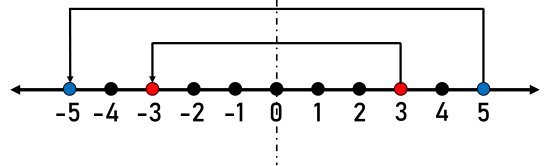
This principle can be observed through a simple example that $5 > 3.$ However, if both sides are multiplied by $-1,$ we obtain $-5 > -3.$ If the sign $>$ is maintained, we actually get the incorrect statement that $-5 > -3,$ whereas in fact $-5$ is smaller than $-3.$ When viewed on a number line, the number that was originally greater is located on the right. When multiplied by a negative number, its position is “reflected” to the opposite side so that the inequality relationship also changes.
General Steps for Solving LIoV
The general steps for solving a linear inequality in one variable are as follows:
- Simplify both sides of the inequality if there are still parentheses or like terms.
- Move all terms containing the variable to one side (usually the left side).
- Move all constant numbers to the other side.
- Simplify the inequality until a form such as $ax > b,$ $ax < b,$ $ax \ge b,$ or $ax \le b$ is obtained.
- Divide both sides by $a$ so that a form such as $x > \dfrac{b}{a},$ or other variations of inequalities is obtained.
Suppose the inequality $$x + 4 \ge 10.$$ is given.The solution steps are as follows:
$$\begin{aligned} x + 4 & \ge 10 \\ x & \ge 10 -4 \\ x & \ge 6 \end{aligned}$$Therefore, the values of $x$ that satisfy the inequality are $x \ge 6,$ meaning all numbers greater than $6.$
Below are several problems and discussions regarding LIoV. The problems presented are arranged gradually, starting from direct problems to contextual modeling problems. Through these exercises, readers are expected to understand the concept of linear inequalities in one variable more deeply and be able to apply them in various real-life situations. Each problem is equipped with detailed and systematic solution steps to help readers follow the mathematical thinking process correctly.
Read: Simple Algebraic Expressions: Word Problems and Step-by-Step Solutions
Today Quote
Multiple Choice Section
The solution of the inequality $x-3 > 10$ is $\cdots \cdot$
A. $x > -7$
B. $x > 7$
C. $x > 13$
D. $x < 13$
Using simple algebraic calculations, we obtain
$$\begin{aligned} x-3 & > 10 \\ x & > 10+3 \\ x & > 13. \end{aligned}$$Therefore, the solution of the linear inequality is $\boxed{x > 13}.$
(Answer C)
The solution of the inequality $-x+7 > -5$ is $\cdots \cdot$
A. $x > -12$
B. $x < -12$
C. $x > 12$
D. $x < 12$
Using simple algebraic calculations, we obtain
$$\begin{aligned} -x+7 & > -5 \\ -x & > -5-7 \\ -x & > -12 \\ x & < \dfrac{-12}{-1} = 12 && (\text{The sign is reversed}). \end{aligned}$$Therefore, the solution of the linear inequality is $\boxed{x < 12}.$
(Answer D)
The solution of the inequality $5 -3x \le -10$ is $\cdots \cdot$
A. $x \le -5$
B. $x \ge -5$
C. $x \le 5$
D. $x \ge 5$
Using simple algebraic calculations, we obtain
$$\begin{aligned} 5-3x & \le -10 \\ -3x & \le -10-5 \\ -3x & \le -15 \\ x & \ge \dfrac{-15}{-3} = 5 && (\text{The sign is reversed}). \end{aligned}$$Therefore, the solution of the linear inequality is $\boxed{x \ge 5}.$
(Answer D)
The integer solution set of the linear inequality $4x-5 \le 10x+12$ is $\cdots \cdot$
A. $\{-3, -2, -1, 0, 1, \cdots\}$
B. $\{-2, -1, 0, 1, 2, \cdots\}$
C. $\{0, 1, 2, 3, 4, \cdots\}$
D. $\{2, 3, 4, 5, 6, \cdots\}$
Using simple algebraic calculations, we obtain
$$\begin{aligned} 4x-5 & \le 10x+12 \\ 4x-10x & \le 12+5 \\ -6x & \le 17 \\ x & \ge -\dfrac{17}{6} && (\text{The sign is reversed}). \end{aligned}$$The smallest integer $x$ such that $x \ge -\dfrac{17}{6}$ is $x = -2.$
Therefore, the integer solution set of the linear inequality is $\{-2, -1, 0, 1, 2, \cdots\}.$
(Answer B)
The number of whole numbers $x$ satisfying $7x-1 \le 5x+5$ is $\cdots \cdot$
A. $1$ C. $3$
B. $2$ D. $4$
Using simple algebraic calculations, we obtain
$$\begin{aligned} 7x-1 & \le 5x+5 \\ 7x-5x & \le 5+1 \\ 2x & \le 6 \\ x & \le 3. \end{aligned}$$Whole numbers include integers starting from $0, 1, 2,$ and so on. Therefore, the solution set of the inequality is $\{0, 1, 2, 3\}.$ This means there are $4$ whole numbers satisfying the condition.
Therefore, the number of whole numbers $x$ satisfying $7x-1 \le 5x+5$ is $\boxed{4}.$
(Answer D)
The solution of the inequality $$\dfrac12(2x-6) \ge \dfrac23(x-4)$$ is $\cdots \cdot$
A. $x \ge -17$
B. $x \ge -1$
C. $x \ge 1$
D. $x \ge 17$
By multiplying both sides by $6,$ we can eliminate the fractions from the inequality. After that, simplify to find the solution.
$$\begin{aligned} \dfrac12(2x-6) & \ge \dfrac23(x-4) \\ \cancelto{3}{6} \cdot \dfrac{1}{\cancel{2}}(2x-6) & \ge \cancelto{2}{6} \cdot \dfrac{2}{\cancel{3}}(x-4) \\ 3(2x-6) & \ge 4(x-4) \\ 6x-18 & \ge 4x-16 \\ 6x-4x & \ge -16+18 \\ 2x & \ge 2 \\ x & \ge 1 \end{aligned}$$Therefore, the solution of the inequality is $\boxed{x \ge 1}.$
(Answer C)
The solution set of the inequality $-6 < 3(x-1) < 9$ is $\cdots \cdot$
A. $\{x \mid -2<x<3, x \in \mathbb{R}\}$
B. $\{x \mid 2<x<3, x \in \mathbb{R}\}$
C. $\{x \mid 1<x<4, x \in \mathbb{R}\}$
D. $\{x \mid -1<x<4, x \in \mathbb{R}\}$
Using simple algebraic calculations, we obtain
$$\begin{array}{rcccl} -6 & < & 3(x-1) & < & 9 \\ \dfrac{-6}{3} & < & x-1 & < & \dfrac{9}{3} \\ -2 & < & x-1 & < & 3 \\ -2+1 & < & x & < & 3+1 \\ -1 & < & x & < & 4 \end{array}$$Therefore, the solution set of the inequality is $\boxed{\{x \mid -1<x<4, x \in \mathbb{R}\}}.$
(Answer D)
Read: Relations and Functions: Middle School Math Problems with Step-by-Step Solutions
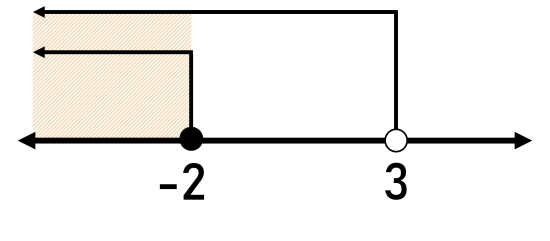
The shaded region on the following number line represents the solution of two linear inequalities, namely $\cdots \cdot$
 A. $x \le 2$ dan $x < 3$
B. $x \le -2$ dan $x < 3$
C. $x \ge -2$ dan $x > 3$
D. $x < -2$ dan $x > 3$
The shaded region lies to the left of $-2,$ so the first linear inequality is $x \le -2.$ The symbol $\le$ (not $<$) is used because the point $-2$ is filled. Then, the shaded region also lies to the left of $3,$ so the next linear inequality is $x < 3$ (not $\le$) because the point $3$ is hollow.
Therefore, the shaded region on the number line represents the solution of two linear inequalities, namely $x \le -2$ and $x < 3.$
(Answer B)
Observe the figure below.
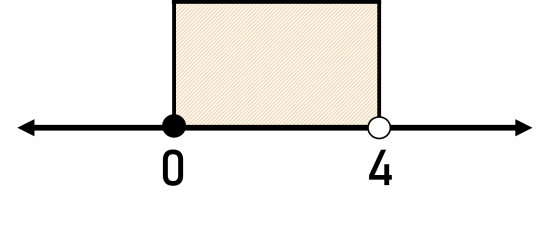 Which of the following inequalities has a solution represented by the shaded region on the number line above?
A. $4 < 2x + 4 \le 12$
B. $2 < x + 2 \le 8$
C. $0 < 4x-8 \le 12$
D. $-2 \le 4x + 4 \le 6$
Check option A:
Simplify the inequality.
$$\begin{array}{rcccl} 4 & < & 2x + 4 & \le & 12 \\ 4-4 & < & (2x+4)-4 & \le & 12-4 \\ 0 & < & 2x & \le & 8 \\ \dfrac{0}{2} & < & x & \le & \dfrac82 \\ 0 & < & x & \le & 4 \end{array}$$The solution of this inequality matches the one shown on the number line.
Check option B:
Simplify the inequality.
$$\begin{array}{rcccl} 2 & < & x + 2 & \le & 8 \\ 2-2 & < & (x+2)-2 & \le & 8-2 \\ 0 & < & x & \le & 6 \end{array}$$The solution of this inequality does not match the one shown on the number line.
Check option C:
Simplify the inequality.
$$\begin{array}{rcccl} 0 & < & 4x-8 & \le & 12 \\ 0+8 & < & (4x-8)+8 & \le & 12+8 \\ 8 & < & 4x & \le & 20 \\ \dfrac84 & < & x & \le & \dfrac{20}{4} \\ 2 & < & x & \le & 5. \end{array}$$The solution of this inequality does not match the one shown on the number line.
Check option D:
Simplify the inequality.
$$\begin{array}{rcccl} -2 & \le & 4x+4 & \le & 6 \\ -2-4 & \le & (4x+4)-4 & \le & 6-4 \\ -6 & \le & 4x & \le & 2 \\ \dfrac{-6}{4} & \le & x & \le & \dfrac{2}{4} \\ -\dfrac32 & \le & x & \le & \dfrac12. \end{array}$$The solution of this inequality does not match the one shown on the number line.
(Answer A)
A rectangular box has a length of $(2x-6)$ cm and a width of $x$ cm. If its perimeter is not more than $48$ cm, then the width of the box $(\ell)$ is $\cdots \cdot$
A. $0 < \ell \le 10$
B. $0 < \ell \le 12$
C. $3 < \ell \le 10$
D. $3 < \ell \le 12$
Since the length cannot be negative, we obtain the inequality
$$\begin{aligned} p & > 0 \\ 2x-6 & > 0 \\ 2x & > 6 \\ x & > 3. \end{aligned}$$A similar condition also applies to the width, namely $\ell > 0,$ or $x > 0.$
Since the perimeter of the rectangle is not more than $48,$ we obtain
$$\begin{aligned} 2p + 2\ell & \le 48 \\ p + \ell & \le 24 \\ (2x-6) + x & \le 24 \\ 3x & \le 30 \\ x & \le 10. \end{aligned}$$For $x > 3,$ $x > 0,$ and $x \le 10,$ it can be concluded that $3 < x \le 10,$ or $3 < \ell \le 10.$
Therefore, the width of the box is $\boxed{3 < \ell \le 10}.$
(Answer C)
A triangle has a base of $10$ cm and a height of $(x-4)$ cm. If the area of the triangle is not less than $(2x-2)$ cm2, then the value of $x$ that satisfies the condition is $\cdots \cdot$
A. $x \ge 6$
B. $x > 6$
C. $x \ge 4$
D. $x > 4$
The area of a triangle can be calculated using the formula $L = \dfrac12 \cdot a \cdot t.$ It is known that the base length is $a = 10$ cm and the height is $t = (x-4)$ cm. Since the area of the triangle is not less than $(2x-2)$ cm2, we obtain
$$\begin{aligned} L & \ge 2x-2 \\ \dfrac12 \cdot 10 \cdot (x-4) & \ge 2x-2 \\ 5(x-4) & \ge 2x-2 \\ 5x-20 & \ge 2x-2 \\ 5x-2x & \ge -2+20 \\ 3x & \ge 18 \\ x & \ge 6. \end{aligned}$$Therefore, the value of $x$ that satisfies the condition is $\boxed{x \ge 6}.$
(Answer A)
Read: System of Linear Equations in Two Variables: Complete Problems and Step-by-Step Solutions
Essay Section
Solve the following linear inequality.
$$x + 4 < 1$$
Using simple algebraic calculations, we obtain
$$\begin{aligned} x + 4 & < 1 \\ x & < 1-4 \\ x & < -3. \end{aligned}$$Therefore, the solution of the linear inequality is $\boxed{x < -3}.$
Solve the following linear inequality.
$$x -5 > 4$$
Using simple algebraic calculations, we obtain
$$\begin{aligned} x-5 & > 4 \\ x & > 4+5 \\ x & > 9. \end{aligned}$$Therefore, the solution of the linear inequality is $\boxed{x > 9}.$
Solve the following linear inequality.
$$x-3 \le -4$$
Using simple algebraic calculations, we obtain
$$\begin{aligned} x-3 & \le -4 \\ x & \le -4+3 \\ x & \le -1. \end{aligned}$$Therefore, the solution of the linear inequality is $\boxed{x \le -1}.$
Solve the following linear inequality.
$$2x + 1 \ge 5$$
Using simple algebraic calculations, we obtain
$$\begin{aligned} 2x + 1 & \ge 5 \\ 2x & \ge 5-1 \\ 2x & \ge 4 \\ x & \ge \dfrac{4}{2} = 2. \end{aligned}$$Therefore, the solution to the linear inequality is $\boxed{x \ge 2}.$
Solve the following linear inequality.
$$3x-5 < 7$$
Using simple algebraic calculations, we obtain
$$\begin{aligned} 3x-5 & < 7 \\ 3x & < 7+5 \\ 3x & < 12 \\ x & < \dfrac{12}{3} = 4. \end{aligned}$$Therefore, the solution to the linear inequality is $\boxed{x < 4}.$
Solve the following linear inequality.
$$4x + 10 \le 30$$
Using simple algebraic calculations, we obtain
$$\begin{aligned} 4x + 10 & \le 30 \\ 4x & \le 30-10 \\ 4x & \le 20 \\ x & \le \dfrac{20}{4} = 5. \end{aligned}$$Therefore, the solution to the linear inequality is $\boxed{x \le 5}.$
Solve the following linear inequality.
$$5x-10 \ge 10$$
Using simple algebraic calculations, we obtain
$$\begin{aligned} 5x-10 & \ge 10 \\ 5x & \ge 10+10 \\ 5x & \ge 20 \\ x & \ge \dfrac{20}{5} = 4. \end{aligned}$$Therefore, the solution to the linear inequality is $\boxed{x \ge 4}.$
Solve the following linear inequality.
$$6x-5 \le -2$$
Using simple algebraic calculations, we obtain
$$\begin{aligned} 6x-5 & \le -2 \\ 6x & \le -2+5 \\ 6x & \le 3 \\ x & \le \dfrac{3}{6} = \dfrac12. \end{aligned}$$Therefore, the solution to the linear inequality is $\boxed{x \le \dfrac12}.$
Solve the following linear inequality.
$$7x-4 > -5$$
Using simple algebraic calculations, we obtain
$$\begin{aligned} 7x-4 & > -5 \\ 7x & > -5+4 \\ 7x & > -1 \\ x & > -\dfrac{1}{7}. \end{aligned}$$Therefore, the solution to the linear inequality is $\boxed{x > -\dfrac17}.$
Solve the following linear inequality.
$$4-3x<-5$$
Using simple algebraic calculations, we obtain
$$\begin{aligned} 4-3x & < -5 \\ -3x & < -5-4 \\ -3x & < -9 \\ x & < \dfrac{-9}{-3} = 3. \end{aligned}$$Therefore, the solution to the linear inequality is $\boxed{x < 3}.$
Solve the following linear inequality.
$$5-4x \le 1 $$
Using simple algebraic calculations, we obtain
$$\begin{aligned} 5-4x & \le 1 \\ -4x & \le 1-5 \\ -4x & \le -4 \\ x & \ge \dfrac{-4}{-4} = 1 && (\text{Sign reversed}). \end{aligned}$$Therefore, the solution to the linear inequality is $\boxed{x \ge 1}.$
Solve the following linear inequality.
$$-4 + 4x \ge 9$$
Using simple algebraic calculations, we obtain
$$\begin{aligned} -4 + 4x & \ge 9 \\ 4x & \ge 9+4 \\ 4x & \ge 13 \\ x & \ge \dfrac{13}{4}. \end{aligned}$$Therefore, the solution to the linear inequality is $\boxed{x \ge \dfrac{13}{4}}.$
Solve the following linear inequality.
$$2 + 3x < 5 + x$$
Using simple algebraic calculations, we obtain
$$\begin{aligned} 2 + 3x & < 5 + x \\ 3x-x & < 5-2 \\ 2x & < 3 \\ x & < \dfrac{3}{2}. \end{aligned}$$Therefore, the solution to the linear inequality is $\boxed{x < \dfrac32}.$
Solve the following linear inequality.
$$2-3x > 5-2x$$
Using simple algebraic calculations, we obtain
$$\begin{aligned} 2-3x & > 5-2x \\ -3x + 2x & > 5-2 \\ -x & > 3 \\ x & < -3 && (\text{Sign reversed}). \end{aligned}$$Therefore, the solution to the linear inequality is $\boxed{x < -3}.$
Solve the following linear inequality.
$$-4x + 5 \le 7x + 10$$
Using simple algebraic calculations, we obtain
$$\begin{aligned} -4x + 5 & \le 7x + 10 \\ -4x-7x & \le 10-5 \\ -11x & \le 5 \\ x & \ge -\dfrac{5}{11} && (\text{The sign is reversed}). \end{aligned}$$Therefore, the solution to the linear inequality is $\boxed{x \ge -\dfrac{5}{11}}.$
Solve the following linear inequality.
$$6x-1>x-10$$
Using simple algebraic calculations, we obtain
$$\begin{aligned} 6x-1 & > x-10 \\ 6x-x & > -10+1 \\ 5x & > -9 \\ x & > -\dfrac95. \end{aligned}$$Therefore, the solution to the linear inequality is $\boxed{x > -\dfrac95}.$
Solve the following linear inequality.
$$5-3x \ge 10-7x$$
Using simple algebraic calculations, we obtain
$$\begin{aligned} 5-3x & \ge 10-7x \\ -3x + 7x & \ge 10-5 \\ 4x & \ge 5 \\ x & \ge \dfrac54. \end{aligned}$$Therefore, the solution to the linear inequality is $\boxed{x \ge \dfrac54}.$
Solve the following linear inequality.
$$4-10x \le 5(x-3)$$
Using simple algebraic calculations, we obtain
$$\begin{aligned} 4-10x & \le 5(x-3) \\ 4-10x & \le 5x-15 \\ -10x-5x & \le -15-4 \\ -15x & \le -19 \\ x & \ge \dfrac{-19}{-15} = \dfrac{19}{15}. \end{aligned}$$Therefore, the solution to the linear inequality is $\boxed{x \ge \dfrac{19}{15}}.$
Solve the following linear inequality.
$$2(4-x) < 10x + 7$$
Using simple algebraic calculations, we obtain
$$\begin{aligned} 2(4-x) & < 10x+7 \\ 8-2x & < 10x+7 \\ -2x-10x & < 7-8 \\ -12x & < -1 \\ x & > \dfrac{-1}{-12} = \dfrac{1}{12} && (\text{The sign is reversed}). \end{aligned}$$Therefore, the solution to the linear inequality is $\boxed{x > \dfrac{1}{12}}.$
Solve the following linear inequality.
$$4(5-7x) \ge 5(3-2x) $$
Using simple algebraic calculations, we obtain
$$\begin{aligned} 4(5-7x) & \ge 5(3-2x) \\ 20-28x & \ge 15-10x \\ -28x + 10x & \ge 15-20 \\ -18x & \ge -5 \\ x & \le \dfrac{-5}{-18} = \dfrac{5}{18} && (\text{The sign is reversed}). \end{aligned}$$Therefore, the solution to the linear inequality is $\boxed{x \le \dfrac{5}{18}}.$
Solve the following linear inequality.
$$\dfrac25(4-x) \le \dfrac12(2x-2)$$
By multiplying both sides by $10,$ we can eliminate the fractions from the inequality. After that, simplify to find the solution.
$$\begin{aligned} \dfrac25(4-x) & \le \dfrac12(2x-2) \\ \cancelto{2}{10} \cdot \dfrac{2}{\cancel{5}}(4-x) & \le \cancelto{5}{10} \cdot \dfrac{1}{\cancel{2}}(2x-2) \\ 4(4-x) & \le 5(2x-2) \\ 16-4x & \le 10x-10 \\ -4x-10x & \le -10-16 \\ -14x & \le -26 \\ x & \ge \dfrac{26}{14} = \dfrac{13}{7} && (\text{The sign is reversed}). \end{aligned}$$Therefore, the solution to the inequality is $\boxed{x \ge \dfrac{13}{7}}.$
If $x$ is an integer, determine the number of values of $x$ that satisfy the following inequality.
$$-4 \le 2(x+4) < 8$$
Using simple algebraic calculations, we obtain
$$\begin{array}{rcccl} -4 & \le & 2(x+4) & < & 8 \\ \dfrac{-4}{2} & \le & x+4 & < & \dfrac{8}{2} \\ -2 & \le & x+4 & < & 4 \\ -2-4 & \le & x & < & 4-4 \\ -6 & \le & x & < & 0 \end{array}$$Since $x$ is an integer, the solution set of this inequality is $$\{-6, -5, -4, -3, -2, -1\}.$$Therefore, there are $6$ integer values of $x$ that satisfy the inequality.
Model the following statement into a linear inequality, then solve the inequality by determining the appropriate variable values.
Skibidi’s age 7 years from now is not more than twice his current age.
Suppose $x$ represents Skibidi’s current age, then the corresponding linear inequality is $x + 7 \le 2x.$ Using simple algebraic calculations, we obtain
$$\begin{aligned} x+7 & \le 2x \\ 2x-x & \ge 7 \\ x & \ge 7. \end{aligned}$$Thus, the solution to the linear inequality is $x \ge 7.$
This means that Skibidi’s current age is at least $7$ years old.
Model the following statement into a linear inequality, then solve the inequality by determining the appropriate variable values.
The weight of Ardi’s bag plus $7$ kg is at least $3$ kg lighter than twice the weight of the bag.
Suppose $t$ represents the weight of Ardi’s bag, then the corresponding linear inequality is $t + 7 \ge 2t-3.$ Using simple algebraic calculations, we obtain
$$\begin{aligned} t+7 & \ge 2t-3 \\ 2t-t & \le 7+3 \\ t & \le 10. \end{aligned}$$Thus, the solution to the linear inequality is $t \le 10.$
This means that the weight of Ardi’s bag is not more than $10$ kg.
Model the following statement into a linear inequality, then solve the inequality by determining the appropriate variable values.
The length of a ribbon is not more than 4 cm minus half of its original length.
Suppose $a$ represents the original length of the ribbon (cm), then the corresponding linear inequality is $a \le 4-\dfrac12a.$ Using simple algebraic calculations, we obtain
$$\begin{aligned} a & \le 4-\dfrac12a \\ a+\dfrac12a & \le 4 \\ \dfrac32a & \le 4 \\ a & \le 4 \cdot \dfrac23 = \dfrac83. \end{aligned}$$Thus, the solution to the linear inequality is $a \le \dfrac83.$
This means that the original length of the ribbon is not more than $\dfrac83$ cm.
Model the following statement into a linear inequality, then solve the inequality by finding the appropriate variable value.
A total of five school buses can carry a maximum of $200$ students.
Suppose $b$ represents the number of students that each bus can carry, then the corresponding linear inequality is $5b \le 200.$ Using simple algebraic calculations, we obtain $b \le \dfrac{200}{5} = 40.$
Thus, the solution to the linear inequality is $b \le 40.$
This means that each bus can carry at most $40$ students.
A parking area charges a fixed fee of Rp5,000 plus Rp3,000 per hour. Someone brings Rp29,000. What is the maximum number of hours the person can park there so that the money is sufficient?
Since each hour of parking costs an additional Rp3,000 and the person has Rp29,000, the corresponding linear inequality for this case is $5.000 + 3.000x \le 29.000.$ In this case, $x$ represents the parking duration (hours). The sign $\le$ is used because the parking fee must not exceed the amount of money available. Solve the inequality as follows.
$$\begin{aligned} 5.000 + 3.000x & \le 29.000 \\ 3.000x & \le 29.000-5.000 \\ 3.000x & \le 24.000 \\ x & \le \dfrac{24.000}{3.000} = 8. \end{aligned}$$From the final form, it can be concluded that the person may only park there for a maximum of $\boxed{8}$ hours. More than that, the money will not be sufficient to pay the parking fee.
A rectangle has length $(x+3)$ cm and width $5$ cm. Its perimeter is no more than $40$ cm. Determine the greatest value of $x$ if $x$ is an integer.
Given that $p = x+3$ cm and $\ell = 5$ cm. The perimeter of a rectangle is calculated by adding the length and width, then multiplying by $2,$ namely $k = 2(p + \ell).$ Since the perimeter is no more than $40$ cm, we obtain the linear inequality $2(p + \ell) \le 40.$ Solve the inequality as follows.
$$\begin{aligned} 2(p + \ell) & \le 40 \\ p + \ell & \le \dfrac{40}{2} = 20 \\ (x + 3) + 5 & \le 20 \\ x + 8 & \le 20 \\ x & \le 20-8 \\ x & \le 12. \end{aligned}$$From the final form, it can be concluded that the greatest value of $x$ is $\boxed{12}.$
A tank contains $x$ liters of water. Every minute, the tank is filled with $3$ liters of water. In order not to exceed the capacity of $50$ liters after $5$ minutes, determine the maximum value of $x.$
Since the tank is filled with $3$ liters of water every minute, the tank will receive $5 \times 3 = 15$ liters of water after the 5th minute. Therefore, the corresponding linear inequality for this case is $x + 15 \le 50.$ Note that the sign $\le$ is used because of the phrase “does not exceed” (meaning, maximum $50$). Simplify the inequality so that we obtain $x \le 35.$
Thus, the maximum value of $x$ is $\boxed{35}.$
The average score of $5$ tests must be at least $80.$ The four scores already obtained are $75,$ $82,$ $78,$ and $85.$ What is the minimum score of the fifth test?
Suppose $x$ is the fifth test score. The average $(\overline{x})$ is calculated by summing all five scores, then dividing by $5,$ namely $$\overline{x} = \dfrac{75 + 82 + 78 + 85 + x}{5}.$$Since the average score must be at least $80,$ we obtain the following linear inequality
$$\dfrac{75 + 82 + 78 + 85 + x}{5} \ge 80.$$Solve the linear inequality as follows.
$$\begin{aligned} \dfrac{75 + 82 + 78 + 85 + x}{5} & \ge 80 \\ 75 + 82 + 78 + 85 + x & \ge 400 \\ 320 + x & \ge 400 \\ x & \ge 80. \end{aligned}$$From the final form, it can be concluded that the minimum score of the fifth test is $\boxed{80}$ so that the average of the five tests is at least $80.$
A delivery service charges the following fees.
- A fixed ordering fee of Rp12,000.
- A delivery fee of Rp4,000 per kilometer.
A customer has a budget of no more than Rp40,000 for one delivery order.
Which statements are correct regarding the problem above? Select all correct statements.
- If $x$ represents the delivery distance (in km), then the problem can be modeled by $4.000x + 12.000 \le 40.000.$
- The maximum delivery distance that the customer can choose is $7$ km.
- If the delivery distance is $8$ km, then the total cost will exceed the budget.
- An additional delivery distance of $3$ km will increase the cost by Rp16,000.
Check Statement 1:
Suppose $x$ represents the delivery distance (in km). The total cost is the sum of the fixed fee plus the delivery fee per kilometer. Therefore, the total cost is represented by $12.000 + 4.000x.$ Since the customer’s budget is Rp40,000, we obtain the following linear inequality model.
$$12.000 + 4.000x \le 40.000$$Thus, Statement 1 is correct.
Check Statement 2:
Notice that
$$\begin{aligned} 12.000 + 4.000x & \le 40.000 \\ 4.000x & \le 40.000-12.000 \\ 4.000x & \le 28.000 \\ x & \le \dfrac{28.000}{4.000} = 7. \end{aligned}$$This means that the maximum delivery distance is $7$ km. Thus, Statement 2 is correct.
Check Statement 3:
If the delivery distance is $8$ km, then the required cost is
$$12.000 + 4.000(8) = \text{Rp}44.000,$$which exceeds the available budget. Thus, Statement 3 is correct.
Check Statement 4:
Since the delivery fee is Rp4,000/km, a distance of $3$ km will require an additional cost of $3 \times 4.000 = \text{Rp}12.000.$ Thus, Statement 4 is incorrect because the additional delivery distance of $3$ km should increase the cost by Rp12,000, not Rp16,000.