
This post will provide you a lot of problems in the matter of derivative of trigonometric functions. You are urged to recall about the fundamental concept of trigonometry as well as the little algebra since they play a major role in this case. The problems are collected in various mathematics literatures and they also come in different difficulties. But happy news come to you. Every problem appears along with the solution. This makes you have the bigger opportunies to learn this lesson.
Quote by Confucius
Before you start, you need to at least remember about this following fundamental derivative of trigonometric functions.
The Derivative of Trigonometric Functions
$$\begin{aligned} & 1.~\text{If}~f(x) = \sin x,~\text{then}~f'(x) = \cos x \\ & 2.~\text{If}~f(x) = \cos x,~\text{then}~f'(x) = -\sin x \\ & 3.~\text{If}~f(x) = \tan x,~\text{then}~f'(x) = \sec^2 x \\ & 4.~\text{If}~f(x) = \csc x,~\text{then}~f'(x) = -\cot x \csc x \\ & 5.~\text{If}~f(x) = \sec x,~\text{then}~f'(x) = \tan x \sec x \\ & 6.~\text{If}~f(x) = \cot x,~\text{then}~f'(x) = -\csc^2 x \end{aligned}$$Notice that a negative sign appears in the derivatives of the co-functions: cosine, cosecant, and cotangent.
Multiple Choice Section
The first derivative of $y = 3 \sin x-\cos x$ is $\cdots \cdot$
A. $3 \cos x-\sin x$
B. $3 \cos x+\sin x$
C. $\cos x-\sin x$
D. $\cos x+\sin x$
E. $5 \cos x-\sin x$
Recall that:
$\begin{aligned} f(x) & = \sin x \implies f'(x) = \cos x \\ f(x) & = \cos x \implies f'(x) = -\sin x \end{aligned}$
By using the facts above, we have
$\begin{aligned} y & = \color{red}{3 \sin x}-\color{blue}{\cos x} \\ \implies y’ & = \color{red}{3 \cos x}-\color{blue}{(-\sin x)} \\ & = 3 \cos x + \sin x \end{aligned}$
Thus, the first derivative of $y = 3 \sin x-\cos x$ is $\boxed{3 \cos x+\sin x}$
(Answer B)
If $g(x) = 3x^2-\dfrac{1}{2x^2}+2 \cos x$, then $g'(x)$ equals $\cdots \cdot$
A. $6x+\dfrac{1}{x^3}-2 \sin x$
B. $6x-\dfrac{1}{x^3}-2 \sin x$
C. $6x-\dfrac{1}{4x}-2 \sin x$
D. $6x+\dfrac{4}{x^3}+2 \sin x$
E. $6x+\dfrac{1}{x^3}+2 \sin x$
Recall that:
$f(x) = \cos x \implies f'(x) = -\sin x$
By using the facts above and the rule of derivative in algebra, we have
$\begin{aligned} g(x) & = 3x^2-\dfrac{1}{2x^2}+2 \cos x \\ & = 3x^2-\dfrac12x^{-2}+2 \cos x \\ g'(x) & = 3(2)x-\dfrac12(-2)x^{-3}+2(-\sin x) \\ & = 6x+\dfrac{1}{x^3}-2 \sin x \end{aligned}$
Thus, $\boxed{g'(x) = 6x+\dfrac{1}{x^3}-2 \sin x}$
(Answer A)
If $h(x) = 2 \sin x + \cos x$ ($x$ is in radian), then the value of $h’\left(\dfrac12\pi\right)$ is $\cdots \cdot$
A. $-2$ C. $0$ E. $2$
B. $-1$ D. $1$
Recall that:
$\begin{aligned} f(x) & = \sin x \implies f'(x) = \cos x \\ f(x) & = \cos x \implies f'(x) = -\sin x \end{aligned}$
By using the facts above, we have
$\begin{aligned} h(x) & = \color{red}{\sin x} + \color{blue}{\cos x} \\ \implies h'(x) & = 2 \color{red}{\cos x} + \color{blue}{(-\sin x)} \\ & = 2 \cos x-\sin x \end{aligned}$
Take $x = \dfrac12\pi$.
$\begin{aligned} h’\left(\dfrac12\pi\right) & = 2 \cos \dfrac12\pi-\sin \dfrac12\pi \\ & = 2(0)-1 = -1 \end{aligned}$
Thus, the value of $\boxed{h’\left(\dfrac12\pi\right) = -1}$
(Answer B)
The differentiation of $T(x) = (\sin x + 1)(\sin x-2)$ is given by $\cdots \cdot$
A. $\sin 2x + \cos x$
B. $\sin 2x-\sin x$
C. $\sin 2x-\cos x$
D. $\cos 2x+\cos x$
E. $\cos 2x-\cos x$
Apply the product rule.
$f(x) = uv \implies f'(x) = u’v+uv’$
Given $T(x) = (\sin x + 1)(\sin x-2)$.
Let:
$\begin{aligned} u & = \sin x + 1 \implies u’ = \cos x \\ v & = \sin x-2 \implies v’ = \cos x \end{aligned}$
Hence, we have
$$\begin{aligned} T'(x) & = u’v+uv’ \\ & = (\cos x)(\sin x-2)+(\sin x+1)(\cos x) \\ & = \color{red}{\cos x \sin x}\color{blue}{-2 \cos x} \color{red}{+ \cos x \sin x} \color{blue}{+ \cos x} \\ & = 2 \sin x \cos x-\cos x \\ & = \sin 2x-\cos x \end{aligned}$$Note: $\boxed{\sin 2x = 2 \sin x \cos x}$
Thus, the differentiation of the function given is $\boxed{T'(x) =\sin 2x-\cos x}$
(Answer C)
If $h(\theta) = \left(\theta + \dfrac{\pi}{2}\right) \sin \theta$, then $h'(\theta)$ equals $\cdots \cdot$
A. $-\sin \theta-\theta \cos \theta + \dfrac{\pi}{2} \cos \theta$
B. $-\sin \theta-\theta \cos \theta -\dfrac{\pi}{2} \cos \theta$
C. $-\sin \theta+\theta \cos \theta -\dfrac{\pi}{2} \cos \theta$
D. $-\sin \theta+\theta \cos \theta +\dfrac{\pi}{2} \cos \theta$
E. $\sin \theta+\theta \cos \theta + \dfrac{\pi}{2} \cos \theta$
Apply the product rule.
$f(x) = uv \implies f'(x) = u’v+uv’$
Given $h(\theta) = \left(\theta + \dfrac{\pi}{2}\right) \sin \theta$.
Let:
$\begin{aligned} u & = \theta + \dfrac{\pi}{2} \implies u’ = 1 \\ v & = \sin \theta \implies v’= \cos \theta \end{aligned}$
Hence, we have
$\begin{aligned} h'(\theta) & = u’v+uv’ \\ & = 1(\sin \theta)+\left( \theta + \dfrac{\pi}{2}\right)(\cos \theta) \\ & = \sin \theta + \theta \cos \theta + \dfrac{\pi}{2} \cos \theta \end{aligned}$
Thus, $\boxed{h'(\theta) =\sin \theta + \theta \cos \theta + \dfrac{\pi}{2} \cos \theta}$
(Answer E)
The differentiation of the function $g(\theta) = \dfrac{1-\sin \theta}{\sin \theta-3}$ is $\cdots \cdot$
A. $\dfrac{-2 \cos \theta}{(\sin \theta-3)^2}$
B. $-2 \cos \theta$
C. $-2 \sin \theta$
D. $2 \sin \theta$
E. $\dfrac{2 \cos \theta}{(\sin \theta-3)^2}$
Apply the product rule.
$f(x) = \dfrac{u}{v} \implies f'(x) = \dfrac{u’v-uv’}{v^2}$
Given $g(\theta) = \dfrac{1-\sin \theta}{\sin \theta-3}$.
Let:
$\begin{aligned} u & = 1-\sin \theta \implies u’ = -\cos \theta \\ v & = \sin \theta-3 \implies v’ = \cos \theta \end{aligned}$
Hence, we have
$$\begin{aligned} g'(\theta) & = \dfrac{u’v-uv’}{v^2} \\ & = \dfrac{(-\cos \theta)(\sin \theta-3)-(1-\sin \theta)(\cos \theta)}{(\sin \theta-3)^2} \\ & = \dfrac{\cancel{-\sin \theta \cos \theta} +3 \cos \theta-\cos \theta+\cancel{\sin \theta \cos \theta}}{(\sin \theta-3)^2} \\ & = \dfrac{2 \cos \theta}{(\sin \theta-3)^2} \end{aligned}$$Thus, the differentiation of the given function is $\boxed{\dfrac{2 \cos \theta}{(\sin \theta-3)^2}}$
(Answer E)
The derivative of $R(t) = \dfrac{\sin t-\cos t}{\cos t + \sin t}$ is $\cdots \cdot$
A. $1+\sin 2t$
B. $1-\sin 2t$
C. $1+\cos 2t$
D. $\dfrac{2}{1+\sin 2t}$
E. $\dfrac{-2}{1+\sin 2t}$
Apply the quotient rule.
$f(x) = \dfrac{u}{v} \implies f'(x) = \dfrac{u’v-uv’}{v^2}$
Given $R(t) = \dfrac{\sin t-\cos t}{\cos t + \sin t}$.
Let:
$\begin{aligned} u & = \sin t-\cos t \implies u’ = \cos t+\sin t \\ v & = \cos t+\sin t \implies v’ = -\sin t+\cos t \end{aligned}$
Hence, we have
$$\begin{aligned} R'(t) & = \dfrac{u’v-uv’}{v^2} \\ & = \dfrac{(\cos t + \sin t)(\cos t + \sin t)-(\sin t-\cos t)(-\sin t+\cos t)}{(\cos t + \sin t)^2} \\ & = \dfrac{(\color{red}{\cos^2 t} + \sin t \cos t + \sin t \cos t \color{red}{+ \sin^2 t})-(\color{red}{-\sin^2 t}+\sin t \cos t+\sin t \cos t\color{red}{-\cos^2 t})}{\color{red}{\cos^2 t} + 2 \sin t \cos t + \color{red}{\sin^2 t}} \\ & = \dfrac{1 + \cancel{2 \sin t \cos t}-(-1)-\cancel{2 \sin t \cos t}}{1 + 2 \sin t \cos t} \\ & = \dfrac{2}{1+ \sin 2t} \end{aligned}$$Note: $\boxed{\begin{aligned} \sin 2t & = 2 \sin t \cos t \\ \sin^2 t + \cos^2 t & = 1 \end{aligned}}$
Thus, the derivative of the function is $\boxed{R'(t) = \dfrac{2}{1+ \sin 2t}}$
(Answer D)
If $y = \tan x-\cot x$, then the value of $\dfrac{\text{d}y}{\text{d}x}\rvert_{x = \frac{\pi}{4}}$ is $\cdots \cdot$
A. $\dfrac14$ C. $1$ E. $4$
B. $\dfrac12$ D. $2$
Recall that:
$\begin{aligned} f(x) & = \tan x \implies f'(x) = \sec^2 x \\ f(x) & = \cot x \implies f'(x) = -\csc^2 x \end{aligned}$
By using the facts above, we have
$\begin{aligned} y & = \color{red}{\tan x}-\color{blue}{\cot x} \\ \dfrac{\text{d}y}{\text{d}x} & = \color{red}{\sec^2 x}-(\color{blue}{-\csc^2 x}) \\ & = \sec^2 x + \csc^2 x \end{aligned}$
Take $x = \dfrac{\pi}{4}$.
$\begin{aligned} \dfrac{\text{d}y}{\text{d}x}\rvert_{x = \frac{\pi}{4}} & = \sec^2 \dfrac{\pi}{4} + \csc^2 \dfrac{\pi}{4} \\ & = (\sqrt2)^2+(\sqrt2)^2 \\ & = 2+2 = 4 \end{aligned}$
Note: $\boxed{\sec \dfrac{\pi}{4} = \csc \dfrac{\pi}{4} = \sqrt2}$
Thus, the value of the first derivative of function $y$ when $x = \dfrac{\pi}{4}$ is $\boxed{4}$
(Answer E)
The derivative of $y = \sec t-\csc t$ is $\cdots \cdot$
A. $\sin^3 t + \cos^3 t$
B. $\sin^3 t-\cos^3 t$
C. $\sin^2 t \cdot \cos^2 t$
D. $\dfrac{1}{(\sin t \cos t)^2}$
E. $\dfrac{\sin^3 t + \cos^3 t}{(\sin t \cos t)^2}$
Recall that:
$\begin{aligned} f(x) & = \sec t \implies f'(x) = \sec t \tan t \\ f(x) & = \csc t \implies f'(x) = -\csc t \cot t \end{aligned}$
By using the facts above, we have
$\begin{aligned} y & = \color{blue}{\sec t}-\color{red}{\csc t} \\ y’ & = \color{blue}{(\sec t \tan t)}-\color{red}{(-\csc t \cot t)} \\ & = \dfrac{1}{\cos t} \cdot \dfrac{\sin t}{\cos t} + \dfrac{1}{\sin t} \cdot \dfrac{\cos t}{\sin t} \\ & = \dfrac{\sin t}{\cos^2 t} + \dfrac{\cos t}{\sin^2 t} \\ & = \dfrac{\sin^3 t + \cos^3 t}{(\sin t \cos t)^2} \end{aligned}$
Thus, the derivative of $y = \sec t-\csc t$ is $\boxed{\dfrac{\sin^3 t + \cos^3 t}{(\sin t \cos t)^2}}$
(Answer E)
If $y = x^3 \tan x$, then $y’$ equals $\cdots \cdot$
A. $x^3 \tan^2 x + 3x^2 \tan x + x^3$
B. $x^3 \tan^2 x + x^2 \tan x + 3x$
C. $x^3 \tan^2 x + 3x^2 \tan x + 3x$
D. $3x^3 \tan^2 x + x^2 \tan x + x^3$
E. $3x^3 \tan^2 x + 3x^2 \tan x + x^3$
Apply the product rule.
$f(x) = uv \implies f'(x) = u’v+uv’$
Given $y = x^3 \tan x$.
Let:
$\begin{aligned} u & = x^3 \implies u’ = 3x^2 \\ v & = \tan x \implies v’ = \sec^2 x \end{aligned}$
Hence, we have
$\begin{aligned} y’ &= u’v+uv’ \\ & = (3x^2)(\tan x)+(x^3)(\sec^2 x) \\ & = 3x^2 \tan x + (x^3)(\tan^2 x + 1) \\ & = x^3 \tan^2 x + 3x^2 \tan x + x^3 \end{aligned}$
Note: $\boxed{\sec^2 x = \tan^2 x + 1}$
Thus, $\boxed{y’ = x^3 \tan^2 x + 3x^2 \tan x + x^3}$
(Answer A)
If $h(x) = x^2 \cot x$, then $h’\left(\dfrac{\pi}{4}\right)$ equals $\cdots \cdot$
A. $\dfrac{\pi}{8}(4+\pi)$ D. $\dfrac{\pi}{4}(8-\pi)$
B. $\dfrac{\pi}{8}(4-\pi)$ E. $\dfrac{\pi}{4}(8+\pi)$
C. $\dfrac{\pi}{8}(\pi-4)$
Apply the product rule.
$f(x) = uv \implies f'(x) = u’v+uv’$
Given $h(x) = x^2 \cot x$.
Let:
$\begin{aligned} u & = x^2 \implies u’ = 2x \\ v & = \cot x \implies v’ = -\csc^2 x \end{aligned}$
Hence, we have
$\begin{aligned} h'(x) & = u’v+uv’ \\ & = (2x)(\cot x)+(x^2)(-\csc^2 x) \\ & = 2x \cot x-x^2 \csc^2 x \end{aligned}$
Take $x = \dfrac{\pi}{4}$.
$\begin{aligned} h’\left(\dfrac{\pi}{4}\right) & = 2 \cdot \dfrac{\pi}{4} \cdot \cot \dfrac{\pi}{4}-\left(\dfrac{\pi}{4}\right)^2 \csc^2 \dfrac{\pi}{4} \\ & = \dfrac{\pi}{2} \cdot 1-\dfrac{\pi^2}{16} \cdot (\sqrt2)^2 \\ & = \dfrac{\pi}{2}-\dfrac{\pi^2}{8} \\ & = \dfrac{\pi}{8}(4-\pi) \end{aligned}$
So, the value of $\boxed{h’\left(\dfrac{\pi}{4}\right) = \dfrac{\pi}{8}(4-\pi)}$
(Answer B)
If $g(x) = \dfrac{\cos x + 2}{\sin x}$ with $\sin x \neq 0$, then the value of $g’\left(\dfrac{\pi}{2}\right)$ is $\cdots \cdot$
A. $-2$ C. $0$ E. $2$
B. $-1$ D. $1$
Apply the quotient rule.
$f(x) = \dfrac{u}{v} \implies f'(x) = \dfrac{u’v-uv’}{v^2}$
Given $g(x) = \dfrac{\cos x + 2}{\sin x}$.
Let:
$\begin{aligned} u & = \cos x + 2 \implies u’ = -\sin x \\ v & = \sin x \implies v’ = \cos x \end{aligned}$
Hence, we have
$$\begin{aligned} g'(x) & = \dfrac{u’v-uv’}{v^2} \\ & = \dfrac{(-\sin x)(\sin x)-(\cos x + 2)(\cos x)}{(\sin x)^2} \\ & = \dfrac{-\sin^2 x -\cos^2 x-2 \cos x}{\sin^2 x} \\ & = \dfrac{-(\color{red}{\sin^2 x + \cos^2 x})-2 \cos x}{\sin^2 x} \\ & = \dfrac{-1-2 \cos x}{\sin^2 x} \end{aligned}$$Take $x = \dfrac{\pi}{2}$.
$\begin{aligned} g’\left(\dfrac{\pi}{2}\right) & = \dfrac{-1-2 \cos \dfrac{\pi}{2}}{\sin^2 \dfrac{\pi}{2}} \\ & = \dfrac{-1-2(0)}{(1)^2} \\ & = \dfrac{-1-0}{1} = -1 \end{aligned}$
Thus, the value of $\boxed{g’\left(\dfrac{\pi}{2}\right) = -1}$
(Answer B)
If $f(x) = \sin x(2+\cos x)$, then the value of $f’\left(\dfrac{\pi}{4}\right) = \cdots \cdot$
A. $2\sqrt2$ D. $\dfrac12\sqrt2$
B. $2$ E. $\dfrac14\sqrt2$
C. $\sqrt2$
Apply the product rule.
$f(x) = uv \implies f'(x) = u’v+uv’$
Given $f(x) = \sin x(2+\cos x)$.
Let:
$\begin{aligned} u & = \sin x \implies u’ & = \cos x \\ v & = 2 + \cos x \implies v’ & = -\sin x \end{aligned}$
Hence, we have
$$\begin{aligned} f'(x) & = u’v + uv’ \\ & = (\cos x)(2+\cos x)+(\sin x)(-\sin x) \\ & = 2 \cos x + \color{red}{\cos^2 x-\sin^2 x} \\ & = 2 \cos x + \color{red}{\cos 2x} \end{aligned}$$Take $x = \dfrac{\pi}{4}$.
$\begin{aligned} f’\left(\dfrac{\pi}{4}\right) & = 2 \cos \dfrac{\pi}{4} + \cos \cancel{2}\left(\dfrac{\pi}{\cancelto{2}{4}}\right) \\ & = \cancel{2} \cdot \dfrac{1}{\cancel{2}}\sqrt2 + 0 = \sqrt2 \end{aligned}$
Thus, the value of $\boxed{f’\left(\dfrac{\pi}{4}\right) = \sqrt2}$
(Answer C)
The first derivative of function $y = \cos (2x^3-x^4)$ is $\cdots \cdot$
A. $y’ = \sin (2x^3-x^4)$
B. $y’ = -\sin (2x^3-x^4)$
C. $y’ = (6x^2-4x^3) \cos (2x^3-x^4)$
D. $y’ = (6x^2-4x^3) \sin (2x^3-x^4)$
E. $y’ = -(6x^2-4x^3) \sin (2x^3-x^4)$
Given $y = \cos (2x^3-x^4)$.
Apply the chain rule.
Misalkan $u = 2x^3-x^4 \implies u’ = 6x^2-4x^3$.
Hence, we have
$\begin{aligned} y & = \cos u \\ \implies y’ & = -\sin u \cdot u’ \\ & = -\sin (2x^3-x^4) \cdot (6x^2-4x^3) \\ & = -(6x^2-4x^3) \sin (2x^3-x^4) \end{aligned}$
Thus, the first derivative of function $y = \cos (2x^3-x^4)$ is $\boxed{y’ = -(6x^2-4x^3) \sin (2x^3-x^4)}$
(Answer E)
The derivative of function $g(\theta) = \cos^3 \theta$ is $\cdots \cdot$
A. $\cos \theta \sin \theta$
B. $3 \cos^2 \theta \sin \theta$
C. $-3 \cos^2 \theta \sin \theta$
B. $3 \sin^2 \theta \cos \theta$
E. $\cos^3 \theta \sin \theta$
Given $g(\theta) = \cos^{3} \theta = (\underbrace{\cos \theta}_{u})^3$.
By applying the chain rule, we have
$\begin{aligned} g'(\theta) & = \color{red}{3} \cos^2 \theta \cdot \underbrace{(-\sin \theta)}_{u’} \\ & = -3 \cos^2 \theta \sin \theta \end{aligned}$
Thus, the derivative of the function is $\boxed{g'(\theta) = -3 \cos^2 \theta \sin \theta}$
(Answer C)
The derivative of $y = \tan (2\theta-3)$ is $\cdots \cdot$
A. $\sin^2 (2\theta-3)$
B. $\cos^2 (2\theta-3)$
C. $\sec^2 (2\theta-3)$
D. $2 \sec^2 (2\theta-3)$
E. $3 \sec^2 (2\theta-3)$
Given $y = \tan \underbrace{(2\theta-3)}_{u}$.
By applying the chain rule, we have
$\begin{aligned} y’ & = \sec^2 (2\theta-3) \cdot \underbrace{2}_{u’} \\ & = 2 \sec^2 (2\theta-3) \end{aligned}$
Thus, the derivative of the function is $\boxed{y’= 2 \sec^2 (2\theta-3)}$
(Answer D)
The first derivative of $g(x) = \dfrac{\sin 2x-\cos x}{\cos 4x}$ is $g'(x)$. The value of $g’\left(\dfrac{\pi}{4}\right) = \cdots \cdot$
A. $4$ C. $\dfrac12\sqrt2$ E. $-1$
B. $2$ D. $-\dfrac12\sqrt2$
Given $g(x) = \dfrac{\sin 2x-\cos x}{\cos 4x}$.
Apply the quotient rule.
Let:
$\begin{aligned} u & = \sin 2x-\cos x \\ \implies u’ & = 2 \cos 2x+\sin x \\ v & = \cos 4x \\ \implies v’ & = -4 \sin 4x \end{aligned}$
Hence, we have
$$\begin{aligned} g'(x) & = \dfrac{u’v-uv’}{v^2} \\ & = \dfrac{(2 \cos 2x + \sin x)(\cos 4x)-(\sin 2x-\cos x)(-4 \sin 4x)}{(\cos 4x)^2} \\ g’\left(\dfrac{\pi}{4}\right) & = \dfrac{\left(2 \cos \dfrac{\pi}{2} + \sin \dfrac{\pi}{4}\right)(\cos \pi)-\left(\sin \dfrac{\pi}{2}-\cos \dfrac{\pi}{4}\right)(-4 \sin \pi)}{(\cos \pi)^2} \\ & = \dfrac{\left(2 \cdot 0 + \dfrac12\sqrt2\right)(-1)-\left(1-\dfrac12\sqrt2\right)(-4 \cdot 0)}{(-1)^2} \\ & = \dfrac{-\dfrac12\sqrt2-0}{1} = -\dfrac12\sqrt2 \end{aligned}$$Thus, the value of $\boxed{g’\left(\dfrac{\pi}{4}\right) = -\dfrac12\sqrt2}$
(Answer D)
The first derivative of function $h(\theta) = \sec^4 (p\theta+q)$ with $p \neq 0$ and $p, q$ be a positive real number, is $\cdots \cdot$
A. $4p \sec (p\theta+q) \cdot h(\theta)$
B. $4p \tan (p\theta+q) \cdot h(\theta)$
C. $4p \sec^4 (p\theta+q) \cdot h(\theta)$
D. $4p \tan^4 (p\theta+q) \cdot h(\theta)$
E. $4p \sec^3 (p\theta+q) \cdot \tan(p\theta + q)$
Given $\color{red}{h(\theta) = \sec^4 (p\theta+q) = (\underbrace{\sec (p\theta + q)}_{u})^4}$.
By applying the chain rule, we have
$$\begin{aligned} h'(\theta) & = 4 \sec^3 (p\theta+q) \cdot \underbrace{\sec (p\theta + q) \tan (p\theta+q) \cdot p}_{u’} \\ & = 4p \tan (p\theta+q) \color{red}{\sec^4 (p\theta+q)} \\ & = 4p \tan (p\theta+q) \cdot \color{red}{h(\theta)} \end{aligned}$$Thus, the first derivative of the trigonometric function is $\boxed{h'(\theta) = 4p \tan (p\theta+q) \cdot h(\theta)}$
(Answer B)
If $y = \sin 3x-\cos 3x$, then $\dfrac{\text{d}y}{\text{d}x} \rvert_{x = 45^{\circ}}$ equals $\cdots \cdot$
A. $-2$ C. $0$ E. $2$
B. $-1$ D. $1$
Given $y = \sin 3x-\cos 3x$.
By using the rule of derivative of algebraic function along the chain rule, we have
$\begin{aligned} y’ & = 3 \cos 3x-(-3 \sin 3x) \\ & = 3 \cos 3x + 3 \sin 3x \end{aligned}$
Take $x = 45^{\circ}$.
$\begin{aligned} \dfrac{\text{d}y}{\text{d}x} \rvert_{x = 45^{\circ}} & = 3 \cos 3(45^{\circ}) + 3 \sin 3(45^{\circ}) \\ & = 3 \cos 135^{\circ} + 3 \sin 135^{\circ} \\ & = 3 \cdot \left(-\dfrac12\sqrt2\right) + 3 \cdot \dfrac12\sqrt2 = 0 \end{aligned}$
Thus, the value of $\boxed{\dfrac{\text{d}y}{\text{d}x} \rvert_{x = 45^{\circ}} = 0}$
(Answer C)
The derivative of $f(x) = x \sin x \cos x$ is $\cdots \cdot$
A. $f'(x) = \dfrac12 \sin 2x + x \cos 2x$
B. $f'(x) = x \sin 2x + x \cos 2x$
C. $f'(x) = x \sin 2x + \dfrac12 \cos 2x$
D. $f'(x) = \dfrac12 \sin 2x-x \cos 2x$
E. $f'(x) = x \sin 2x-\cos 2x$
Given $f(x) = \underbrace{x \sin x}_{u} \underbrace{\cos x}_{v}$.
Apply the product rule as
$u’ = 1(\sin x) + x(\cos x) = \sin x + x \cos x$ and $v’ = -\sin x$.
We have
$$\begin{aligned} f'(x) & = u’v + uv’ \\ & = (\sin x+x \cos x)(\cos x)+(x \sin x)(-\sin x) \\ & = \sin x \cos x + x \cos^2 x-x \sin^2 x \\ & = \dfrac12(2 \sin x \cos x) + x(\cos^2 x-\sin^2 x) \\ & = \dfrac12 \sin 2x + x \cos 2x \end{aligned}$$Note: Recall that
$\boxed{\sin 2x = 2 \sin x \cos x}$ and $\boxed{\cos 2x = \cos^2 x-\sin^2 x}$
Thus, the derivative of $f(x)$ is $\boxed{f'(x) = \dfrac12 \sin 2x + x \cos 2x}$
(Answer A)
If $y = (x \cos x)^2$, then $y’ = \cdots \cdot$
A. $2x \cos^2 x-2x^2 \sin x \cos x$
B. $2x \cos^2 x+2x^2 \sin x \cos x$
C. $2x \cos x+2x^2 \sin x \cos x$
D. $\cos 2x-2x^2 \sin x \cos x$
E. $\cos^2 x+2x^2 \sin x \cos x$
Given $y = (\underbrace{x \cos x}_{a})^2$.
First, we will find the derivative of $a$ by using the product rule.
Let:
$\begin{aligned} u & = x \implies u’ = 1 \\ v & = \cos x \implies v’ = -\sin x \end{aligned}$
Therefore, we will have
$\begin{aligned} a’ & = u’v + uv’ \\ & = 1(\cos x)+x(-\sin x) \\ & = \cos x-x \sin x \end{aligned}$
Now apply the chain rule.
$\begin{aligned} y’ & = 2a \cdot a’ \\ & = 2(x \cos x)(\cos x-x \sin x) \\ & = 2x \cos^2 x-2x^2 \sin x \cos x \end{aligned}$
So, the derivative of the function is given by $\boxed{y’ = 2x \cos^2 x-2x^2 \sin x \cos x}$
(Answer A)
The differentiation of $y = \sin^3 (2x+3)$ is $\cdots \cdot$
A. $-\dfrac32(\cos (6x + 9)-\cos (2x+3))$
B. $\dfrac94(\cos (2x+3)-\cos (6x+9))$
C. $\dfrac34(\cos (2x+3)-\cos (6x+9))$
D. $\dfrac34(\cos (6x + 9)-\cos (2x+3))$
E. $\dfrac32(\cos (6x + 9)-\cos (2x+3))$
Given $y = \sin^3 (2x+3) = (\underbrace{\sin (2x+3)}_{u})^3$.
By applying the chain rule, we have
$$\begin{aligned} y’ & = 3 \sin^2 (2x+3) \cdot \underbrace{(2 \cos (2x + 3))}_{u’} \\ & = 6 \sin (2x+3) \sin (2x+3) \cos (2x+3) \\ & = \cancelto{3}{6} \sin (2x+3) \cdot \dfrac{1}{\cancel{2}} \sin 2(2x+3) && (\sin A \cos A = \dfrac12 \sin 2A) \\ & = 3 \sin (2x+3) \sin (4x+6) \\ & = -\dfrac32\left[\cos ((2x+3)+(4x+6))-\cos ((2x+3)-(4x+6))\right] && (\sin A \sin B = -\dfrac12[\cos (A+B)-\cos(A-B)]) \\ & = -\dfrac32(\cos (6x+9)-\cos (-2x-3)) \\ & = -\dfrac32(\cos (6x+9)-\cos (2x+3)) \end{aligned}$$Thus, the differentiation of $y$ is $\boxed{y’ = -\dfrac32(\cos (6x+9)-\cos (2x+3))}$
(Answer A)
If given $y = \sqrt{1+\sin^2 x}$, then $y’ = \cdots \cdot$
A. $\dfrac{\sin x + \cos x}{1+\sin^2 x}$
B. $\dfrac{\sin x + \cos x}{\sqrt{1+\sin^2 x}}$
C. $\dfrac{\sin x-\cos x}{1+\sin^2 x}$
D. $\dfrac{\sin x-\cos x}{\sqrt{1+\sin^2 x}}$
E. $\dfrac{\sin x \cos x}{\sqrt{1+\sin^2 x}}$
Given $y = \sqrt{1+\sin^2 x} = (1+\sin^2 x)^{\frac12}$.
By applying the chain rule, we have
$\begin{aligned} y’ & = \dfrac12(1+\sin^2 x)^{-\frac12} \cdot D_x(1+\sin^2 x) \\ & = \dfrac{1}{\cancel{2}}(1+\sin^2 x)^{-\frac12} \cdot (\cancel{2} \sin x) D_x(\sin x) \\ & = (1 + \sin^2 x)^{-\frac12} \sin x \cos x \\ & = \dfrac{\sin x \cos x}{\sqrt{1+\sin^2 x}} \end{aligned}$
Thus, the derivative of $y$ is $\boxed{y’ = \dfrac{\sin x \cos x}{\sqrt{1+\sin^2 x}}}$
(Answer E)
If $y = \sin(\sin(\sin(\cdots \sin(\sin x))\cdots))$, then the value of $\dfrac{\text{d}y}{\text{d}x}$ at $x=0$ is $\cdots \cdot$
A. $-\infty$ C. $0$ E. $\infty$
B. $-1$ D. $1$
Observe the equation $y_1 = \sin x$.
Its first derivative is given by $y_1′ = \cos x$.
Now, observe the equation $y_2 = \sin (\underbrace{\sin x}_{u})$.
Its derivative can be evaluated by applying the chain rule as follows.
$y_2’= \underbrace{\cos x}_{u’} \cos (\sin x)$
Next, observe the equation $y_3 = \sin(\underbrace{\sin(\sin x))}_{u})$.
Its derivative also can be evaluated by applying the chain rule as follows.
$y_3’= \underbrace{\cos x \cos (\sin x)}_{u’} \cos(\sin(\sin x)))$
Looking at the pattern of its derivatives, it can be concluded that the first derivative of $y = \sin(\sin(\sin(\cdots \sin(\sin x))\cdots))$ has the expressions of $\color{red}{\cos x}$, $\color{red}{\cos(\sin x)}$, $\cdots$, and $\color{red}{\cos(\sin(\sin(\cdots \sin(\sin x))\cdots))}$.
Notice that $\sin 0 = 0$ and $\cos 0 = 1$.
Substituting $x = 0$ will lead us to
$y’_{x = 0} = \cos 0 \cdot \cos 0 \cdots \cos 0 = 1$
(Answer D)
If $f(x) = \dfrac{\sec x + \csc x}{\csc x \sec x}$, then $f^{(2019)}(x)$ (the $2019$th derivative) equals $\cdots \cdots$
A. $\sin x + \cos x$
B. $\cos x-\sin x$
C. $\sec x+\csc x$
D. $-\sin x-\cos x$
E. $-\cos x+\sin x$
Simplify $f(x)$ first as follows.
$\begin{aligned} f(x) & = \dfrac{\sec x + \csc x}{\csc x \sec x} \\ & = \dfrac{\dfrac{1}{\cos x}+\dfrac{1}{\sin x}}{\dfrac{1}{\sin x \cos x}} \\ & = \dfrac{\sin x \bcancel{\cos x}}{\cancel{\cos x}} + \dfrac{\cancel{\sin x} \cos x}{\cancel{\sin x}} \\ & = \sin x + \cos x \end{aligned}$
Look at the derivative patterns.
$\begin{aligned} f'(x) & = \cos x-\sin x \\ f^{\prime \prime}(x) & = -\sin x-\cos x \\ f^{\prime \prime \prime}(x) & = -\cos x+\sin x \\ f^{(4)}(x) & = \sin x+\cos x \end{aligned}$
Apparently, the fourth derivative of function $f(x)$ equals to itself.
This means that every $4n$th of derivatives for natural number $n$ equals to $f(x) = \sin x + \cos x$. This rule is also hold for the $(4n+1)$th derivatives, $(4n+2)$th derivatives, and $(4n+3)$th derivatives.
Since $2019$ has a remainder of $3$ after divided by $4$, then the $2019$th derivative of function $f$ equals to its third derivative, that is
$\boxed{f^{(2019})(x) = f^{\prime \prime \prime}(x) = -\cos x+\sin x}$
(Answer E)
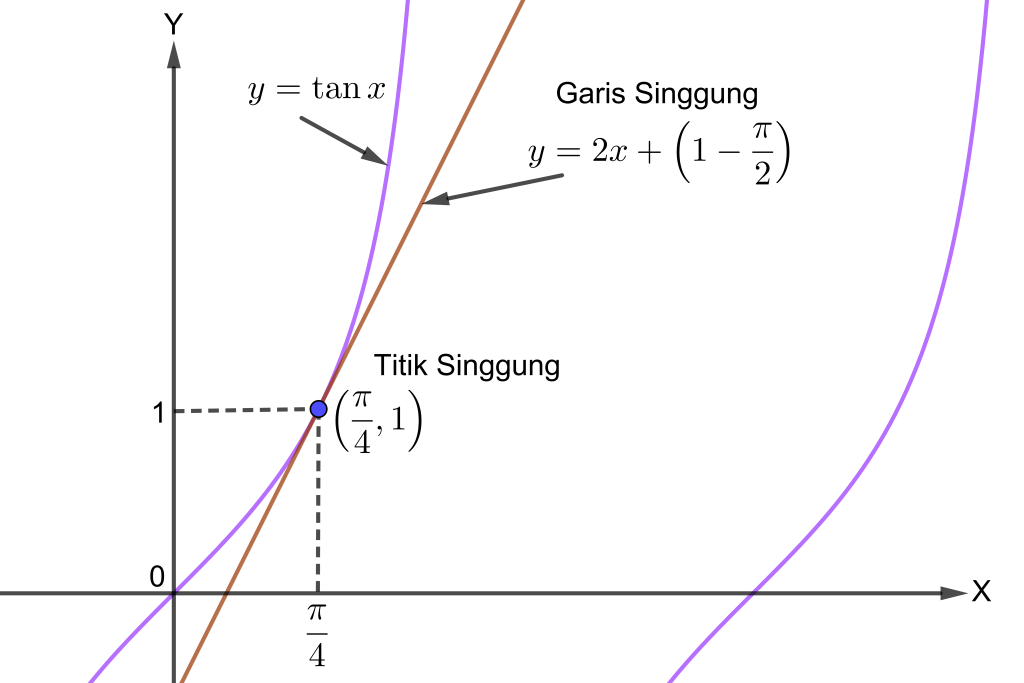
The equation for the tangent line of the curve $y = \tan x$ at the point $\left(\dfrac{\pi}{4}, 1\right)$ is $\cdots \cdot$
A. $y = 2x + \left(1+\dfrac{\pi}{2}\right)$
B. $y = 2x + \left(\dfrac{\pi}{2}-1\right)$
C. $y = 2x + \left(1-\dfrac{\pi}{2}\right)$
D. $y = 2x + (2-\pi)$
E. $y = 2x + (2+\pi)$
Given $y = \tan x$ and tangent point $\left(\dfrac{\pi}{4}, 1\right)$.
First, we will find the derivative of $y$. It is simply $y’ = \sec^2 x$.
Plug $x = \dfrac{\pi}{4}$ into $y’$ so we have the slope.
$m = \sec^2 \dfrac{\pi}{4} = (\sqrt2)^2 = 2$
The equation for the tangent line that runs through $(x_1, y_1) = \left(\dfrac{\pi}{4}, 1\right)$ and a slope of $m = 2$ is
$\begin{aligned} y & = m(x-x_1)+y_1 \\ & = 2\left(x-\dfrac{\pi}{4}\right)+1 \\ & = 2x-\dfrac{\pi}{2}+1 \\ & = 2x + \left(1-\dfrac{\pi}{2}\right) \end{aligned}$
Thus, the equation for the tangent line is $\boxed{y = 2x + \left(1-\dfrac{\pi}{2}\right)}$
The graph is shown below.
(Answer C)
The tangent line that passes through the curve $y = \sin x + \cos x$ at the point having abscissa of $\dfrac{\pi}{2}$ will intersect $Y$-axis at the point whose ordinate is $\cdots \cdot$
A. $-\dfrac{\pi}{2} + 1$ D. $\dfrac{\pi}{2}$
B. $-\dfrac{\pi}{2}$ E. $\dfrac{\pi}{2} + 1$
C. $-\dfrac{\pi}{2}- 1$
Given $y = \sin x + \cos x$.
Plug $x = \dfrac{\pi}{2}$ to get
$y = \sin \dfrac{\pi}{2} + \cos \dfrac{\pi}{2}= 1 + 0 = 1 $
The tangent point is at $\left(\dfrac{\pi}{2}, 1\right)$.
The derivative of $y$ is $y’ = \cos x-\sin x$.
The slope of the tangent line$(m)$ is represented as the value of $y’$ at $x = \dfrac{\pi}{2}$, that is
$y’ = m = \cos \dfrac{\pi}{2}-\sin \dfrac{\pi}{2} = 0-1 = -1$
The line that runs through $(x_1, y_1) = \left(\dfrac{\pi}{2}, 1\right)$ and has a gradien of $m = -1$ is
$\boxed{\begin{aligned} y-y_1 & = m(x-x_1) \\ y-1 & = -1\left(x-\dfrac{\pi}{2}\right) \\ y & = -x + \dfrac{\pi}{2} + 1 \end{aligned}}$
This line intersects $Y$-axis at $x = 0$ so we have
$\boxed{y = 0 + \dfrac{\pi}{2} + 1 = \dfrac{\pi}{2} + 1}$
The graph is shown below.

(Answer E)
Essay Section
Find $\dfrac{\text{d}y}{\text{d}x}$ for the following functions.
a. $y = 2x + \sin x$
b. $y = 5 \sin x-6 \cos x$
c. $y = 8x^3-\sin x +6$
d. $y = 6 \cos x-8(x^2+x)$
e. $y = 2 \sin x + \tan x$
f. $y = x^2 + \cos x + \cos \dfrac{\pi}{4}$
Answer a)
Given $y = 2x + \sin x$.
$\begin{aligned} \dfrac{\text{d}y}{\text{d}x} & = \dfrac{\text{d}}{\text{d}x}(2x) + \dfrac{\text{d}}{\text{d}x}(\sin x) \\ & = 2 + \cos x \end{aligned}$
Thus, its derivative is $\boxed{\dfrac{\text{d}y}{\text{d}x} = 2 + \cos x}$
Answer b)
Given $y = 5 \sin x-6 \cos x$.
$\begin{aligned} \dfrac{\text{d}y}{\text{d}x} & = 5 \dfrac{\text{d}}{\text{d}x}(\sin x)-6 \dfrac{\text{d}}{\text{d}x}(\cos x) \\ & = 5 \cos x-6(-\sin x) \\ & = 5 \cos x + 6 \sin x \end{aligned}$
Thus, its derivative is $\boxed{\dfrac{\text{d}y}{\text{d}x} = 5 \cos x + 6 \sin x}$
Answer c)
Given $y = 8x^3-\sin x + 6$.
$\begin{aligned} \dfrac{\text{d}y}{\text{d}x} & = 8 \dfrac{\text{d}}{\text{d}x}(x^3)- \dfrac{\text{d}}{\text{d}x}(\sin x) + \dfrac{\text{d}}{\text{d}x} (6) \\ & = 8(3x^2)-\cos x+0 \\ & = 24x^2-\cos x \end{aligned}$
Thus, its derivative is $\boxed{\dfrac{\text{d}y}{\text{d}x} = 24x^2-\cos x}$
Answer d)
Given $y = 6 \cos x-8(x^2+x)$.
The equation above is equivalent to $y = 6 \cos x-8x^2-8x$.
$\begin{aligned} \dfrac{\text{d}y}{\text{d}x} & = 6 \dfrac{\text{d}}{\text{d}x}(\cos x)-8\dfrac{\text{d}}{\text{d}x}(x^2)-8\dfrac{\text{d}}{\text{d}x} (x) \\ & = 6(-\sin x)-8(2x)-8(1) \\ & = -6 \sin x-16x-8 \end{aligned}$
Thus, its derivative is $\boxed{\dfrac{\text{d}y}{\text{d}x} = -6 \sin x-16x-8}$
Answer e)
Given $y = 2 \sin x + \tan x$.
$\begin{aligned} \dfrac{\text{d}y}{\text{d}x} & = 2 \dfrac{\text{d}}{\text{d}x}(\sin x)+\dfrac{\text{d}}{\text{d}x}(\tan x) \\ & = 2(\cos x)+\sec^2 x \\ & = 2 \cos x + \sec^2 x \end{aligned}$
Thus, its derivative is $\boxed{\dfrac{\text{d}y}{\text{d}x} = 2 \cos x + \sec^2 x}$
Answer f)
Given $y = x^2 + \cos x + \cos \dfrac{\pi}{4}$.
$\begin{aligned} \dfrac{\text{d}y}{\text{d}x} & = \dfrac{\text{d}}{\text{d}x}(x^2)+\dfrac{\text{d}}{\text{d}x}(\cos x) + \dfrac{\text{d}}{\text{d}x}\left(\cos \dfrac{\pi}{4}\right) \\ & = 2x + (-\sin x) + 0 \\ & = 2x-\sin x \end{aligned}$
Thus, its derivative is $\boxed{\dfrac{\text{d}y}{\text{d}x} = 2x-\sin x}$
Find the value of $f’\left(\dfrac{\pi}{4}\right)$ for the following functions.
a. $f(t) = 2 \sec t + 3 \tan t-\tan \dfrac{\pi}{3}$
b. $f(\theta) = 2 \sin \theta + 3 \cos \theta$
c. $f(t) = \sin^2 t + \cos^2 t$
d. $f(\alpha) = \csc \alpha + \sec \alpha$
e. $f(x) = \tan x-\cot x$
Find the function’s derivative and then plug its variable as $\dfrac{\pi}{4}$.
Answer a)
Given $f(t) = 2 \sec t + 3 \tan t-\tan \dfrac{\pi}{3}$.
$\begin{aligned} f'(t) & = 2 (\sec t \tan t) + 3 (\sec^2 t)-0 \\ f’\left(\dfrac{\pi}{4}\right) & = 2 \cdot \sec \dfrac{\pi}{4} \cdot \tan \dfrac{\pi}{4} + 3 \sec^2 \dfrac{\pi}{4} \\ & = 2 \cdot \sqrt2 \cdot 1 + 3 (\sqrt2)^2 \\ & = 2\sqrt2 + 6 \end{aligned}$
Thus, the value of $\boxed{f’\left(\dfrac{\pi}{4}\right) = 2\sqrt2+6}$
Answer b)
Given $f(\theta) = 2 \sin \theta + 3 \cos \theta$.
$\begin{aligned} f'(\theta) & = 2 \cos \theta + 3(-\sin \theta) \\ & = 2 \cos \theta-3 \sin \theta \\ f’\left(\dfrac{\pi}{4}\right) & = 2 \cos \dfrac{\pi}{4}-3 \sin \dfrac{\pi}{4} \\ & = 2 \cdot \dfrac12\sqrt2-3 \cdot \dfrac12\sqrt2 \\ & = \sqrt2-\dfrac32\sqrt2 = -\dfrac12\sqrt2 \end{aligned}$
Thus, the value of $\boxed{f’\left(\dfrac{\pi}{4}\right) = -\dfrac12\sqrt2}$
Answer c)
Given $f(t) = \sin^2 t + \cos^2 t$.
Notice that $f(t) = 1$ since $\sin^2 t + \cos^2 t = 1$ (Pythagorean Identity). In other words, $f(t)$ is merely a constant function.
This means, $f'(t) = 0$ since the derivative of any constant function is always zero.
Thus, $\boxed{f’\left(\dfrac{\pi}{4}\right) = 0}$
Answer d)
Given $f(\alpha) = \csc \alpha + \sec \alpha$.
By using the addition rule of derivative, we have
$f'(\alpha) = (-\csc \alpha \cot \alpha) + (\sec \alpha \tan \alpha)$
Plug $\alpha = \dfrac{\pi}{4}$ to get
$$\begin{aligned} f’\left(\dfrac{\pi}{4}\right) & = \left(-\csc \dfrac{\pi}{4} \cot \dfrac{\pi}{4}\right) + \left(\sec \dfrac{\pi}{4} \tan \dfrac{\pi}{4}\right) \\ & = (-\sqrt2 \cdot 1) + (\sqrt2 \cdot 1) \\ & = -\sqrt2 + \sqrt2 = 0 \end{aligned}$$Thus, $\boxed{f’\left(\dfrac{\pi}{4}\right) = 0}$
Answer e)
Given $f(x) = \tan x-\cot x$.
By using the subtraction rule of derivative, we have
$\begin{aligned} f'(x) & = \sec^2 x-(-\csc^2 x) \\ & = \sec^2 x + \csc^2 x \end{aligned}$
Plug $x = \dfrac{\pi}{4}$ to get
$\begin{aligned} f’\left(\dfrac{\pi}{4}\right) & = \sec^2 \dfrac{\pi}{4} + \csc^2 \dfrac{\pi}{4} \\ & = (\sqrt2)^2 + (\sqrt2)^2 \\ & = 2+2 = 4 \end{aligned}$
Thus, $\boxed{f’\left(\dfrac{\pi}{4}\right) = 4}$
If $h(x) = x \cdot g(x)$ with
$g(x) = \dfrac{a \sin x + b \cos x}{c \sin x + d \cos x}$,
and $(c \sin x + d \sin x) \neq 0$, show that $x \cdot h'(x) = h(x) + x^2g'(x)$.
Given $h(x) = x \cdot g(x)$.
By applying the product rule, we have
$h'(x) = 1 \cdot g(x) + x \cdot g'(x)$.
Hence,
$\begin{aligned} x \cdot h'(x) & = x(g(x) + x \cdot g'(x)) \\ & = x \cdot g(x) + x^2 \cdot g'(x) \\ & = h(x) + x^2 \cdot g'(x) \end{aligned}$
Thus, it is shown that $\boxed{x \cdot h'(x) = h(x) + x^2g'(x)}$
Show that the first derivative of function
$f(x) = \dfrac{a \sin x + b \cos x}{c \sin x + d \cos x}$
is
$f'(x) = \dfrac{ad-bc}{(c \sin x + d \cos x)^2}$.
Given $f(x) = \dfrac{a \sin x + b \cos x}{c \sin x + d \cos x}$.
Applying the quotient rule, first we assume
$$\begin{aligned} & u = a \sin x + b \cos x \implies u’ = a \cos x-b \sin x \\ & v = c \sin x + d \cos x \implies v’ = c \cos x-d \sin x \end{aligned}$$Therefore, we have
$$\begin{aligned} f'(x) & = \dfrac{u’v-uv’}{v^2} \\ & = \dfrac{(a \cos x-b \sin x) (c \sin x + d \cos x)-(a \sin x + b \cos x)(c \cos x-d \sin x)}{(c \sin x + d \cos x)^2} \end{aligned}$Notice that to prove the statement above, we only need to observe the numerator, since their denominators are already same.
We express the numerator of $f'(x)$ as follows.
$$\begin{aligned} g'(x) & = (a \cos x-b \sin x) \cdot (c \sin x + d \cos x)-(a \sin x + b \cos x)(c \cos x-d \sin x) \\ & = \cancel{ac \sin x \cos x} + ad \cos^2 x-bc \sin^2 x-\bcancel{bd \sin x \cos x}-(\cancel{ac \sin x \cos x}-ad \sin^2 x + bc \cos^2 x-\bcancel{bd \sin x \cos x}) \\ & = ad \sin^2 x + ad \cos^2 x-bc \sin^2 x-bc \cos^2 x \\ & = ad(\sin^2 x + \cos^2 x)-bc(\sin^2 x + \cos^2 x) \\ & = ad(1)-bc(1) = ad-bc \end{aligned}$$Thus, it is showed that the first derivative of $f(x)$ is $\boxed{f'(x)= \dfrac{ad-bc}{(c \sin x + d \cos x)^2}}$
By applying the following formula:
$f(x) = \dfrac{a \sin x + b \cos x}{c \sin x + d \cos x}$
whose derivative is given by
$f'(x) = \dfrac{ad-bc}{(c \sin x + d \cos x)^2}$,
evaluate the derivative of the following functions.
a. $g(\theta) = \dfrac{\sin \theta}{\sin \theta + \cos \theta}$
b. $h(t) = \dfrac{2 \sin t-\cos t}{3 \sin t + \cos t}$
c. $p(\alpha) = \dfrac{\sin \alpha + 2 \cos \alpha}{3 \sin \alpha}$
d. $k(x) = \dfrac{4 \cos x-2 \sin x}{5 \cos x + 3 \sin x}$
Answer a)
Express the function into the general form of the given formula.
$g(\theta) = \dfrac{1 \sin \theta + 0 \cos \theta}{1 \sin \theta + 1 \cos \theta}$
We have $a = c = d = 1$, and $b = 0$.
Hence, its derivative is given by
$\begin{aligned} g'(\theta) & = \dfrac{ad-bc}{(c \sin \theta + d \cos \theta)^2} \\ & = \dfrac{1(1)-0(1)}{(\sin \theta + \cos \theta)^2} \\ & = \dfrac{1}{(\sin \theta + \cos \theta)^2} \end{aligned}$
Answer b)
Given $h(t) = \dfrac{2 \sin t-\cos t}{3 \sin t + \cos t}$.
The function $h$ is already in the form of the formula, with $a = 2$, $b= -1$, $c = 3$, and $d = 1$.
The derivative of this function is
$\begin{aligned} h'(t) & = \dfrac{ad-bc}{(c \sin t + d \cos t)^2} \\ & = \dfrac{2(1)-(-1)(3)}{(3 \sin t + \cos t)^2} \\ & = \dfrac{5}{(3 \sin t + \cos t)^2} \end{aligned}$
Answer c)
Express the function into the general form of the given formula.
$p(\alpha) = \dfrac{1 \sin \alpha + 2 \cos \alpha}{3 \sin \alpha + 0 \cos \alpha}$
We have $a = 1$, $b = 2$, $c = 3$, and $d = 0$.
Hence, its derivative is given by
$\begin{aligned} p'(\alpha) & = \dfrac{ad-bc}{(c \sin \alpha + d \cos \alpha)^2} \\ & = \dfrac{1(0)-(2)(3)}{(3 \sin \alpha + 0 \cos \alpha)^2} \\ & = -\dfrac{6}{9 \sin^2 \alpha} = -\dfrac{2}{3 \sin^2 \alpha} \end{aligned}$
Answer d)
Express the function into the general form of the given formula.
$k(x) = \dfrac{-2 \sin x + 4 \cos x}{3 \sin x + 5 \cos x}$
We have $a = -2$, $b = 4$, $c = 3$, and $d = 5$.
Hence, its derivative is given by
$\begin{aligned} k'(x) & = \dfrac{ad-bc}{(c \sin x + d \cos x)^2} \\ & = \dfrac{(-2)(5)-(4)(3)}{(3 \sin x + 5 \cos x)^2} \\ & = -\dfrac{22}{(3 \sin x + 5 \cos x)^2} \end{aligned}$
Given functions $f(\theta) = \sin \theta$ and $g(\theta) = \cos \theta$.
Show that:
a. $f'(\theta) \cdot g(\theta)-f(\theta) \cdot g'(\theta) = 1$
b. $f'(\theta) \cdot g(\theta)+f(\theta) \cdot g'(\theta) = 2 \cos^2 \theta-1$
Given:
$f(\theta) = \sin \theta \implies f'(\theta) = \cos \theta$
$g(\theta) = \cos \theta \implies g'(\theta) = -\sin \theta$
Answer a)
$\begin{aligned} & f'(\theta) \cdot g(\theta)-f(\theta) \cdot g'(\theta) \\ & = \cos \theta \cdot (\cos \theta)-\sin \theta \cdot (-\sin \theta) \\ & = \cos^2 \theta + \sin^2 \theta = 1 \end{aligned}$
(Q.E.D)
Answer b)
$\begin{aligned} & f'(\theta) \cdot g(\theta)+f(\theta) \cdot g'(\theta) \\ & = \cos \theta \cdot (\cos \theta)+\sin \theta \cdot (-\sin \theta) \\ & = \cos^2 \theta- \sin^2 \theta \\ & = \cos^2 \theta-(1-\cos^2 \theta) \\ & = 2 \cos^2 \theta-1 \end{aligned}$
(Q.E.D)
If $f(x) = \dfrac{x \sin x}{\sin x + \cos x}$, with $(\sin x + \cos x) \neq 0$, prove that $f'(x)(1+ \sin 2x) = x + \sin x(\sin x + \cos x)$.
Given $f(x) = \dfrac{x \sin x}{\sin x + \cos x}$.
We will find the first derivative of $f(x)$ by applying the quotient rule.
Let:
$$\begin{aligned} u & = x \sin x \implies u’ = \sin x + x \cos x \\ v & = \sin x + \cos x \implies v’ = \cos x-\sin x \end{aligned}$$Hence,
$$\begin{aligned} f'(x) & = \dfrac{u’v-uv’}{v^2} \\ & = \dfrac{(\sin x + x \cos x)(\sin x + \cos x)-(x \sin x)(\cos x-\sin x)}{(\sin x + \cos x)^2} \\ & = \dfrac{\sin^2 x + \sin x \cos x +\cancel{ x \sin x \cos x} + x \cos^2 x- \cancel{x \sin x \cos x} + x \sin^2 x}{(\sin^2 x + \cos^2 x) + 2 \sin x \cos x} \\ & = \dfrac{\sin^2 x + \sin x \cos x + x(\sin^2 x + \cos^2 x)}{1 + \sin 2x} \\ & = \dfrac{\sin x(\sin x + \cos x) + x(1)}{1+\sin 2x} \\ & = \dfrac{x + \sin x(\sin x + \cos x)}{1+\sin 2x} \end{aligned}$$Next, we have
$\begin{aligned} & f'(x)(1+\sin 2x) \\ & = \dfrac{x + \sin x(\sin x + \cos x)}{\cancel{1+\sin 2x}} \cdot \cancel{(1+\sin 2x)} \\ & = x + \sin x(\sin x + \cos x) \end{aligned}$
(Q.E.D)
Evaluate the derivative of the following trigonometric function.
$f(t) = \dfrac{2t \sin t + 3 \cos t}{\sin t + 3t \cos t}$
Use the quotient rule.
Let:
$\begin{aligned} u & = 2t \sin t + 3 \cos t \\ u’ & = (2 \sin t + 2t \cos t)-3 \sin t \\ & = -\sin t + 2t \cos t \\ v & = \sin t + 3t \cos t \\ v’ & = \cos t + (3 \cos t -3t \sin t) \\ & = 4 \cos t-3t \sin t \end{aligned}$
Hence, we have
$$\begin{aligned} f'(t) & = \dfrac{u’v-uv’}{v^2} \\ & = \dfrac{(-\sin t + 2t \cos t)(\sin t + 3t \cos t)-(2t \sin t + 3 \cos t)(4 \cos t-3t \sin t)}{(\sin t + 3t \cos t)^2} \\ & = \dfrac{\color{red}{-\sin^2 t} -3t \sin t \cos t + 2t \sin t \cos t + \color{blue}{6t^2 \cos^2 t} + 3 \sin t \cos t + 9t \cos^2 t-8t \sin t \cos t+\color{red}{6t^2 \sin^2 t}\color{blue}{-12 \cos^2 t}+9t \sin t \cos t}{(\sin t + 3t \cos t)^2} \\ & = \dfrac{(6t^2-1) \sin^2 t + (6t^2-12) \cos^2 t + (-3t+2t-8t+9t) \sin t \cos t}{(\sin t + 3t \cos t)^2} \\ & = \dfrac{(6t^2-1) \sin^2 t + (6t^2-12) \cos^2 t}{(\sin t + 3t \cos t)^2} \end{aligned}$$Thus, the derivative of the function is $\boxed{f'(t) = \dfrac{(6t^2-1) \sin^2 t + (6t^2-12) \cos^2 t}{(\sin t + 3t \cos t)^2}}$
Given that $f(x) = \dfrac{\cos x-\sin x}{\cos x + \sin x}$ with $(\cos x + \sin x) \neq 0$. Prove that $f'(x) = -1(1 + f^2(x))$.
Use the quotient rule.
$\boxed{f(x) = \dfrac{u}{v} \implies f'(x) = \dfrac{u’v-uv’}{v^2}}$
Given $f(x) = \dfrac{\cos x-\sin x}{\cos x + \sin x}$.
Let:
$\begin{aligned} u & = \color{red}{\cos x} \color{blue}{-\sin x} \\ u’ & = \color{red}{-\sin x}\color{blue}{-\cos x} = -(\cos x + \sin x) \\ v & = \color{red}{\cos x}\color{blue}{+\sin x} \\ v’ & = \color{red}{-\sin x}\color{blue}{+\cos x} = \cos x-\sin x \end{aligned}$
Hence,
$$\begin{aligned} f'(x) & = \dfrac{-(\cos x + \sin x)(\cos x + \sin x)-(\cos x-\sin x)(\cos x-\sin x) }{(\cos x + \sin x)^2} \\ & = -1\left(\dfrac{(\cos x + \sin x)^2 + (\cos x-\sin x)^2}{(\cos x + \sin x)^2}\right) \\ & = -1\left(\dfrac{(\cos x + \sin x)^2}{(\cos x + \sin x)^2} + \dfrac{(\cos x-\sin x)^2}{(\cos x + \sin x)^2}\right) \\ & = -1\left(1+\left(\dfrac{\cos x-\sin x}{\cos x+\sin x}\right)^2\right) \\ f'(x) & = -1(1 + f^2(x)) \end{aligned}$$(Q.E.D)
Find the derivative of the following function
$h(y) = y^3-y^2 \cos y + 2y \sin y + 2 \cos y$
Given $h(y) = y^3-\color{red}{y^2 \cos y} + \color{blue}{2y \sin y} + 2 \cos y$.
The expression in blue above is the product of two functions, so its derivative can be evaluated by applying the product rule: $f(x) = uv \implies f'(x) = u’v + uv’$.
Hence, we have
$$\begin{aligned} h'(y) & = 3y^2-(2y \cos y + y^2 (-\sin y)) + 2(\sin y + y \cos y) + 2 (-\sin y) \\ & = 3y^2-\cancel{2y \cos y}+y^2 \sin y + \bcancel{2 \sin y} + \cancel{2y \cos y}-\bcancel{2 \sin y} \\ & = 3y^2+y^2 \sin y \end{aligned}$$Thus, the derivative of the trigonometric function is $\boxed{h'(y) = 3y^2 + y^2 \sin y}$
Find the equation for the tangent line on the curve of the following trigonometric functions at the given point.
- $f(x) = \sin x$ at the point whose abscissa is $x = \dfrac{\pi}{6}$.
- $f(x) = \cot x-2 \csc x$ at the point whose abscissa is $x = \dfrac{\pi}{3}$.
Answer a)
For $x = \dfrac{\pi}{6}$, we have
$f\left(\dfrac{\pi}{6}\right) = \sin \dfrac{\pi}{6} = \dfrac12$
The tangent point is at $\left(\dfrac{\pi}{6}, \dfrac12\right)$.
The first derivative of function $f(x)= \sin x$ is $f'(x) = \cos x$.
The slope of the tangent line is represented as the value of function $f’$ at $x = \dfrac{\pi}{6}$, that is
$m = f’\left(\dfrac{\pi}{6}\right) = \cos \dfrac{\pi}{6} = \dfrac12\sqrt3$.
The equation for the tangent line that runs through $(x_1, y_1) = \left(\dfrac{\pi}{6}, \dfrac12\right)$ having a slope of $m = \dfrac12\sqrt3$ is
$\begin{aligned} y & = m(x-x_1)+y_1 \\ y & = \dfrac12\sqrt3\left(x-\dfrac{\pi}{6}\right) + \dfrac12 \\ 2y & = \sqrt3\left(x-\dfrac{\pi}{6}\right) +1 \end{aligned}$
Thus, its tangent line is given by $\boxed{2y = \sqrt3\left(x-\dfrac{\pi}{6}\right) +1}$
Answer b)
For $x = \dfrac{\pi}{3}$, we have
$\begin{aligned} f\left(\dfrac{\pi}{3}\right) & = \cot \dfrac{\pi}{3}-2 csc \dfrac{\pi}{3} \\ & = \dfrac{\sqrt3}{3}-2 \cdot \dfrac23\sqrt3 \\ & = (1-4)\dfrac{\sqrt3}{3} = -\sqrt3 \end{aligned}$
The tangent point is at $\left(\dfrac{\pi}{3}, -\sqrt3\right)$.
The first derivative of function $f(x)= \cot x-2 \csc x$ is
$\begin{aligned}vf'(x) & = -\csc^2 x-2(-\csc x \cot x) \\ & = 2 \csc x \cot x-\csc^2 x \end{aligned}$
The slope of the tangent line is represented as the value of function $f’$ at $x = \dfrac{\pi}{3}$, yaitu
$\begin{aligned} m & = f’\left(\dfrac{\pi}{3}\right) \\ & = 2 \csc \dfrac{\pi}{3} \cot \dfrac{\pi}{3} -\csc^2 \dfrac{\pi}{3} \\ & = 2 \cdot \dfrac23\sqrt3 \cdot \dfrac13\sqrt3-\left(\dfrac23\sqrt3\right)^2 \\ & = \dfrac43-\dfrac{4}{9}(3) = 0 \end{aligned}$
The equation for the tangent line that runs through $(x_1, y_1) = \left(\dfrac{\pi}{3}, -\sqrt3\right)$ having a slope of $m = 0$ is
$\begin{aligned} y & = m(x-x_1)+y_1 \\ y & = 0\left(x-\dfrac{\pi}{6}\right) + (-\sqrt3) \\ y & = -\sqrt3 \end{aligned}$
Evaluate the equation for the normal line on the curve of the following trigonometric functions at the given point.
- $h(\theta) = \theta + \sin \theta$ at the point whose ordinate is $0$.
- $f(x) = x \cos x$ at the point whose abscissa is $x = \dfrac{\pi}{3}$.
Answer a)
Given $h(\theta) = \theta + \sin \theta$.
For $y = 0$, we have $0 = \theta + \sin \theta$ hence that $\theta = 0$.
The tangent point is at $(0, 0)$.
The first derivative of function $f(\theta)= \theta + \sin \theta$ is $f'(\theta) = 1 + \cos \theta$.
The slope of the tangent line is represented as the value of function $f’$ at $\theta = 0$, that is
$m = f'(0) = 1 + \cos 0 = 2$
The normal line is defined as the line that perpendicular to the tangent line at the point of tangency. The slope of the normal line is given by
$m_n = -\dfrac{1}{m} = -\dfrac12$
The equation for the normal line that runs through $(x_1, y_1) = (0, 0)$ having a slope of $m_n = -\dfrac12$ is
$\begin{aligned} y & = m_n(x-x_1)+y_1 \\ y & = -\dfrac12(x-0) + 0 \\ y & = -\dfrac12x \end{aligned}$
Thus, the equation for the normal line is given by $\boxed{y = -\dfrac12x}$
Answer b)
Given $f(x) = x \cos x$.
For $x = \dfrac{\pi}{3}$, we have
$\begin{aligned} f\left(\dfrac{\pi}{3}\right) & = \dfrac{\pi}{3} \cos \dfrac{\pi}{3} \\ & = \dfrac{\pi}{3} \cdot \dfrac12 \\ & = \dfrac{\pi}{6} \end{aligned}$
The tangent point is at $\left(\dfrac{\pi}{3}, \dfrac{\pi}{6}\right)$.
The first derivative of function $f(x) = x \cos x$ is $f'(x) = \cos x-x \sin x$ (by applying the product rule).
The slope of the tangent line is represented as the value of function $f’$ at $x= \dfrac{\pi}{3}$, that is
$\begin{aligned} m & = f’\left(\dfrac{\pi}{3}\right) \\ & = \cos \dfrac{\pi}{3}-\dfrac{\pi}{3} \sin \dfrac{\pi}{3} \\ & = \dfrac12-\dfrac{\pi}{3} \cdot \dfrac12\sqrt3 \\ & = \dfrac12-\dfrac{\sqrt3}{6}\pi \\ & = \dfrac{3-\sqrt3\pi}{6} \end{aligned}$
The normal line is defined as the line that perpendicular to the tangent line at the point of tangency. The slope of the normal line is given by
$m_n = -\dfrac{1}{m} = \dfrac{6}{\sqrt3\pi-3}$
The equation for the normal line that runs through $(x_1, y_1) = \left(\dfrac{\pi}{3}, \dfrac{\pi}{6}\right)$ and bergradien $m_n = \dfrac{6}{\sqrt3\pi-3}$ adalah
$\begin{aligned} y & = m_n(x-x_1)+y_1 \\ y & = \dfrac{6}{\sqrt3\pi-3}\left(x-\dfrac{\pi}{3}\right) + \dfrac{\pi}{6} \end{aligned}$
Thus, the equation for the normal line is given by $\boxed{y = \dfrac{6}{\sqrt3\pi-3}\left(x-\dfrac{\pi}{3}\right) + \dfrac{\pi}{6}}$
Find the first derivative of the following trigonometric functions.
a. $f(x) = \cos^7 (x^3)$
b. $g(x) = \cot (2x^4)$
c. $r(x) = (\sin 3x-9 \cos^3 x)^6$
Apply the chain rule several times.
Answer a)
Given $f(x) = \cos^7 (x^3) = (\underbrace{\cos (x^3)}_{u})^7$.
We have
$\begin{aligned} f'(x) & = 7 (\cos^6 (x^3)) \cdot \underbrace{(-\sin (x^3)) \cdot 3x^2}_{u’} \\ & = -21x^2 \sin (x^3) \cos^6 (x^3) \end{aligned}$
Thus, the first derivative of function $f(x)$ is $\boxed{f'(x) = -21x^2 \sin (x^3) \cos^6 (x^3)}$
Answer b)
Given $g(x) = \cot (\underbrace{2x^4}_{u})$.
We have
$\begin{aligned} g'(x) & = -\csc^2 (2x^4) \cdot \underbrace{8x^3}_{u’} \\ & = -8x^3 \csc^2 (2x^4) \end{aligned}$
Thus, the first derivative of function $g(x)$ is $\boxed{g'(x) = -8x^3 \csc^2 (2x^4)}$
Answer c)
Given $r(x) = (\underbrace{\sin 3x-9 \cos^3 x}_{u})^6$.
We have
$r'(x) = 6 (\sin 3x-9 \cos^3 x)^5 \cdot$ $\underbrace{(3 \cos 3x-27 \cos^2 x (-\sin x))}_{u’}$
Note: The derivative of $v = \cos^3 x$ is $v’ = 3 \cos^2 x (-\sin x)$.
Thus, the first derivative of function $r(x)$ is $$\boxed{r'(x) = 6 (\sin 3x-9 \cos^3 x)^5 \cdot (3 \cos 3x-27 \cos^2 x (-\sin x))}$$
Find the first derivative of the following functions.
a. $f(\theta) = \sin (\sin \theta)$
b. $h(x) = \sin (2 \cos x)$
c. $H(x) = \sin [\sin (\sin x)]$
Apply the chain rule several times.
Answer a)
Given $f(\theta) = \sin (\underbrace{\sin \theta}_{u})$.
We have
$\begin{aligned} f'(\theta) & = \cos (\sin \theta) \cdot \underbrace{\cos \theta}_{u’} \\ & = \cos \theta \cos (\sin \theta) \end{aligned}$
Answer b)
Given $h(x) = \sin (\underbrace{2 \cos x}_{u})$.
We have
$\begin{aligned} h'(x) & = \cos (2 \cos x) \cdot \underbrace{-2 \sin x}_{u’} \\ & = -2 \sin x \cos (2 \cos x) \end{aligned}$
Answer c)
Given $H(x) = \sin [\underbrace{\sin (\underbrace{\sin x}_{v})}_{u}]$.
We have
$\begin{aligned} H'(x) & = \cos [\sin (\sin x)] \cdot \underbrace{\cos (\sin x)}_{u’} \cdot \underbrace{\cos x}_{v’} \\ & = \cos x \cos (\sin x) \cos [\sin (\sin x)] \end{aligned}$
By applying the chain rule, find the derivative of the following functions.
a. $y = \sin (4x^2+3x)$
b. $y = (1+\sin^2 x)(1-\sin^2 x)$
c. $y = \left(\dfrac{\cos x}{1+\sin x}\right)^3$
d. $y = \dfrac{(1+\sin x)^2}{x^3}$
e. $y = (x^2-1)^3 \cos (3x+2)$
f. $y = \dfrac{1}{\sqrt{\cos x^2}}$
Answer a)
Given $y = \sin (\underbrace{4x^2+3x}_{u})$.
By applying the chain rule, we have its derivative.
$y’ = \underbrace{(8x + 3)}_{u’} \cos (4x^2+3x)$
Answer b)
Given
$\begin{aligned} y & = (1+\sin^2 x)(1-\sin^2 x) \\ & = 1-\sin^4 x = 1-(\underbrace{\sin x}_{u})^4 \end{aligned}$
Its derivative is given by
$\begin{aligned} y’ & = 0-4 \sin^3 x \cdot \underbrace{\cos x}_{u} \\ & = -4 \sin^3 x \cos x \end{aligned}$
Answer c)
Given $y = \left(\underbrace{\dfrac{\cos x}{1+\sin x}}_{u}\right)^3$.
The derivative of $u$ can be evaluated by applying the quotient rule, while for the function $y$, its derivative can be evaluated by applying the chain rule in whole.
$$\begin{aligned} y’ & = 3 \cdot \dfrac{\cos x}{1+\sin x} \cdot \dfrac{(-\sin x)(1+\sin x)-(\cos x)(\cos x)}{(1+\sin x)^2} \\ & = \dfrac{3 \cos x(-\sin x-\sin^2 x-\cos^2 x)}{(1+\sin x)^3} \\ & = \dfrac{3 \cos x(-\sin x-1)}{(1+\sin x)^3} && (\sin^2 x + \cos^2 x = 1) \\ & = \dfrac{-3 \cos x\cancel{(1 + \sin x)}}{(1+\sin x)^{\cancelto{2}{3}}} \\ & = \dfrac{-3 \cos x}{(1+\sin x)^2} \end{aligned}$$Answer d)
Given $y = \dfrac{(1+\sin x)^2}{x^3}$.
Overall, we apply the quotient rule to find the derivative of $y$, but each of the components is differentiated by using the chain rule and product rule.
Let:
$\begin{aligned} u & = (1+\sin x)^2 \\ \implies u’ & = 2(1+\sin x)(\cos x) \\ v & = x^3 \\ \implies v’ & = 3x^2 \end{aligned}$
Hence, its derivative is given by
$$\begin{aligned} y’ & = \dfrac{u’v-uv’}{v^2} \\ & = \dfrac{2(1+\sin x)(\cos x)(x^3)-(1+\sin x)^2(3x^2)}{(x^3)^2} \\ & = \dfrac{2x^3(1+\sin x)(\cos x)-3x^2(1+\sin x)^2}{x^6} \end{aligned}$$Answer e)
Given $y = (x^2-1)^3 \cos (3x+2)$.
Overall, we apply the product rule to find the derivative of $y$, but each of the components is differentiated by using the chain rule.
Let:
$\begin{aligned} u & = (x^2-1)^3 \\ \implies u’ & = 3(x^2-1)^2(2x) = 6x(x^2-1)^2 \\ v & = \cos (3x+2) \\ \implies v’ & = -3 \sin (3x+2) \end{aligned}$
Hence, its derivative is given by
$$\begin{aligned} y’ & = u’v + uv’ \\ & = 6x(x^2-1)^2 \cos (3x+2) + (x^2-1)^3(-3 \sin (3x+2)) \\ & = (x^2-1)^2(6x \cos (3x+2)-3(x^2-1) \sin (3x+2)) \end{aligned}$$Answer f)
Given:
$y = \dfrac{1}{\sqrt{\cos x^2}} = (\underbrace{\cos x^2}_{u})^{-\frac12} $
By applying the power rule and the chain rule (to find the derivative of $u$), we have
$\begin{aligned} y’ & = -\dfrac{1}{\cancel{2}}(\cos x^2)^{-\frac32} \cdot \underbrace{(-\sin x^2 \cdot \cancel{2}x)}_{u’} \\ & = \dfrac{x \sin x^2}{\cos x^2 \cdot \sqrt{\cos x}} \end{aligned}$
If $\dfrac{\text{d}f}{\text{d}x} = \dfrac{\sin x}{x}$ and $u(x) = \cot x$, evaluate $\dfrac{\text{d}f}{\text{d}u}$.
Given $\dfrac{\text{d}f}{\text{d}x} = \dfrac{\sin x}{x}$.
Since $u(x) = \cot x$, then we can express $x$ as the function of $u$ (recall the inverse function): $x = \text{arccot}~u$.
Note: Arcus (written as $\text{arc}$) is the notation to express the inverse of trigonometric functions.
The derivative of $x$ with respect to $u$ is
$\dfrac{\text{d}x}{\text{d}u} = -\dfrac{1}{1+x^2}$.
By applying the chain rule, we have
$\begin{aligned} \dfrac{\text{d}f}{\text{d}u} & = \dfrac{\text{d}f}{\text{d}x} \cdot \dfrac{\text{d}x}{\text{d}u} \\ & = \dfrac{\sin x}{x} \cdot \left(-\dfrac{1}{1+x^2}\right) \\ & = -\dfrac{\sin x}{x + x^3} \end{aligned}$