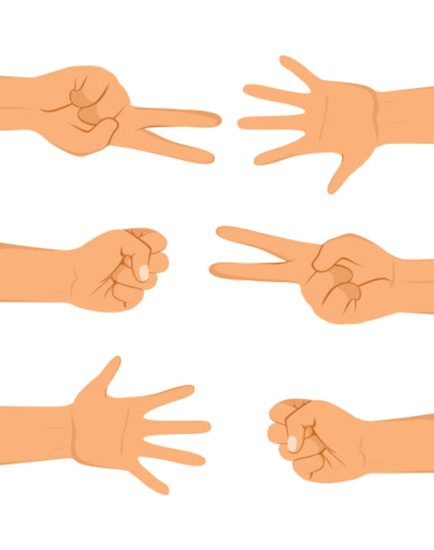
Two people play rock-paper-scissors 15 times. Under ideal conditions, how many times is each of them expected to win?
This question leads us to one of the concepts in probability theory known as expected frequency, denoted by $F_h.$
Expected frequency is the expected number of occurrences of an event from a number of trials conducted. Suppose $𝑃(𝐴)$ represents the probability of event 𝑨, while $𝑛$ represents the number of trials. The expected frequency of event $𝐴$ is calculated as follows.
$$\boxed{F_h = P(A) \times n}$$
Basically, expected frequency is an important concept in probability theory used to predict the number of occurrences of an event based on its probability. In the context of experiments or trials, expected frequency is obtained by multiplying the probability of an event by the total number of trials performed. This concept is very useful for comparing empirically obtained results with what is theoretically expected to occur.
For example, if we roll a die $60$ times, then the probability of each die face appearing is $\dfrac16.$ Therefore, the expected frequency for each die face from $1$ to $6$ is $60 \times \dfrac16 = 10.$ This means that, theoretically, each die face is expected to appear 10 times. However, in practice, the actual results may differ, although they are usually not far from the expected value, especially when the number of trials is large.
In mathematics education, understanding expected frequency helps students see the relationship between theoretical probability and empirical data. This concept not only strengthens understanding of probability, but also trains critical thinking skills in analyzing experimental results. Students can be invited to conduct simple simulations, such as flipping coins, rolling dice, drawing playing cards, or playing rock-paper-scissors, and then compare the obtained data with the expected frequency of each event.
Read: Probability Problems and Step-by-Step Solutions for Middle School
Related to expected frequency, there is another term in probability theory called relative frequency. In probability theory, relative frequency is a measure that shows how often an event occurs compared to the number of trials conducted. It is an experimental approach to probability that is useful when theoretical probability is difficult to determine or unavailable.
Relative frequency is calculated using the following formula:
$$\boxed{F_r = \dfrac{n_0}{n}}$$where $F_r$ represents the relative frequency (its value ranges from $0$ to $1$), $n_0$ represents the number of observed occurrences, and $n$ represents the total number of trials.
To deepen understanding of expected frequency, several practice problems and solutions related to the topic are presented below. The problems below are designed at a junior high school level of difficulty, making them very suitable for students with a basic level of understanding.
Falkland’s Law
Multiple Choice Section
Problem Number 1
A person rolls two standard dice repeatedly $180$ times. The expected frequency of obtaining a sum of $5$ is $\cdots$ times.
A. $10$ C. $30$ E. $80$
B. $20$ D. $50$
Suppose $A$ is the event of obtaining a sum of $5$ when rolling two standard dice. This means, $$A = \{(1, 4), (4, 1), (2, 3), (3, 2)\}$$so that $\text{n}(A) = 4.$ Meanwhile, the number of sample points in the experiment of rolling two standard dice is $\text{n}(S) = 6 \times 6 = 36.$ Therefore, we obtain
$$P(A) = \dfrac{\text{n}(A)}{\text{n}(S)} = \dfrac{4}{36} = \dfrac19.$$Since the experiment is conducted $n =180$ times, the expected frequency of obtaining a sum of $5$ is
$$F_h = P(A) \times n = \dfrac19 \times 180 = 20~\text{times}.$$(Answer B)
Read: Solved Probability and Combinatorics Problems for Senior High School
Problem Number 2
A person tosses two coins 40 times. The expected frequency of obtaining one heads and one tails is $\cdots$ times.
A. $5$ C. $15$ E. $25$
B. $10$ D. $20$
Suppose $E$ is the event of obtaining one heads and one tails when tossing two coins. This means, $$E = \{(A, G), (G, A),\}$$so that $\text{n}(E) = 2.$ Meanwhile, the number of sample points in the experiment of tossing two coins is $\text{n}(S) = 2 \times 2 = 4.$ Therefore, we obtain
$$P(E) = \dfrac{\text{n}(E)}{\text{n}(S)} = \dfrac{2}{4} = \dfrac12.$$Since the experiment is conducted $n =40$ times, the expected frequency of obtaining one heads and one tails is
$$F_h = P(E) \times n = \dfrac12 \times 40 = 20~\text{times}.$$(Answer D)
Problem Number 3
A person draws one card at random from a standard deck of playing cards. This experiment is conducted up to $50$ times. The expected frequency of obtaining an Ace card is $\cdots$ times.
A. $1$ or $2$
B. $2$ or $3$
C. $3$ or $4$
D. $4$ or $5$
E. $5$ or $6$
Suppose $A$ is the event that an Ace card is drawn. This means, $\text{n}(A) = 4$ because there are $4$ Ace cards in a standard deck of playing cards, namely the Ace of spades, Ace of clubs, Ace of diamonds, and Ace of hearts. Meanwhile, the number of sample points in the experiment of drawing one card is $\text{n}(S) = 52$ because there are $52$ cards in a standard deck. Therefore, we obtain
$$P(A) = \dfrac{\text{n}(A)}{\text{n}(S)} = \dfrac{4}{52} = \dfrac{1}{13}.$$Since the experiment is conducted $n =50$ times, the expected frequency of obtaining an Ace card is
$$F_h = P(A) \times n = \dfrac{1}{13} \times 50 = 3,\cdots~\text{times}.$$Notice that $3,\cdots$ lies between $3$ and $4.$ Therefore, it can be concluded that the expected frequency of obtaining an Ace card is $3$ or $4$ times.
(Answer C)
Problem Number 4
In a box, there are $4$ green balls and $6$ yellow balls. If one ball is drawn randomly $120$ times, how many times is a yellow ball expected to be drawn?
A. $48$ C. $72$ E. $108$
B. $60$ D. $90$
Suppose $A$ is the event that a yellow ball is drawn. This means, $\text{n}(A) = 6$ because there are $6$ yellow balls in the box. Meanwhile, the number of sample points in the experiment of drawing one ball is $\text{n}(S) = 10$ because there are $4+6=10$ balls in total in the box. Therefore, we obtain
$$P(A) = \dfrac{\text{n}(A)}{\text{n}(S)} = \dfrac{6}{10} = \dfrac35.$$Since the experiment is conducted $n =120$ times, the expected frequency of drawing a yellow ball is
$$F_h = P(A) \times n = \dfrac{3}{\cancel{5}} \times \cancelto{24}{120} = 72~\text{times}.$$Therefore, a yellow ball is expected to be drawn $72$ times.
(Answer C)
Read: Pigeonhole Principle: Theory, Examples, and Problem Solving
Problem Number 5
A bag contains 12 candies: 5 orange-flavored, 4 strawberry-flavored, and 3 grape-flavored. If one candy is randomly drawn in 60 trials, how many times is a grape-flavored candy expected to be drawn?
A. $5$ C. $15$ E. $30$
B. $10$ D. $20$
Suppose $A$ is the event that a grape-flavored candy is drawn. This means, $\text{n}(A) = 3$ because there are $3$ grape-flavored candies in the bag. Meanwhile, the number of sample points in the experiment of drawing one candy is $\text{n}(S) = 12$ because there are $12$ candies in total in the bag. Therefore, we obtain
$$P(A) = \dfrac{\text{n}(A)}{\text{n}(S)} = \dfrac{3}{12} = \dfrac14.$$Since the experiment is conducted $n =60$ times, the expected frequency of drawing a grape-flavored candy is
$$F_h = P(A) \times n = \dfrac{1}{\cancel{4}} \times \cancelto{15}{60} = 15~\text{times}.$$Therefore, a grape-flavored candy is expected to be drawn $15$ times.
(Answer C)
Problem Number 6
A spinning wheel with a pointer is divided into four equal sections colored orange, gray, purple, and white. If the wheel is spun 100 times, how many times is the pointer expected to land on gray or purple?
A. $20$ C. $50$ E. $75$
B. $40$ D. $60$
Suppose $A$ is the event that the wheel pointer lands on gray or purple. Since there are two intended colors, we obtain $\text{n}(A) = 2.$ Meanwhile, the number of sample points in the spinning wheel experiment is $\text{n}(S) = 4$ because the wheel is divided into $4$ equal color sections. Therefore, we obtain
$$P(A) = \dfrac{\text{n}(A)}{\text{n}(S)} = \dfrac{2}{4} = \dfrac12.$$Since the experiment is conducted $n = 100$ times, the expected frequency of the wheel pointer landing on gray or purple is
$$F_h = P(A) \times n = \dfrac{1}{\cancel{2}} \times \cancelto{50}{100} = 50~\text{times}.$$Therefore, the wheel pointer is expected to land on gray or purple $50$ times.
(Answer C)
Problem Number 7
Out of $50$ raffle tickets, $20$ contain prizes and the rest do not. If one ticket is randomly drawn 200 times, the prize-winning raffle ticket is expected to be drawn $\cdots$ times.
A. $40$ C. $70$ E. $80$
B. $50$ D. $75$
Suppose $A$ is the event that a prize-winning raffle ticket is drawn. This means, $\text{n}(A) = 20$ because there are $20$ prize-winning raffle tickets available. Meanwhile, the number of sample points in the spinning wheel experiment is $\text{n}(S) = 50$ because there are a total of $50$ raffle tickets. Therefore, we obtain
$$P(A) = \dfrac{\text{n}(A)}{\text{n}(S)} = \dfrac{20}{50} = \dfrac25.$$Since the experiment is conducted $n = 200$ times, the expected frequency of drawing a prize-winning raffle ticket is
$$F_h = P(A) \times n = \dfrac{2}{\cancel{5}} \times \cancelto{40}{200} = 80~\text{times}.$$Therefore, the prize-winning raffle ticket is expected to be drawn $80$ times.
(Answer E)
Problem Number 8
A special die has faces numbered: $2,$ $2,$ $3,$ $4,$ $5,$ and $6.$ If the die is rolled $120$ times, how many times is an even number expected to appear?
A. $60$ C. $80$ E. $100$
B. $75$ D. $90$
Suppose $A$ is the event of obtaining an even number when rolling the special die. This means, $\text{n}(A) = 4$ because there are $4$ even numbers on the faces of the die, namely $2, 2, 4,$ and $6.$ Meanwhile, the number of sample points in the experiment of rolling the special die is $\text{n}(S) = 6$ because the die has $6$ faces. Therefore, we obtain
$$P(A) = \dfrac{\text{n}(A)}{\text{n}(S)} = \dfrac{4}{6} = \dfrac23.$$Since the experiment is conducted $n = 120$ times, the expected frequency of obtaining an even number is
$$F_h = P(A) \times n = \dfrac{2}{\cancel{3}} \times \cancelto{40}{120} = 80~\text{times}.$$Therefore, an even number is expected to appear $80$ times.
(Answer C)
Read: Conditional Probability: Definitions, Formulas, and Solved Problems
Problem Number 9
In a small lottery game, the probability of winning is 1 out of 12. If the game is played 240 times, how many times is the player expected to win?
A. $10$ C. $25$ E. $40$
B. $20$ D. $30$
Suppose $A$ is the event that the player wins. It is known that $P(A) = \dfrac{1}{12}$ and the experiment is conducted $n = 240$ times. Thus, the expected frequency of the player winning is
$$F_h = P(A) \times n = \dfrac{1}{\cancel{12}} \times \cancelto{20}{240} = 20~\text{times}.$$(Answer B)
Problem Number 10
A capsule machine gives a probability of $0,\!40$ for obtaining a mini doll. If a person plays it $200$ times, how many times is the person expected not to obtain a mini doll?
A. $60$
B. $80$
C. $100$
D. $120$
E. $140$
Suppose $A$ is the event that the person does not obtain a mini doll. It is known that $P(A^C) = 0,\!40$ so that $P(A) = 1-0,\!40 = 0,\!60.$ Since the experiment is conducted $n = 200$ times, the expected frequency of the person not obtaining a mini doll is
$$F_h = P(A) \times n = 0,\!60 \times 200 = 120~\text{times}.$$(Answer D)
Problem Number 11
Three coins are tossed together 120 times. How many times is it expected that exactly two heads will appear?
A. $30$ C. $45$ E. $75$
B. $40$ D. $60$
Let $E$ be the event that exactly two heads appear when the three coins are tossed. This means $\text{n}(E) = 3$ because there are three possible outcomes, namely $(H, H, T),$ $(H, T, H),$ and $(T, H, H).$ Meanwhile, the number of sample space elements for tossing three coins is $\text{n}(S) = 2 \times 2 \times 2 = 8.$ Therefore, we obtain
$$P(E) = \dfrac{\text{n}(E)}{\text{n}(S)} = \dfrac{3}{8}.$$Since the experiment is conducted $n = 120$ times, the expected frequency of exactly two heads is
$$F_h = P(E) \times n = \dfrac{3}{\cancel{8}} \times \cancelto{15}{120} = 45~\text{times}.$$Thus, exactly two heads are expected to appear $45$ times.
Note: The term “exactly two” means exactly two, no less and no more. The word “exactly” is used for emphasis.
(Answer C)
Problem Number 12
Two people play rock-paper-scissors 30 times. The expected frequency that the first person wins against the second person is $\cdots$
A. $5$ C. $15$ E. $25$
B. $10$ D. $20$
Let $A$ be the event that the first person wins against the second person in rock-paper-scissors. Let $(X, Y)$ denote the first person choosing $X$ and the second person choosing $Y.$ There are three ways for the first person to win, namely $(S, P), (R, S),$ and $(P, R),$ where $S, R, P$ represent scissors, rock, and paper respectively. Thus, $\text{n}(A) = 3.$ Meanwhile, the number of sample space elements is $\text{n}(S) = 3 \times 3 = 9.$ Therefore, we obtain
$$P(A) = \dfrac{\text{n}(A)}{\text{n}(S)} = \dfrac{3}{9} = \dfrac13.$$Since the experiment is conducted $n = 30$ times, the expected frequency is
$$F_h = P(A) \times n = \dfrac{1}{\cancel{3}} \times \cancelto{10}{30} = 10~\text{times}.$$(Answer B)
Problem Number 13
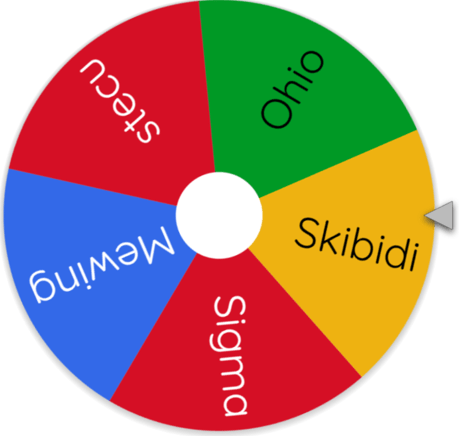
A total of $5$ words will be randomly selected using a name picker as shown in the image.
 If the experiment is conducted $30$ times, the expected frequency of selecting the word “Stecu” or “Mewing” is $\cdots$
A. $5$ C. $12$ E. $18$
B. $10$ D. $15$
Let $A$ be the event of selecting the word “Stecu” or “Mewing”. From the image, there are $5$ words in equally sized regions: Stecu, Ohio, Skibidi, Sigma, and Mewing. Since Stecu and Mewing occupy $2$ out of $5$ regions, the probability is $P(A) = \dfrac25.$ The experiment is conducted $n = 30$ times, so the expected frequency is
$$F_h = P(A) \times n = \dfrac{2}{\cancel{5}} \times \cancelto{6}{30} = 12~\text{times}.$$(Answer C)
Problem Number 14
A biased die is rolled repeatedly 90 times. If the probability of getting an even number is twice the probability of getting an odd number, the expected frequency of obtaining the number $5$ is $\cdots$
A. $5$ C. $15$ E. $30$
B. $10$ D. $20$
Let $x$ be the probability of getting an odd number. This means each of $1, 3,$ and $5$ has probability $x,$ while each of $2, 4,$ and $6$ has probability $2x.$ Since total probability is 1, we get
$$\begin{aligned} (x+x+x)+(2x+2x+2x) &= 1 \\ 9x &= 1 \\ x &= \dfrac19. \end{aligned}$$Thus, the probability of an odd number is $\dfrac19.$
Let $A$ be the event of obtaining the number $5$. Since $5$ is odd, $P(A) = \dfrac19.$ The experiment is conducted $n = 90$ times, so
$$F_h = P(A) \times n = \dfrac{1}{\cancel{9}} \times \cancelto{10}{90} = 10~\text{times}.$$(Answer B)
Read: Compound Events in Probability: Definitions, Formulas, and Solved Problems
Problem Number 15
Two dice are rolled repeatedly $x$ times. If the expected frequency of obtaining a sum of $8$ is $15$ times, the value of $x$ is $\cdots$
A. $72$ D. $120$
B. $90$ E. $150$
C. $108$
It is known that the number of sample space elements for rolling two dice is $\text{n}(S) = 6 \times 6 = 36.$ Meanwhile, the event of obtaining a sum of $8$ is $$A = \{(2, 6), (6, 2), (3, 5), (5, 3), (4, 4)\}$$so $\text{n}(A) = 5.$ Thus, $P(A) = \dfrac{5}{36}.$ Since the expected frequency is $15$, we get
$$\begin{aligned} F_h &= P(A) \times n \\ 15 &= \dfrac{5}{36} \times n \\ n &= \cancelto{3}{15} \times \dfrac{36}{\cancel{5}} = 108. \end{aligned}$$Thus, the value of $x$ is $\boxed{108}.$
(Answer C)
Problem Number 16
A die is rolled 50 times. The following table shows the results of the experiment.
$$\begin{array}{|c|c|c|c|c|c|c|} \hline \textbf{Die face} & 1 & 2 & 3 & 4 & 5 & 6 \\ \hline \textbf{Frequency} & 8 & 8 & 9 & 8 & 9 & 8 \\ \hline \end{array}$$The relative frequency of obtaining the number $4$ is $\cdots \cdot$
A. $\dfrac{8}{25}$ D. $\dfrac{4}{15}$
B. $\dfrac{4}{25}$ E. $\dfrac{2}{5}$
C. $\dfrac{8}{15}$
From the table, it is known that the number $4$ appears 8 times, so $n_0 = 8.$ The total number of trials is $n = 50.$ Therefore, the relative frequency of obtaining the number $4$ is
$$F_r = \dfrac{n_0}{n} = \dfrac{8}{50} = \dfrac{4}{25}.$$(Answer B)
Essay Section
Problem Number 1
Hompimpa is a method used to determine a winner in a game, usually played by children before starting a game. The word “hompimpa” is often spoken together with the phrase “alaium gambreng”, although other variations also exist. After saying it, each player shows one of two hand positions: palm facing down or up (sometimes referred to as black or white). A player is said to win if they show a hand position that is different from the other two players. Otherwise, the hompimpa must be repeated.
- At a certain moment, hompimpa is played by three people. What is the probability that the hompimpa must be repeated?
- Suppose hompimpa is played by three people for $80$ trials. Determine the expected frequency of the first person winning against the other two.
- Suppose hompimpa is played by three people for $80$ trials. Determine the expected frequency of the first person winning against the other two, given that the first and second players always choose the same hand position.
Solution a)
Let $A$ be the event that hompimpa is repeated. All possible outcomes when hompimpa is played by three people are shown in the following table. Note: $P$ denotes white, while $H$ denotes black.
$$\begin{array}{ccc} \hline \text{Person 1} & \text{Person 2} & \text{Person 3} \\ \hline P & P & P \\ P & P & H \\ P & H & P \\ P & H & H \\ H & P & P \\ H & P & H \\ H & H & P \\ H & H & H \\ \hline \end{array}$$From the table above, the sample space of the hompimpa experiment has $\text{n}(S) = 8$ outcomes. From these $8$ outcomes, there are $2$ cases in which hompimpa is repeated, namely $(P, P, P)$ and $(H, H, H).$ Thus, $\text{n}(A) = 2.$
Therefore, we obtain
$$P(A) = \dfrac{\text{n}(A)}{\text{n}(S)} = \dfrac{2}{8} = \dfrac14.$$Thus, the probability that hompimpa is repeated is $\dfrac14.$
Solution b)
Let $B$ be the event that the first person wins against the other two. From the $8$ outcomes in the table above, there are $2$ cases in which the first person wins, namely $(H, P, P)$ and $(P, H, H).$ Thus, $\text{n}(B) = 2.$
Therefore, we obtain
$$P(B) = \dfrac{\text{n}(B)}{\text{n}(S)} = \dfrac{2}{8} = \dfrac14.$$Since the experiment is conducted $n = 80$ times, the expected frequency of event $B$ is
$$F_h = P(B) \times n = \dfrac{1}{\cancel{4}} \times \cancelto{20}{80} = 20~\text{times}.$$Thus, the expected frequency of the first person winning is $20$ times.
Solution c)
Let $C$ be the event that the first person wins against the other two, given that the first and second players always choose the same hand position. Under this condition, the sample space is given by
$$S = \{(P, P, P), (H, P, P), (P, H, H), (H, H, H)\}$$so that $\text{n}(S) = 4.$ From these $4$ outcomes, the cases in which $C$ occurs are $(H, P, P)$ and $(P, H, H),$ so $\text{n}(C) = 2.$ Therefore, we obtain
$$P(C) = \dfrac{\text{n}(C)}{\text{n}(S)} = \dfrac{2}{4} = \dfrac12.$$Since the experiment is conducted $n = 80$ times, the expected frequency of event $C$ is
$$F_h = P(C) \times n = \dfrac{1}{\cancel{2}} \times \cancelto{40}{80} = 40~\text{times}.$$Thus, the expected frequency of the first person winning against the other two, given that the first and second players always choose the same hand position, is $40$ times.