

The Cauchy–Schwarz inequality is one of the most famous and most important inequalities in mathematics. In various fields such as linear algebra, mathematical analysis, statistics, physics, and even machine learning, the Cauchy–Schwarz Inequality serves as a fundamental tool in proving many theorems.
In simple terms, the Cauchy–Schwarz Inequality states that the inner product of two vectors cannot exceed the product of the lengths (or norms) of those vectors.
Read: QM-AM-GM-HM Inequality: Formulas, Proofs, and Solved Problems
The Cauchy–Schwarz inequality is also known by several other names:
- Inequality of Cauchy–Schwarz
- Cauchy–Bunyakovsky–Schwarz Inequality
In international mathematical literature, the term “Cauchy–Schwarz Inequality” is the most commonly used.
The statement of the Cauchy–Schwarz inequality is as follows.
Cauchy-Schwarz Inequality
Let $a_1, a_2, \cdots, a_n$ dan $b_1, b_2, \cdots, b_n$ be sequences of real numbers. Then, the following inequality holds:
$$(a_1^2 + a_2^2 + \cdots + a_n^2)(b_1^2 + b_2^2 + \cdots + b_n^2) \ge (a_1b_1 + a_2b_2 + \cdots + a_nb_n)^2.$$Alternatively, it can be written in sigma notation as follows.
$$\left(\displaystyle \sum_{k=1}^n a_k^2\right) \left(\displaystyle \sum_{k=1}^n b_k^2\right) \ge \left(\sum_{k=1}^n a_kb_k\right)^2.$$Equality holds if and only if $$\dfrac{a_1}{b_1} = \dfrac{a_2}{b_2} = \cdots = \dfrac{a_n}{b_n}$$or equivalently, it can also be expressed in the following proportional form: $$a_1 : a_2 : \cdots : a_n = b_1 : b_2 : \cdots : b_n.$$
Let $a_1, a_2, \cdots, a_n$ dan $b_1, b_2, \cdots, b_n$ be sequences of real numbers.
Define
$$f(x) = \displaystyle \sum_{k=1}^n (a_k-b_kx)^2.$$Expand, then simplify.
$$\begin{aligned} f(x) & = \displaystyle \sum_{k=1}^n \left((a_k)^2-2a_kb_kx + (b_kx)^2\right) \\ & = \displaystyle \sum_{k=1}^n \left((a_k)^2-2a_kb_kx + (b_k)^2x^2\right) \\ & = \displaystyle \sum_{k=1}^n (a_k)^2-2\left(\sum_{k=1}^n a_kb_k\right)x + \sum_{k=1}^n (b_k)^2x^2. \end{aligned}$$Observe that the final expression $f(x) = Ax^2 + Bx + C$ is a quadratic form with $A = \displaystyle \sum_{k=1}^n (b_k)^2,$ $B = \displaystyle -2\sum_{k=1}^n a_kb_k,$ dan $C = \displaystyle \sum_{k=1}^n (a_k)^2.$
Since $$f(x) = \displaystyle \sum_{k=1}^n (a_k-b_kx)^2,$$we must have $f(x) \ge 0$ (positive semidefinite). Therefore, its discriminant must satisfy $0.$
Hence, we obtain
$$\begin{aligned} D & \le 0 \\ B^2-4AC & \le 0 \\ \left(-2\displaystyle \sum_{k=1}^n a_kb_k\right)^2-4\left(\displaystyle \sum_{k=1}^n (b_k)^2\right)\left(\displaystyle \sum_{k=1}^n (a_k)^2\right) & \le 0 \\ \cancel{4}\left(\displaystyle \sum_{k=1}^n a_kb_k\right)^2 & \le \cancel{4}\left(\displaystyle \sum_{k=1}^n (b_k)^2\right)\left(\displaystyle \sum_{k=1}^n (a_k)^2\right) \\ \left(\displaystyle \sum_{k=1}^n a_kb_k\right)^2 & \le \left(\displaystyle \sum_{k=1}^n (b_k)^2\right)\left(\displaystyle \sum_{k=1}^n (a_k)^2\right). \end{aligned}$$Equality holds when $\dfrac{a_k}{b_k} = \alpha$ for some real number $\alpha \neq 0$ where $k = 1, 2, \cdots, n.$
Therefore, the Cauchy–Schwarz inequality is proven to hold. $\blacksquare$
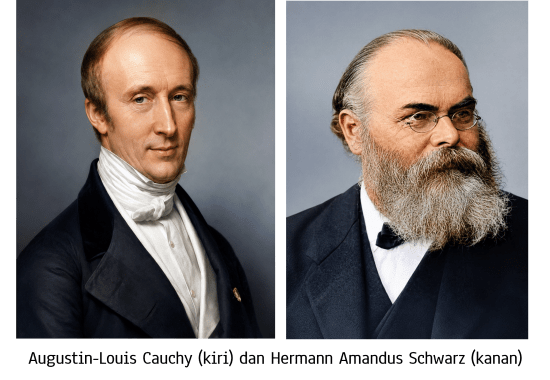
The first mathematician who introduced the early form of the Cauchy–Schwarz inequality was Augustin-Louis Cauchy. He was a French mathematician who lived from 1789 to 1857. Cauchy introduced this inequality in 1821 through his studies in mathematical analysis and series. For this reason, the name “Cauchy” was attached to the Cauchy–Schwarz inequality.
Several decades after Cauchy, the German mathematician Hermann Amandus Schwarz refined and popularized the general form of the Cauchy–Schwarz inequality. Schwarz lived from 1843 to 1921 and worked extensively in the field of complex analysis. Because of his major contribution to the modern form of this inequality, the name “Schwarz” was also included, leading to the well-known name “Cauchy–Schwarz inequality.”
In several Russian mathematics textbooks, the Cauchy–Schwarz Inequality is also referred to as the “Cauchy–Bunyakovsky–Schwarz Inequality.” This name comes from Viktor Bunyakovsky, who developed a more general version of the inequality in 1859. Therefore, the Cauchy–Schwarz Inequality is actually the result of contributions from several great mathematicians.
In mathematical olympiads, the Cauchy–Schwarz Inequality is often used to:
- find minimum values
- find maximum values
- prove inequalities
- solve algebraic optimization problems
Because of its remarkable power and versatility, olympiad students are usually expected to master the Cauchy–Schwarz inequality.
Read Indonesian Version: Materi, Soal, dan Pembahasan – Ketaksamaan Cauchy-Schwarz
@shanedizzysukardi Di balik artikel web mathcyber1997.com yang tampak rapi, ada perjuangan, rasa pegal, dan jenuh yang menghantui di balik layar 🫠 #mathcyber #matematika #webmatematika #cauchy #aljabar ♬ The Winner Is… Version – DeVotchKa
Today Quote
Essay Format
For every positive real numbers $a, b,$ and $c,$ prove that
$$(a+b+c)\left(\dfrac{1}{a} + \dfrac{1}{b} + \dfrac{1}{c}\right) \ge 9.$$
Observe that
$$(a+b+c)\left(\dfrac{1}{a} + \dfrac{1}{b} + \dfrac{1}{c}\right)$$can be written in a form involving squares, namely
$$\left[(\sqrt{a})^2 + (\sqrt{b})^2 + (\sqrt{c})^2\right] \left[ \left(\dfrac{1}{\sqrt{a}}\right)^2 + \left(\dfrac{1}{\sqrt{b}}\right)^2 + \left(\dfrac{1}{\sqrt{c}}\right)^2\right].$$Then, by using the Cauchy-Schwarz inequality, we obtain
$$\begin{aligned} \left[(\sqrt{a})^2 + (\sqrt{b})^2 + (\sqrt{c})^2\right] \left[ \left(\dfrac{1}{\sqrt{a}}\right)^2 + \left(\dfrac{1}{\sqrt{b}}\right)^2 + \left(\dfrac{1}{\sqrt{c}}\right)^2\right] & \ge \left(\sqrt{a} \cdot \dfrac{1}{\sqrt{a}} + \sqrt{b} \cdot \dfrac{1}{\sqrt{b}} + \sqrt{c} \cdot \dfrac{1}{\sqrt{c}}\right)^2 \\ & \ge (1 + 1 + 1)^2 \\ & \ge 3^2 \\ & \ge 9. \end{aligned}$$Therefore, it is proven that
$$(a+b+c)\left(\dfrac{1}{a} + \dfrac{1}{b} + \dfrac{1}{c}\right) \ge 9.$$ $\blacksquare$
Nesbitt’s inequality, named after Alfred Nesbitt, states that for all positive real numbers $a, b,$ and $c,$ the following inequality holds
$$\dfrac{a}{b+c} + \dfrac{b}{a+c} + \dfrac{c}{a+b} \ge \dfrac32$$or, in cyclic sum notation,
$$\displaystyle \sum_{\text{cyc}} \dfrac{a}{b+c} \ge \dfrac32.$$Equality holds when $a = b = c.$
Using the Cauchy-Schwarz inequality, prove Nesbitt’s inequality above.
Take arbitrary positive real numbers $a, b,$ and $c.$
Apply the Cauchy-Schwarz inequality with the following configuration.
$$\begin{array}{c|c|} a_1 = \sqrt{a+b} & b_1 = \dfrac{1}{\sqrt{a+b}} \\ a_2 = \sqrt{a+c} & b_2 = \dfrac{1}{\sqrt{a+c}} \\ a_3 = \sqrt{b+c} & b_3 = \dfrac{1}{\sqrt{b+c}} \\ \end{array}$$Thus, we obtain
$$\begin{aligned} (a_1^2 + a_2^2 + a_3^2)(b_1^2 + b_2^2 + b_3^2) & \ge (a_1b_1 + a_2b_2 + a_3b_3)^2 \\ \left((a+b) + (a+c) + (b+c)\right) \left(\dfrac{1}{a+b} + \dfrac{1}{a+c} + \dfrac{1}{b+c}\right) & \ge (1 + 1 + 1)^2 \\ 2(a+b+c)\left(\dfrac{1}{a+b} + \dfrac{1}{a+c} + \dfrac{1}{b+c}\right) & \ge 9 \\ \dfrac{a+b+c}{b+c} + \dfrac{a+b+c}{a+c} + \dfrac{a+b+c}{a+b} & \ge \dfrac92 \\ \dfrac{a}{b+c} + \dfrac{b}{a+c} + \dfrac{c}{a+b} & \ge \dfrac92-3 = \dfrac32. \end{aligned}$$Therefore, it is proven that for all positive real numbers $a, b,$ and $c,$
$$\dfrac{a}{b+c} + \dfrac{b}{a+c} + \dfrac{c}{a+b} \ge \dfrac32.$$ $\blacksquare$
Given $x + 2y = 4.$ Find the maximum value of $\sqrt{x} + \sqrt{y}.$
Choose $a_1 = \sqrt{x},$ $a_2 = \sqrt{2y},$ $b_1 = 1$ and $b_2 = \dfrac{1}{\sqrt2}.$
Using the Cauchy-Schwarz inequality, we obtain
$$\begin{aligned} \left[\left(\sqrt{x}\right)^2 + \left(\sqrt{2y}\right)^2\right] \left[\left(1\right)^2 + \left(\dfrac{1}{\sqrt{2}}\right)^2\right] & \ge \left[(\sqrt{x})(1) + (\sqrt{2y})\left(\dfrac{1}{\sqrt2}\right)\right]^2 \\ (x + 2y)\left(1 + \dfrac12\right) & \ge \left(\sqrt{x} + \sqrt{y}\right)^2 \\ 4 \cdot \dfrac32 & \ge \left(\sqrt{x} + \sqrt{y}\right)^2 \\ \left(\sqrt{x} + \sqrt{y}\right)^2 & \le 6. \end{aligned}$$Since $\sqrt{x} + \sqrt{y}$ cannot be negative, we must have $0 \le \sqrt{x} + \sqrt{y} \le \sqrt{6}.$
Therefore, the maximum value of $\sqrt{x} + \sqrt{y}$ is $\boxed{\sqrt{6}}.$
Determine the maximum value of $x + 2y + 3z$ subject to $x^2 + y^2 + z^2 = 1$ for all real numbers $x, y,$ and $z.$ Also determine the values of $x, y,$ and $z$ for which the maximum value is attained.
Suppose that $x, y,$ and $z$ are real numbers satisfying $x^2 + y^2 + z^2 = 1.$ Using the Cauchy-Schwarz inequality, we obtain
$$\begin{aligned} (1x + 2y + 3z)^2 & \le (1^2 + 2^2 + 3^2)(x^2 + y^2 + z^2) \\ (1x + 2y + 3z)^2 & \le (1 + 4 + 9)(1) \\ (1x + 2y + 3z)^2 & \le 14. \end{aligned}$$From the last inequality, we obtain
$$-\sqrt{14} \le x + 2y + 3z \le \sqrt{14}.$$This means that $\sqrt{14}$ is the maximum value of $x + 2y + 3z.$
This maximum value is attained when the following ratio holds.
$$x : y : z = 1 : 2 : 3.$$This means that $y = 2x$ and $z = 3x.$ Since $x^2 + y^2 + z^2 = 1,$ substitution yields
$$\begin{aligned} x^2 + (2x)^2 + (3x)^2 & = 1 \\ x^2 + 4x^2 + 9x^2 & = 1 \\ 14x^2 & = 1 \\ x^2 & = \dfrac{1}{14} \\ x & = \dfrac{1}{\sqrt{14}}. \end{aligned}$$Consequently, $y = \dfrac{2}{\sqrt{14}}$ and $z = \dfrac{3}{\sqrt{14}}.$
Therefore, the maximum value is attained when $x = \dfrac{1}{\sqrt{14}},$ $y = \dfrac{2}{\sqrt{14}},$ and $z = \dfrac{3}{\sqrt{14}}.$
Determine the maximum value of $\sqrt{x} + \sqrt{3x-2} + \sqrt{5-4x}$ for every real number $x.$ Also determine the value of $x$ for which the maximum value is attained.
Using the Cauchy-Schwarz inequality, we obtain
$$\begin{aligned} \left(1\sqrt{x} + 1\sqrt{3x-2} + 1\sqrt{5-4x}\right)^2 & \le (1^2 + 1^2 + 1^2)((\sqrt{x})^2 + (\sqrt{3x-2})^2 + (\sqrt{5-4x})^2 \\ \left(1\sqrt{x} + 1\sqrt{3x-2} + 1\sqrt{5-4x}\right)^2 & \le (3)(x + (3x-2) + (5-4x)) \\ \left(1\sqrt{x} + 1\sqrt{3x-2} + 1\sqrt{5-4x}\right)^2 & \le (3)(3) \\ \left(1\sqrt{x} + 1\sqrt{3x-2} + 1\sqrt{5-4x}\right)^2 & \le 9. \end{aligned}$$Since $\sqrt{x} + \sqrt{3x-2} + \sqrt{5-4x}$ cannot be negative, the last inequality implies
$$\sqrt{x} +\sqrt{3x-2} + \sqrt{5-4x} \le 3.$$Therefore, the maximum value of the expression is $3.$
This maximum value is attained when the following ratio holds.
$$\sqrt{x} : \sqrt{3x-2} : \sqrt{5-4x} = 1 : 1 : 1.$$This means that we obtain
$$\begin{aligned} \sqrt{x} & = \sqrt{3x-2} \\ x & = 3x-2 \\ x & = 1. \end{aligned}$$Therefore, the maximum value is attained when $x = 1.$
Suppose that $x$ and $y$ are real numbers such that $x\sqrt{1-y^2} + y\sqrt{1-x^2} = 1.$ Prove that $x^2 + y^2 = 1.$
By using the Cauchy-Schwarz inequality (choose $a_1 = x,$ $a_2 = \sqrt{1-x^2},$ $b_1 = \sqrt{1-y^2},$ and $b_2 = y$), we obtain
$$\begin{aligned} \left(x\sqrt{1-y^2} + y\sqrt{1-x^2}\right)^2 & \le \left[x^2 + \left(\sqrt{1-x^2}\right)^2\right] \left[y^2 + \left(\sqrt{1-y^2}\right)^2\right] \\ & \le \left[x^2 + (1-x^2)\right] \left[y^2 + (1-y^2)\right] \\ & \le 1. \end{aligned}$$Equality holds if and only if
$$\dfrac{x}{\sqrt{1-y^2}} = \dfrac{\sqrt{1-x^2}}{y}.$$From here, we obtain
$$\begin{aligned} xy & = (\sqrt{1-y^2})(\sqrt{1-x^2}) \\ x^2y^2 & = (1-y^2)(1-x^2) \\ x^2y^2 & = x^2y^2-x^2-y^2+1 \\ x^2+y^2 & = 1. \end{aligned}$$Therefore, it is proven that $x^2 + y^2 = 1.$ $\blacksquare$
Observe the following right triangle.
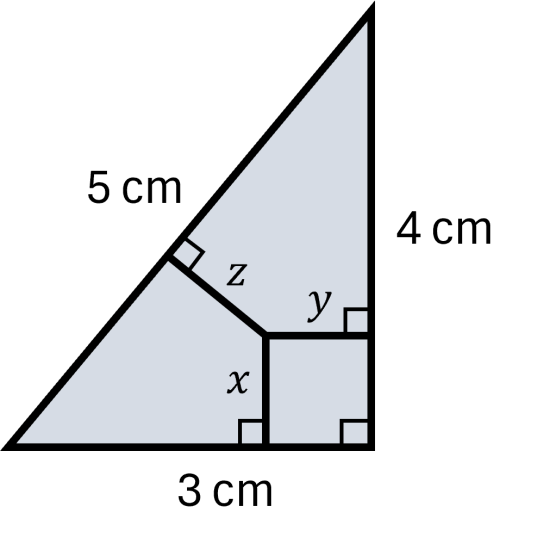 Determine the minimum value of $x^2 + y^2 + z^2$ along with the values of $x, y,$ and $z$ that make the minimum value attained.
Draw auxiliary lines as shown in the following figure so that the large right triangle can be partitioned into three smaller right triangles.
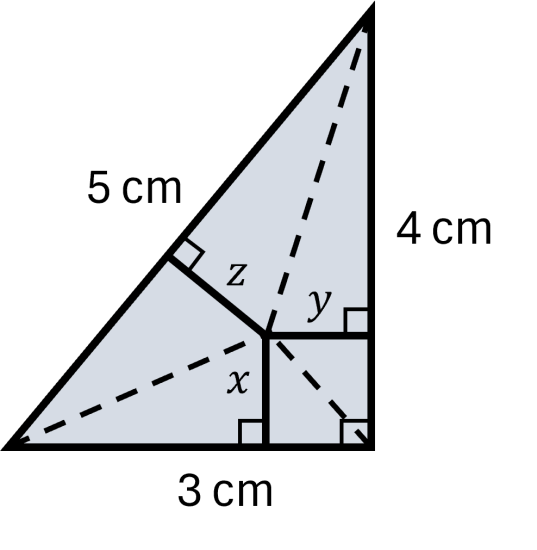 Thus, the area of the large right triangle can be expressed as follows.
$$\begin{aligned} L & = \dfrac12(3)(4) \\ \dfrac12(3)(x) + \dfrac12(4)(y) + \dfrac12(5)(z) & = \dfrac12(3)(4) \\ 3x + 4y + 5z & = 12. && (\text{Both sides are multiplied by 2}) \end{aligned}$$Apply the Cauchy-Schwarz inequality with the following configuration.
$$\begin{array}{c|c} a_1 = x & b_1 = 3 \\ a_2 = y & b_2 = 4 \\ a_3 = z & b_3 = 5 \\ \end{array}$$Thus, we obtain
$$\begin{aligned} (x^2 + y^2 + z^2)(3^2 + 4^2 + 5^2) & \ge (3x + 4y + 5z)^2 \\ (x^2 + y^2 + z^2)(50) & \ge (12)^2 \\ x^2 + y^2 + z^2 & \ge \dfrac{144}{50} = \dfrac{72}{25}. \end{aligned}$$Therefore, the minimum value of $x^2+y^2+z^2$ is $\dfrac{72}{25}.$
Equality holds when $x : y : z = 3 : 4 : 5.$ This ratio shows that $y = \dfrac43x$ and $z = \dfrac53x$ so that substitution into the equation $3x + 4y + 5z = 12$ will produce
$$\begin{aligned} 3x + 4\left(\dfrac43x\right) + 5\left(\dfrac53x\right) & = 12 \\ 3x + \dfrac{16}{3}x + \dfrac{25}{3}x & = 12 \\ \dfrac{50}{3}x & = 12 \\ x & = \dfrac{18}{25}. \end{aligned}$$Consequently, $y = \dfrac{24}{25}$ and $z = \dfrac65.$
Therefore, the values $x = \dfrac{18}{25},$ $y = \dfrac{24}{25},$ and $z = \dfrac65$ will make the minimum value attained.
Suppose that $a, b,$ and $c$ are positive real numbers such that $abc = 1.$ Prove that
$$\dfrac{1}{a^3(b+c)} + \dfrac{1}{b^3(a+c)} + \dfrac{1}{c^3(a+b)} \ge \dfrac32.$$
Suppose that $x = ab,$ $y = bc,$ and $z = ac.$ This means that $x, y,$ and $z$ are positive real numbers such that
$$xyz = (ab)(bc)(ac) = (abc)^2 = (1)^2 = 1.$$The left-hand side of the inequality above can be written as
$$\begin{aligned} \dfrac{1}{a^3(b+c)} + \dfrac{1}{b^3(a+c)} + \dfrac{1}{c^3(a+b)} & =\dfrac{1}{a^2(ab+ac)} + \dfrac{1}{b^2(ab+bc)} + \dfrac{1}{c^2(ac+bc)} \\ & = \dfrac{bc}{(ab)(ca)(ab+ac)}+ \dfrac{ac}{(ab)(bc)(ab+bc)} + \dfrac{ab}{(ac)(bc)(ac+bc)} \\ & = \dfrac{y}{xz(x+z)} + \dfrac{z}{xy(x+y)} + \dfrac{x}{yz(y+z)} \\ & = \dfrac{y^2}{xyz(x+z)} + \dfrac{z^2}{xyz(x+y)} + \dfrac{x^2}{xyz(y+z)} \\ & = \dfrac{x^2}{y+z} + \dfrac{y^2}{x+z} + \dfrac{z^2}{x+y}. \end{aligned}$$Apply the Cauchy-Schwarz inequality with the following configuration.
$$\begin{array}{c|c} a_1 = \dfrac{x}{\sqrt{y+z}} & b_1 = \sqrt{y+z} \\ a_2 = \dfrac{y}{\sqrt{x+z}} & b_2 = \sqrt{x+z} \\ a_3 = \dfrac{z}{\sqrt{x+y}} & b_3 = \sqrt{x+y} \\ \end{array}$$Thus, we obtain$$\begin{aligned} (a_1^2 + a_2^2 + a_3^2)(b_1^2 + b_2^2 + b_3^2) & \ge (a_1b_1 + a_2b_2 + a_3b_3)^2 \\ \left( \dfrac{x^2}{y+z} + \dfrac{y^2}{x+z} + \dfrac{z^2}{x+y}\right) \left((y+z) + (x+z) + (x+y)\right) & \ge (x + y + z)^2 \\ \left( \dfrac{x^2}{y+z} + \dfrac{y^2}{x+z} + \dfrac{z^2}{x+y}\right) \cdot 2\left(x+y+z)\right) & \ge (x + y + z)^2 \\ \left(\dfrac{x^2}{y+z} + \dfrac{y^2}{x+z} + \dfrac{z^2}{x+y}\right) & \ge \dfrac{(x+y+z)^2}{2(x+y+z)} = \dfrac{x+y+z}{2}. \end{aligned}$$Then, by using the AM-GM inequality, we obtain
$$\left( \dfrac{x^2}{y+z} + \dfrac{y^2}{x+z} + \dfrac{z^2}{x+y}\right) \ge \dfrac32\left(\dfrac{x+y+z}{3}\right) \ge \dfrac32(xyz)^{1/3} = \dfrac32(1)^{1/3} = \dfrac32.$$Therefore, it is proven that
$$\dfrac{1}{a^3(b+c)} + \dfrac{1}{b^3(a+c)} + \dfrac{1}{c^3(a+b)} \ge \dfrac32.$$ $\blacksquare$