The area of a triangle can actually be determined using trigonometry, namely based on the measure of an angle and the lengths of the two sides enclosing it.
Triangle Area Rule in Trigonometry
Consider the following triangle $ABC$.
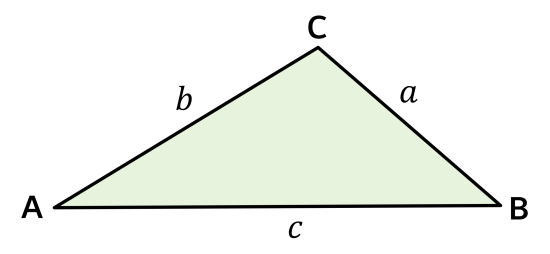
Thus, the area of $\triangle ABC$ can be calculated using the following formula if the lengths of two sides of the triangle and the measure of the included angle are known.
$$\begin{aligned} A_{\triangle ABC} & = \dfrac12 ab \sin C \\ A_{\triangle ABC} & = \dfrac12 bc \sin A \\ A_{\triangle ABC} & = \dfrac12 ac \sin B \end{aligned}$$If only the length of one side and the measures of the three angles are known, the area of the triangle can be calculated using the following formula.
$$\begin{aligned} A_{\triangle ABC} & = \dfrac{a^2 \sin B \sin C}{2 \sin A} \\ A_{\triangle ABC} & = \dfrac{b^2 \sin A \sin C}{2 \sin B} \\ A_{\triangle ABC} & = \dfrac{c^2 \sin A \sin B}{2 \sin C} \end{aligned}$$
A formal proof of the triangle area formula in trigonometry can be seen in the following panel.
Construct triangle $ABC$ as follows.
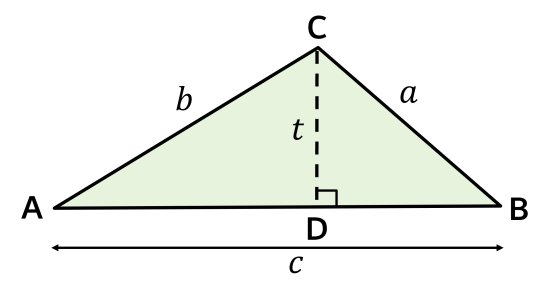 Draw the altitude of triangle $ABC$ from $C$ to side $AB$ so that line $CD$ is formed.
In right triangle $ACD,$ we have
$$\sin A = \dfrac{t}{b} \Rightarrow t = b \sin A.$$Thus, we obtain
$$\begin{aligned} A_{\Delta ABC} & = \dfrac12 \cdot \text{base} \cdot \text{height} \\ & = \dfrac12 \cdot c \cdot b \sin A \\ & = \dfrac12bc \sin A. \end{aligned}$$By using the other altitudes and a similar process, we obtain the following three symmetric formulas.
$$\boxed{\begin{aligned} A_{\triangle ABC} & = \dfrac12bc \sin A \\ A_{\triangle ABC} & = \dfrac12ac \sin B \\ A_{\triangle ABC} & = \dfrac12ab \sin C \end{aligned}}$$
In triangle $ABC,$ the law of sines holds, namely
$$\dfrac{a}{\sin A} = \dfrac{b}{\sin B} = \dfrac{c}{\sin C}.$$From this form, we obtain $a = \dfrac{b \sin A}{\sin B}.$
Substitute it into the formula $A_{\Delta ABC} = \dfrac12ab \sin C$ so that we get
$$\begin{aligned} A_{\Delta ABC} & = \dfrac12 \cdot \dfrac{b \sin A}{\sin B} \cdot b \sin C \\ & = \dfrac{b^2 \sin A \sin C}{2 \sin B}. \end{aligned}$$Using a similar process, we obtain the following three symmetric formulas.
$$\boxed{\begin{aligned} A_{\triangle ABC} & = \dfrac{a^2 \sin B \sin C}{2 \sin A} \\ & = \dfrac{b^2 \sin A \sin C}{2 \sin B} \\ & = \dfrac{c^2 \sin A \sin B}{2 \sin C} \end{aligned}}$$Thus, the triangle area formula in trigonometry is proven. $\blacksquare$
To gain a deeper understanding of this topic, several problems and their solutions are provided below. Hopefully, they will be useful.
Read: Basic Trigonometry Problems and Step-by-Step Answers
Multiple Choice Section
Consider the following triangle $KLM$.
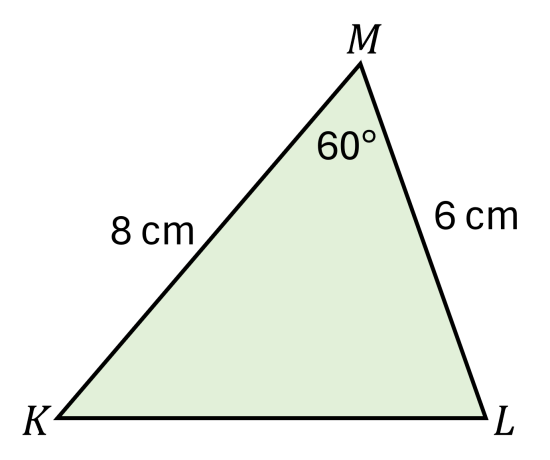 The area of the triangle is $\cdots~\text{cm}^2.$
A. $12$ D. $24\sqrt3$
B. $6\sqrt3$ E. $48\sqrt3$
C. $12\sqrt3$
From the figure, the following information is known.
- $KM = 8$ cm.
- $LM = 6$ cm.
- $\angle M = 60^\circ.$
Using the triangle area formula in trigonometry viewed from $\angle M,$ we obtain
$$\begin{aligned} A_{\Delta KLM} & = \dfrac12 \cdot KM \cdot LM \cdot \sin M \\ & = \dfrac12 \cdot 8 \cdot 6 \cdot \sin 60^\circ \\ & = \dfrac{1}{\cancel{2}} \cdot \cancelto{4}{8} \cdot \cancelto{3}{6} \cdot \dfrac{1}{\cancel{2}}\sqrt3 \\ & = 12\sqrt3~\text{cm}^2. \end{aligned}$$Therefore, the area of triangle $KLM$ is $\boxed{12\sqrt3~\text{cm}^2}.$
(Answer C)
Read: Special Angle Trigonometry Problems with Detailed Explanations
In triangle $ABC,$ the side lengths are $a = 16$ cm and $b = 10$ cm, and the area of the triangle is $40~\text{cm}^2.$ If $\Delta ABC$ is acute, the angle formed between sides $a$ and $b$ is $\cdots \cdot$
A. $30^\circ$ D. $75^\circ$
B. $45^\circ$ E. $90^\circ$
C. $60^\circ$
The following information is known.
- $a = 16$ cm.
- $b = 10$ cm.
- $\Delta ABC$ is acute.
- $A_{\Delta ABC} = 40~\text{cm}^2.$
The angle formed between sides $a$ and $b$ is angle $C.$ Using the triangle area formula in trigonometry viewed from $\angle C,$ we obtain
$$\begin{aligned} A_{\Delta ABC} & = \dfrac12 \cdot a \cdot b \cdot \sin C \\ 40 & = \dfrac{1}{\cancel{2}} \cdot \cancelto{8}{16} \cdot 10 \cdot \sin C \\ 40 & = 80 \sin C \\ \sin C & = \dfrac{40}{80} = \dfrac12. \end{aligned}$$This means that there are two possible values for angle $C,$ namely $\angle C = 30^\circ$ or $\angle C = 150^\circ.$ However, since $\Delta ABC$ is acute, $\angle C = 150^\circ$ is impossible.
Therefore, the angle formed between sides $a$ and $b$ is $\boxed{30^\circ}.$
(Answer A)
Acute triangle $ABC$ has an area of $40\sqrt3~\text{cm}^2.$ If the side lengths are $BC = 16$ cm and $AC = 10$ cm, the length of side $AB$ is $\cdots$ cm.
A. $8$ D. $14$
B. $10$ E. $15$
C. $12$
The following information is known.
- $\Delta ABC$ is acute.
- $A_{\Delta ABC} = 40\sqrt3~\text{cm}^2.$
- $BC = 16$ cm.
- $AC = 10$ cm.
First, we will determine the measure of $\angle C$ using the triangle area formula in trigonometry.
$$\begin{aligned} A_{\Delta ABC} & = \dfrac12 \cdot BC \cdot AC \cdot \sin C \\ 40\sqrt3 & = \dfrac{1}{\cancel{2}} \cdot \cancelto{8}{16} \cdot 10 \cdot \sin C \\ 40\sqrt3 & = 80 \sin C \\ \sin C & = \dfrac{40\sqrt3}{80} = \dfrac12\sqrt3 \end{aligned}$$Since $\sin C = \dfrac12\sqrt3,$ we obtain $\angle C = 60^\circ$ or $120^\circ.$ However, because $\Delta ABC$ is acute, $\angle C$ must be $60^\circ.$
Next, we will use the law of cosines (viewed from $\angle C$) to find the opposite side, namely side $AB.$
$$\begin{aligned} AB^2 & = BC^2 + AC^2-2 \cdot BC \cdot AC \cdot \cos C \\ & = 16^2 + 10^2-2 \cdot 16 \cdot 10 \cdot \cos 60^\circ \\ & = 16^2 + 10^2-\cancel{2} \cdot 16 \cdot 10 \cdot \dfrac{1}{\cancel{2}} \\ & = 256 + 100-160 \\ & = 196 \\ AB & = \sqrt{196} = 14~\text{cm} \end{aligned}$$Therefore, the length of side $AB$ is $\boxed{14~\text{cm}}.$
(Answer D)
Read: Applications of Trigonometric Identities – Formulas, Problems, and Step-by-Step Solutions
In parallelogram $ABCD,$ it is known that $AB = 5$ cm, $BC = 4$ cm, and $\angle ABC = 120^\circ.$ The area of the parallelogram is $\cdots~\text{cm}^2.$
A. $5\sqrt2$ D. $10\sqrt2$
B. $5\sqrt3$ E. $10\sqrt3$
C. $10$
The following information is known.
- $ABCD$ is a parallelogram.
- $AB = 5$ cm.
- $BC = 4$ cm.
- $\angle ABC = 120^\circ.$
Draw the parallelogram $ABCD$ as follows.
 First, find the area of $\Delta ABC$ using the triangle area formula in trigonometry viewed from $\angle B.$
$$\begin{aligned} A_{\Delta ABC} & = \dfrac12 \cdot AB \cdot BC \cdot \sin \angle ABC \\ & = \dfrac12 \cdot 5 \cdot 4 \cdot \sin 120^\circ \\ & = \dfrac{1}{\cancel{2}} \cdot 5 \cdot \cancel{4} \cdot \dfrac{1}{\cancel{2}}\sqrt3 \\ & = 5\sqrt3~\text{cm}^2. \end{aligned}$$Since $\Delta ADC$ is congruent to $\Delta ABC$ (based on the properties of a parallelogram), we must have $A_{\Delta ADC} = 5\sqrt3~\text{cm}^2.$ Consequently, the area of parallelogram $ABCD,$ which is the sum of the areas of the two triangles, is $5\sqrt3 + 5\sqrt3 = 10\sqrt3~\text{cm}^2.$
Therefore, the area of the parallelogram is $\boxed{10\sqrt3~\text{cm}^2}.$
(Answer E)
The area of quadrilateral $ABCD$ in the figure below is $\cdots~\text{cm}^2.$
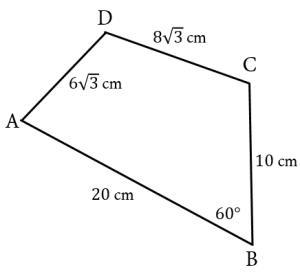 A. $(72 + 50\sqrt3)$
B. $(72 + 25\sqrt3)$
C. $74$
D. $(36 + 50\sqrt3)$
E. $(36 + 25\sqrt3)$
Consider again the following quadrilateral $ABCD.$
 The area of quadrilateral $ABCD$ is equal to the sum of the areas of triangles $ABC$ and $ACD.$
The area of triangle $ABC$ can be determined directly using the triangle area formula in trigonometry.
$$\begin{aligned} A_{\triangle ABC} & = \dfrac12 \cdot AB \cdot BC \cdot \sin 60^{\circ} \\ & = \dfrac{1}{\cancel{2}} \cdot \cancelto{5}{20} \cdot 10 \cdot \dfrac{1}{\cancel{2}}\sqrt3 \\ & = 50\sqrt3~\text{cm}^2 \end{aligned}$$In triangle $ABC,$ the length of $AC$ can be found using the law of cosines.
$$\begin{aligned} AC^2 & = AB^2+BC^2-2 \cdot AB \cdot BC \cos 60^{\circ} \\ AC^2 & = 20^2+10^2-2 \cdot 20 \cdot 10 \cdot \dfrac12 \\ AC^2 & = 400+100-200 \\ AC^2 & = 300 \\ AC & = \sqrt{300} = 10\sqrt3~\text{cm} \end{aligned}$$The area of triangle $ACD$ can be determined using Heron’s formula because all three side lengths are known.
The semiperimeter of the triangle is
$$\begin{aligned} S & = \dfrac{AD+CD+AC}{2} \\ & = \dfrac{6\sqrt3+8\sqrt3+10\sqrt3}{2} = 12\sqrt3. \end{aligned}$$Thus, we obtain
$$\begin{aligned} A_{\triangle ACD} & = \sqrt{S(S-AD)(S-CD)(S-AC)} \\ & = \sqrt{12\sqrt3(6\sqrt3)(4\sqrt3)(2\sqrt3)} \\ & = \sqrt{(12 \cdot 6 \cdot 4 \cdot 2) \cdot (\sqrt3)^4} \\ & = \sqrt{(2^2 \cdot 3 \cdot 2 \cdot 3 \cdot 2^2 \cdot 2 \cdot 3^2} \\ & = \sqrt{2^6 \cdot 3^4} \\ & = 2^3 \cdot 3^2 = 8 \cdot 9 = 72~\text{cm}^2. \end{aligned}$$Therefore, we obtain that the area of quadrilateral $ABCD$ is $$\boxed{A_{\triangle ACD} + A_{\triangle ABC} = (72 + 50\sqrt3)~\text{cm}^2}.$$(Answer A)
Read: Proofs of Trigonometric Identities: Formulas, Methods, and Solved Problems
The perimeter of a regular hexagon is $84~\text{cm}.$ The area of the hexagon is $\cdots~\text{cm}^2.$
A. $588\sqrt3$ D. $245\sqrt3$
B. $392\sqrt3$ E. $147\sqrt3$
C. $294\sqrt3$
There are two ways to determine the area of the hexagon, namely using the Pythagorean theorem and the triangle area formula in trigonometry.
Method 1: Pythagorean Theorem
Consider the following sketch.
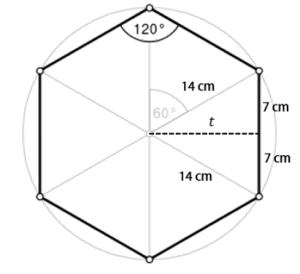 Since the perimeter of the regular hexagon is $84~\text{cm},$ the side length is $84 \div 6 = 14~\text{cm}.$
Draw an altitude from the center of the hexagon to one of its sides.
Suppose the length of this altitude is $t.$ Using the Pythagorean theorem, we obtain
$\begin{aligned} t & = \sqrt{14^2-7^2} \\ & = \sqrt{196-49} = \sqrt{147} = 7\sqrt3~\text{cm}. \end{aligned}$
Thus, the area of the hexagon can be determined, since its area is 6 times the area of one of the composing triangles.
$\begin{aligned} A_{\text{hexagon}} & = 6 \times A_{\triangle} \\ & = 6 \times \dfrac12 \times 14 \times 7\sqrt3 \\ & = 294\sqrt3~\text{cm}^2 \end{aligned}$
Therefore, the area of the hexagon is $\boxed{294\sqrt3~\text{cm}^2}.$
Method 2: Triangle Area Formula in Trigonometry
Consider the following sketch.
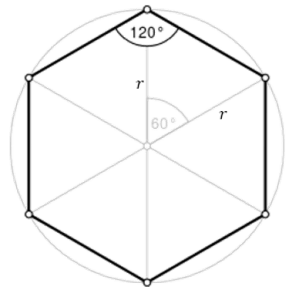 The length of $r = 84 \div 6 = 14~\text{cm}$ and $n = 6$ (because it is a hexagon). The area of the hexagon is
$\begin{aligned} A_{\text{hexagon}} & = n \left(\dfrac12r^2 \sin \dfrac{360^{\circ}}{n}\right) \\ & = \cancelto{3}{6}\left(\dfrac{1}{\cancel{2}}(14)^2 \sin \dfrac{360^{\circ}}{6}\right) \\ & = 3(196)\left(\dfrac12\sqrt3\right) \\ & = 294\sqrt3~\text{cm}^2. \end{aligned}$
(Answer C)
The area of a regular $12$-gon with each side length equal to $4~\text{cm}$ is $\cdots~\text{cm}^2.$
A. $(96+48\sqrt3)$
B. $(24+12\sqrt3)$
C. $(24\sqrt3+12)$
D. $(96\sqrt3+48)$
E. $(96\sqrt3+12)$
Observe the following regular $12$-gon and its partition into congruent isosceles triangles.
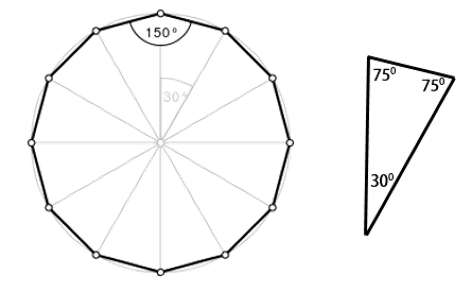 The measure of angle $BAC$ is $\dfrac{360^{\circ}}{12} = 30^{\circ}$ so each base angle is $\dfrac{180^{\circ}-30^{\circ}}{2} = 75^{\circ}.$ By using the law of sines, we obtain
$$\begin{aligned} \dfrac{x}{\sin 75^{\circ}} & = \dfrac{4}{\sin 30^{\circ}} \\ \dfrac{x}{\sin (45+30)^{\circ}} & = \dfrac{4}{\frac12} \\ \dfrac{x}{\sin 45^{\circ} \cos 30^{\circ} + \cos 45^{\circ} \sin 30^{\circ}} & = 8. \end{aligned}$$Next, we get
$$\begin{aligned} x & = 8(\sin 45^{\circ} \cos 30^{\circ} + \cos 45^{\circ} \sin 30^{\circ}) \\ x & = 8\left(\dfrac12\sqrt2 \cdot \dfrac12\sqrt3 + \dfrac12\sqrt2 \cdot \dfrac12\right) \\ x & = 8\left(\dfrac14\sqrt6 + \dfrac14\sqrt2\right) \\ x & = 2\sqrt6 + 2\sqrt2 = [2(\sqrt6+\sqrt2)]~\text{cm}. \end{aligned}$$The area of triangle $ABC$ in the figure above is
$$\begin{aligned} A_{\triangle ABC} & = \dfrac12 \cdot x \cdot x \cdot \sin 30^{\circ} \\ & = \dfrac12 \cdot 4(\sqrt6+\sqrt2)^2 \cdot \dfrac12 \\ & = (\sqrt6 + \sqrt2)^2 \\ & = 8 + 2\sqrt12 = (8 + 4\sqrt3)~\text{cm}^2. \end{aligned}$$Twelve congruent triangles like triangle $ABC$ have a total area equal to the area of the regular $12$-gon, namely
$$\begin{aligned} L & = 12 \cdot A_{\triangle ABC} \\ & = 12 \cdot (8+4\sqrt3) \\ & = (96+48\sqrt3)~\text{cm}^2. \end{aligned}$$Therefore, the area of the regular $12$-gon is $\boxed{(96+48\sqrt3)~\text{cm}^2}.$
(Answer A)
Read: Trigonometric Equations: Definitions, Formulas, and Solved Problems
Given a right triangle $ABC$ with right angle at $C$. Point $D$ lies on side $AC$ such that line segment $BD$ bisects angle $ABC$. It is known that $AB = 3$ and the area of triangle $ABD$ is $9$. The length of side $CD$ is $\cdots \cdot$
A. $4$ C. $7$ E. $9$
B. $6$ D. $8$
Observe the following sketch of triangle $ABC$.
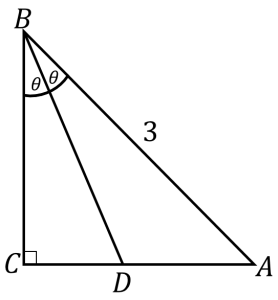 Let $\angle CBD = \angle DBA = \theta.$
In right triangle $BCD$, the trigonometric ratio gives
$\sin \theta = \dfrac{CD}{BD} \Leftrightarrow \color{red}{CD = BD \sin \theta}.$
Based on the triangle area formula in trigonometry for $\triangle ABD$ viewed from angle $\theta$, we obtain
$\begin{aligned} A_{\triangle ABD} & = \dfrac12 \cdot AB \cdot \color{red}{BD \cdot \sin \theta} \\ 9 & = \dfrac12 \cdot 3 \cdot \color{red}{CD} \\ CD & = 9 \cdot \dfrac23 = 6. \end{aligned}$
Therefore, the length of side $CD$ is $\boxed{6}.$
(Answer B)
A hexagon is positioned inside a right triangle as shown in the following figure.
 The area of the hexagon is $\cdots \cdot$
A. $60$ D. $120$
B. $80$ E. $180$
C. $100$
Suppose we label each vertex as follows.
 Notice that $\sin B = \dfrac{AC}{BC} = \dfrac{15}{25} = \dfrac35$ and $\sin C = \dfrac{AB}{BC} = \dfrac{20}{25} = \dfrac45.$
The area of $\triangle AEF$ (a right triangle) is
$$\begin{aligned} A_{\triangle AEF} & = \dfrac12 \times AF \times AE \\ & = \dfrac12 \times 5 \times 5 \\ & = \dfrac{25}{2}. \end{aligned}$$The area of $\triangle HGB$ can be found using the triangle area formula in trigonometry.
$$\begin{aligned} A_{\triangle HGB} & = \dfrac12 \times GB \times HB \times \sin B \\ & = \dfrac12 \times 5 \times 5 \times \dfrac35 \\ & = \dfrac{15}{2} \end{aligned}$$In the same way, we calculate the area of triangle $CDI.$
$$\begin{aligned} A_{\triangle CDI} & = \dfrac12 \times CD \times CI \times \sin C \\ & = \dfrac12 \times 5 \times 5 \times \dfrac45 \\ & = 10 \end{aligned}$$The area of the hexagon is equal to the area of right triangle $ABC$ minus the sum of the areas of the three triangles calculated above.
$$\begin{aligned} A_{\text{hexagon}} & = A_{\triangle ABC}-\left(A_{\triangle AEF}+A_{\triangle HGB} + A_{\triangle CDI}\right) \\ & = \dfrac12 \times 15 \times 20-\left(\dfrac{25}{2}+\dfrac{15}{2}+10\right) \\ & = 150-30 = 120 \end{aligned}$$Therefore, the area of the hexagon is $\boxed{120}.$
(Answer D)
Read: Law of Sines: Formulas, Proofs, and Solved Problems
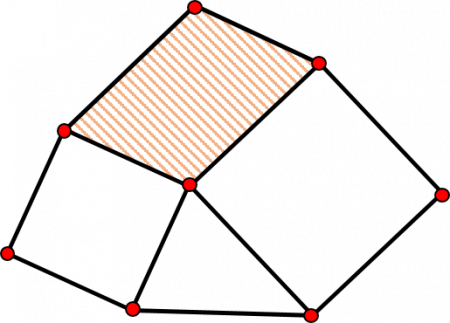
In the figure below, there are two squares with side lengths of $4$ cm and $5$ cm respectively, a triangle with area $8~\text{cm}^2,$ and a shaded parallelogram. The area of the parallelogram is $\cdots~\text{cm}^2.$
 A. $15$ D. $20$
B. $16$ E. $22$
C. $18$
Consider the triangle whose two side lengths are $4$ cm and $5$ cm. Suppose the angle formed by the two sides is $x.$
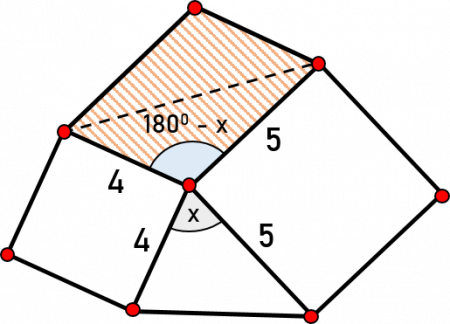 Using the triangle area rule in trigonometry, we obtain
$$\begin{aligned} A_{\triangle} & = \dfrac12ab \sin x \\ 8 & = \dfrac12(4)(5) \sin x \\ 8 & = 10 \sin x \\ \sin x & = \dfrac{8}{10} = \dfrac45. \end{aligned}$$The parallelogram above has side lengths of $4$ cm and $5$ cm with the included angle equal to $(180^\circ-x).$ Its area is equal to $2$ times the area of the triangle obtained by dividing it along a diagonal.
$$\begin{aligned} A_{\text{parallelogram}} & = 2 \cdot \dfrac12ab \sin (180^\circ-x) \\ & = (4)(5) \sin x \\ & = 20 \cdot \dfrac45 \\ & = 16~\text{cm}^2 \end{aligned}$$Therefore, the area of the parallelogram is $\boxed{16~\text{cm}^2}.$
(Answer B)
Read: Law of Cosines: Formulas, Proofs, and Solved Problems
Essay Section
An artist is going to create a decorative design for a triangular glass panel, as shown in the figure below. After measuring it, the glass is found to have side lengths of $18$ cm and $10$ cm, with an included angle of $45^\circ.$ What is the area of the triangular glass?

From the given figure, suppose the glass is represented by triangle $ABC$ with $AB = 10$ cm and $AC = 18$ cm as well as $\angle A = 45^\circ.$
Using the triangle area rule in trigonometry, we obtain
$$\begin{aligned} A_{\Delta ABC} & = \dfrac12 \cdot AB \cdot AC \cdot \sin A \\ & = \dfrac12 \cdot 10 \cdot 18 \cdot \sin 45^\circ \\ & = \dfrac{1}{\cancel{2}} \cdot \cancelto{5}{10} \cdot \cancelto{9}{18} \cdot \dfrac{1}{\cancel{2}}\sqrt2 \\ & = 45\sqrt2~\text{cm}^2. \end{aligned}$$Therefore, the area of the triangular glass is $\boxed{45\sqrt2~\text{cm}^2}.$
A flock of birds is flying together across the blue sky. At a certain moment, their positions form a triangular shape whose vertices are labeled $A,B,$ and $C.$ The distance from bird $A$ to bird $B$ is $30$ m, while the distance from bird $A$ to bird $C$ is $40$ m. The angle formed at point $A$ is $45^\circ.$
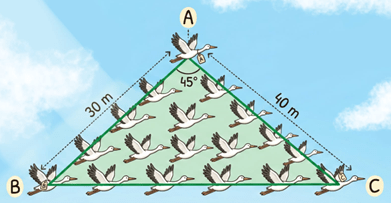 Determine the area of the triangle formed by the birds’ formation.
The following information is known.
- $AB = 30$ m.
- $AC = 40$ m.
- $\angle A = 45^\circ.$
Using the triangle area rule in trigonometry viewed from $\angle A,$ we obtain
$$\begin{aligned} A_{\Delta ABC} & = \dfrac12 \cdot AB \cdot AC \cdot \sin A \\ & = \dfrac12 \cdot 30 \cdot 40 \cdot \sin 45^\circ \\ & = \dfrac{1}{\cancel{2}} \cdot \cancelto{15}{30} \cdot \cancelto{20}{40} \cdot \dfrac{1}{\cancel{2}}\sqrt2 \\ & = 300\sqrt2~\text{m}^2. \end{aligned}$$Therefore, the area of the triangle formed by the birds’ formation is $\boxed{300\sqrt2~\text{m}^2}.$
Given quadrilateral $PQRS$ with $PS = 3$ cm, $PQ = 4$ cm, $QR = 6$ cm, $\angle SPQ = 90^\circ,$ and $\angle SQR = 120^\circ.$ Determine the area of quadrilateral $PQRS.$
The following information is known.
- $PS = 3$ cm.
- $PQ = 4$ cm.
- $QR = 6$ cm.
- $\angle SPQ = 90^\circ.$
- $\angle SQR = 120^\circ.$
Draw quadrilateral $PQRS$ as follows.
 The area of quadrilateral $PQRS$ is the sum of the areas of right triangle $PQS$ and obtuse triangle $QRS.$
First, calculate the area of $\Delta PQS$ using the standard method.
$$\begin{aligned} A_{\Delta PQS} & = \dfrac12 \cdot PQ \cdot PS \\ & = \dfrac{1}{\cancel{2}} \cdot \cancelto{2}{4} \cdot 3 \\ & = 6~\text{cm}^2 \end{aligned}$$The next step is to find the area of $\Delta QRS$ using the triangle area rule in trigonometry viewed from $\angle Q.$ However, the side length $QS$ must first be found using the Pythagorean theorem in $\Delta PQS.$
$$\begin{aligned} QS & = \sqrt{PQ^2 + PS^2} \\ & = \sqrt{(4)^2 + (3)^2} \\ & = \sqrt{16 + 9} = \sqrt{25} = 5~\text{cm} \end{aligned}$$Thus, we obtain
$$\begin{aligned} A_{\Delta QRS} & = \dfrac12 \cdot QR \cdot QS \cdot \sin \angle SQR \\ & = \dfrac12 \cdot 6 \cdot 5 \cdot \sin 120^\circ \\ & = \dfrac{1}{\cancel{2}} \cdot \cancelto{3}{6} \cdot 5 \cdot \dfrac{1}{2}\sqrt3 \\ & = \dfrac{15}{2}\sqrt3~\text{cm}^2. \end{aligned}$$Therefore, the area of quadrilateral $PQRS$ is $\left(6 + \dfrac{15}{2}\sqrt3\right)~\text{cm}^2.$
A container shaped like a triangular prism contains some water as shown in the figure below.
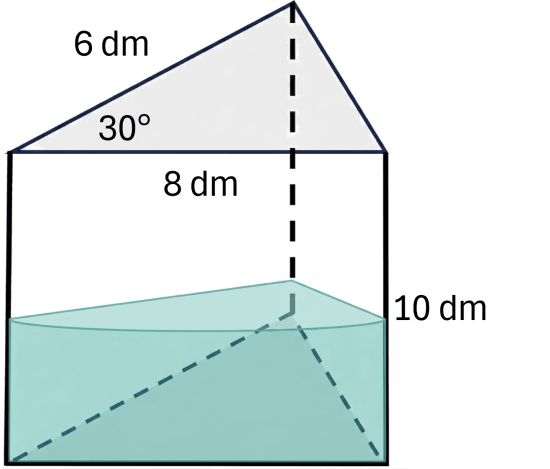 If pouring $80$ liters of water into the container will make it completely full, determine the initial volume of water.
The following information is known.
- Triangle side length, $a = 6$ dm.
- Triangle side length, $b = 8$ dm.
- Included angle of the triangle $\theta = 30^\circ.$
- Prism height $t = 10$ dm.
Using the triangle area rule in trigonometry, we first find the area of the prism’s base.
$$\begin{aligned} A_b &= \dfrac12ab \sin \theta \\ & = \dfrac12(6)(8) \sin 30^\circ \\ & = \dfrac{1}{\cancel{2}} \cdot \cancelto{3}{6} \cdot \cancelto{4}{8} \cdot \dfrac{1}{\cancel{2}} \\ & = 12~\text{dm}^2. \end{aligned}$$The prism volume can be determined by multiplying the base area and its height.
$$V = A_b \times t = 12 \times 10 = 120~\text{dm}^2$$Since $1~\text{dm}^2$ is equivalent to $1$ liter, it is concluded that the total volume of the prism is $120$ liters.
This means that the initial volume of water is $\boxed{120-80 = 40}$ liters.
Prove that the area of the cyclic quadrilateral $ABCD$ in the figure below is $L = \dfrac12(ab + cd) \sin \theta.$
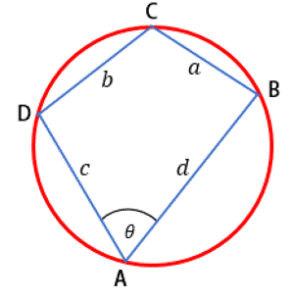
By applying the concept of the area of a triangle in trigonometry, we obtain
$\begin{aligned} A_{\triangle ABD} & = \dfrac12 cd \sin \theta \\ A_{\triangle BCD} & = \dfrac12 ab \sin C. \end{aligned}$
In a cyclic quadrilateral, the sum of opposite angles is $180^{\circ}$ so that
$\theta + \angle C = 180^{\circ} \iff \angle C = 180^{\circ}- \theta.$
Thus, the area of triangle $BCD$ can be written as
$\begin{aligned} A_{\triangle BCD} & = \dfrac12 ab \sin (180^{\circ}- \theta) \\ & = \dfrac12 ab \sin \theta. \end{aligned}$
This means that the area of quadrilateral $ABCD$ is
$\begin{aligned} A_{ABCD} & = A_{\triangle ABD} + A_{\triangle BCD} \\ & = \dfrac12 cd \sin \theta + \dfrac12 ab \sin \theta \\ & = \dfrac12(ab+cd) \sin \theta. \end{aligned}$
Therefore, it is proven that the area of the cyclic quadrilateral $ABCD$ is $\boxed{A_{ABCD} = \dfrac12(ab + cd) \sin \theta}.$
Prove that the area of any quadrilateral $ABCD$ in the figure below is $L = \dfrac12 \cdot AC \cdot BD \cdot \sin \theta.$

The area of quadrilateral $ABCD$ can be calculated by summing the areas of its four constituent triangles. The area of each triangle can be determined using the sine rule (remember that $\sin (180^{\circ}-\theta) = \sin \theta).$
$\begin{aligned} A_{\triangle CDP} & = \dfrac12 \cdot CP \cdot DP \cdot \sin \theta \\ A_{\triangle BCP} & = \dfrac12 \cdot CP \cdot BP \cdot \sin \theta \\ A_{\triangle ABP} & = \dfrac12 \cdot AP \cdot BP \cdot \sin \theta \\ A_{\triangle ADP} & = \dfrac12 \cdot AP \cdot DP \cdot \sin \theta \end{aligned}$
Thus, we obtain
$$\begin{aligned} A_{ABCD} & = A_{\triangle CDP} + A_{\triangle BCP} + A_{\triangle ABP} + A_{\triangle ADP} \\ & = \dfrac12 \cdot CP \cdot DP \cdot \sin \theta + \dfrac12 \cdot CP \cdot BP \cdot \sin \theta \\ & + \dfrac12 \cdot AP \cdot BP \cdot \sin \theta + \dfrac12 \cdot AP \cdot DP \cdot \sin \theta \\ & = \dfrac12 \sin \theta(CP(DP+BP)+AP(BP+DP)) \\ & = \dfrac12 \sin \theta(CP \cdot BD + AP \cdot BD) \\ & = \dfrac12 \sin \theta \cdot BD(CP + AP) \\ & = \dfrac12 \sin \theta \cdot BD \cdot AC \\ & = \dfrac12 \cdot AC \cdot BD \cdot \sin \theta. \end{aligned}$$Therefore, it is proven that the area of quadrilateral $ABCD$ is $\boxed{A_{ABCD} = \dfrac12 \cdot AC \cdot BD \cdot \sin \theta}.$