Trigonometric identities can be defined as equations that relate certain trigonometric ratios. Trigonometric identities are generally used to transform expressions containing trigonometric ratios into other, simpler forms. Difficulty in choosing the appropriate identity is a common problem encountered in learning because we are required to think critically and creatively when manipulating expressions.
Quote by John von Neumann
The trigonometric identities referred to include the following.
Pythagorean Identities
Sum and Difference of Angles Identities
Sum and Difference of Functions Identities
Double Angle Identities
Half-Angle Identities
Product Identities
The following section presents several problems along with their solutions. Study them for good.
Read: Basic Trigonometry Problems and Step-by-Step Answers
Multiple Choice Section
Problem Number 1
If $\cos 2A = -\dfrac{7}{25}$ for $180^{\circ} \leq 2A \leq 270^{\circ}$, then $\cdots \cdot$
A. $\sin A = \pm \dfrac45$
B. $\cos A = \dfrac35$
C. $\tan A = \dfrac43$
D. $\sin A = -\dfrac45$
E. $\csc A = \dfrac54$
It is known that $\cos 2A = -\dfrac{7}{25}.$
Because $180^{\circ} \leq 2A \leq 270^{\circ}$, by dividing the three parts by $2$, we obtain $90^{\circ} \leq A \leq 135^{\circ}.$
Therefore, $A$ is in quadrant II.
Notice that $\cos 2A = 2 \cos^2 A-1$ so that we obtain
$\begin{aligned} \cos 2A & = -\dfrac{7}{25} \\ 2 \cos^2 A-1 & = -\dfrac{7}{25} \\ \cos^2 A & = \dfrac{9}{25} \\ \cos A & =- \dfrac35 \end{aligned}$
$\cos A$ is negative because $A$ is in quadrant II.
Known: $\text{adjacent} = 3$ and $\text{hypotenuse} = 5$. Using the right triangle approach and the Pythagorean theorem, we obtain
$\text{opposite} = \sqrt{5^2-3^2} = 4.$
From here, we obtain
$\begin{aligned} \sin A & = \dfrac{\text{opposite}}{\text{hypotenuse}} = \dfrac45 \\ \tan A & = -\dfrac{\text{opposite}}{\text{adjacent}} = -\dfrac43 \\ \csc A & = \dfrac{\text{hypotenuse}}{\text{opposite}} = \dfrac54 \end{aligned}$
Notice that only $\sin$ and its reciprocal, $\csc$, are positive in quadrant II.
Based on the explanation above, the correct answer option is E.
Problem Number 2
If it is known that $\sin A = \dfrac35$ and $\cos B = -\dfrac35$ where $A$ and $B$ lie in the same quadrant, then the value of $\sin (2A+B) = \cdots \cdot$
A. $\dfrac{7}{12}$ C. $\dfrac{5}{12}$ E. $\dfrac57$
B. $\dfrac45$ D. $\dfrac37$
It is known
$\sin A = \dfrac{\text{opposite}}{\text{hypotenuse}} = \dfrac35$ and
$\cos B = \dfrac{\text{adjacent}}{\text{hypotenuse}} = – \dfrac35.$
The quadrant where the sine value is positive and the cosine value is negative is quadrant II. Therefore, $A$ and $B$ lie in quadrant II.
Using the right triangle approach and the Pythagorean theorem (Pythagorean Triple: $3, 4, 5),$ we obtain
$\cos A = -\dfrac45$ and $\sin B = \dfrac45.$
Next, by using the angle sum identities:
$\boxed{\begin{aligned} \sin (x + y) & = \sin x \cos y + \cos x \sin y \\ \sin 2x & = 2 \sin x \cos x \\ \cos 2x & = \cos^2 x-\sin^2 x \end{aligned}}$
we obtain
$$\begin{aligned} \sin (2A+B) & = \sin 2A \cos B + \cos 2A \sin B \\ & = (2 \sin A \cos A) \cos B + (\cos^2 A-\sin^2 A) \sin B \\ & = 2 \cdot \dfrac35 \cdot \left(-\dfrac45\right) \cdot \left(-\dfrac35\right) + \left(\left(-\dfrac45\right)^2-\left(\dfrac35\right)\right)^2 \cdot \dfrac45 \\ & = \dfrac{72}{125} + \left(\dfrac{16}{25}-\dfrac{9}{25}\right) \cdot \dfrac45 \\ & = \dfrac{72}{125} + \dfrac{28}{125} \\ & = \dfrac{100}{125} = \dfrac45 \end{aligned}$$Therefore, the value of $\boxed{\sin (2A+B) = \dfrac45}.$
(Answer B)
Read: Special Angle Trigonometry Problems with Detailed Explanations
Problem Number 3
The value of $\cos 265^{\circ}-\cos 95^{\circ} = \cdots \cdot$
A. $-2$ C. $0$ E. $2$
B. $-1$ D. $1$
Use the sum and difference identities.
$$\boxed{\cos A-\cos B = -2 \sin \dfrac12(A+B) \sin \dfrac12(A-B)}$$Thus, we can write
$$\begin{aligned} \cos 265^{\circ}-\cos 95^{\circ} & = -2 \sin \dfrac12(265^{\circ}+95^{\circ}) \sin \dfrac12(265^{\circ}-95^{\circ}) \\ & = -2 \sin \dfrac12(360^{\circ}) \sin \dfrac12(170^{\circ}) \\ & = -2 \sin 180^{\circ} \sin 85^{\circ} \\ & = -2 \cdot 0 \cdot \sin 85^{\circ} \\ & = 0 \end{aligned}$$Therefore, the value of $\boxed{\cos 265^{\circ}-\cos 95^{\circ} = 0}.$
(Answer C)
Problem Number 4
The value of $\sin 75^{\circ}-\sin 165^{\circ}$ is $\cdots \cdot$
A. $\dfrac14\sqrt2$ D. $\dfrac12\sqrt2$
B. $\dfrac14\sqrt3$ E. $-\dfrac12\sqrt2$
C. $\dfrac14\sqrt6$
Use the sum and difference identities.
$$\boxed{\sin A-\sin B = 2 \cos \dfrac12(A+B) \sin \dfrac12(A-B)}$$Thus, we can write
$$\begin{aligned} \sin 75^{\circ}-\sin 165^{\circ} & = 2 \cos \dfrac12(75^{\circ}+165^{\circ}) \sin \dfrac12(75^{\circ}-165^{\circ}) \\ & = 2 \cos \dfrac12(240^{\circ}) \sin \dfrac12(-90^{\circ}) \\ & = 2 \cos 120^{\circ} (-\sin 45^{\circ}) \\ & = 2 \cdot \left(-\dfrac12\right) \cdot \left(-\dfrac12\sqrt2\right) \\ & = \dfrac12\sqrt2 \end{aligned}$$Therefore, the value of $\boxed{\sin 75^{\circ}-\sin 165^{\circ} = \dfrac12\sqrt2}.$
(Answer D)
Problem Number 5
It is known that $\cos x = \dfrac35$ for $0^{\circ} < x < 90^{\circ}$. The value of $\sin 3x + \sin x = \cdots \cdot$
A. $\dfrac{75}{125}$ D. $\dfrac{124}{125}$
B. $\dfrac{96}{125}$ E. $\dfrac{144}{125}$
C. $\dfrac{108}{125}$
It is known that $\cos x = \dfrac35$ with $x$ located in the first quadrant.
Known: $\text{adjacent} = 3$ and $\text{hypotenuse} = 5$.
Using the right triangle approach and the Pythagorean theorem, we obtain
$\text{opposite} = \sqrt{5^2-3^2} = 4.$
From here, we obtain
$\sin x = \dfrac{\text{opposite}}{\text{hypotenuse}} = \dfrac45.$
Next, use the following trigonometric identities.
$$\boxed{\begin{aligned} \sin A + \sin B & = 2 \sin \dfrac12(A+B) \cos \dfrac12(A-B) \\ \sin 2x & = 2 \sin x \cos x \end{aligned}}$$We will obtain
$$\begin{aligned} \sin 3x + \sin x & = 2 \sin \dfrac12(3x+x) \cos \dfrac12(3x-x) \\ & = 2 \sin 2x \cos x \\ & = 2(2 \sin x \cos x) \cos x \\ & = 4 \sin x \cos^2 x \\ & = 4 \cdot \dfrac45 \cdot \left(\dfrac35\right)^2 \\ & = \dfrac{144}{125} \end{aligned}$$Therefore, the value of $\boxed{\sin 3x + \sin x = \dfrac{144}{125}}.$
(Answer E)
Read: Proofs of Trigonometric Identities: Formulas, Methods, and Solved Problems
Problem Number 6
It is known that $\sin A + \sin B = 1$ and $\cos A + \cos B = \dfrac{\sqrt5}{\sqrt3}$. The value of $\cos (A-B)=\cdots \cdot$
A. $1$ C. $\dfrac12\sqrt2$ E. $\dfrac13$
B. $\dfrac12\sqrt3$ D. $\dfrac12$
Use the following trigonometric identities.
$$\boxed{\begin{aligned} \sin^2 x + \cos^2 x & = 1 \\ \cos (A-B) &= \cos A \cos B + \sin A \sin B \end{aligned}}$$It is known that $\sin A + \sin B = 1.$
Square both sides,
$\begin{aligned} (\sin A + \sin B)^2 & = 1^2 \\ \color{blue}{\sin^2 A + 2 \sin A \sin B + \sin^2 B} & \color{blue}{= 1} \end{aligned}$
It is known that $\cos A+ \cos B = \dfrac{\sqrt5}{\sqrt3}.$
Square both sides,
$$\begin{aligned} (\cos A + \cos B)^2 & = \left(\dfrac{\sqrt5}{\sqrt3}\right)^2 \\ \color{red}{\cos^2 A + 2 \cos A \cos B + \cos^2 B} & \color{red}{=\dfrac53}\end{aligned}$$Add the two equations marked in blue and red above.
$$\begin{aligned} (\sin^2 A + \cos^2 A) + 2 \sin A \sin B + 2 \cos A \cos B) + (\sin^2 B + \cos^2 B) & = 1+\dfrac53 \\ \cancel{1} + 2(\cos A \cos B + \sin A \sin B) + 1 & = \cancel{1}+\dfrac53 \\ 2(\cos A \cos B + \sin A \sin B) & = \dfrac23 \\ \cos A \cos B + \sin A \sin B & = \dfrac13 \\ \cos (A-B) & = \dfrac13 \end{aligned}$$Therefore, the value of $\boxed{\cos(A-B)=\dfrac13}.$
(Answer E)
Problem Number 7
It is known that $x$ and $y$ are acute angles with $x-y=\dfrac{\pi}{6}$. If $\tan x = 3 \tan y$, then $x+y=\cdots \cdot$
A. $\dfrac{\pi}{2}$ D. $\dfrac{2\pi}{3}$
B. $\dfrac{\pi}{3}$ E. $\pi$
C. $\dfrac{\pi}{6}$
It is known that $x-y = \dfrac{\pi}{6}$ and $\color{red}{\tan x = 3 \tan y}$ where $x, y$ are acute.
Using the tangent difference identity, we obtain
$\begin{aligned} \tan (x-y) & = \dfrac{\color{red}{\tan x}-\tan y}{1+\color{red}{\tan x} \tan y} \\ \tan \dfrac{\pi}{6} &= \dfrac{\color{red}{3 \tan y}-\tan y}{1+\color{red}{3 \tan y} \tan y} \\ \dfrac{1}{\sqrt3} & = \dfrac{2 \tan y}{1 + 3 \tan^2 y} \\ 1+3 \tan^2 y & = 2\sqrt3 \tan y \\ (\sqrt3 \tan y-1)^2 & = 0 \\ \sqrt3 \tan y-1 & = 0 \\ \tan y & = \dfrac{1}{\sqrt3} \\ \Rightarrow y & = \dfrac{\pi}{6} \end{aligned}$
Because $x-y=\dfrac{\pi}{6}$ and $y=\dfrac{\pi}{6}$, it means that $x=\dfrac{\pi}{3}$.
Therefore, the value of $\boxed{x+y=\dfrac{\pi}{3}+\dfrac{\pi}{6} = \dfrac{\pi}{2}}.$
(Answer A)
Problem Number 8
It is known that $\sin \alpha = \dfrac35$ and $\cos \beta = \dfrac{12}{13}$ ($\alpha$ and $\beta$ are acute angles). The value of $\sin (\alpha + \beta) = \cdots \cdot$
A. $\dfrac{56}{65}$ D. $\dfrac{20}{65}$
B. $\dfrac{48}{65}$ E. $\dfrac{16}{65}$
C. $\dfrac{36}{65}$
It is known:
$\begin{aligned} \sin \alpha & = \dfrac35 \\ \cos \beta & = \dfrac{12}{13} \\ \alpha, \beta~&\text{are acute}. \end{aligned}$
The sine value for angle $\beta$ and the cosine value for angle $\alpha$ will be positive because both $\alpha$ and $\beta$ are in the first quadrant.
Notice that
$\begin{aligned} \cos \alpha & = + \sqrt{1-\sin^2 \alpha} \\ & = \sqrt{1-\left(\dfrac35\right)^2} \\ & = \sqrt{1-\dfrac{9}{25}} \\ & = \sqrt{\dfrac{16}{25}} = \dfrac45 \end{aligned}$
and
$\begin{aligned} \sin \beta & = + \sqrt{1-\cos^2 \beta} \\ & = \sqrt{1-\left(\dfrac{12}{13}\right)^2} \\ & = \sqrt{1-\dfrac{144}{169}} \\ & = \sqrt{\dfrac{25}{169}} = \dfrac{5}{13} \end{aligned}$
Using the sine angle sum identity, we obtain
$\begin{aligned} \sin (\alpha + \beta) & = \sin \alpha \cos \beta + \cos \alpha \sin \beta \\ & = \dfrac35 \cdot \dfrac{12}{13} + \dfrac45 \cdot \dfrac{5}{13} \\ & = \dfrac{36}{65}+\dfrac{20}{65} = \dfrac{56}{65} \end{aligned}$
Therefore, the value of $\boxed{\sin (\alpha + \beta) = \dfrac{56}{65}}.$
(Answer A)
Problem Number 9
It is known that $\cos x = \dfrac{12}{13}$. The value of $\tan \dfrac12x = \cdots \cdot$
A. $\dfrac{1}{26}$ D. $\dfrac{5}{\sqrt{26}}$
B. $\dfrac{1}{5}$ E. $\dfrac{5}{13}$
C. $\dfrac{1}{\sqrt{26}}$
It is known that $\cos x = \dfrac{12}{13}$.
Using the Pythagorean identity, we obtain
$\begin{aligned} \sin x & = \sqrt{1-\cos^2 x} \\ & = \sqrt{1-\left(\dfrac{12}{13}\right)^2} \\ & = \sqrt{\dfrac{25}{169}} = \dfrac{5}{13} \end{aligned}$
Notice that $\tan \dfrac12x$ can be determined using the half-angle identity.
$\begin{aligned} \tan \dfrac12x & = \dfrac{1-\cos x}{\sin x} \\ & = \dfrac{1-\dfrac{12}{13}}{\dfrac{5}{13}} \\ & = \dfrac{\dfrac{1}{\cancel{13}}}{\dfrac{5}{\cancel{13}}} = \dfrac15 \end{aligned}$
Therefore, the value of $\boxed{\tan \dfrac12x = \dfrac15}.$
(Answer B)
Problem Number 10
Another form of $\dfrac{1+\cos 2A}{\sin 2A}$ is $\cdots \cdot$
A. $\sin A$ D. $\tan A$
B. $\cos A$ E. $1+\sin A$
C. $\cot A$
Use the following double-angle identities.
$\boxed{\begin{aligned} \cos 2A & = 1-2 \sin^2 A \\ \sin 2A & = 2 \sin A \cos A \end{aligned}}$
We will obtain
$$\begin{aligned} \dfrac{1+\cos 2A}{\sin 2A} & = \dfrac{1 + (1-2 \sin^2 A)}{2 \sin A \cos A} \\ & = \dfrac{2-2 \sin^2 A}{2 \sin A \cos A} \\ & = \dfrac{2(1 -\sin^2 A)}{2 \sin A \cos A} \\ & = \dfrac{2 \cos^2 A}{2 \sin A \cos A} \\ & = \dfrac{\cos A}{\sin A} = \cot A \end{aligned}$$Therefore, another form of $\dfrac{1+\cos 2A}{\sin 2A}$ is $\boxed{\cot A}.$
(Answer C)
Read: Trigonometric Equations: Definitions, Formulas, and Solved Problems
Problem Number 11
If $\tan \alpha = 1$ and $\tan \beta = \dfrac13$ with $\alpha, \beta$ acute angles, then $\sin (\alpha-\beta) = \cdots \cdot$
A. $\dfrac23\sqrt5$ D. $\dfrac25$
B. $\dfrac15\sqrt5$ E. $\dfrac15$
C. $\dfrac12$
It is known:
$\begin{aligned} \tan \alpha & = 1 \\ \tan \beta & = \dfrac{1}{3} \\ \alpha, \beta~&\text{acute}. \end{aligned}$
The sine and cosine values for angle $\beta$ and angle $\alpha$ will be positive because both $\alpha, \beta$ are in the first quadrant.
Because $\tan \alpha = \dfrac{\text{opposite}}{\text{adjacent}} = \dfrac{1}{1}$, then
$\begin{aligned} \sin \alpha & = \dfrac{ \text{opposite}}{\text{hypotenuse}} = + \dfrac{1}{\sqrt{1+1}} = \dfrac{1}{\sqrt2} \\ \cos \alpha & = \dfrac{ \text{adjacent}}{\text{hypotenuse}} = + \dfrac{1}{\sqrt{1+1}} = \dfrac{1}{\sqrt2} \end{aligned}$
Because $\tan \beta = \dfrac{\text{opposite}}{\text{adjacent}} = \dfrac{1}{3}$, then
$\begin{aligned} \sin \beta & = \dfrac{ \text{opposite}}{\text{hypotenuse}} = + \dfrac{1}{\sqrt{1+3^2}} = \dfrac{1}{\sqrt{10}} \\ \cos \beta & = \dfrac{ \text{adjacent}}{\text{hypotenuse}} = +\dfrac{3}{\sqrt{1+3^2}} = \dfrac{3}{\sqrt{10}} \end{aligned}$
Using the sine difference identity, we obtain
$$\begin{aligned} \sin (\alpha- \beta) & = \sin \alpha \cos \beta-\cos \alpha \sin \beta \\ & = \dfrac{1}{\sqrt{2}} \cdot \dfrac{3}{\sqrt{10}}-\dfrac{1}{\sqrt{2}} \cdot \dfrac{1}{\sqrt{10}} \\ & = \dfrac{3}{\sqrt{20}}-\dfrac{1}{\sqrt{20}} = \dfrac{2}{\sqrt{20}} = \dfrac15\sqrt5 \end{aligned}$$Therefore, the value of $\boxed{\sin (\alpha-\beta) = \dfrac15\sqrt5}.$
(Answer B)
Problem Number 12
It is known that $\tan \alpha-\tan \beta = \dfrac15$ and $\sin (\alpha-\beta) = \dfrac16$ with $\alpha$ and $\beta$ acute angles. The value of $\cos \alpha \cos \beta = \cdots \cdot$
A. $\dfrac16$ C. $\dfrac12$ E. $\dfrac65$
B. $\dfrac15$ D. $\dfrac56$
Notice that $\sin (\alpha-\beta) = \dfrac16$ can be rewritten in another form using the sine difference identity, namely
$\color{red}{\sin \alpha \cos \beta-\cos \alpha \sin \beta = \dfrac16}.$
From the equation $\tan \alpha-\tan \beta = \dfrac15$, we obtain
$\begin{aligned} \dfrac{\sin \alpha}{\cos \alpha}-\dfrac{\sin \beta}{\cos \beta} & = \dfrac15 \\ \dfrac{\color{red}{\sin \alpha \cos \beta-\cos \alpha \sin \beta}}{\cos \alpha \cos \beta} & = \dfrac15 \\ \dfrac{\color{red}{\frac16}}{\cos \alpha \cos \beta} & = \dfrac15 \\ \cos \alpha \cos \beta & = \dfrac56 \end{aligned}$
Therefore, the value of $\boxed{\cos \alpha \cos \beta=\dfrac56}.$
(Answer D)
Problem Number 13
Given $\sin x + \cos x = -\dfrac15$ and $\dfrac{3\pi}{4} \leq x < \pi$, then the value of $\sin 2x = \cdots \cdot$
A. $-\dfrac{24}{25}$ D. $\dfrac{8}{25}$
B. $-\dfrac{7}{25}$ E. $\dfrac{24}{25}$
C. $\dfrac{7}{25}$
Given $\sin x + \cos x = -\dfrac15$.
Square both sides to obtain
$$\begin{aligned} (\sin x + \cos x)^2 & = \left(-\dfrac15\right)^2 \\ \color{red}{\sin^2 x} + \color{blue}{2 \sin x \cos x} + \color{red}{\cos^2 x} & = \dfrac{1}{25} \\ 1 + \sin 2x & = \dfrac{1}{25} \\ \sin 2x & = \dfrac{1}{25}-1 \\ &= -\dfrac{24}{25} \end{aligned}$$Note:
$\boxed{\begin{aligned} \color{red}{\sin^2 x + \cos^2 x} & = \color{red}{1} \\ \color{blue}{2 \sin x \cos x} & = \color{blue}{\sin 2x} \end{aligned}}$
Therefore, the value of $\boxed{\sin 2x = -\dfrac{24}{25}}.$
(Answer A)
Problem Number 14
If $\sin \theta + \cos \theta = \dfrac12$, then the value of $\sin^3 \theta + \cos^3 \theta = \cdots \cdot$
A. $\dfrac12$ D. $\dfrac58$
B. $\dfrac34$ E. $\dfrac{11}{16}$
C. $\dfrac{9}{16}$
From the equation
$\color{blue}{\sin \theta + \cos \theta = \dfrac12}$,
square both sides to obtain
$\begin{aligned} (\sin \theta + \cos \theta)^2 & = (\dfrac12)^2 \\ \color{red}{\sin^2 \theta} + 2 \sin \theta \cos \theta + \color{red}{\cos^2 \theta} & = \dfrac14 \\ \color{red}{1} + 2 \sin \theta \cos \theta & = \dfrac14 \\ 2 \sin \theta \cos \theta & = -\dfrac34 \\ \sin \theta \cos \theta & = -\dfrac38 \end{aligned}$
Use the factorization formula:
$a^3+b^3 = (a+b)^3-3ab(a+b)$
For $a = \sin \theta$ and $b = \cos \theta$, we obtain
$$\begin{aligned} \sin^3 \theta + \cos^3 \theta & = (\color{blue}{\sin \theta + \cos \theta})^3-3 \sin \theta \cos \theta(\color{blue}{\sin \theta + \cos \theta}) \\ & = \left(\dfrac12\right)^3-3\left(-\dfrac38\right)\left(\dfrac12\right) \\ & = \dfrac18 + \dfrac{9}{16} = \dfrac{11}{16} \end{aligned}$$Therefore, the value of $\boxed{\sin^3 \theta + \cos^3 \theta = \dfrac{11}{16}}.$
(Answer E)
Problem Number 15
If $$\begin{pmatrix} \tan x & 1 \\ 1 & \tan x \end{pmatrix} \begin{pmatrix} \cos^2 x \\ \sin x \cos x \end{pmatrix} = \dfrac12\begin{pmatrix} a \\ b \end{pmatrix}$$ with $0 \leq x \leq \pi$ and $b=2a$, then the value of $x$ that satisfies is $\cdots \cdot$
A. $60^{\circ}$ C. $30^{\circ}$ E. $15^{\circ}$
B. $45^{\circ}$ D. $20^{\circ}$
First, convert the matrix equation above into ordinary algebraic equations by performing matrix multiplication.
We will obtain two equations, namely
$$\begin{cases} \tan x \cos^2 x + \sin x \cos x & = \dfrac{a}{2} && (\cdots 1) \\ \cos^2 x + \tan x \sin x \cos x & = \dfrac{b}{2} && (\cdots 2) \end{cases}$$Observe equation $(2)$.
Since $\tan x = \dfrac{\sin x}{\cos x}$ (ratio identity) and $\cos^2 x = 1-\sin^2 x$ (Pythagorean Identity), then we obtain
$$\begin{aligned} (1-\sin^2 x)+\dfrac{\sin x}{\cancel{\cos x}} \cdot \sin x \cdot \cancel{\cos x} & = \dfrac{b}{2} \\ 1-\sin^2 x + \sin^2 x & = \dfrac{b}{2} \\ 1 & = \dfrac{b}{2} \\ b & = 2 \end{aligned}$$Since it is known that $b=2a$ and we obtain $b=2$, then $a=1$.
Substitute $a=1$ into equation $(1)$.
$$\begin{aligned} \tan x \cos^2 x + \sin x \cos x & = \dfrac12 \\ \dfrac{\sin x}{\cancel{\cos x}} \cdot \cancelto{\cos x}{\cos^2 x} + \sin x \cos x & = \dfrac12 \\ \sin x \cos x + \sin x \cos x & = \dfrac12 \\ \color{red}{2 \sin x \cos x} & = \dfrac12 \\ \color{red}{\sin 2x} & = \dfrac12 \end{aligned}$$It is known that $0 \leq x \leq \pi.$
Sine equals $\dfrac12$ when the angle is $30^{\circ}$ or $150^{\circ}$. Therefore, we write
$\sin 2x = \sin 30^{\circ}$ which means $x = 15^{\circ}$ and
$\sin 2x = \sin 150^{\circ}$ which means $x = 75^{\circ}.$
Therefore, the value of $x$ that satisfies based on the available answer choices is $\boxed{15^{\circ}}.$
(Answer E)
Read: Law of Sines: Formulas, Proofs, and Solved Problems
Problem Number 16
If the acute angle $\alpha$ satisfies $\sin \alpha = \dfrac13\sqrt3$, then $\tan \left(\dfrac12 \pi-\alpha\right)+3 \cos \alpha = \cdots \cdot$
A. $3\sqrt2-\sqrt3$
B. $3\sqrt2+\sqrt3$
C. $\sqrt6+\sqrt2$
D. $\sqrt6-\sqrt2$
E. $\sqrt3+\sqrt2$
Given $\sin \alpha = \dfrac{\sqrt3}{3} = \dfrac{\text{opposite}}{\text{hypotenuse}}.$
Using the Pythagorean Theorem, we obtain
$\text{adjacent} = \sqrt{(3)^2-(\sqrt3)^2} = \sqrt6$
Therefore, we get
$\begin{aligned} \cos \alpha & = \dfrac{\text{adjacent}}{\text{hypotenuse}} = \dfrac{\sqrt6}{3} \\ \cot \alpha & = \dfrac{\text{adjacent}}{\text{opposite}} = \dfrac{\sqrt6}{\sqrt3} = \sqrt2 \end{aligned}$
Notice that $\tan \left(\dfrac12 \pi-\alpha\right) = \cot \alpha$.
Thus,
$$\begin{aligned} \tan \left(\dfrac12 \pi-\alpha\right)+3 \cos \alpha & = \cot \alpha + 3 \cos \alpha \\ & = \sqrt2 + \cancel{3} \cdot \dfrac{\sqrt6}{\cancel{3}} \\ & = \sqrt6 + \sqrt2 \end{aligned}$$Therefore, the value of $\boxed{\tan \left(\dfrac12 \pi-\alpha\right)+3 \cos \alpha = \sqrt6 + \sqrt2}.$
(Answer C)
Problem Number 17
Another form of $2 \cos \left(\dfrac14 \pi + x\right) \sin \left(\dfrac14 \pi + x\right) = \cdots \cdot$
A. $1-\sin 2x$ D. $1+\cos 2x$
B. $1-\cos 2x$ E. $\cos 2x$
C. $1+\sin 2x$
Using the double-angle identity:
$\boxed{\sin 2A = 2 \sin A \cos A}$
it is obtained that
$\begin{aligned} & 2 \cos \left(\dfrac14 \pi + x\right) \sin \left(\dfrac14 \pi + x\right) \\ & = \sin 2\left(\dfrac14 \pi + x\right) \\ & = \sin \left(\dfrac12 \pi + 2x\right) \\ & = \cos 2x \end{aligned}$
Therefore, the value of $$\boxed{2 \cos \left(\dfrac14 \pi + x\right) \sin \left(\dfrac14 \pi + x\right) = \cos 2x}.$$(Answer E)
Problem Number 18
The value of $\sin 160^{\circ} + \sin 140^{\circ}-\cos 10^{\circ}$ is $\cdots \cdot$
A. $2$ C. $0$ E. $-2$
B. $1$ D. $-1$
Use the sum identity of sine functions:
$$\boxed{\sin A + \sin B = 2 \sin \dfrac{A+B}{2} \cos \dfrac{A+B}{2}}$$We will obtain
$$\begin{aligned} & \color{red}{\sin 160^{\circ} + \sin 140^{\circ}}-\cos 10^{\circ} \\ & = 2 \sin \dfrac{160^{\circ}+140^{\circ}}{2} \cos \dfrac{160^{\circ}-140^{\circ}}{2}-\cos 10^{\circ} \\ & = 2 \sin 150^{\circ} \cos 10^{\circ}-\cos 10^{\circ} \\ & = 2 \cdot \dfrac12 \cdot \cos 10^{\circ}-\cos 10^{\circ} = 0 \end{aligned}$$Therefore, the value of $\boxed{\sin 160^{\circ} + \sin 140^{\circ}-\cos 10^{\circ} = 0}.$
(Answer C)
Problem Number 19
The value of $\cos^2 30^{\circ} + \cos^2 40^{\circ}+$ $\cos^2 50^{\circ} +\cos^2 60^{\circ}$ is $\cdots \cdot$
A. $2$ C. $1$ E. $0$
B. $\dfrac32$ D. $\dfrac12$
Use the Pythagorean identity and the angle relation identity in the first quadrant below.
$\boxed{\begin{aligned} \cos^2 x & = 1-\sin^2 x \\ \sin x & = \cos (90^{\circ}-x) \end{aligned}}$
We will obtain
$$\begin{aligned} & \cos^2 30^{\circ} + \cos^2 40^{\circ}+\cos^2 50^{\circ} +\cos^2 60^{\circ} \\ & = (1-\cancel{\sin^2 30^{\circ}}) + (1-\bcancel{\sin^2 40^{\circ}}) + \bcancel{\sin^2 40^{\circ}} + \cancel{\sin^2 30^{\circ}} \\ & = 1+1=2 \end{aligned}$$Therefore, the value of $$\boxed{\cos^2 30^{\circ} + \cos^2 40^{\circ}+\cos^2 50^{\circ} +\cos^2 60^{\circ}=2}.$$(Answer A)
Problem Number 20
In right triangle $ABC$, it holds that $\sin A \sin B = 0,5$. If the right angle is at $A$, then the value of $\cos (A+B)= \cdots \cdot$
A. $1$ C. $0$ E. $-1$
B. $0,\!5$ D. $-0,\!5$
Given $\triangle ABC$ (right triangle). It is known that $\sin A \sin B = 0,\!5.$
It is also known that the right angle is at point $A$, which means it can be written as
$\sin 90^{\circ} \sin B = 0,\!5.$
Since $\sin 90^{\circ} = 1$, then $\sin B = 0,\!5.$
Using the sine and cosine angle relation, it is obtained
$\begin{aligned} \cos (A+B) & = \cos (90^{\circ}+B) \\ & = -\sin B = -0,\!5 \end{aligned}$
Therefore, the value of $\boxed{\cos (A+B)=-0,\!5}.$
(Answer D)
Read: Law of Cosines: Formulas, Proofs, and Solved Problems
Problem Number 21
In right triangle $ABC$, it holds that $\cos A \cos B = \dfrac13$. The value of $\cos 2A = \cdots \cdot$
A. $\dfrac13\sqrt2$ D. $\dfrac19$
B. $\dfrac23\sqrt2$ E. $\dfrac13\sqrt5$
C. $1$
Notice that $\cos A \cos B = \dfrac13$. If $A = 90^{\circ}$ or $B = 90^{\circ}$, then the equation does not hold because $\cos 90^{\circ} = 0$. This means the right angle is at $C$, written as $\angle C = 90^{\circ}$.
This also means that $B = 90^{\circ}-A.$
Thus, it is obtained
$\begin{aligned} \cos A \cos B & = \dfrac13 \\ \cos A \cos (90^{\circ}-A) & = \dfrac13 \\ \cos A \sin A & = \dfrac13 \\ \text{Multiply}~2~\text{on both sides} \\ 2 \cos A \sin A & = \dfrac23 \\ \sin 2A & = \dfrac23 \end{aligned}$
Note: Remember that
$\boxed{\begin{aligned} \cos (90^{\circ}-A) & = \sin A \\ 2 \sin A \cos A & = \sin 2A \end{aligned}}$
Using the right triangle approach as shown in the figure,
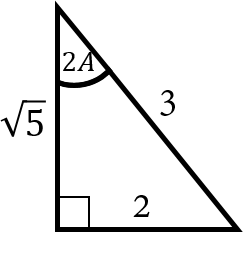 it is obtained that $\boxed{\cos 2A = \dfrac{\text{adj}}{\text{hyp}} = \dfrac13\sqrt5}.$
(Answer E)
Problem Number 22
If $\dfrac12x + y = \dfrac{\pi}{4}$, then $\tan x = \cdots \cdot$
A. $\dfrac{1-\tan^2 y}{2 \tan y}$ D. $\dfrac{\tan^2 y}{1+\tan y}$
B. $\dfrac{\tan y+1}{1-\tan y}$ E. $\dfrac{1-2 \tan y}{1+\tan^2 y}$
C. $\dfrac{2 \tan y}{1+\tan y}$
Notice that by multiplying both sides by $2$, we obtain
$\begin{aligned} \dfrac12x+y =\dfrac{\pi}{4} \Rightarrow x + 2y & = \dfrac{\pi}{2} \\ x & = \dfrac{\pi}{2}-2y \end{aligned}$
Next, use the double-angle identity for tangent.
$\boxed{\begin{aligned} \tan (90^{\circ}-\theta) & = \cot \theta \\ \tan 2\theta & = \dfrac{2 \tan \theta}{1-\tan^2 \theta} \end{aligned}}$
For cotangent, simply swap the numerator and denominator positions.
Thus,
$\begin{aligned} \tan x & = \tan \left(\dfrac{\pi}{2}-2y\right) \\ & = \cot 2y \\ & = \dfrac{1-\tan^2 y}{2 \tan y} \end{aligned}$
Therefore, we obtain $\boxed{\tan x = \dfrac{1-\tan^2 y}{2 \tan y}}.$
(Answer A)
Problem Number 23
If $\sin (3x+2y) = \dfrac13$ and $\cos (3x-4y) = \dfrac34,$ then the value of $\dfrac{\sin 6y}{\cos 9x} = \cdots \cdot$
A. $\dfrac{9-6\sqrt{14}}{21-4\sqrt{14}}$
B. $\dfrac{3-\sqrt{14}}{1+4\sqrt{14}}$
C. $\dfrac{3-2\sqrt{7}}{4-2\sqrt{14}}$
D. $\dfrac{\sqrt{7}}{25+4\sqrt{14}}$
E. $\dfrac{3+5\sqrt{7}}{12-4\sqrt{14}}$
Given $\sin (3x+2y) = \dfrac13$ and $\cos (3x-4y) = \dfrac34$.
Let $\alpha = 3x + 2y$ and $\beta = 3x-4y$ so that
$$\begin{aligned} 6y & = (3x+2y)-(3x-4y) = \alpha-\beta \\ 9x &= 2(3x+2y)+(3x-4y) = 2\alpha+\beta \end{aligned}$$
 Notice that $\sin \alpha = \dfrac13$ so by using the right triangle approach, we obtain $\cos \alpha = \dfrac{2\sqrt2}{3}$. Likewise, for $\cos \beta = \dfrac34$, we obtain $\sin \beta = \dfrac{\sqrt7}{4}.$
Next, we obtain
$\begin{aligned} \sin 6y & = \sin (\alpha-\beta) \\ & = \sin \alpha \cos \beta+\cos \alpha \sin \beta \\ & = \dfrac13 \cdot \dfrac34-\dfrac{\sqrt7}{4} \cdot \dfrac{2\sqrt2}{3} \\ & = \dfrac{3-2\sqrt{14}}{12} \end{aligned}$
and
$$\begin{aligned} \cos 9x & = \cos (2\alpha+\beta) \\ & = \cos 2\alpha \cos \beta-\sin 2\alpha \sin \beta \\ & = (\cos^2 \alpha-\sin^2 \alpha) \cos \beta-2 \sin \alpha \cos \alpha \sin \beta \\ & = \left(\left(\dfrac{2\sqrt2}{3}\right)^2-\left(\dfrac13\right)^2\right) \cdot \dfrac34-\cancel{2} \cdot \dfrac13 \cdot \dfrac{2\sqrt2}{3} \cdot \dfrac{\sqrt7}{\cancelto{2}{4}} \\ & = \dfrac{7}{12}-\dfrac{2\sqrt{14}}{18} = \dfrac{21-4\sqrt{14}}{36} \end{aligned}$$Thus, we get
$\begin{aligned} \dfrac{\sin 6y}{\cos 9x} & = \dfrac{3-2\sqrt{14}}{\cancel{12}} \times \dfrac{\cancelto{3}{36}}{21-4\sqrt{14}} \\ & = \dfrac{9-6\sqrt{14}}{21-4\sqrt{14}} \end{aligned}$
Therefore, the value of $\dfrac{\sin 6y}{\cos 9x}$ is $\boxed{\dfrac{9-6\sqrt{14}}{21-4\sqrt{14}}}.$
(Answer A)
Problem Number 24
The value of $20 \cos 20^{\circ} \cos 40^{\circ} \cos 80^{\circ}$ is $\cdots \cdot$
A. $\dfrac12$ C. $\dfrac52$ E. $\dfrac92$
B. $\dfrac32$ D. $\dfrac72$
Use the following trigonometric identities.
$$\boxed{\begin{aligned} 2 \cos x \cos y & = \cos (x+y) + \cos (x-y) \\ \cos x + \cos y & = 2 \cos \dfrac12(x+y) \cos \dfrac12(x-y) \end{aligned}}$$For that, we can obtain
$$\begin{aligned} & 20 \cos 20^{\circ} \cos 40^{\circ} \cos 80^{\circ} \\ & = 10(2 \cos 20^{\circ} \cos 40^{\circ}) \cos 80^{\circ} \\ & = 10(\cos 60^{\circ} + \cos (-20^{\circ})) \cos 80^{\circ} \\ & = 10 \cos 60^{\circ} \cos 80^{\circ} + 10 \cos 20^{\circ} \cos 80^{\circ} \\ & = 10 \left(\dfrac12\right) \cos 80^{\circ} + 5(2 \cos 20^{\circ} \cos 80^{\circ}) \\ & = 5 \cos 80^{\circ} + 5(\cos 100^{\circ} + \cos (-60^{\circ}) \\ & = 5(\cos 80^{\circ} + \cos 100^{\circ}) + \dfrac52 \\ & = 5(2 \cos \dfrac12(80^{\circ}+100^{\circ}) \cos \dfrac12(80^{\circ}-100^{\circ}) + \dfrac52 \\ & = 5(2 \cos 90^{\circ} \cos 10^{\circ}) + \dfrac52 \\ & = 5(2(0) \cos 10^{\circ}) + \dfrac52 \\ & = \dfrac52 \end{aligned}$$Therefore, the value of $\boxed{20 \cos 20^{\circ} \cos 40^{\circ} \cos 80^{\circ} = \dfrac52}.$
(Answer C)
Problem Number 25
If $\sin (40+x)^{\circ} = a$ with $0^{\circ}<x<45^{\circ}$, then the value of $\cos (70^{\circ}+x) = \cdots \cdot$
A. $\dfrac{\sqrt{1-a^2}-a}{2}$
B. $\dfrac{\sqrt{3(1-a^2)}-a}{2}$
C. $\dfrac{\sqrt{3(1-a^2)}+a}{2}$
D. $\dfrac{\sqrt{2(1-a^2)}+a}{2}$
E. $\dfrac{\sqrt{2(1-a^2)}-a}{2}$
Given $\sin (40+x)^{\circ} = \dfrac{\text{opposite}}{\text{hypotenuse}} = \dfrac{a}{1}$ with $(40^{\circ}+x)$ located in the first quadrant.
Based on the Pythagorean formula, we obtain
$\text{adjacent} = \sqrt{1^2-a^2} = \sqrt{1-a^2}$
thus
$\begin{aligned} \cos (40^{\circ} + x) & = \dfrac{\text{adjacent}}{\text{hypotenuse}} \\ & = \dfrac{\sqrt{1-a^2}}{1} \\ & = \sqrt{1-a^2} \end{aligned}$
Therefore,
$$\begin{aligned} \cos (70^{\circ}+x) & = \color{red}{\cos ((40^{\circ}+x)+30^{\circ})} \\ & = \cos (40^{\circ}+x) \cos 30^{\circ}-\sin (40^{\circ}+x) \sin 30^{\circ} \\ & = \sqrt{1-a^2} \cdot \dfrac12\sqrt3-a \cdot \dfrac12 \\ & = \dfrac12\sqrt{3(1-a^2)}-\dfrac12a \\ & = \dfrac{\sqrt{3(1-a^2)}-a}{2} \end{aligned}$$Note: use the sum and difference angle formulas.
Therefore, the value of $\boxed{\cos (70^{\circ}+x) = \dfrac{\sqrt{3(1-a^2)}-a}{2}}.$
(Answer B)
Problem Number 26
If $\cos (x+15^{\circ}) = a$ with $0^{\circ} \leq x \leq 30^{\circ}$, then the value of $\cos (2x+60^{\circ}) = \cdots \cdot$
A. $\dfrac12\sqrt3(2a^2-1)+a\sqrt{1-a^2}$
B. $\dfrac12\sqrt3(2a^2-1)-a\sqrt{1-a^2}$
C. $\dfrac12\sqrt3(a^2-1)+a\sqrt{1-a^2}$
D. $\dfrac12\sqrt3(2a^2-1)+a\sqrt{1+a^2}$
E. $\dfrac12\sqrt3(a^2+1)+a\sqrt{1-a^2}$
Given $\cos (x+15^{\circ}) = a$ with $0^{\circ} \leq x \leq 30^{\circ}.$
Notice that
$\begin{aligned} \color{red}{\cos (2x+30^{\circ})} & = \cos 2(x+15^{\circ}) \\ & = 2 \cos^2 (x+15^{\circ})-1 \\ & = \color{red}{2a^2-1} \end{aligned}$
Therefore,
$$\begin{aligned} \color{blue}{\sin (2x+30^{\circ})} & = \sqrt{1-\cos^2 (2x+30^{\circ})} \\ & = \sqrt{1-(2a^2-1)^2} \\ & = \sqrt{1-(4a^4-4a^2+1)} \\ & = \sqrt{4a^2(1-a^2)} \\ & = \color{blue}{2a\sqrt{1-a^2}} \end{aligned}$$Next, using the cosine sum identity, we obtain
$$\begin{aligned} \cos (2x+60^{\circ}) & = \cos ((2x+30^{\circ})+30^{\circ}) \\ & = \color{red}{\cos (2x+30^{\circ})} \cdot \cos 30^{\circ}-\color{blue}{\sin (2x+30^{\circ})} \cdot \sin 30^{\circ} \\ & = \color{red}{(2a^2-1)} \cdot \dfrac12\sqrt3-\color{blue}{2a\sqrt{1-a^2}} \cdot \dfrac12 \\ & = \dfrac12\sqrt3(2a^2-1)-a\sqrt{1-a^2} \end{aligned}$$Therefore, the value of
$$\boxed{\cos (2x+60^{\circ}) = \dfrac12\sqrt3(2a^2-1)-a\sqrt{1-a^2}}.$$(Answer B)
Read: Triangle Area Rule in Trigonometry: Formulas, Proofs, and Solved Problems
Problem Number 27
Observe the rectangle constructed from $10$ unit squares below.
 What is the measure of the angle $(\beta-\alpha)$?
A. $30^{\circ}$ C. $60^{\circ}$ E. $90^{\circ}$
B. $45^{\circ}$ D. $75^{\circ}$
Observe the following sketch.
 From the figure, it is known that
$\begin{aligned} |AB| & = 3 \\ |AC| & = 5 \\ |BF| & = 2 \\ |CD| & = 1 \end{aligned}$
Note: A notation such as $|AB|$ means the length of $AB$.
Using the Pythagorean Theorem, we obtain
$\begin{aligned} |AF| & = \sqrt{|AB|^2+|BF|^2} \\ & = \sqrt{3^2+2^2} = \sqrt{13} \\ |AD| & = \sqrt{|AC|^2+|CD|^2} \\ & = \sqrt{5^2+1^2} = \sqrt{26} \end{aligned}$
so that the following trigonometric ratios apply
$\begin{aligned} \sin \alpha & = \dfrac{|CD|}{|AD|} = \dfrac{1}{\sqrt{26}} \\ \cos \alpha & = \dfrac{|AC|}{|AD|} = \dfrac{5}{\sqrt{26}} \\ \sin \beta & = \dfrac{|AB|}{|AF|} = \dfrac{3}{\sqrt{13}} \\ \cos \beta & = \dfrac{|BF|}{|AF|} = \dfrac{2}{\sqrt{13}} \end{aligned}$
Using the sine difference identity, we obtain
$$\begin{aligned} \sin (\beta-\cos \alpha) & = \sin \beta \cos \alpha-\sin \alpha \cos \beta \\ & = \dfrac{3}{\sqrt{13}} \cdot \dfrac{5}{\sqrt{26}}- \dfrac{1}{\sqrt{26}} \cdot \dfrac{2}{\sqrt{13}} \\ & = \dfrac{15}{\sqrt{13^2 \cdot 2}}-\dfrac{2}{\sqrt{13^2 \cdot 2}} \\ & = \dfrac{13}{13\sqrt2} = \dfrac12\sqrt2 \end{aligned}$$Since $\alpha, \beta$ are acute, then $(\alpha-\beta)$ must also be acute, so the possible value for $(\beta-\alpha)$ is $45^{\circ}.$
(Answer B)
Problem Number 28
If $\alpha = \sin^2 \theta + \cos^4 \theta$, then for all real values of $\theta$, the following holds $\cdots \cdot$
A. $\dfrac34 \leq \alpha \leq \dfrac43$
B. $\dfrac43 \leq \alpha \leq 2$
C. $\dfrac34 \leq \alpha \leq 2$
D. $\dfrac34 \leq \alpha \leq 1$
E. $1 \leq \alpha \leq 2$
Substitute $\cos^2 \theta = 1-\sin^2 \theta$ into the given equation to obtain
$\begin{aligned} & \sin^2 \theta + (1-\sin^2 \theta)^2 \\ & = \sin^2 \theta + (1-2 \sin^2 \theta + \sin^4 \theta) \\ & = 1- \sin^2 \theta + \sin^4 \theta \\ & = 1-(\sin^2 \theta)(1-\sin^2 \theta) \\ & = 1-\sin^2 \theta \cos^2 \theta \\ & = 1-(\sin \theta \cos \theta)^2 \\ & = 1-\left(\dfrac12 \sin 2\theta\right)^2 = 1-\dfrac14 \sin^2 2\theta \end{aligned}$
Note: $2 \sin x \cos x = \sin 2x$.
Since the value of $\sin \theta$ lies in the interval $-1 \leq \sin \theta \leq 1$, then the following applies
$\begin{array}{rcccl} -1 & \leq & \sin 2\theta & \leq & 1 \\ 0 & \leq & \sin^2 2\theta & \leq & 1 \\ 0 & \leq & \dfrac14 \sin^2 2\theta & \leq & 1 \\ -\dfrac14 & \leq & -\dfrac14 \sin^2 2\theta & \leq & 0 \\ 1-\dfrac14 & \leq & 1-\dfrac14 \sin^2 2\theta & \leq & 1+0 \\ \dfrac34 & \leq & \dfrac14 \sin^2 2\theta & \leq & 1 \end{array}$
Therefore, for all real values of $\theta$, the following holds $\boxed{\dfrac34 \leq \alpha \leq 1}.$
(Answer D)
Problem Number 29
If $\tan (A+B) = 5$ and $\tan (A-B) = 2$, then $\tan 2A = \cdots \cdot$
A. $7$ D. $\dfrac97$
B. $\dfrac79$ E. $-\dfrac97$
C. $-\dfrac79$
It is known that:
$\begin{aligned} \tan (A+B) & = 5 \\ \tan(A-B) & = 2 \end{aligned}$
Since $2A = (A+B)+(A-B)$, then using the tangent angle sum identity:
$\boxed{\tan (x+y) = \dfrac{\tan x + \tan y}{1- \tan x \tan y}}$
we obtain
$$\begin{aligned} \tan 2A & = \tan ((A+B)+(A-B)) \\ & = \dfrac{\tan (A+B)+\tan(A-B)}{1-\tan (A+B) \tan (A-B)} \\ & = \dfrac{5+2}{1-5 \cdot 2} \\ & = \dfrac{7}{1-10} = -\dfrac79 \end{aligned}$$Therefore, the value of $\boxed{\tan 2A = -\dfrac79}.$
(Answer C)
Problem Number 30
If $A = 20^{\circ}$ and $B = 25^{\circ}$, then the value of $(1+\tan A)(1+\tan B)$ is $\cdots \cdot$
A. $0$ C. $2$ E. $4$
B. $1$ D. $3$
Observe that
$(1+\tan A)(1+\tan B) = 1+\tan A +$ $\tan B + \tan A \tan B.$
The sum of the angles $A$ and $B$ is $20^{\circ}+25^{\circ}=45^{\circ}$.
Using the tangent angle sum identity, we obtain
$$\begin{aligned} \tan (A+B) & = \dfrac{\tan A + \tan B}{1- \tan A \tan B} \\ \tan 45^{\circ} & = \dfrac{\tan A + \tan B}{1- \tan A \tan B} \\ 1 & = \dfrac{\tan A + \tan B}{1- \tan A \tan B} \\ 1-\tan A \tan B & = \tan A + \tan B \\ \color{blue}{1} & = \color{blue}{\tan A + \tan B + \tan A \tan B} \end{aligned}$$Thus,
$\begin{aligned} & (1+\tan A)(1+\tan B) \\ & = 1+\color{blue}{\tan A + \tan B + \tan A \tan B} \\ & = 1+1= 2 \end{aligned}$
Therefore, the value of $(1+\tan A)(1+\tan B)$ is $\boxed{2}.$
(Answer C)
Problem Number 31
If $\cos 2x + \cos 4x = \dfrac12$, then $\sin 4x + 2 \sin 6x + \sin 8x = \cdots \cdot$
A. $\sin 2x + \sin 4x$
B. $\sin x + \sin 2x$
C. $\cos x + \cos 2x$
D. $\cos 2x + \cos 4x$
E. $\sin 2x+\cos 4x$
It is known that $\cos 2x + \cos 4x = \dfrac12$.
Use the following trigonometric identities.
$$\boxed{\begin{aligned} \sin (A+B) & = \sin A \cos B + \cos A \sin B \\ \sin 2A & = 2 \sin A \cos A \end{aligned}}$$We will obtain
$$\begin{aligned} & \sin 4x + 2 \sin 6x + \sin 8x \\ & = 2 \sin 2x \cos 2x + 2 \sin (2x+4x) + 2 \sin 4x \cos 4x \\ & = 2 \sin 2x \cos 2x + 2(\sin 2x \cos 4x + \cos 2x \sin 4x) + 2 \sin 4x \cos 4x \\ & = \color{red}{2 \sin 2x} \cos 2x + \color{red}{2 \sin 2x} \cos 4x + \color{blue}{2 \sin 4x} \cos 2x + \color{blue}{2 \sin 4x} \cos 4x \\ & = 2 \sin 2x(\cos 2x + \cos 4x) + 2 \sin 4x(\cos 2x + \cos 4x) \\ & = 2 \sin 2x \left(\dfrac12\right) + 2 \sin 4x \left(\dfrac12\right) \\ & = \sin 2x + \sin 4x \end{aligned}$$Therefore, $\sin 4x + 2 \sin 6x + \sin 8x$ is equal to $\boxed{\sin 2x+\sin 4x}.$
(Answer A)
Problem Number 32
Given the system of equations
$$\begin{cases} \sin (x+y) & =1+\dfrac15 \cos y \\ \sin (x-y) &= -1+\cos y \end{cases}$$with $0<y<\dfrac{\pi}{2}$. The value of $\cos 2x = \cdots \cdot$
A. $\dfrac{7}{25}$ D. $-\dfrac{7}{24}$
B. $\dfrac{7}{24}$ E. $-\dfrac{17}{25}$
C. $-\dfrac{7}{25}$
Based on the sum/difference angle identities, we know that
$\sin (x \pm y) = \sin x \cos y \pm \cos x \sin y.$
Therefore, each equation above can be rewritten as
$$\begin{cases} \sin x \cos y + \cos x \sin y & =1+\dfrac15 \cos y \\ \sin x \cos y -\cos x \sin y &= -1+\cos y \end{cases}$$Add the two equations so that we obtain
$\begin{aligned} 2 \sin x \cancel{\cos y} & = 0 + \dfrac65 \cancel{\cos y} \\ 2 \sin x & = \dfrac65 \\ \sin x & = \dfrac35 \end{aligned}$
Thus,
$\begin{aligned} \cos 2x & = 1-2 \sin^2 x \\ & = 1-2 \left(\dfrac35\right)^2 \\ & = 1-\dfrac{18}{25} = \dfrac{7}{25} \end{aligned}$
Therefore, the value of $\boxed{\cos 2x = \dfrac{7}{25}}.$
(Answer A)
Problem Number 33
If $\sin x = a$, then $\dfrac{1}{2a^2-3+\frac{1}{a^2}} = \cdots \cdot$
A. $\sin^2 x \tan^2 x$
B. $\sec^2 x \cos x$
C. $\cos 2x \csc x$
D. $\sec 2x \tan^2 x$
E. $\dfrac{1+\cot x}{\sin x \cos x}$
The following trigonometric identities are used to solve the problem above.
$\boxed{\begin{aligned} \sin^2 x + \cos^2 x & = 1 \\ \cos 2x & = 1-2 \sin^2 x \\ \sec x & = \dfrac{1}{\cos x} \end{aligned}}$
First, multiply the numerator and denominator by $a^2$, then factor the denominator, then substitute $a = \sin x$, and use the trigonometric identities above to simplify the resulting expression.
$$\begin{aligned} \dfrac{1}{2a^2-3+\frac{1}{a^2}} & = \dfrac{a^2}{2a^4-3a^2+1} \\ & = \dfrac{a^2}{(2a^2-1)(a^2-1)} \\ & = \dfrac{\sin^2 x}{(2 \sin^2 x-1)(\sin^2 x-1)} \\ & = \dfrac{\sin^2 x}{(1-2 \sin^2 x)(1-\sin^2 x)} \\ & = \dfrac{\sin^2 x}{\cos 2x \cos^2 x} \\ & = \dfrac{1}{\cos 2x} \cdot \dfrac{\sin^2 x}{\cos^2 x} \\ & = \sec 2x \tan^2 x \end{aligned}$$Therefore, the result of $\boxed{\dfrac{1}{2a^2-3+\frac{1}{a^2}} = \sec 2x \tan^2 x}.$
(Answer D)
Problem Number 34
If $\dfrac{\cos 2\alpha-\cos 2\beta}{\sin (\alpha + \beta)} = -\dfrac23$, then the value of $\sin(\alpha-\beta) = \cdots \cdot$
A. $1$ D. $0$
B. $\dfrac13$ E. $-\dfrac12\sqrt2$
C. $\dfrac15\sqrt5$
Use the following trigonometric identity.
$$\boxed{\cos A-\cos B = -2 \sin \dfrac12(A+B) \sin \dfrac12(A-B)}$$We obtain
$$\begin{aligned} \dfrac{\cos 2\alpha-\cos 2\beta}{\sin (\alpha+\beta)} & = -\dfrac23 \\ \dfrac{-2 \sin \dfrac12(2\alpha+2\beta) \sin \dfrac12(2\alpha-2\beta)}{\sin (\alpha+\beta)} & = -\dfrac23 \\ \dfrac{-2 \cancel{\sin (\alpha + \beta)} \sin (\alpha-\beta)}{\cancel{\sin (\alpha+\beta)}} & = -\dfrac23 \\ -2 \sin (\alpha-\beta) & = -\dfrac23 \\ \sin (\alpha-\beta) & = \dfrac13 \end{aligned}$$Therefore, the value of $\boxed{\sin(\alpha-\beta) = \dfrac13}.$
(Answer B)
Problem Number 35
Suppose $f(x) = \dfrac{\sin^2 x}{\sin x + \cos x}$. The value of $$\dfrac{f(1^\circ) + f(2^\circ) + f(3^\circ) + \cdots + f(20^\circ)}{f(181^\circ) + f(182^\circ) + \cdots + f(200^\circ)}$$is $\cdots \cdot$
A. $\sqrt2$ C. $\dfrac12\sqrt2$ E. $-1$
B. $1$ D. $0$
Given $f(x) = \dfrac{\sin^2 x}{\sin x + \cos x}$.
We will use the following trigonometric identities.
$$\boxed{\begin{aligned} \sin (180^{\circ} + A) & = -\sin A \\ \cos (180^{\circ} + A) & = -\cos A \end{aligned}}$$Notice that
$$\begin{aligned} f(180^\circ + x) & = \dfrac{\sin^2 (180^\circ + x)}{\sin (180^\circ + x) + \cos (180^\circ + x)} \\ & = \dfrac{\sin^2 x}{-\sin x-\cos x} \\ & = -\dfrac{\sin^2 x}{\sin x + \cos x} \\ & = -f(x) \end{aligned}$$Thus, we obtain
$$\begin{aligned} & \dfrac{f(1^\circ) + f(2^\circ) + f(3^\circ) + \cdots + f(20^\circ)}{f(181^\circ) + f(182^\circ) + \cdots + f(200^\circ)} \\ & = \dfrac{f(1^\circ) + f(2^\circ) + f(3^\circ) + \cdots + f(20^\circ)}{-f(1^\circ)-f(2^\circ)-\cdots-f(20^\circ)} \\ & = -\dfrac{f(1^\circ) + f(2^\circ) + f(3^\circ) + \cdots + f(20^\circ)}{f(1^\circ) + f(2^\circ) + f(3^\circ) + \cdots + f(20^\circ)} \\ & = -1 \end{aligned}$$Therefore, the value of $$\boxed{\dfrac{f(1^\circ) + f(2^\circ) + f(3^\circ) + \cdots + f(20^\circ)}{f(181^\circ) + f(182^\circ) + \cdots + f(200^\circ)} = -1}.$$(Answer E)
Problem Number 36
The following trigonometric identity is given.
$$\sin x \sin 2x + \sin 2x \sin 3x = 8 \sin^A x \cos^B x$$The value of $A + B = \cdots \cdot$
A. $2$ C. $5$ E. $8$
B. $3$ D. $6$
Use the following trigonometric identities.
$$\boxed{\begin{aligned} \sin A + \sin B & = 2 \sin \dfrac12(A+B) \cos \dfrac12(A-B) && (\text{Sum Function Identity}) \\ \sin 2A & = 2 \sin A \cos A && (\text{Double Angle Identity}) \end{aligned}}$$We obtain
$$\begin{aligned} \sin x \sin 2x + \sin 2x \sin 3x & = \sin 2x(\sin x + \sin 3x) \\ & = \sin 2x \cdot 2 \sin \dfrac12(x+3x) \cos \dfrac12(x-3x) \\ & = 2 \sin 2x \sin 2x \cos (-x) \\ & = 2 (2 \sin x \cos x)(2 \sin x \cos x) \cos x \\ & = 8 \sin^2 x \cos^3 x \end{aligned}$$Therefore, the values are $A=2$ and $B=3$, so $\boxed{A+B=5}.$
(Answer C)
Problem Number 37
For angles $x$ and $y$, the following system of equations applies.
$$\begin{cases} \sin^2 x + \cos^2 y & = \dfrac32a \\ \cos^2 x + \sin^2 y & = \dfrac12a^2 \end{cases}$$The sum of all possible values of $a$ for the system of equations above is $\cdots \cdot$
A. $4$ D. $-3$
B. $1$ E. $-4$
C. $-1$
Given
$$\begin{cases} \sin^2 x + \cos^2 y & = \dfrac32a \\ \cos^2 x + \sin^2 y & = \dfrac12a^2 \end{cases}$$Add the two equations above so that the Pythagorean Identity can be applied to the left-hand side.
$$\begin{aligned} (\sin^2 x + \cos^2 x) + (\sin^2 y + \cos^2 y) & = \dfrac32a + \dfrac12a^2 \\ 1+1 & = \dfrac32a+\dfrac12a^2 \\ a^2+3a-4 & = 0 \\ (a+4)(a-1) & = 0 \\ a = -4~\text{or}~a & = 1 \end{aligned}$$Notice that $$\begin{aligned} -1 & \leq \sin x \leq 1 \\ -1 & \leq \cos x \leq 1 \\ -2 & \leq \sin x + \cos x \leq 2 \\ -2 & \leq \sin^2 x + \cos^2 x \leq 2 \end{aligned}$$However, substituting $a = -4$ actually makes the right-hand side equal to $-6$ so its value lies outside the interval. Therefore, the sum of the possible values of $a$ is $\boxed{1}.$
(Answer B)
Problem Number 38
Given that $$\begin{cases} m & = \cos 0^\circ + \cos 1^\circ + \cos 2^\circ + \cdots + \cos 45^\circ \\ n & = \cos 45^\circ + \cos 46^\circ + \cos 47^\circ + \cdots + \cos 90^\circ \end{cases}$$The value of $\dfrac{m+n}{m}$ is equal to $\cdots \cdot$
A. $\sqrt2$ D. $2\sqrt2$
B. $\sqrt3$ E. $2\sqrt3$
C. $2$
The trigonometric identities that we will use are as follows.
$$\boxed{\begin{aligned} \cos A + \cos B & = 2 \cos \left(\dfrac{A+B}{2}\right) \cos \left(\dfrac{A-B}{2}\right) && (\text{Sum-to-Product Identity}) \\ \cos (-A) & = \cos A && (\text{Negative Angle Identity}) \end{aligned}}$$Observe that
$$\begin{aligned} m+n & = \left(\cos 0^\circ + \cos 1^\circ + \cos 2^\circ + \cdots + \cos 45^\circ\right) + \left(\cos 45^\circ + \cos 46^\circ + \cos 47^\circ + \cdots + \cos 90^\circ\right) \\ & = (\cos 0^\circ + \cos 90^\circ) + (\cos 1^\circ + \cos 89^\circ) + (\cos 2^\circ + \cos 88^\circ) + \cdots + (\cos 44^\circ + \cos 46^\circ) + (\cos 45^\circ + \cos 45^\circ) \\ & = 2 \cos 45^\circ \cos (-45^\circ) + 2 \cos 45^\circ \cos (-44^\circ) + 2 \cos 45^\circ \cos (-43^\circ) + \cdots + 2 \cos 45^\circ \cos (-1^\circ) + 2 \cos 45^\circ \cos (0^\circ) \\ & = 2 \left(\dfrac12\sqrt2\right) \cos (45^\circ) + 2 \left(\dfrac12\sqrt2\right)\cos (44^\circ) + 2 \left(\dfrac12\sqrt2\right) \cos (43^\circ) + \cdots + 2 \left(\dfrac12\sqrt2\right) \cos (1^\circ) + 2 \left(\dfrac12\sqrt2\right) \cos (0^\circ) \\ & = \sqrt2 \cos 45^\circ + \sqrt2 \cos 44^\circ + \sqrt2 \cos 43^\circ + \cdots + \sqrt2 \cos 1^\circ + \sqrt2 \cos 0^\circ \\ & = \sqrt2\left(\cos 45^\circ + \cos 44^\circ + \cos 43^\circ + \cdots + \cos 1^\circ + \cos 0^\circ\right) \\ & = (\sqrt2)m \end{aligned}$$Thus, the value of the requested expression can now be determined.
$$\dfrac{m+n}{m} = \dfrac{(\sqrt2)\cancel{m}}{\cancel{m}} = \sqrt2$$Therefore, the value of $\boxed{\dfrac{m+n}{m} = \sqrt2}.$
(Answer A)
Problem Number 39
Define the product notation (product notation) as $$\displaystyle \prod_{n=1}^k a_n = a_1 \cdot a_2 \cdot \cdots \cdot a_k.$$The value of $\displaystyle \prod_{n=1}^{89} (\tan n^\circ \cos 1^\circ + \sin 1^\circ)$ is $\cdots \cdot$
A. $\sin 1^\circ$ D. $\tan 1^\circ$
B. $\sec 1^\circ$ E. $\cos 1^\circ$
C. $\csc 1^\circ$
Observe that
$$\begin{aligned} \displaystyle \prod_{n=1}^{89} (\tan n^\circ \cos 1^\circ+ \sin 1^\circ) & = \prod_{n=1}^{89} \left(\dfrac{\sin n^\circ}{\cos n^\circ} \cos 1^\circ + \sin 1^\circ\right) \\ & = \prod_{n=1}^{89} \dfrac{\sin n^\circ \cos 1^\circ + \sin 1^\circ \cos n^\circ}{\cos n^\circ} \\ & = \prod_{n=1}^{89} \dfrac{\sin (n^\circ + 1^\circ)}{\cos n^\circ} \\ & = \dfrac{\sin 2^\circ}{\cos 1^\circ} \cdot \dfrac{\sin 3^\circ}{\cos 2^\circ} \cdot \cdots \cdot \dfrac{\sin 90^\circ}{\cos 89^\circ} \\ & = \dfrac{\sin 2^\circ}{\cos 88^\circ} \cdot \dfrac{\sin 3^\circ}{\cos 87^\circ} \cdot \cdots \cdot \dfrac{\sin 89^\circ}{\cos 1^\circ} \cdot \dfrac{\sin 90^\circ}{\cos 89^\circ} \\ & = \dfrac{\sin 2^\circ}{\sin 2^\circ} \cdot \dfrac{\sin 3^\circ}{\sin 3^\circ} \cdot \cdots \cdot \dfrac{\sin 89^\circ}{\sin 89^\circ} \cdot \dfrac{1}{\sin 1^\circ} \\ & = 1 \cdot 1 \cdot \cdots \cdot 1 \cdot \csc 1^\circ \\ & = \csc 1^\circ \end{aligned}$$Therefore, the value of $\displaystyle \prod_{n=1}^{89} (\tan n^\circ \cos 1^\circ + \sin 1^\circ)$ is $\boxed{\csc 1^\circ}.$
(Answer C)
Essay Section
Problem Number 1
Determine the value of the following trigonometric expressions.
a. $1-2 \sin^2 22,5^{\circ}$
b. $2 \cos 97,5^{\circ} \sin 52,5^{\circ}$
c. $6 \sin 165^{\circ} \cos 15^{\circ}$
d. $\dfrac{\cos 75^{\circ}-\cos 15^{\circ}}{\sin 75^{\circ}-\sin 15^{\circ}}$
Answer a)
Based on the double-angle identity:
$\boxed{\cos 2x = 1-2 \sin^2 x}$
we obtain
$\begin{aligned} 1-2 \sin^2 22,5^{\circ} & = \cos 2(22,5^{\circ}) \\ & = \cos 45^{\circ} \\ & = \dfrac12\sqrt2 \end{aligned}$
Answer b)
Based on the product identity:
$$\boxed{2 \sin A \cos B = \sin (A+B)+\sin (A-B)}$$we obtain
$$\begin{aligned} & 2 \cos 97,5^{\circ} \sin 52,5^{\circ} \\ & = \sin (52,5^{\circ}+97,5^{\circ}) + \sin (52,5^{\circ}-97,5^{\circ}) \\ & = \sin (150^{\circ}) + \sin (-45^{\circ}) \\ & = \sin 150^{\circ}- \sin 45^{\circ} \\ & = \dfrac12-\dfrac12\sqrt2 \\ & = \dfrac12(1-\sqrt2) \end{aligned}$$
Answer c)
Based on the product identity:
$$\boxed{2 \sin A \cos B = \sin (A+B)+\sin (A-B)}$$we obtain
$\begin{aligned} & 6 \sin 165^{\circ} \cos 15^{\circ} \\ & = 3(2 \sin 165^{\circ} \cos 15^{\circ}) \\ & = 3(\sin (165^{\circ} + 15^{\circ}) + \sin (165^{\circ} -15^{\circ}) \\ & = 3(\sin 180^{\circ} + \sin 150^{\circ}) \\ & = 3\left(0 + \dfrac12\right) = \dfrac32 \end{aligned}$
Answer d)
Based on the difference identities of sine and cosine functions:
$$\boxed{\begin{aligned} \sin A-\sin B & = 2 \cos \dfrac{A+B}{2} \sin \dfrac{A+B}{2} \\ \cos A-\cos B & = -2 \sin \dfrac{A+B}{2} \sin \dfrac{A+B}{2} \end{aligned}}$$we obtain
$\begin{aligned} & \dfrac{\cos 75^{\circ}-\cos 15^{\circ}}{\sin 75^{\circ}-\sin 15^{\circ}} \\ & = \dfrac{-2 \sin \dfrac{75^{\circ}+15^{\circ}}{2} \cos \dfrac{75^{\circ}-15^{\circ}}{2}}{2 \cos \dfrac{75^{\circ}+15^{\circ}}{2} \sin \dfrac{75^{\circ}-15^{\circ}}{2}} \\ & = \dfrac{-\cancel{2} \sin 45^{\circ} \bcancel{\sin 30^{\circ}}}{\cancel{2} \cos 45^{\circ} \bcancel{\sin 30^{\circ}}} \\ & = \dfrac{-\cancel{\dfrac12\sqrt2}}{\cancel{\dfrac12\sqrt2}} \\ & = -1 \end{aligned}$
Problem Number 2
If $\sin \left(A+\dfrac{\pi}{3}\right) = \sin A$, prove that $\tan A = \sqrt3$.
Based on the sine angle-sum identity:
$\boxed{\sin (x+y) = \sin x \cos y + \cos x \sin y}$
we obtain
$$\begin{aligned} \sin \left(A+\dfrac{\pi}{3}\right) & = \sin A \\ \sin A \cos \dfrac{\pi}{3} + \cos A \sin \dfrac{\pi}{3} & = \sin A \\ \sin A \cdot \dfrac12 + \cos A \cdot \dfrac12\sqrt3 & = \sin A \\ \dfrac12\sin A-\sin A & = -\dfrac12\sqrt3 \cos A \\ \bcancel{-\dfrac12} \sin A & = \bcancel{-\dfrac12}\sqrt3 \cos A \\ \sin A & = \sqrt3 \cos A \\ \dfrac{\sin A}{\cos A} = \tan A & = \sqrt3 \end{aligned}$$Therefore, it is proven that $\tan A = \sqrt3$.
Problem Number 3
If $3 \cos \left(A+\dfrac{\pi}{4}\right) = \cos \left(A-\dfrac{\pi}{4}\right)$, prove that $\tan A = \dfrac12$.
Based on the cosine sum and difference identities:
$\boxed{\cos (x \pm y) = \cos x \cos y \mp \sin x \sin y}$
we obtain
$$\begin{aligned} 3 \cos \left(A+\dfrac{\pi}{4}\right) & = \cos \left(A-\dfrac{\pi}{4}\right) \\ 3 \left(\cos A \cos \dfrac{\pi}{4}-\sin A \sin \dfrac{\pi}{4}\right) & = \cos A \cos \dfrac{\pi}{4}+\sin A \sin \dfrac{\pi}{4} \\ 3 \left(\cos A \cdot \dfrac12\sqrt2 -\sin A \cdot \dfrac12\sqrt2\right) & = \cos A \cdot \dfrac12\sqrt2 +\sin A \cdot \dfrac12\sqrt2 \\ \dfrac32\sqrt2 \cos A-\dfrac32\sqrt2 \sin A & = \dfrac12\sqrt2 \cos A+ \dfrac12\sqrt2 \sin A \\ \dfrac32\sqrt2 \cos A-\dfrac12\sqrt2 \cos A & = \dfrac12\sqrt2 \sin A+\dfrac32\sqrt2 \sin A \\ \bcancel{\sqrt2} \cos A & = 2 \cdot \bcancel{\sqrt2} \sin A \\ \cos A & = 2 \sin A \\ \dfrac{\sin A}{\cos A} = \tan A & = \dfrac12 \end{aligned}$$Therefore, it is proven that $\tan A = \dfrac12$.
Problem Number 4
Determine the value of $x$ for $0 \leq x \leq 360^{\circ}$ if:
$$\begin{aligned} \text{a}. &~\cos x = \cos 100^{\circ} \cos 35^{\circ}-\sin 100^{\circ} \sin 35^{\circ} \\ \text{b}. &~\sin x = \sin 115^{\circ} \cos 5^{\circ} + \cos 115^{\circ} \sin 5^{\circ} \\ \text{c}. &~\tan 3x = \dfrac{\tan \dfrac{7}{12}\pi-\tan \dfrac{\pi}{12}}{1+\tan \dfrac{7}{12}\pi \tan \dfrac{\pi}{12}} \end{aligned}$$
Answer a)
The equation is given by
$$\cos x = \cos 100^{\circ} \cos 35^{\circ}-\sin 100^{\circ} \sin 35^{\circ}.$$Use the cosine angle-sum identity.
$\boxed{\cos (A+B) = \cos A \cos B-\sin A \sin B}$
For $A = 100^{\circ}$ and $B = 35^{\circ}$, we obtain
$\begin{aligned} & \cos 100^{\circ} \cos 35^{\circ}-\sin 100^{\circ} \sin 35^{\circ} \\ & = \cos (100^{\circ} + 35^{\circ}) \\ & = \cos 135^{\circ} = -\dfrac12\sqrt2 \end{aligned}$
Therefore, the value of $x = 135^{\circ}$. In addition, the value of $x$ can also be $225^{\circ}$ because $\cos 225^{\circ} = -\dfrac12\sqrt2$.
Answer b)
The equation is given by
$\sin x = \sin 115^{\circ} \cos 5^{\circ} + \cos 115^{\circ} \sin 5^{\circ}$
Use the sine angle-sum identity.
$$\boxed{\sin (A+B) = \sin A \cos B-\cos A \sin B}$$For $A = 115^{\circ}$ and $B = 5^{\circ}$, we obtain
$\begin{aligned} & \sin 115^{\circ} \cos 5^{\circ} + \cos 115^{\circ} \sin 5^{\circ} \\ & = \sin (115^{\circ} + 5^{\circ}) \\ & = \sin 120^{\circ} = \dfrac12\sqrt3 \end{aligned}$
Therefore, the value of $x = 120^{\circ}$. In addition, the value of $x$ can also be $60^{\circ}$ because $\sin 60^{\circ} = \dfrac12\sqrt3$.
Answer c)
The equation is given by
$\tan 3x = \dfrac{\tan \dfrac{7}{12}\pi-\tan \dfrac{\pi}{12}}{1+\tan \dfrac{7}{12}\pi \tan \dfrac{\pi}{12}}$
Use the tangent angle-difference identity.
$\boxed{\tan (A-B) = \dfrac{\tan A-\tan B}{1+\tan A \tan B}}$
For $A = \dfrac{7}{12}\pi$ and $B = \dfrac{\pi}{12}$, we obtain
$$\begin{aligned} \dfrac{\tan \dfrac{7}{12}\pi-\tan \dfrac{\pi}{12}}{1+\tan \dfrac{7}{12}\pi \tan \dfrac{\pi}{12}} & = \tan \left(\dfrac{7}{12}\pi-\dfrac{\pi}{12}\right) \\ & = \tan \dfrac12\pi = \tan 3x \end{aligned}$$Based on the basic trigonometric equation, we obtain the following form.
$\begin{aligned} 3x & = \dfrac12\pi + k \cdot \pi \\ x & = \dfrac16\pi + k \cdot \dfrac{\pi}{3} \end{aligned}$
For $k = 0, 1, 2, 3, 4, 5$, respectively, we obtain $x = \dfrac16\pi$, $x = \dfrac12\pi$, $x = \dfrac56\pi$, $x = \dfrac76\pi$, $\dfrac32\pi$, and $x = \dfrac{11}{6}\pi$.
Problem Number 5
Given that $a+b+c=180^{\circ}$, $\sin a = \dfrac35$, and $\cos b = \dfrac{5}{13}$. Determine the value of $\sin c$.
Since $\sin A = \dfrac35$, then by using the Pythagorean identity, we obtain
$\begin{aligned} \cos a &= \sqrt{1-\sin^2 a} \\ & = \sqrt{1-\left(\dfrac35\right)^2} \\ & = \sqrt{1-\dfrac{9}{25}} = \sqrt{\dfrac{16}{25}} = \dfrac45 \end{aligned}$
Using the same principle, from $\cos b = \dfrac{5}{13}$, we obtain
$\begin{aligned} \sin b & = \sqrt{1-\cos^2 b} \\ & = \sqrt{1-\left(\dfrac{5}{13}\right)^2} \\ & = \sqrt{1-\dfrac{25}{169}} = \sqrt{\dfrac{144}{169}} = \dfrac{12}{13} \end{aligned}$
Notice that $a+b+c=180^{\circ}$ so that $c=180^{\circ}-(a+b)$. Therefore, we obtain
$\begin{aligned} \sin c & = \sin (180^{\circ}-(a+b)) \\ & = \sin (a+b) \\ & = \sin a \cos b + \cos a \sin b \\ & = \dfrac35 \cdot \dfrac{5}{13} + \dfrac45 \cdot \dfrac{12}{13} \\ & = \dfrac{15}{65}+\dfrac{48}{65} = \dfrac{63}{65} \end{aligned}$
Therefore, the value of $\boxed{\sin c = \dfrac{63}{65}}.$
Problem Number 6
Observe the following figure.

Determine the value of $\tan (x+y)$.
We will determine the values of $\tan x$ and $\tan y$ first by observing the figure above.
Based on the Pythagorean theorem, the length of $KM$ is formulated by
$\begin{aligned} KM & = \sqrt{KL^2+LM^2} \\ & = \sqrt{24^2+7^2} \\ & = \sqrt{625} = 25~\text{cm} \end{aligned}$
Also based on the Pythagorean theorem, the length of $KN$ is formulated by
$\begin{aligned} KN & = \sqrt{KM^2-MN^2} \\ & = \sqrt{25^2-15^2} \\ & = \sqrt{400} = 20~\text{cm} \end{aligned}$
Thus,
$\tan x = \dfrac{LM}{KL} = \dfrac{7}{24}$
$\tan y = \dfrac{MN}{KN} = \dfrac{15}{20} = \dfrac34.$
Use the tangent angle-sum identity.
$\begin{aligned} \tan (x+y) & = \dfrac{\tan x + \tan y}{1-\tan x \tan y} \\ & = \dfrac{\dfrac{7}{24} + \dfrac34}{1-\dfrac{7}{24} \cdot \dfrac34} \\ & = \dfrac{\dfrac{25}{24}}{1-\dfrac{21}{96}} \\ & = \dfrac{\cancel{25}}{\cancel{24}} \cdot \dfrac{\cancelto{4}{96}}{\cancelto{3}{75}} \\ & = \dfrac43 \end{aligned}$
Therefore, the value of $\boxed{\tan (x+y) = \dfrac{4}{3}}.$
Problem Number 7
If $x+y=\dfrac54\pi$, prove that $(1+\tan x)(1+\tan y) = 2$.
To prove the statement above, we will use the tangent angle-sum identity.
$$\begin{aligned} \tan (x+y) & = \dfrac{\tan x + \tan y }{1-\tan x \tan y} \\ \tan \dfrac54\pi & = \dfrac{\tan x + \tan y }{1-\tan x \tan y} \\ 1 & = \dfrac{\tan x + \tan y }{1-\tan x \tan y} \\ 1-\tan x \tan y & = \tan x + \tan y \\ \tan x + \tan y + \tan x \tan y-1 & = 0 \\ (\tan x + 1)(\tan y +1)-2 & = 0 \\ (\tan x + 1)(\tan y +1) & = 2 \end{aligned}$$Therefore, it is proven that $\boxed{(\tan x + 1)(\tan y +1)=2}.$
Problem Number 8
If $\sin (x+60^{\circ}) = \sin x$, prove that $\tan x = \sqrt3$.
Use the sine angle-sum identity.
$$\begin{aligned} \sin (x+60^{\circ}) & = \sin x \\ \sin x \cos 60^{\circ} + \cos x \sin 60^{\circ} & = \sin x \\ \dfrac12 \sin x + \dfrac12\sqrt3 \cos x & = \sin x \\ \cancel{\dfrac12}\sqrt3 \cos x & = \cancel{\dfrac12} \sin x \\ \sqrt3 \cos x & = \sin x \\ \dfrac{\sin x}{\cos x} = \tan x & = \sqrt3 \end{aligned}$$Therefore, it is proven that $\tan x = \sqrt3$.
Problem Number 9
If $p = \sin x + \sin y$ and $q = \cos x + \cos y$, prove that $\dfrac12(p^2+q^2) = 1+\cos (x-y)$.
Given
$\begin{aligned} p & = \sin x + \sin y \\ q & = \cos x + \cos y \end{aligned}$
It will be proven that $\dfrac12(p^2+q^2) = 1+\cos (x-y)$ by using the following trigonometric identities.
$$\boxed{\begin{aligned} \sin^2 x + \cos^2 x & = 1 \\ \cos (x-y) & = \cos x \cos y + \sin x \sin y \end{aligned}}$$We will obtain
$$\begin{aligned} \dfrac12(p^2+q^2) & = \dfrac12((\sin x+\sin y)^2+(\cos x + \cos y)^2) \\ & = \dfrac12(\color{red}{\sin^2 x} + 2 \sin x \sin y + \color{blue}{\sin^2 y} + \color{red}{\cos^2 x} + 2 \cos x \cos y + \color{blue}{\cos^2 y}) \\ & = \dfrac12(2(\cos x \cos y + \sin x \sin y)+\color{red}{1}+\color{blue}{1}) \\ & = (\cos x \cos y + \sin x \sin y)+1 \\ & = 1+\cos (x-y) \end{aligned}$$Therefore, it is proven that $\dfrac12(p^2+q^2) = 1+\cos (x-y)$.
Problem Number 10
Prove the following equations.
$$\begin{aligned} \text{a}. &~\sin (x+y) \sin (x-y) = \sin^2 x-\sin^2 y \\ \text{b}. &~\cos (x+y) \cos (x-y) = \cos^2 x-\sin^2 y \end{aligned}$$
Answer a)
By using the following trigonometric identities:
$$\boxed{\begin{aligned} \sin (A \pm B) & = \sin A \cos B \pm \cos A \sin B \\ \sin^2 A + \cos^2 A & = 1 \end{aligned}}$$we obtain
$$\begin{aligned} \sin (x+y) \sin (x-y) & =(\sin x \cos y + \cos x \sin y)(\sin x \cos y-\cos x \sin y) \\ & = \sin^2 x \cos^2 y- \bcancel{\sin x \sin y \cos x \cos y} + \bcancel{\sin x \sin y \cos x \cos y} -\cos^2 x \sin^2 y \\ & = \sin^2 x \cos^2 y-\cos^2 x \sin^2 y \\ & = \sin^2 x(1-\sin^2 y)-(1-\sin^2 x) \sin^2 y \\ & = \sin^2 x-\cancel{\sin^2 x \sin^2 y}-\sin^2 y+\cancel{\sin^2 x \sin^2 y} \\ & = \sin^2 x-\sin^2 y \end{aligned}$$Therefore, it is proven that $\sin (x+y) \sin (x-y) = \sin^2 x-\sin^2 y$.
Answer b)
By using the following trigonometric identities:
$$\boxed{\begin{aligned} \sin (A \pm B) & = \sin A \cos B \pm \cos A \sin B \\ \sin^2 A + \cos^2 A & = 1 \end{aligned}}$$we obtain
$$\begin{aligned} \cos (x+y) \cos (x-y) & =(\cos x \cos y- \sin x \sin y)(\cos x \cos y+\sin x \sin y) \\ & = \cos^2 x \cos^2 y+\bcancel{\sin x \sin y \cos x \cos y}- \bcancel{\sin x \sin y \cos x \cos y} -\sin^2 x \sin^2 y \\ & = \cos^2 x \cos^2 y-\sin^2 x \sin^2 y \\ & = \cos^2 x(1-\sin^2 y)-(1-\cos^2 x) \sin^2 y \\ & = \cos^2 x-\cancel{\cos^2 x \sin^2 y}-\sin^2 y+\cancel{\cos^2 x \sin^2 y} \\ & = \cos^2 x-\sin^2 y \end{aligned}$$Therefore, it is proven that $\cos (x+y) \cos (x-y) = \cos^2 x-\sin^2 y$.
Problem Number 11
Calculate the result.
$\cos^2 1^{\circ} + \cos^2 2^{\circ} + \cdots + \cos^2 14^{\circ}$ $+ \cos^2 76^{\circ} + \cos^2 77^{\circ} + \cdots + \cos^2 90^{\circ}.$
Use the angle relation and the following trigonometric identities.
$\begin{aligned} \cos x & = \sin (90^{\circ}-x) \\ \sin^2 x + \cos^2 x & = 1 \end{aligned}$
We can write
$$\begin{aligned} & \cos^2 1^{\circ} + \cos^2 2^{\circ} + \cdots + \cos^2 14^{\circ} + \cos^2 76^{\circ} + \cos^2 77^{\circ} + \cdots + \cos^2 90^{\circ} \\ & = \cos^2 1^{\circ} + \cos^2 2^{\circ} + \cdots + \cos^2 14^{\circ} + \sin^2 (90^{\circ}-76^{\circ}) + \sin^2 (90^{\circ}-77^{\circ}) + \cdots + \sin^2 (90^{\circ}-89^{\circ}) + \cos^2 90^{\circ} \\ & = (\cos^2 1^{\circ} +\sin^2 1^{\circ}) + (\cos^2 2^{\circ} + \sin^2 2^{\circ}) + \cdots + (\cos^2 14^{\circ} + \sin^2 14^{\circ}) + \color{red}{\cos^2 90^{\circ}} \\ & = \underbrace{1+1+\cdots+1}_{\text{there are 14}} + \color{red}{0} \\ & = 14 \end{aligned}$$Therefore, the result of the trigonometric expression is $\boxed{14}.$
Problem Number 12
Determine the value of $\log_{10} (\tan 1^{\circ}) + \log_{10} (\tan 2^{\circ}) +$ $\log_{10} (\tan 3^{\circ})+ \cdots + \log_{10} (\tan 88^{\circ}) +$ $\log_{10} (\tan 89^{\circ})$.
Use the following logarithm property.
$\boxed{\log_a b + \log_a c = \log_a bc}$
Also use the complementary angle relation for tangent.
$\boxed{\tan x \tan (90^{\circ}-x) = \tan x \cot x = 1}$
We obtain
$$\begin{aligned} & \log_{10} (\tan 1^{\circ}) + \log_{10} (\tan 2^{\circ}) + \log_{10} (\tan 3^{\circ}) + \cdots + \log_{10} (\tan 88^{\circ}) + \log_{10} (\tan 89^{\circ}) \\ & = \log_{10} (\tan 1^{\circ} \cdot \tan 2^{\circ} \cdot \tan 3^{\circ} \cdots \tan 88^{\circ} \cdot \tan 89^{\circ}) \\ & = \log_{10} ((\tan 1^{\circ} \tan 89^{\circ}) \cdot (\tan 2^{\circ} \tan 88^{\circ}) \cdots (\tan 44^{\circ} \tan 46^{\circ}) \cdot \tan 45^{\circ}) \\ & = \log_{10} (1 \cdot 1 \cdots 1 \cdot 1) \\ & = \log_{10} 1 = 0 \end{aligned}$$Therefore, the result of the calculation is $\boxed{0}.$
Problem Number 13
Determine the value of $x$ that satisfies $0 \leq x \leq \pi$ and $$\dfrac{1}{\sin \left(\dfrac{x}{2^{2010}}\right)} = 2^{2010} \sqrt2 \cos \left(\dfrac{x}{2}\right) \cos \left(\dfrac{x}{2^2}\right) \cdots \cos \left(\dfrac{x}{2^{2010}}\right)$$
In the equation given above, multiply both sides by $\sin \left(\dfrac{x}{2^{2010}}\right)$, then use the double-angle identity $\sin x \cos x = \dfrac12 \sin 2x$ repeatedly up to $2010$ times.
$$\begin{aligned} \dfrac{1}{\sin \left(\dfrac{x}{2^{2010}}\right)} & = 2^{2010} \sqrt2 \cos \left(\dfrac{x}{2}\right) \cos \left(\dfrac{x}{2^2}\right) \cdots \cos \left(\dfrac{x}{2^{2010}}\right) \\ 1 & = 2^{2010} \sqrt2 \cos \left(\dfrac{x}{2}\right) \cos \left(\dfrac{x}{2^2}\right) \cdots \color{red}{\cos \left(\dfrac{x}{2^{2010}}\right) \sin \left(\dfrac{x}{2^{2010}}\right)} \\ 1 & = \dfrac12 \cdot 2^{2010} \sqrt2 \cos \left(\dfrac{x}{2}\right) \cos \left(\dfrac{x}{2^2}\right) \cdots \color{red}{\cos \left(\dfrac{x}{2^{2009}}\right) \sin \left(\dfrac{x}{2^{2009}}\right)} \\ 1 & = \left(\dfrac12\right)^2 \cdot 2^{2010} \sqrt2 \cos \left(\dfrac{x}{2}\right) \cos \left(\dfrac{x}{2^2}\right) \cdots \cos \color{red}{\left(\dfrac{x}{2^{2008}}\right) \sin \left(\dfrac{x}{2^{2008}}\right)} \\ \vdots & ~~~~~~~~~~~\vdots~~~~~~~~~~~~\vdots~~~~~~~~~~~~\vdots \\ 1 & = \left(\dfrac12\right)^{2009} \cdot 2^{2010} \sqrt2 \cos \left(\dfrac{x}{2}\right) \sin \left(\dfrac{x}{2}\right) \\ 1 & = \cancel{\left(\dfrac12\right)^{2010}} \cdot \cancel{2^{2010}} \sqrt2 \sin x \\ 1 & = \sqrt2 \sin x \\ \dfrac{1}{\sqrt2} & = \sin x \end{aligned}$$Since $0 \leq x \leq \pi$, we obtain $x = \dfrac{\pi}{4}$ or $x = \dfrac{3\pi}{4}.$