Trigonometry starts to become even more exciting at this stage. After learning the basics of trigonometric ratios, it is now time to explore special angle trigonometric ratios in greater depth across different quadrants. In this topic, you will gain a clearer understanding of how special angles work and how they are applied in various trigonometric problems. To help strengthen your understanding, this article provides a collection of practice questions along with detailed explanations. Hopefully, these examples can serve as a helpful and enjoyable learning reference for mastering special-angle trigonometry.
Today Quote
Multiple Choice Section
Question Number 1
Observe the following figure.
 The value of $\cos \alpha$ is $\cdots \cdot$
A. $\dfrac45$ C. $\dfrac34$ E. $-\dfrac45$
B. $\dfrac35$ D. $-\dfrac35$
The length $OA = r$ is the hypotenuse length of a right triangle whose sides lie on the coordinate axes, so by using the Pythagorean Theorem, we obtain
$\begin{aligned} OA = r & = \sqrt{(-6)^2+8^2} \\ & = \sqrt{36+64} = \sqrt{100} = 10. \end{aligned}$
Since $\alpha$ lies in Quadrant II, the cosine value of angle alpha is negative, therefore
$\cos \alpha = -\dfrac{x}{r} = -\dfrac{6}{10} = -\dfrac35.$
Therefore, the value of $\boxed{\cos \alpha = -\dfrac35}.$
(Answer D)
Read: Basic Trigonometry Problems and Step-by-Step Answers
Question Number 2
The trigonometric ratio equivalent to $\cos (180^{\circ} + \alpha)$ is $\cdots \cdot$
A. $\cos \alpha$ D. $-\cos \alpha$
B. $\tan \alpha$ E. $-\sin \alpha$
C. $\sin \alpha$
For Quadrant III, the following angle relations apply:
$\begin{aligned} \sin (180^{\circ} + \alpha) & =-\sin \alpha \\ \cos (180^{\circ} + \alpha) & = -\cos \alpha \\ \tan (180^{\circ} + \alpha) & = \tan \alpha \end{aligned}$
Therefore, the trigonometric ratio equivalent to $\cos (180^{\circ} + \alpha)$ is $\boxed{-\cos \alpha}.$
(Answer D)
Question Number 3
The value of $\dfrac{\sin 60^{\circ}}{1 + \cos 60^{\circ}} = \cdots \cdot$
A. $\tan 60^{\circ}$ D. $\csc 60^{\circ}$
B. $\tan 30^{\circ}$ E. $\sin 60^{\circ}$
C. $\sec 60^{\circ}$
By substituting the values of the trigonometric ratios for special angles, we obtain
$\begin{aligned} \dfrac{\sin 60^{\circ}}{1 + \cos 60^{\circ}} & = \dfrac{\frac12\sqrt3}{1 + \frac12} \\ & = \dfrac{\frac{1}{\cancel{2}} \sqrt3}{\frac{3}{\cancel{2}}} \\ & = \dfrac{1}{3}\sqrt3 \end{aligned}$
The expression equivalent in value to $\dfrac13\sqrt3$ is $\boxed{\tan 30^{\circ}}.$
(Answer B)
Question Number 4
The value of $\sin \dfrac23\pi + \sin \dfrac73 \pi$ is $\cdots \cdot$
A. $-\sqrt{3}$ D. $1$
B. $-1$ E. $\sqrt3$
C. $0$
Convert radians to degrees:
$\boxed{a~\text{rad} = a \times \dfrac{180^{\circ}} {\pi}}.$
Therefore,
$\begin{aligned} & \dfrac23\pi = \dfrac23\pi \times \dfrac{180^{\circ}} {\pi} = 120^{\circ} \\ & \dfrac73\pi = \dfrac73\pi \times \dfrac{180^{\circ}} {\pi} = 420^{\circ} \end{aligned}$
Thus,
$\begin{aligned} & \sin \dfrac23\pi + \sin \dfrac73 \pi \\ & = \sin 120^{\circ} + \sin 420^{\circ} \\ & = \sin (180-60)^{\circ} + \sin (360+60)^{\circ} \\ & = \sin 60^{\circ} + \sin 60^{\circ} \\ & = \dfrac12\sqrt3 +\dfrac12\sqrt3 = \sqrt3 \end{aligned}$
Therefore, the value of $\boxed{\sin \dfrac23\pi + \sin \dfrac73 \pi = \sqrt3}.$
(Answer E)
Read: Applications of Trigonometric Identities – Formulas, Problems, and Step-by-Step Solutions
Question Number 5
The value of $\dfrac{\sin 150^{\circ} + \sin 120^{\circ}}{\cos 210^{\circ} -\cos 300^{\circ}} = \cdots \cdot$
A. $2$ C. $0$ E. $-1$
B. $1$ D. $-\dfrac12$
Using the concept of related-angle trigonometric ratios, we obtain
$\begin{aligned} & \dfrac{\sin 150^{\circ} + \sin 120^{\circ}}{\cos 210^{\circ}- \cos 300^{\circ}} \\ & = \dfrac{\sin (180-30)^{\circ} + \sin (180-60)^{\circ}}{\cos (180 + 30)^{\circ} -\cos (360 -60)^{\circ}} \\ & = \dfrac{\sin 30^{\circ} + \sin 60^{\circ}}{-\cos 30^{\circ} -\cos 60^{\circ}} \\ & = \dfrac{\dfrac12 + \dfrac12\sqrt3}{-\dfrac12\sqrt3- \dfrac12} \\ & = \dfrac{\cancel{\dfrac12 + \dfrac12\sqrt3}}{-\cancel{\left(\dfrac12\sqrt3 + \dfrac12\right)}} = -1 \end{aligned}$
Therefore, the value of $\boxed{\dfrac{\sin 150^{\circ} + \sin 120^{\circ}}{\cos 210^{\circ} – \cos 300^{\circ}} = -1}.$
(Answer E)
Question Number 6
The value of $\cos 330^{\circ} \tan (-315)^{\circ}$ $-\sin (-210^{\circ}) \cot 330^{\circ}$ is $\cdots \cdot$
A. $\frac14\sqrt3$ D. $\sqrt3$
B. $\frac13\sqrt3$ E. $2\sqrt3$
C. $\frac12\sqrt3$
Using the concept of related-angle trigonometric ratios, we will calculate them one by one.
$$\begin{aligned} \cos 330^\circ & = \cos (-30^\circ) = cos 30^\circ = \dfrac12\sqrt3 \\ \tan (-315)^\circ & = \tan (-315 + 360)^\circ = \tan 45^\circ = 1 \\ \sin (-210)^\circ & = \sin (-210+360)^\circ = \sin 150^\circ = \dfrac12 \\ \cot 330^\circ & = \cot -30^\circ = -\cot 30^\circ = -\sqrt3 \end{aligned}$$Thus, we obtain
$$\begin{aligned} & \cos 330^{\circ} \tan (-315)^{\circ} -\sin (-210^{\circ}) \cot 330^{\circ} \\ & = \dfrac12\sqrt3 \cdot 1-\dfrac12 \cdot (-\sqrt3) \\ & = \dfrac12\sqrt3+\dfrac12\sqrt3 \\ & = \sqrt3. \end{aligned}$$Therefore, the value of $$\boxed{\cos 330^{\circ} \tan (-315)^{\circ} – \sin (-210^{\circ}) \cot 330^{\circ} = \sqrt3}.$$(Answer D)
Question Number 7
If $\alpha = \dfrac{3\pi}{4}$ is known, the correct statement is $\cdots \cdot$
A. $\sin \alpha = \cos \alpha$
B. $\sin \alpha + \cos \alpha = 1$
C. $\sin \alpha + \cos \alpha = 0$
D. $\sin \alpha -\cos \alpha = 1$
E. $\sin \alpha -\cos \alpha = 0$
Since $\alpha = \dfrac{3\pi}{4}$, then
$\begin{aligned} \sin \alpha & = \sin \dfrac{3\pi}{4} = \sin 135^{\circ} \\ & = \sin (180-45)^{\circ} \\ & = \sin 45^{\circ} = \dfrac12\sqrt2 \end{aligned}$
and
$\begin{aligned} \cos \alpha & = \cos \dfrac{3\pi}{4} = \cos 135^{\circ} \\ & = \cos (180-45)^{\circ} \\ & = -\cos 45^{\circ} = -\dfrac12\sqrt2 \end{aligned}$
Thus, the correct statement is
$$\boxed{\sin \alpha + \cos \alpha = \dfrac12\sqrt2 + \left(-\dfrac12\sqrt2\right) = 0}.$$(Answer C)
Question Number 8
If $\tan \alpha = \dfrac34$ with $180^{\circ} \leq \alpha \leq 270^{\circ}$, the value of $\sin \alpha = \cdots \cdot$
A. $-\dfrac34$ C. $-\dfrac35$ E. $\dfrac34$
B. $-\dfrac45$ D. $\dfrac35$
Notice that $\alpha$ lies in Quadrant III, so the tangent value is positive, while the sine value is negative.
 Since $\tan \alpha = \dfrac34$, it can be assumed that the length of the opposite side is $3$, while the length of the adjacent side is $4$ (tan = op/adj) as shown in the following figure.

Thus, $\text{hyp} = \sqrt{3^2+4^2} = \sqrt{25}=5.$
Therefore, $\sin \alpha = -\dfrac{\text{op}} {\text{hyp}} = -\dfrac{3}{5}.$
(The sine value is negative when it lies in Quadrant III)
Therefore, the value of $\boxed{\sin \alpha =-\dfrac35}.$
(Answer C)
Read: Proofs of Trigonometric Identities: Formulas, Methods, and Solved Problems
Question Number 9
Given that $90^{\circ} < \theta < 180^{\circ}$ and $\sin \theta = \dfrac56$. The value of $\cos \theta = \cdots \cdot$
A. $-\dfrac65$ D. $\dfrac16\sqrt{11}$
B. $-\dfrac15\sqrt{11}$ E. $\dfrac15\sqrt{11}$
C. $-\dfrac16\sqrt{11}$
Notice that $\theta$ lies in Quadrant II, so the sine value is positive, while the cosine value is negative.
Since $\sin \theta = \dfrac56$, it can be assumed that the length of the opposite side is $5$, while the hypotenuse length is $6$ (sin = op/hyp) as shown in the following figure.
 Thus, $\text{adj} = \sqrt{6^2-5^2} = \sqrt{36-25}=\sqrt{11}.$
Therefore,
$\cos \theta = -\dfrac{\text{adj}} {\text{hyp}} = -\dfrac{\sqrt{11}}{6} = -\frac16\sqrt{11}$
(The cosine value is negative when it lies in Quadrant II)
Therefore, the value of $\boxed{\cos \theta = -\frac16\sqrt{11}}.$
(Answer C)
Question Number 10
Given a right triangle $ABC$ with the right angle at $B$. If $\angle A = 30^{\circ}$ and $BC = 6~\text{cm}$, the length of $AC = \cdots~\text{cm}$.
A. $6\sqrt2$ D. $12\sqrt2$
B. $6\sqrt3$ E. $12\sqrt3$
C. $12$
Observe the following sketch.
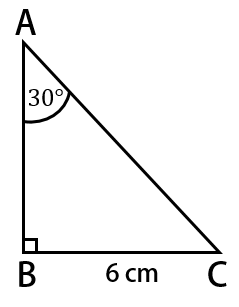 Since the known side length is $BC$ (the opposite side) and the side length being asked is $AC$ (the hypotenuse), the trigonometric ratio used is sine (op/hyp).
$\begin{aligned} \sin 30^{\circ} & = \dfrac{BC}{AC} \\ \dfrac12 & = \dfrac{6}{AC} \\ AC & = 6 \times \dfrac21 = 12~\text{cm} \end{aligned}$
Therefore, the side length $\boxed{AC = 12~\text{cm}}.$
(Answer C)
Question Number 11
The simplified form of $\sin \left(\dfrac{\pi}{2} + 2x\right) + \sin \left(\dfrac{\pi}{2} – 2x\right)$ is $\cdots \cdot$
A. $2 \sin 2x$ D. $2 \cos x$
B. $2 \cos 2x$ E. $\cos 2x$
C. $2 \sin x$
By using the concept of related-angle trigonometric ratios, we obtain
$\begin{aligned} & \sin \left(\dfrac{\pi}{2} + 2x\right) + \sin \left(\dfrac{\pi}{2} – 2x\right) \\ & = \sin (90^{\circ} + 2x) + \sin (90^{\circ} – 2x) \\ & = \cos 2x + \cos 2x = 2 \cos 2x \end{aligned}$
(Answer B)
Question Number 12
If $x+y+z=180^{\circ}$, the expression $\sin \dfrac12(y+z)$ is equivalent to $\cdots \cdot$
A. $\tan x$ D. $\sin \frac12x$
B. $\sin 2x$ E. $\cos \frac12x$
C. $\cos 2x$
The equation $x+y+z=180^{\circ}$ is equivalent to $y+z=180^{\circ}-x$, therefore
$\begin{aligned} \sin \dfrac12(y+z) & = \sin \dfrac12(180^{\circ} -x) \\ & = \sin \left(90 -\dfrac12x\right) \\ & = \cos \dfrac12x \end{aligned}$
Therefore, the expression $\sin \dfrac12(y+z)$ is equivalent to $\boxed{\cos \dfrac12x}.$
(Answer E)
Read: Trigonometric Equations: Definitions, Formulas, and Solved Problems
Question Number 13
In triangle $ABC$, the value of $\cot(A+B)=\cdots \cdot$
A. $\tan C$ D. $-\tan C$
B. $\cot C$ E. $-\cot C$
C. $-\cos C$
The sum of the three angles in a triangle is always $180^{\circ}$.
In triangle $ABC$, we have
$\begin{aligned} A + B + C & = 180^{\circ} \\ & \Leftrightarrow A + B & = 180^{\circ} -C. \end{aligned}$
Thus,
$\begin{aligned} \cot (A + B) & = \cot (180^{\circ} -C) \\ & = -\cot C. \end{aligned}$
Therefore, the value of $\boxed{\cot(A+B) = -\cot C}.$
(Answer E)
Question Number 14
If the acute angle $\alpha$ satisfies $\sin \alpha = \dfrac13\sqrt3$, the value of $\tan \left(\dfrac{\pi}{2} -\alpha\right)$ $+ 3 \cos \alpha = \cdots \cdot$
A. $3\sqrt2 + \sqrt3$ D. $\sqrt6 -\sqrt2$
B. $3\sqrt2 -\sqrt3$ E. $\sqrt3 + \sqrt2$
C. $\sqrt6 + \sqrt2$
It is known that $\sin \alpha = \dfrac13\sqrt3 = \dfrac{\sqrt3}{3}.$
Since the sine of an angle is the ratio between the length of the opposite side and the hypotenuse in a right triangle, we may assume that they are respectively $\text{op} = \sqrt3$ and $\text{hyp} = 3$, so by using the Pythagorean Theorem, the length of the adjacent side is
$\begin{aligned} \text{adj} & = \sqrt{(\text{hyp})^2-(\text{op})^2} \\ & = \sqrt{(3)^2 – (\sqrt3)^2} \\ & = \sqrt{9-3} = \sqrt6. \end{aligned}$
Since $\alpha$ is an acute angle, all trigonometric ratios are positive.
Thus,
$$\begin{aligned} \tan \left(\dfrac{\pi}{2} – \alpha\right) + 3 \cos \alpha & = \tan (90^{\circ} -\alpha) + 3 \cos \alpha \\ & = \cot \alpha + 3 \cos \alpha \\ & = \dfrac{\text{adj}}{\text{op}} + 3 \times \dfrac{\text{adj}}{\text{hyp}} \\ & = \dfrac{\sqrt6}{\sqrt3} + \cancel{3} \times \dfrac{\sqrt6}{\cancel{3}} \\ & = \sqrt2 + \sqrt6 \\ & = \sqrt6 + \sqrt2. \end{aligned}$$Therefore, the value of $\boxed{\tan \left(\dfrac{\pi}{2} -\alpha\right) + 3 \cos \alpha = \sqrt6 + \sqrt2}.$
(Answer C)
Question Number 15
If $\tan \alpha = \dfrac12$ and $\alpha$ is an acute angle, then the value of $2 \sin \alpha- \sin \left(\alpha +\dfrac{\pi}{2}\right)$ $+ \cos (\pi -\alpha) = \cdots \cdot$
A. $\dfrac25\sqrt5$ D. $-\dfrac25\sqrt5$
B. $\dfrac15\sqrt5$ E. $-\dfrac45\sqrt5$
C. $-\dfrac15\sqrt5$
It is known that $\tan \alpha = \dfrac12$.
Since the tangent of an angle is the ratio of the opposite side length to the adjacent side length in a right triangle, we may assume that they are respectively $\text{op} = 1$ and $\text{adj} = 3$ so that by using the Pythagorean Theorem, the hypotenuse length is
$\begin{aligned} \text{hyp} & = \sqrt{(\text{op})^2+(\text{adj})^2} \\ & = \sqrt{(1)^2 + (2)^2} \\ & = \sqrt{1+4} = \sqrt5. \end{aligned}$
Since $\alpha$ is an acute angle, all trigonometric ratios are positive.
Thus,
$$\begin{aligned} & 2 \sin \alpha -\sin \left(\alpha + \dfrac{\pi}{2}\right) + \cos (\pi -\alpha) \\ & = 2 \sin \alpha -\sin \left(\alpha + 90^{\circ}\right) + \cos (180^{\circ}- \alpha) \\ & = 2 \sin \alpha -\cos \alpha -\cos \alpha \\ & = 2 \sin \alpha -2 \cos \alpha \\ & = 2\left(\sin \alpha-\cos \alpha\right) \\ & = 2 \left(\dfrac{\text{op}}{\text{hyp}} -\dfrac{\text{adj}}{\text{hyp}}\right) \\ & = 2\left(\dfrac{1}{\sqrt5} -\dfrac{2}{\sqrt5}\right) = -\dfrac{2}{\sqrt5} = -\dfrac25\sqrt5. \end{aligned}$$Therefore, the value of $$\boxed{2 \sin \alpha -\sin \left(\alpha + \dfrac{\pi}{2}\right) + \cos (\pi -\alpha) = -\dfrac25\sqrt5}.$$(Answer D)
Question Number 16
Observe the following figure.
 It is known that the length $AC = p$ and $\angle BAC = \theta$. The length $DE = \cdots \cdot$
A. $p \sin \theta \cos \theta$ D. $p \sin \theta$
B. $p \sin^2 \theta \cos \theta$ E. $p \cos \theta$
C. $p \sin \theta \cos^2 \theta$
In right triangle $ABC$, we have
$\cos \theta = \dfrac{AB}{AC} = \dfrac{AB}{p} \Leftrightarrow AB = p \cos \theta.$
In right triangle $ABD$, we have
$\begin{aligned} \cos \theta & = \dfrac{AD}{AB} \\ AD & = AB \cos \theta \\ & = (p \cos \theta) \cos \theta = p \cos^2 \theta. \end{aligned}$
In right triangle $ADE$, we have
$\begin{aligned} \sin \theta & = \dfrac{DE}{AD} \\ DE & = AD \sin \theta \\ & = (p \cos^2 \theta) \sin \theta = p \sin \theta \cos^2 \theta. \end{aligned}$
Therefore, the length $\boxed{DE = p \sin \theta \cos^2 \theta}.$
(Answer C)
Read: Law of Sines: Formulas, Proofs, and Solved Problems
Question Number 17
In the following inequality, the angle measures are expressed in radians. The correct inequality is $\cdots \cdot$
A. $\sin 1 < \sin 2 < \sin 3$
B. $\sin 3 < \sin 2 < \sin 1$
C. $\sin 1 < \sin 3 < \sin 2$
D. $\sin 2 < \sin 1 < \sin 3$
E. $\sin 3 < \sin 1 < \sin 2$
It is known that
$\begin{aligned} 1~\text{rad} & \approx 57,\!3^{\circ} \\ 2~\text{rad} & \approx 114,\!6^{\circ} \\ 3~\text{rad} & \approx 171,\!9^{\circ}. \end{aligned}$
This means,
$$\begin{aligned} \sin 1 & \approx \sin 57,\!3^{\circ} \\ \sin 2 & \approx \sin 114,\!6^{\circ} = \sin (180-65,\!4)^{\circ} = \sin 65,\!4^{\circ} \\ \sin 3 & \approx \sin 171,\!9^{\circ} = \sin (180-8,\!1)^{\circ} = \sin 8,\!1^{\circ}. \end{aligned}$$In Quadrant I, the larger the angle, the larger the sine value approaching $1$. Thus, the order of the values written as an inequality is $\sin 8,1^{\circ} < \sin 57,3^{\circ} < \sin 65,4^{\circ}$ or in radians written as $\boxed{\sin 3 < \sin 1 < \sin 2}.$
(Answer E)
Question Number 18
The value of $\tan 25^{\circ} \cdot \tan 65^{\circ} -\dfrac{\sin 25^{\circ}}{\cos 65^{\circ}} = \cdots \cdot$
A. $-2$ C. $0$ E. $2$
B. $-1$ D. $1$
Using the concept of angle relations in trigonometric ratios,
$\boxed{\begin{aligned} \cot x & = \tan (90^{\circ} -x) \\ \sin x & = \cos (90^{\circ} -x) \end{aligned}},$
we obtain
$$\begin{aligned} & \tan 25^{\circ} \cdot \tan 65^{\circ} -\dfrac{\sin 25^{\circ}}{\cos 65^{\circ}} \\ & = \tan 25^{\circ} \cdot \tan (90^{\circ}-25^{\circ})-\dfrac{\sin 25^{\circ}}{\cos (90^{\circ}-25^{\circ})} \\ & = \tan 25^{\circ} \cdot \cot 25^{\circ} -\dfrac{\sin 25^{\circ}}{\sin 25^{\circ}} \\ & = 1 -1 = 0 \end{aligned}$$Therefore, the value of $\boxed{\tan 25^{\circ} \cdot \tan 65^{\circ}- \dfrac{\sin 25^{\circ}}{\cos 65^{\circ}} = 0}.$
(Answer C)
Question Number 19
If $\sin 70^{\circ} = p$ and $\cos 70^{\circ}=q$, the value of $\cos 110^{\circ} \cdot \cot 160^{\circ} +$ $\sin 200^{\circ} = \cdots \cdot$
A. $p-q$ D. $2q$
B. $p+q$ E. $2p-2q$
C. $2p$
Using the concept of angle relations in trigonometric ratios,
$\boxed{\begin{aligned} \sin (90^{\circ}- x) & = \cos x \\ \cot (90^{\circ} + x) & = -\tan x \\ \cos (180^{\circ} – x) & = -\cos x \\ \sin (180^{\circ}+x) & = -\sin x \end{aligned}},$
we obtain
$$\begin{aligned} & \cos 110^{\circ} \cdot \cot 160^{\circ} + \sin 200^{\circ} \\ & = \cos (180^{\circ}-70^{\circ}) \cdot \cot (90^{\circ} + 70^{\circ}) + \sin (180^{\circ}+20^{\circ}) \\ & = (-\cos 70^{\circ})(-\tan 70^{\circ})-\sin 20^{\circ} \\ & = \cancel{\cos 70^{\circ}} \cdot \dfrac{\sin 70^{\circ}}{\cancel{\cos 70^{\circ}}} -\sin (90^{\circ}-70^{\circ}) \\ & = \sin 70^{\circ}- \cos 70^{\circ} = p-q \end{aligned}$$Therefore, the value of $\boxed{\cos 110^{\circ} \cdot \cot 160^{\circ} + \sin 200^{\circ} = p-q}.$
(Answer A)
Read: Law of Cosines: Formulas, Proofs, and Solved Problems
Essay Section
Problem Number 1
It is known that triangle $DEF$ is right-angled at $F$. If $\cos (D + F) = p$, determine:
a. the value of $\sin D;$
b. the value of $\cos E.$
Answer a)
Since triangle $DEF$ is right-angled at $F$, the measure of angle $F = 90^{\circ}$ so that
$\begin{aligned} \cos (D + F) & = p \\ \cos (D + 90^{\circ}) & = p \\ -\sin D & = p \\ \sin D & = -p \end{aligned}$
Therefore, the value of $\boxed{\sin D = -p}.$
Answer b)
The sum of the angles in a triangle is $180^{\circ}$. In other words, it can be written as
$\begin{aligned} D + E +F & = 180^{\circ} \\ \Leftrightarrow E & = 180^{\circ} -D -F \end{aligned}$
Since the measure of angle $F = 90^{\circ}$, then $E = 90^{\circ} -D$ so that
$\cos E = \cos (90^{\circ} -D) = \sin D = -p.$
Therefore, the value of $\boxed{\cos E = -p}..$
Read: Triangle Area Rule in Trigonometry: Formulas, Proofs, and Solved Problems
Problem Number 2
Observe the figure below.
 Triangle $ABD$ is right-angled at $A$ and triangle $BCD$ is right-angled at $C$. Determine the length of $CD$.
In right triangle $ABD$, the length of $AD$ can be determined using the cosine trigonometric ratio.
$\begin{aligned} \cos 45^{\circ} & = \dfrac{AB}{BD} \\ \dfrac12\sqrt2 & = \dfrac{10}{BD} \\ BD & = 10 \times \dfrac{2}{\sqrt2} = 10\sqrt2~\text{cm} \end{aligned}$
In right triangle $BCD$, the length of $CD$ can also be determined using the cosine trigonometric ratio.
$\begin{aligned} \cos 60^{\circ} & = \dfrac{CD}{BD} \\ \dfrac12 & = \dfrac{CD}{10\sqrt2} \\ CD & = 10\sqrt2 \times \dfrac12 = 5\sqrt2~\text{cm} \end{aligned}$
Therefore, the length of $\boxed{CD = 5\sqrt2~\text{cm}}.$