
In mathematics, trigonometry is the branch of study that explores the relationship between angles and sides in a triangle. As one of the core topics taught in senior high school, trigonometry is often considered challenging by many students. This perception usually arises from the large number of unfamiliar terms and formulas that students believe they must memorize. In reality, however, students are not expected to memorize every formula mechanically. What truly matters is their ability to reason, understand concepts, and recognize the logic behind how each formula is derived.
This becomes a shared responsibility, especially for mathematics teachers, to create a more interactive and meaningful learning experience in the classroom. Trigonometry should not be taught merely as a collection of formulas written in textbooks, but as a fascinating mathematical concept that can be understood through exploration, visualization, and critical thinking. With the right teaching approach, students can develop a deeper understanding of trigonometry without feeling overwhelmed by memorization.
Today Quote
Trigonometry covers a long and fascinating journey, ranging from the most basic concepts to more advanced and complex topics. In this article, you will find practice problems and detailed explanations about the fundamentals of trigonometric ratios. The Solution focuses on angle concepts and the use of the six primary trigonometric ratios: sine, cosine, tangent, secant, cosecant, and cotangent.
Trigonometric Ratios
There are six types of trigonometric ratios: sine, cosine, tangent, cosecant, secant, and cotangent. These ratios describe the relationships between the lengths of the sides in a right triangle.
 In triangle $ABC$ with the right angle at $B$, the following relationships apply:
$\begin{aligned} \sin \alpha & = \dfrac{BC}{AC}~~~~~~\csc \alpha = \dfrac{AC}{BC} \\ \cos \alpha & = \dfrac{AB}{AC}~~~~~~\sec \alpha = \dfrac{AC}{AB} \\ \tan \alpha & = \dfrac{BC}{AB}~~~~~~\cot \alpha= \dfrac{AB}{BC} \end{aligned}$
Multiple Choice Section
Problem Number 1
The angle measure that corresponds to the figure below is $\cdots \cdot$

A. $30^{\circ}$ D. $330^{\circ}$
B. $60^{\circ}$ E. $390^{\circ}$
C. $300^{\circ}$
The angle formed moves clockwise, so its sign is negative, namely $-30^{\circ}.$ Since one full rotation equals $360^{\circ},$ then $-30^{\circ}$ is equivalent to $(360-30)^{\circ} = 330^{\circ}.$
Therefore, the angle measure is $\boxed{330^{\circ}}.$
(Answer D)
Read: Special Angle Trigonometry Problems with Detailed Explanations
Problem Number 2
The angle measure $\dfrac34\pi~\text{rad}$ is equal to $\cdots \cdot$
A. $75^{\circ}$ D. $210^{\circ}$
B. $105^{\circ}$ E. $270^{\circ}$
C. $135^{\circ}$
Recall that $\pi~\text{rad} = 180^{\circ}.$ Thus,
$\begin{aligned} \dfrac34\pi~\text{rad} & = \dfrac{3}{\cancel{4}} \times \cancelto{45}{180}^{\circ} \\ & = 3 \times 45^{\circ} = 135^{\circ}. \end{aligned}$
Therefore, the angle measure $\dfrac34\pi~\text{rad}$ is equal to $\boxed{135^{\circ}}.$
(Answer C)
Problem Number 3
The angle measure $72^{\circ}$ is equal to $\cdots~\text{rad}.$
A. $\dfrac15\pi$ D. $\dfrac34\pi$
B. $\dfrac25\pi$ E. $\dfrac56\pi$
C. $\dfrac23\pi$
Recall that $1^{\circ} = \dfrac{\pi}{180}~\text{rad}.$ Thus,
$\begin{aligned} 72^{\circ} & = \cancelto{2}{72} \times \dfrac{\pi}{\cancelto{5}{180}}~\text{rad} \\ & = \dfrac25\pi~\text{rad}. \end{aligned}$
Therefore, the angle measure $72^{\circ}$ is equal to $\boxed{\dfrac25\pi~\text{rad}}.$
(Answer B)
Problem Number 4
Observe the figure below.
 Triangle $ABC$ is right-angled at $C$. The following statements are correct, except $\cdots \cdot$
A. $\sin \alpha = \dfrac{BC}{AB}$
B. $\sin \beta = \dfrac{AC}{AB}$
C. $\cos \alpha = \dfrac{AC}{AB}$
D. $\cos \beta = \dfrac{BC}{AC}$
E. $\tan \alpha = \dfrac{BC}{AC}$
Based on the figure above, the trigonometric ratios for sine, cosine, and tangent of angles $\alpha$ and $\beta$ are as follows.
$\begin{aligned} \sin \alpha & = \dfrac{\text{opp}}{\text{hyp}} = \dfrac{BC}{AB} \\ \cos \alpha & = \dfrac{\text{adj}}{\text{hyp}} = \dfrac{AC}{AB} \\ \tan \alpha & = \dfrac{\text{opp}}{\text{adj}} = \dfrac{BC}{AC} \\ \sin \beta & = \dfrac{\text{opp}}{\text{hyp}} = \dfrac{AC}{AB} \\ \cos \beta & = \dfrac{\text{adj}}{\text{hyp}} = \dfrac{BC}{AB} \\ \tan \beta & = \dfrac{\text{opp}}{\text{adj}} = \dfrac{AC}{BC} \end{aligned}$
Therefore, among the five given statements (choices), the incorrect statement is option D.
Read: Applications of Trigonometric Identities – Formulas, Problems, and Step-by-Step Solutions
Problem Number 5
Observe the following figure.
 The value of $\cos \alpha$ is $\cdots \cdot$
A. 1 C. $\dfrac12\sqrt3$ E. $\dfrac13\sqrt3$
B. $\sqrt3$ D. $\dfrac12$
Using the Pythagorean theorem, the length of $c = AB$ can be determined as follows.
$\begin{aligned} c & = \sqrt{a^2+b^2} \\ & = \sqrt{(\sqrt3)^2+1^2} \\ & = \sqrt4=2 \end{aligned}$
The cosine of an angle is the ratio between the side adjacent to the angle and the hypotenuse of a right triangle. Therefore, $\boxed{\cos \alpha = \dfrac{b}{c} = \dfrac{1}{2}}.$
(Answer D)
Problem Number 6
Given the coordinates of point $A(-2\sqrt2,-2\sqrt2).$ The polar coordinates of point $A$ are $\cdots \cdot$
A. $(4,210^{\circ})$ D. $(5,240^{\circ})$
B. $(2,240^{\circ})$ E. $(4,225^{\circ})$
C. $(2,225^{\circ})$
It is known that $x = y = -2\sqrt2.$ The polar coordinates are written in the form $(r, \theta)$ with
$\begin{aligned} r & = \sqrt{x^2+y^2} \\ & = \sqrt{(-2\sqrt2)^2+(-2\sqrt2)^2} \\ & = \sqrt{8+8} = 4. \end{aligned}$
and
$\begin{aligned} & \tan \theta = \dfrac{y} {x} = \dfrac{-2\sqrt2}{-2\sqrt2} = 1 \\ & \Rightarrow \theta = 45^{\circ} \lor 225^{\circ}. \end{aligned}$
Since point $A$ lies in quadrant III (both $x$ and $y$ are negative), then $\theta = 225^{\circ}.$ Therefore, the polar coordinates of $A(-2\sqrt2,-2\sqrt2)$ are $\boxed{(4, 225^{\circ})}.$
(Answer E)
Problem Number 7
Triangle $KLM$ has coordinates $K(-5, -2),$ $L(3, -2),$ and $M(-5,4).$ The values of $\cos L$ and $\tan M$ respectively are $\cdots \cdot$
A. $\dfrac35$ and $\dfrac34$
B. $\dfrac34$ and $\dfrac35$
C. $\dfrac34$ and $\dfrac43$
D. $\dfrac45$ and $\dfrac34$
E. $\dfrac45$ and $\dfrac43$
First, sketch triangle $KLM$ on the Cartesian coordinate system as follows.

It can be seen that triangle $KLM$ is a right triangle (at $L$).
From the figure above, it is known that $KL = 3 -(-5) = 8;$ $KM = 4 -(-2) = 6.$
Using the Pythagorean theorem, we obtain
$\begin{aligned} LM & = \sqrt{KL^2 + KM^2} \\ & = \sqrt{8^2 + 6^2} \\ & = \sqrt{64+36} = \sqrt{100} = 10. \end{aligned}$
Therefore,
$\begin{aligned} \cos L & = \dfrac{KL}{LM} = \dfrac{8}{10} = \dfrac45 \\ \tan M & = \dfrac{KL}{KM} = \dfrac86 = \dfrac43. \end{aligned}$
Therefore, the values of $\cos L$ and $\tan M$ respectively are $\boxed{\dfrac45}$ and $\boxed{\dfrac43}.$
(Answer E)
Problem Number 8
It is known that triangle $PQR$ has coordinates $P(-3,2),$ $Q(-3, -2),$ and $R(3,2).$ The value of $\dfrac{3 \sec R}{\csc Q} = \cdots \cdot$
A. $1$ D. $\sqrt{13}$
B. $2$ E. $2\sqrt{13}$
C. $3$
First, sketch triangle $KLM$ on the Cartesian coordinate system as follows.
 It can be seen that triangle $PQR$ is a right triangle (at $P$).
Without analyzing further about the side lengths of triangle $PQR$, we can actually directly calculate the value of $\dfrac{3 \sec R}{\csc Q}$ as follows by remembering that secant is the reciprocal of cosine (hyp/adj), while cosecant is the reciprocal of sine (hyp/opp). Therefore,
$\dfrac{3 \sec R}{\csc Q} = \dfrac{3 \times \cancel{\dfrac{QR}{PR}}}{\cancel{\dfrac{QR}{PR}}} = 3.$
(Answer C)
Problem Number 9
It is known that $\triangle ABC$ is right-angled at $B$. If $\cos A = \dfrac34,$ then the value of $\cot A = \cdots \cdot$
A. $\sqrt{7}$ D. $\dfrac34\sqrt7$
B. $\dfrac37\sqrt7$ E. $\dfrac43\sqrt7$
C. $\dfrac47\sqrt7$
The cosine of an angle is the ratio of the side adjacent to the angle to the hypotenuse in a right triangle.
Therefore, $\cos A = \dfrac{3}{4} = \dfrac{AB}{AC}.$
Suppose $AB = 3$ and $AC = 4,$ then by using the Pythagorean theorem, we obtain
$\begin{aligned} BC & = \sqrt{AC^2 -AB^2} \\ & = \sqrt{(4)^2-(3)^2} = \sqrt{7}. \end{aligned}$
The cotangent of an angle is the ratio of the side adjacent to the angle to the side opposite the angle in a right triangle.
Therefore, $\cot A = \dfrac{AB}{BC} = \dfrac{3}{\sqrt7} = \dfrac37\sqrt7.$
Therefore, the value of $\boxed{\cot A = \dfrac37\sqrt7}.$
(Answer B)
Problem Number 10
It is known that $P$ is an acute angle. If $\tan P = \dfrac{5\sqrt{11}}{11},$ then the value of $\sin P = \cdots \cdot$
A. $\dfrac{5}{\sqrt{11}}$ D. $\dfrac{\sqrt{11}}{5}$
B. $\dfrac{6}{\sqrt{11}}$ E. $\dfrac{\sqrt{11}}{6}$
C. $\dfrac56$
Since $P$ is an acute angle, all trigonometric ratios are positive.
The tangent of an angle is the ratio of the side opposite the angle to the side adjacent to the angle in a right triangle.
Therefore, $\tan P = \dfrac{5\sqrt{11}}{11} = \dfrac{\text{opp}}{\text{adj}}.$
Suppose $\text{opp} = 5\sqrt{11}$ and $\text{adj} = 11,$ then using the Pythagorean theorem, the hypotenuse length is obtained as follows:
$\begin{aligned} \text{hyp} & = \sqrt{(\text{opp})^2 + (\text{adj})^2} \\ & = \sqrt{(5\sqrt{11})^2 + (11)^2} \\ &= \sqrt{275 + 121} \\ & = \sqrt{396} \\ & = \sqrt{36 \times 11} = 6\sqrt{11}. \end{aligned}$
The sine of an angle is the ratio of the side opposite the angle to the hypotenuse in a right triangle.
Therefore, $\sin P = \dfrac{\text{opp}}{\text{hyp}} = \dfrac{5\cancel{\sqrt{11}}}{6\cancel{\sqrt{11}}} = \dfrac56.$
Therefore, the value of $\boxed{\sin P = \dfrac56}.$
(Answer C)
Problem Number 11
It is known that $\triangle ABC$ is right-angled at $C.$ If $\sin B = p,$ then the value of $\tan B = \cdots \cdot$
A. $\dfrac{p}{\sqrt{1-p^2}}$
B. $\dfrac{1}{\sqrt{1-p^2}}$
C. $\dfrac{1}{\sqrt{p^2-1}}$
D. $\dfrac{p}{\sqrt{p^2-1}}$
E. $\dfrac{\sqrt{1-p^2}}{p}$
Observe the following sketch of right triangle $ABC$.
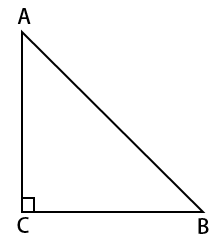 Since $\sin B = p = \dfrac{p}{1} = \dfrac{AC}{AB}$, we may suppose that $AC = p$ and $AB = 1,$ so by using the Pythagorean theorem, we obtain
$\begin{aligned} BC & = \sqrt{AB^2 -AC^2} \\ & = \sqrt{(1)^2-p^2} \\ & = \sqrt{1-p^2}. \end{aligned}$
Thus, $\tan B = \dfrac{\text{opp}}{\text{adj}} = \dfrac{AC}{BC} = \dfrac{p}{\sqrt{1-p^2}}.$
Therefore, the value of $\boxed{\tan B = \dfrac{p}{\sqrt{1-p^2}}}.$
(Answer A)
Read: Proofs of Trigonometric Identities: Formulas, Methods, and Solved Problems
Problem Number 12
Observe $\triangle KLM$ below.
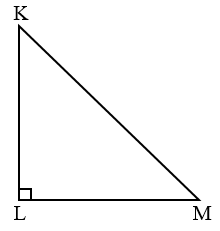 If $\cos K = \dfrac{1}{a}$, then the value of $\sin K \tan K = \cdots \cdot$
A. $\dfrac{a^2+1}{a}$
B. $\dfrac{a^2-1}{a}$
C. $\dfrac{a}{a^2-1}$
D. $\dfrac{a}{a^2+1}$
E. $\dfrac{a^2-1}{a^2+1}$
The cosine of an angle is the ratio of the side adjacent to the angle to the hypotenuse in a right triangle.
Therefore, $\cos K = \dfrac{1}{a} = \dfrac{KL}{KM}.$
Suppose $KL = 1$ and $KM = a$, then using the Pythagorean theorem, we obtain
$\begin{aligned} LM & = \sqrt{KM^2 -KL^2} \\ & = \sqrt{a^2-(1)^2} \\ & = \sqrt{a^2-1}. \end{aligned}$
The sine of an angle is the ratio of the side opposite the angle to the hypotenuse in a right triangle, while the tangent of an angle is the ratio of the side opposite the angle to the adjacent side in a right triangle. Therefore,
$\begin{aligned} \sin K \tan K & = \dfrac{LM}{KM} \times \dfrac{LM}{KL} \\ & = \dfrac{\sqrt{a^2-1}}{a} \times \dfrac{\sqrt{a^2-1}}{1} \\ & = \dfrac{a^2-1}{a}. \end{aligned}$
Therefore, the value of $\boxed{\sin K \tan K = \dfrac{a^2-1}{a}}.$
(Answer B)
Problem Number 13
Based on the figure below, if $\cos \theta = \dfrac23$, then the value of $x$ that satisfies is $\cdots \cdot$
 A. $3\sqrt5$ D. $6\sqrt5$
B. $4\sqrt5$ E. $7\sqrt5$
C. $5\sqrt5$
Without paying attention to the given right triangle figure, the length of the side opposite angle $\theta$ can be calculated using the Pythagorean theorem.
In this case, since $\cos \theta = \dfrac23$, let $\text{adj} = 2$ and $\text{hyp} = 3$ so that $\text{opp} = \sqrt{3^2 -2^2} = \sqrt5.$
Thus, $\sin \theta = \dfrac{\text{opp}}{\text{hyp}} = \dfrac{\sqrt5}{3}.$ Based on the given figure, it must be that $\sin \theta=\dfrac{5}{x}.$ Consequently,
$\dfrac{\sqrt5}{3} = \dfrac{5}{x} \Leftrightarrow \dfrac{\cancel{5}}{3\sqrt5} = \dfrac{\cancel{5}}{x}.$
Therefore, the value of $x$ is $\boxed{3\sqrt5}.$
(Answer A)
Problem Number 14
If $\tan \alpha = \dfrac{1}{a}$ with $0^{\circ} < \alpha < 90^{\circ},$ then the value of $\cos \alpha -\dfrac{1}{\sin \alpha}$ is equal to $\cdots \cdot$
A. $\dfrac{a^2+a+1}{\sqrt{1+a^2}}$
B. $\dfrac{a^2+a-1}{\sqrt{1+a^2}}$
C. $\dfrac{a^2-a+1}{\sqrt{1+a^2}}$
D. $\dfrac{a^2-a-1}{\sqrt{1+a^2}}$
E. $\dfrac{-a^2+a-1}{\sqrt{1+a^2}}$
Since $\alpha$ is in quadrant I, all trigonometric ratios are positive.
It is known that $\tan \alpha = \dfrac{\text{opp}}{\text{adj}} = \dfrac{1}{a}$ so that we may suppose the length of the side opposite the angle is $\text{opp} = 1$ and the length of the adjacent side is $\text{adj} = a.$
Thus, the hypotenuse length of the right triangle is
$\begin{aligned} \text{hyp} & = \sqrt{(\text{opp})^2+(\text{adj})^2} \\ & = \sqrt{1^2+a^2}. \end{aligned}$
Therefore, we obtain
$$\begin{aligned} \cos \alpha -\dfrac{1}{\sin \alpha} & = \dfrac{\text{adj}}{\text{hyp}} -\dfrac{\text{hyp}}{\text{opp}} \\ & = \dfrac{a}{\sqrt{1+a^2}}- \dfrac{\sqrt{1+a^2}}{1} \\ & = \dfrac{a -(a^2+1)}{\sqrt{a^2+1}} \\ & = \dfrac{-a^2+a-1}{\sqrt{a^2+1}}. \end{aligned}$$Therefore, the value of $\boxed{\cos \alpha -\dfrac{1}{\sin \alpha} = \dfrac{-a^2+a-1}{\sqrt{a^2+1}}}.$
(Answer E)
Problem Number 15
Triangle $KLM$ is right-angled at $L.$ If $\sin M = \dfrac23$ and $KL = \sqrt{20}~\text{cm},$ then the side length $KM = \cdots~\text{cm}.$
A. $2\sqrt5$ D. $3\sqrt{10}$
B. $3\sqrt5$ E. $4\sqrt{10}$
C. $2\sqrt{10}$
Observe the following sketch.
 The sine of an angle is the ratio of the side opposite the angle to the hypotenuse in a right triangle. Thus, it can be written as
$\begin{aligned} \sin M & = \dfrac23 \\ \dfrac{KL}{KM} & = \dfrac23 \\ \dfrac{\sqrt{20}}{KM} & = \dfrac23 \\ KM & = \dfrac{3\sqrt{20}}{2} = \dfrac{3 \times \cancel{2}\sqrt5}{\cancel{2}} \\ & = 3\sqrt5~\text{cm}. \end{aligned}$
Therefore, the side length $\boxed{KM = 3\sqrt5~\text{cm}}.$
(Answer B)
Problem Number 16
Triangle $DEF$ has altitude side $DF.$ If the area of the triangle is $9~\text{cm}^2$ and the length $EF = 3~\text{cm},$ then the value of $\cos E = \cdots \cdot$
A. $\dfrac15\sqrt5$ D. $\dfrac45\sqrt5$
B. $\dfrac25\sqrt5$ E. $\sqrt5$
C. $\dfrac35\sqrt5$
Observe the following sketch.
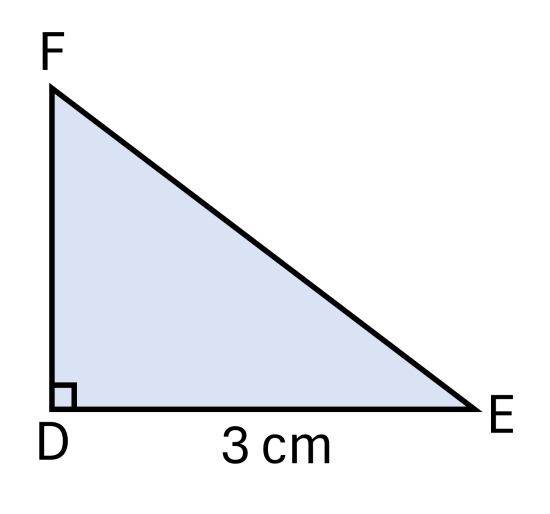 Since the area of triangle $DEF$ is $9~\text{cm}^2,$ by using the triangle area formula, we obtain
$\begin{aligned} L_{\triangle DEF} & = \dfrac{DE \times DF}{2} \\ 9 & = \dfrac{3 \times DF}{2} \\ DF & = \dfrac{9 \times 2}{3} = 6~\text{cm}. \end{aligned}$
Next, using the Pythagorean theorem, we obtain
$\begin{aligned} EF & = \sqrt{DE^2 + DF^2} \\ & = \sqrt{3^2+6^2} \\ & = \sqrt{9+36} = \sqrt{45} = 3\sqrt5~\text{cm}. \end{aligned}$
Thus,
$\begin{aligned} \cos E & = \dfrac{\text{adj}}{\text{hyp}} = \dfrac{DE}{EF} \\ & = \dfrac{\cancel{3}}{\cancel{3}\sqrt5} = \dfrac15\sqrt5~\text{cm}. \end{aligned}$
Therefore, the value of $\boxed{\cos E = \dfrac15\sqrt5~\text{cm}}.$
(Answer A)
Problem Number 17
Based on the figure below, the value of the ratio $\sin^2 \theta$ is $\cdots \cdot$
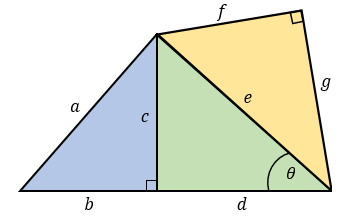 A. $\dfrac{a^2-d^2}{f^2+g^2}$
B. $\dfrac{a^2+b^2}{f^2+g^2}$
C. $\dfrac{a^2-b^2}{f^2-g^2}$
D. $\dfrac{a^2+b^2}{f^2-g^2}$
E. $\dfrac{a^2-b^2}{f^2+g^2}$
Notice that by using the Pythagorean theorem, we obtain the following two equations.
$\begin{cases} c^2 & = a^2 -b^2 \\ e^2 & = f^2 + g^2 \end{cases}$
Thus, we obtain
$\sin^2 \theta = \dfrac{c^2}{e^2} = \dfrac{a^2-b^2}{f^2+g^2}.$
(Answer E)
Problem Number 18
If $\tan x = -\dfrac23$, then the value of $\dfrac{5 \sin x + 6 \cos x}{2 \cos x -3 \sin x}$ is $\cdots \cdot$
A. $-\dfrac76$ C. $\dfrac13$ E. $\dfrac76$
B. $-\dfrac23$ D. $\dfrac23$
To obtain the form of $\tan x$, note that $\dfrac{\sin x}{\cos x} = \tan x$, so we need to divide both the numerator and denominator by $\cos x.$ Thus,
$$\begin{aligned} \dfrac{5 \sin x + 6 \cos x}{2 \cos x -3 \sin x} & = \dfrac{\dfrac{5 \sin x}{\cos x} + \dfrac{6 \cos x}{\cos x}}{\dfrac{2 \cos x}{\cos x} -\dfrac{3 \sin x}{\cos x}} \\ & = \dfrac{5 \tan x + 6}{2 -3 \tan x} \\ & = \dfrac{5\left(-\dfrac23\right) + 6}{2 -3\left(-\dfrac23\right)} \\ & = \dfrac{\frac83}{4} = \dfrac{8}{12} = \dfrac23. \end{aligned}$$Thus, the value of $\boxed{\dfrac{5 \sin x + 6 \cos x}{2 \cos x -3 \sin x} = \dfrac23}.$
(Answer D)
Problem Number 19
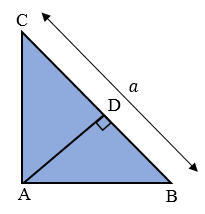
In the right triangle $ABC$ below, the length of $BC = a$ and $\angle ABC = \beta.$ The length of altitude $AD = \cdots \cdot$
 A. $\sin^2 \beta \cos \beta$
B. $a \sin \beta \cos \beta$
C. $a \sin^2 \beta$
D. $a \sin \beta \cos^2 \beta$
E. $a \sin \beta$
Consider the right triangle $ABC.$
Using the cosine ratio, we have
$\begin{aligned} \cos \beta & = \dfrac{AB}{BC} = \dfrac{AB}{a} \\ AB & = a \cos \beta. \end{aligned}$
Now consider the right triangle $ABD$ (right angle at $D$).
Using the sine ratio, we have
$\begin{aligned} \sin \beta & = \dfrac{AD}{AB} \\ AD & = AB \sin \beta \\ AD & = (a \cos \beta) \sin \beta = a \sin \beta \cos \beta. \end{aligned}$
Thus, the length of the altitude is $\boxed{AD = a \sin \beta \cos \beta}.$
(Answer B)
Problem Number 20
Observe the figure below.
 Quadrilateral $ABCD$ has right angles at $A$ and $C.$ Given that $\angle ABD = \alpha, \angle CBD = \beta,$ and the length of $AD = p.$ The length of side $BC$ is $\cdots \cdot$
A. $p \sin \alpha \cos \beta$
B. $p \cos \alpha \sin \beta$
C. $\dfrac{p \sin \alpha}{\cos \beta}$
D. $\dfrac{p \cos \beta}{\sin \alpha}$
E. $\dfrac{p \sin \beta}{\sin \alpha}$
Consider the right triangle $ABD.$
The sine value of angle alpha is given by
$\sin \alpha = \dfrac{AD}{BD} \Leftrightarrow BD = \dfrac{AD}{\sin \alpha} = \dfrac{p}{\sin \alpha}.$
Consider the right triangle $BCD.$
The cosine value of angle beta is given by $\cos \beta = \dfrac{BC}{BD}$, so we obtain
$\begin{aligned} BC & = \cos \beta \cdot BD \\ & = \cos \beta \cdot \dfrac{p}{\sin \alpha} \\ & = \dfrac{p \cos \beta}{\sin \alpha}. \end{aligned}$
Thus, the length of the side is $\boxed{BC = \dfrac{p \cos \beta}{\sin \alpha}}.$
(Answer D)
Read: Trigonometric Equations: Definitions, Formulas, and Solved Problems
Essay Section
Problem Number 1
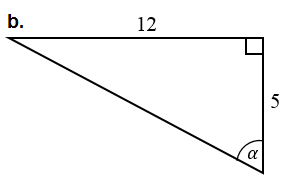
Determine the values of $\sin \alpha$, $\cos \alpha$, $\tan \alpha,$ $\sec \alpha,$ $\csc \alpha,$ and $\cot \alpha$ in the following triangles.

c.
Answer a)
From the given figure, it is known that the lengths of the side adjacent to angle alpha and the hypotenuse in the right triangle are respectively $\text{sa} = 12$ and $\text{mi} = 15.$
Using the Pythagorean theorem, the length of the side opposite angle $\alpha$ is obtained, namely
$\begin{aligned} \text{de} & = \sqrt{15^2-12^2} \\ & = \sqrt{225-144} = \sqrt{81} = 9. \end{aligned}$
Therefore, we obtain
$\begin{aligned} \sin \alpha & = \dfrac{\text{de}}{\text{mi}} = \dfrac{9}{15} = \dfrac35 \\ \cos \alpha & = \dfrac{\text{sa}}{\text{mi}} = \dfrac{12}{15} = \dfrac45 \\ \tan \alpha & = \dfrac{\text{de}}{\text{sa}} = \dfrac{9}{12} = \dfrac34 \\ \csc \alpha & = \dfrac{\text{mi}}{\text{de}} = \dfrac{15}{9} = \dfrac53 \\ \sec \alpha & = \dfrac{\text{mi}}{\text{sa}} = \dfrac{15}{12} = \dfrac54 \\ \cot \alpha & = \dfrac{\text{sa}}{\text{de}} = \dfrac{12}{9} = \dfrac43. \end{aligned}$
Answer b)
From the given figure, it is known that the lengths of the opposite side and adjacent side to angle alpha in the right triangle are respectively $\text{de} = 12$ and $\text{sa} =5.$ Using the Pythagorean theorem, the length of the hypotenuse is obtained, namely
$\begin{aligned} \text{mi} & = \sqrt{12^2+5^2} \\ & = \sqrt{144+25} = \sqrt{169} = 13. \end{aligned}$
Therefore, we obtain
$\begin{aligned} \sin \alpha & = \dfrac{\text{de}}{\text{mi}} = \dfrac{12}{13} \\ \cos \alpha & = \dfrac{\text{sa}}{\text{mi}} = \dfrac{5}{13} \\ \tan \alpha & = \dfrac{\text{de}}{\text{sa}} = \dfrac{12}{5} \\ \csc \alpha & = \dfrac{\text{mi}}{\text{de}} = \dfrac{13}{12} \\ \sec \alpha & = \dfrac{\text{mi}}{\text{sa}} = \dfrac{13}{5} \\ \cot \alpha & = \dfrac{\text{sa}}{\text{de}} = \dfrac{5}{12}.\end{aligned}$
Answer c)
Redraw the figure by labeling its vertices as shown below.
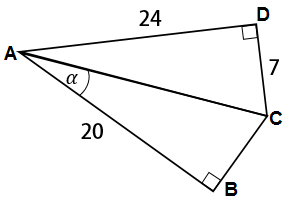 The length of $AC$ can be determined using the Pythagorean theorem, namely
$\begin{aligned} AC & = \sqrt{AD^2 + CD^2} \\ & = \sqrt{24^2+7^2} \\ & = \sqrt{576+49} = \sqrt{625} = 25. \end{aligned}$
The length of $BC$ can also be determined using the Pythagorean theorem, namely
$\begin{aligned} BC & = \sqrt{AC^2 -AB^2} \\ & = \sqrt{25^2-20^2} \\ & = \sqrt{625-400} = \sqrt{225} = 15. \end{aligned}$
From here, it is known that the lengths of the side opposite angle alpha, the side adjacent to angle alpha, and the hypotenuse in $\triangle ABC$ are respectively
$\text{de} = 15~~~\text{sa} = 20~~~\text{mi} = 25.$
Therefore, we obtain
$\begin{aligned} \sin \alpha & = \dfrac{\text{de}}{\text{mi}} = \dfrac{15}{25} = \dfrac35 \\ \cos \alpha & = \dfrac{\text{sa}}{\text{mi}} = \dfrac{20}{25} = \dfrac45 \\ \tan \alpha & = \dfrac{\text{de}}{\text{sa}} = \dfrac{15}{20} = \dfrac34 \\ \csc \alpha & = \dfrac{\text{mi}}{\text{de}} = \dfrac{25}{15} = \dfrac53 \\ \sec \alpha & = \dfrac{\text{mi}}{\text{sa}} = \dfrac{25}{20} = \dfrac54 \\ \cot \alpha & = \dfrac{\text{sa}}{\text{de}} = \dfrac{20}{15} = \dfrac43. \end{aligned}$
Problem Number 2
Triangle $KLM$ is right-angled at $K.$ If $\sin L = 0,\!28,$ determine:
a. $\tan L;$
b. $\tan M.$
Observe the following sketch.
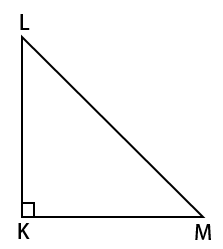 Since $\sin L = 0,\!28,$ we get
$\begin{aligned} \sin L & = \dfrac{28}{100} \\ \dfrac{KM}{ML} & = \dfrac{7}{25}. \end{aligned}$
Suppose $KM = 7$ and $ML = 25,$ then using the Pythagorean theorem, we obtain
$\begin{aligned} KL & = \sqrt{ML^2-KM^2} \\ & = \sqrt{25^2-7^2} \\ & = \sqrt{625-49} = \sqrt{576} = 24. \end{aligned}$
Answer a)
$\tan L = \dfrac{KM}{KL} = \dfrac{7}{24}.$
Answer b)
$\tan M = \dfrac{KL}{KM} = \dfrac{24}{7}.$
Problem Number 3
Observe the following right triangle.
 Prove the following statements.
a. $\sin^2 C + \cos^2 C = 1$
b. $\csc^2 A -\cot^2 A = 1$
Based on the Pythagorean theorem, $b^2=a^2+c^2.$
Answer a)
Proof of the left-hand side.
$$\begin{aligned} \sin^2 C + \cos^2 C & = \left(\dfrac{AB}{AC}\right)^2 + \left(\dfrac{BC}{AC}\right)^2 \\ & = \left(\dfrac{c}{b}\right)^2 + \left(\dfrac{a}{b}\right)^2 \\ & = \dfrac{c^2 + a^2}{b^2} \\ &= \dfrac{b^2}{b^2} = 1 \end{aligned}$$Answer b)
Proof of the left-hand side.
$$\begin{aligned} \csc^2 C -\cot^2 C & = \left(\dfrac{AC}{AB}\right)^2- \left(\dfrac{BC}{AB}\right)^2 \\ & = \left(\dfrac{b}{c}\right)^2 -\left(\dfrac{a}{c}\right)^2 \\ & = \dfrac{b^2 -a^2}{c^2} \\ &= \dfrac{c^2}{c^2} = 1 \end{aligned}$$
Read: Law of Sines: Formulas, Proofs, and Solved Problems
Problem Number 4
Observe the following figure.
 If the length of $AD = 1~\text{cm}$, show that the length of $BD = \dfrac{\tan \alpha}{\tan \beta -\tan \alpha}~\text{cm}.$
The tangent of an angle is the ratio of the side opposite the angle to the side adjacent to the angle in a right triangle. In triangle $ABC$, we obtain
$$\begin{aligned} \tan \alpha & = \dfrac{BC}{AB} = \dfrac{BC}{AD + BD} = \dfrac{BC}{1 + BD} \\ BC & = \tan \alpha(1 + BD) \\ BC & = \color{red}{\tan \alpha + BD \tan \alpha} \end{aligned}$$In triangle $DBC$, we obtain
$$\begin{aligned} \tan \beta & = \dfrac{BC}{BD} \\ \tan \beta & = \dfrac{ \color{red}{\tan \alpha + BD \tan \alpha}}{BD} \\ BD \tan \beta & = \tan \alpha + BD \tan \alpha \\ BD(\tan \beta -\tan \alpha) & = \tan \alpha \\ BD & = \dfrac{\tan \alpha}{\tan \beta -\tan \alpha}~\text{cm}. \end{aligned}$$(Proven)
Problem Number 5
It is known that square $ABCD$ has side length $6a$ units. Its two diagonals intersect at point $O.$ If point $P$ lies on diagonal $AC$ with ratio $OP : PC = 1 : 2,$ determine the value of $\sin \angle PBO.$
Observe the following sketch.
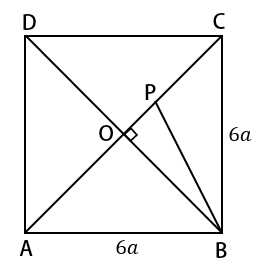 Based on the properties of a square, its two diagonals must intersect perpendicularly at the midpoint, namely point $O.$
The diagonal length $AC = BD$ can be determined using the Pythagorean theorem, for example by considering right triangle $ABD.$
$\begin{aligned} AC = BD & = \sqrt{AB^2+AD^2} \\ & = \sqrt{(6a)^2 + (6a)^2} \\ & = \sqrt{(6a)^2(1+1)} \\ & = 6a\sqrt2~\text{units} \end{aligned}$
Point $P$ lies on $AC$ with ratio $OP : PC = 1 : 2.$
Since $AC = 6a\sqrt2$, then the length $OC = 3a\sqrt2$ (half of $AC$).
Based on the ratio, we obtain
$\begin{aligned} OP & = \dfrac{1}{1+2} \times OC \\ & = \dfrac13 \times 3a\sqrt2 = a\sqrt2. \end{aligned}$
Now consider right triangle $BOP$ as illustrated below.
 The length $BP$ can be determined using the Pythagorean theorem as follows.
$\begin{aligned} BP & = \sqrt{BO^2 + OP^2} \\ & = \sqrt{(3a\sqrt2)^2 + (a\sqrt2)^2} \\ & = \sqrt{18a^2 + 2a^2} = \sqrt{20a^2} \\ & = 2a\sqrt5~\text{units} \end{aligned}$
Thus,
$\begin{aligned} \sin \angle PBO & = \dfrac{OP}{BP} = \dfrac{a\sqrt2}{2a\sqrt5} \\ & = \dfrac{\sqrt2}{2\sqrt5} = \dfrac{1}{10}\sqrt{10}. \end{aligned}$
Therefore, the value of $\boxed{\sin \angle PBO = \dfrac{1}{10}\sqrt{10}}$
Read: Law of Cosines: Formulas, Proofs, and Solved Problems
Problem Number 6
The following figure is a unit circle and an intersecting triangle. The bolded line segments form a right trapezoid. Determine the area of the trapezoid.
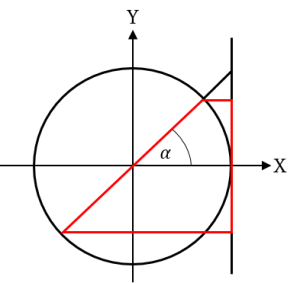
Observe the following trapezoid sketch.
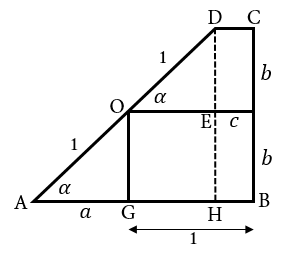 In right triangle $AGO$, it holds that $$\cos \alpha = \dfrac{a}{1} = a.$$In right triangle $OED$, it holds that $$\cos \alpha = \dfrac{1-c}{1} \Leftrightarrow c = 1-\cos \alpha.$$In right triangle $AHD$, it holds that $$\sin \alpha = \dfrac{2b}{2} = b.$$Thus, the area of the trapezoid is
$$\begin{aligned} L & = \dfrac{AB + DC}{2} \times BC \\ & = \dfrac{(a+1) + c}{\cancel{2}} \times \cancel{2}b \\ & = \left(\cos \alpha + 1 + (1-\cos \alpha)\right) \times \sin \alpha \\ & = 2 \sin \alpha. \end{aligned}$$Therefore, the area of the trapezoid is $\boxed{2 \sin \alpha}.$
Problem Number 7
A person is at height $h$ above the surface of a lake. Above the person, a bird is seen at an angle of elevation $\alpha$ and its reflection in the water is seen at an angle of depression $\beta$ as shown in the figure below.
 What is the flying height of the bird?
Observe the following sketch.
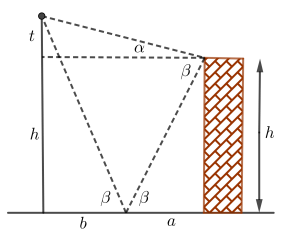 From the figure above, it holds that
$$\begin{aligned} \tan \alpha & = \dfrac{t}{a+b} \Leftrightarrow \color{blue}{a+b = \dfrac{t}{\tan \alpha}} && (\cdots 1) \\ \tan \beta & = \dfrac{h}{a} && (\cdots 2) \\ \tan \beta & = \dfrac{h+t}{b}. && (\cdots 3) \end{aligned}$$From Equations $(2)$ and $(3),$ we obtain
$$\begin{aligned} \tan \beta & = \dfrac{h+(h+t)}{a+b} \\ \tan \beta & = \dfrac{2h+t}{a+b} \\ \color{blue}{(a+b)} \tan \beta & = 2h+t \\ \dfrac{t}{\tan \alpha} \cdot \tan \beta & = 2h+t \\ t \left(\dfrac{\tan \beta}{\tan \alpha}-1\right) & = 2h \\ t\left(\dfrac{\tan \beta-\tan \alpha}{\tan \alpha}\right) & = 2h \\ t & = \dfrac{2h \tan \alpha}{\tan \beta-\tan \alpha}. \end{aligned}$$Since the bird’s height above the water/ground surface is equal to $t + h$, we obtain
$$\begin{aligned} \text{Bird Height} & = \dfrac{2h \tan \alpha}{\tan \beta-\tan \alpha} + h \\ & = \dfrac{2h \tan \alpha}{\tan \beta-\tan \alpha} + \dfrac{h(\tan \beta- \tan \alpha)}{\tan \beta-\tan \alpha} \\ & = \dfrac{h(2 \tan \alpha+\tan \beta-\tan \alpha)}{\tan \beta-\tan \alpha} \\ & = \dfrac{\tan \alpha+\tan \beta}{\tan \beta-\tan \alpha} \cdot h. \end{aligned}$$Therefore, the bird’s height is $\boxed{\dfrac{\tan \alpha+\tan \beta}{\tan \beta-\tan \alpha} \cdot h}.$
Read: Triangle Area Rule in Trigonometry: Formulas, Proofs, and Solved Problems
Problem Number 8
Inside a right triangle $ABC$ there is a square as shown in the figure below.
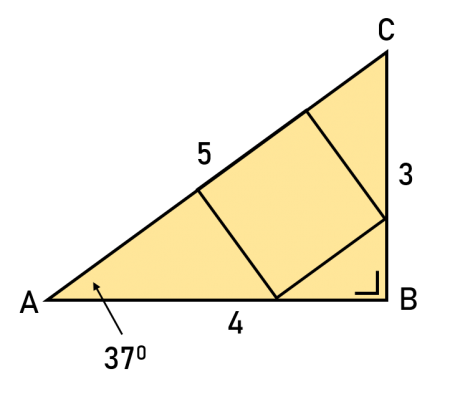 It is known that angle $A$ is approximately $37^\circ.$ Determine the side length of the square.
In the triangle, it holds that
$$\begin{aligned} \sin 37^\circ & = \dfrac{BC}{AC} = \dfrac35 \\ \cos 37^\circ & = \dfrac{AB}{AC} = \dfrac45. \end{aligned}$$Suppose the side length of the square = $s.$
Position points $D, E, F$ as shown in the figure below. Also suppose $CE = x$ and $EB = y$ so that $x + y = BC = 3.$ In triangle $CDE,$ we obtain
$$\begin{aligned} \cos 37^\circ & = \dfrac{DE}{CE} \\ \dfrac45 & = \dfrac{s}{x} \\ x & = \dfrac54s. \end{aligned}$$In triangle $FBE,$ we obtain
$$\begin{aligned} \sin 37^\circ & = \dfrac{EB}{FE} \\ \dfrac35 & = \dfrac{y}{s} \\ y & = \dfrac35s. \end{aligned}$$Thus,
$$\begin{aligned} x + y & = 3 \\ \dfrac54s + \dfrac35s & = 3 \\ \dfrac{25+12}{20}s & = 3 \\ \dfrac{37}{20}s & = 3 \\ s & = \dfrac{60}{37}. \end{aligned}$$Therefore, the side length of the square is $\boxed{\dfrac{60}{37}}$