

Suppose we toss a coin (with sides heads $H$ and tails $T$) three times. The eight resulting outcomes are equally likely to occur. Let $F$ denote the event that the tails side appears on the first toss. Given this information, what is the probability of event $E,$ namely the event that tails appears an odd number of times? Since the first toss results in tails, there are only 4 possible outcomes: $TTT,$ $THH,$ $TTH,$ and $THT.$ The outcomes in which tails appears an odd number of times are only $TTT$ and $THH.$ Because each outcome is equally likely to occur, each outcome in $F$ has probability $\dfrac14.$ Consequently, the probability of $E$ given that $F$ occurs is $\dfrac24 = \dfrac12.$ A probability such as this is called the conditional probability of $E$ given $F.$ From this, we can formulate the following definition.
Definition: Conditional Probability
The notation $P(E \mid F)$ must be understood carefully. Here, we ask: if the outcome of an experiment satisfies $F,$ then how often does that outcome also satisfy $E$? In other words, we calculate how often $E$ occurs when $F$ has already occurred first. Distinguish this case from problems asking how often $E$ and $F$ occur simultaneously.
The properties of conditional probability that can be derived from the definition above are as follows.
Properties of Conditional Probability
Suppose $E$ and $F$ are events in the sample space $S$ with $p(F) > 0.$
- If $E \subseteq F,$ then $E \cap F = E$ so that $p(E \mid F) = \dfrac{p(E)}{p(F)}.$
- If $F \subseteq E,$ then $E \cap F = F$ so that $p(E \mid F) = \dfrac{p(F)}{p(F)} = 1.$
Also note that from the definition of conditional probability, we obtain
$$\begin{aligned} p(E \mid F) & = \dfrac{p(E \cap F)}{p(F)} \\ & = \dfrac{n(E \cap F)/n(S)}{n(F)/n(S)} \\ & = \dfrac{n(E \cap F)}{n(F)} \end{aligned}$$where $n(S)$ denotes the total number of elements in the sample space.
Let’s Analyze!
Problem 1: A fair die is rolled twice. What is the probability that the sum of the die faces is greater than $10$ if the first roll must be $6$?
Problem 2: A fair die is rolled twice. What is the probability that the sum of the die faces is greater than $10$ if it is known that the first roll is $6$?
In your opinion, do these two problems have the same meaning?
If examined carefully, problem 1 indicates that we have not rolled the die at all, whereas problem 2 indicates that the die has already been rolled once and resulted in the face value $6.$
Let $E$ denote the event that the sum of the die faces is greater than $10$ and let $F$ denote the event that the first roll results in $6.$
This means that $$E = \{(5, 6), (6, 5), (6, 6)\}$$and $$F = \{(6, 1), (6, 2), (6, 3), (6, 4), (6, 5), (6, 6)\}$$so that $n(E) = 3$ and $n(F) = 6.$ Problem 1 asks for the probability of $E \cap F = \{(6, 5), (6, 6)\},$ namely $p(E \cap F) = \dfrac{n(E \cap F)}{n(S)} = \dfrac{2}{36} = \dfrac{1}{18}.$ In contrast, problem 2 asks for the probability of event $E$ given that $F$ has occurred, namely $$p(E \mid F) = \dfrac{n(E \cap F)}{n(F)} = \dfrac{2}{6} = \dfrac13.$$
Another example is given as follows. Suppose there is a family with two children. What is the conditional probability that the family has two boys if it is known that the family has at least one boy? Assume each outcome $BB, BG,$ $GB,$ and $GG$ is equally likely, where $B$ and $G$ respectively represent a boy and a girl. The notation $BG$ means that the family has a first child who is a boy and a second child who is a girl. Conversely, $GB$ means that the family has a first child who is a girl and a second child who is a boy.
Solution: Let $E$ denote the event that the family has two boys. Let $F$ denote the event that the family has two children with at least one boy. This means that $E = \{BB\},$ $F = \{BB, BG, GB\},$ and $E \cap F = \{BB\}.$ Since each outcome is equally likely, we obtain $p(F) = \dfrac34$ and $p(E \cap F) = \dfrac14$ so that we conclude $$p(E \mid F) = \dfrac{p(E \cap F)}{p(F)} = \dfrac{1/4}{3/4} = \dfrac13.$$
Review again the experiment of tossing a coin three times. Does knowing the occurrence of heads on the first toss (event $E$) change the probability that heads appears an odd number of times (event $F$)? In other words, is it true that $p(E \mid F) = p(E)$? This equation holds for events $E$ and $F$ because $p(E \mid F) = \dfrac12$ and $p(E) = \dfrac12.$ Therefore, we call $E$ and $F$ independent events. When two events are independent, the occurrence of one event gives no information about the probability of the other event occurring. Since $p(E \mid F) = \dfrac{p(E \cap F)}{p(F)},$ asking whether $p(E \mid F) = p(E)$ is equivalent to asking whether $p(E \cap F) = p(E) \cdot p(F).$ This forms the basis for the following definition of independent events.
Definition: Independent Events
Definition: Pairwise Independent and Mutually Independent
From the definition above, it can be seen that mutually independent events must also form pairwise independent events. However, the converse does not necessarily hold.
This article was written based on several sources, including English-language references. Two of the sources used are the book “Discrete Mathematics and Its Applications” written by Kenneth H. Rosen and the book “Probability & Statistics for Engineers & Scientists” written by Ronald E. Walpole, et al.
Today Quote
Multiple Choice Section
Problem Number 1
An olympiad coach from a school will select one student to participate in a quiz competition. There are 7 male students who meet the criteria: 3 from class A and the remaining 4 from class B. In addition, there are 8 female students who meet the criteria: 5 from class A and the remaining 3 from class B. For certain reasons, the olympiad coach only selects students from class B. If each student has the same probability of being selected, the probability that a female student is selected is $\cdots \cdot$
A. $\dfrac15$ C. $\dfrac37$ E. $\dfrac38$
B. $\dfrac17$ D. $\dfrac47$
In this case, the selection of a female student occurs after the condition that a student from class B has been selected. Therefore, this is a case of conditional probability.
Let $E$ denote the event that a female student is selected. Let $F$ denote the event that a student from class B is selected. This means that $n(F) = 3 + 4 = 7$ and $n(E \cap F) = 3.$ Thus, we obtain $$p(E \mid F) = \dfrac{n(E \cap F)}{n(F)} = \dfrac{3}{7}.$$Therefore, the probability that a female student is selected under these conditions is $\boxed{\dfrac37}$
(Answer B)
Problem Number 2
A total of $12$ fifth-semester students, $18$ third-semester students, and $35$ first-semester students attended the Introduction to Chemistry course. The final grades showed that $3$ fifth-semester students, $10$ third-semester students, and $5$ first-semester students received grade A. If a student is selected randomly from the class and is known to have received grade A, the probability that the student is in the fifth semester is $\cdots \cdot$
A. $\dfrac12$ C. $\dfrac16$ E. $\dfrac23$
B. $\dfrac13$ D. $\dfrac18$
Let $X$ and $Y$ respectively denote the events that a fifth-semester student is selected and that a student receives grade A in the Introduction to Chemistry course.
In this case, we seek the value of $p(X \mid Y).$
Since the number of fifth-semester students who received grade A is $n(X \cap Y) = 3$ and the number of students who received grade A is $n(Y) = 3+10+5=18,$ we obtain
$$\begin{aligned} p(X \mid Y) & = \dfrac{n(X \cap Y)}{n(Y)} \\ & = \dfrac{3}{18} \\ & = \dfrac16. \end{aligned}$$Therefore, the probability that the selected student is a fifth-semester student given that the student received grade A is $\boxed{\dfrac16}$
(Answer C)
Problem Number 3
Two fair dice are rolled simultaneously. If the sum of the dice faces is less than $4,$ the probability that the first die shows $1$ is $\cdots \cdot$
A. $\dfrac13$ C. $\dfrac16$ E. $\dfrac{1}{18}$
B. $\dfrac23$ D. $\dfrac{1}{12}$
In this experiment, the occurrence of the first die showing $1$ happens after the condition that the sum of the dice faces is less than $4.$ Therefore, this is a case of conditional probability.
Let $E$ denote the event that the first die shows $1.$ Let $F$ denote the event that the sum of the dice faces is less than $4.$ This means that $$F = \{(1, 1), (1, 2), (2, 1)\}$$and $$E \cap F = \{(1, 1), (1, 2)\}$$so that $n(F) = 3$ and $n(E \cap F) = 2.$ Thus, we obtain $$p(E \mid F) = \dfrac{n(E \cap F)}{n(F)} = \dfrac{2}{3}.$$Therefore, the probability that the first die shows $1$ given that the sum of the dice faces is less than $4$ is $\boxed{\dfrac23}$
(Answer B)
Problem Number 4
Two fair six-sided dice are rolled simultaneously. The probability that the sum of the dice faces is greater than $9$ given that the first die shows $5$ is $\cdots \cdot$
A. $\dfrac12$ C. $\dfrac14$ E. $\dfrac{1}{18}$
B. $\dfrac13$ D. $\dfrac16$
Let $E$ denote the event that the sum of the dice faces is greater than $9.$ Let $F$ denote the event that the first die shows $5,$ namely $\{(5, 1), (5, 2), \cdots, (5, 6)\}.$ Thus, we obtain $E \cap F = \{(5, 5), (5, 6)\}.$ This means that $p(F) = \dfrac{6}{6^2} = \dfrac{1}{6}$ and $p(E \cap F) = \dfrac{2}{6^2} = \dfrac{1}{18}$ so that $$p(E \mid F) = \dfrac{p(E \cap F)}{p(F)} = \dfrac{1/18}{1/6} = \dfrac13.$$Therefore, the probability that the sum of the dice faces is greater than $9$ given that the first die shows $5$ is $\boxed{\dfrac13}$
(Answer B)
Problem Number 5
It is known that there is a box containing $30$ light bulbs, $6$ of which are defective. If two bulbs are selected randomly and the selections are made one at a time, then the probability that the two selected bulbs are defective is $\cdots \cdot$
A. $\dfrac15$ C. $\dfrac{1}{29}$ E. $\dfrac{1}{30}$
B. $\dfrac16$ D. $\dfrac{5}{29}$
Let $E$ denote the event that a defective bulb is selected on the first draw and let $F$ denote the event that a defective bulb is selected on the second draw. The notation $E \cap F$ can be interpreted as the occurrence of event $E,$ followed by the occurrence of $F$ (after $E$ occurs).
The probability of event $E$ is $P(E) = \dfrac{6}{30} = \dfrac15,$ while the probability of event $F$ is $P(F \mid E) = \dfrac{6-1}{30-1} = \dfrac{5}{29}.$
Thus, the probability that the two selected bulbs are defective is $$\begin{aligned} P(E \cap F) & = P(E) \cdot P(F \mid E) \\ & = \dfrac15 \cdot \dfrac{5}{29} \\ & = \dfrac{1}{29}. \end{aligned}$$(Answer C)
Problem Number 6
Suppose there are $2$ sessions in a competition. Each session consists of $76$ rounds. If a player wins in the first round of the first session, the player has the right to continue to the first round of the second session, and so on. A player is known to have won $30$ rounds in the first session. In the second session, the player managed to win $15$ rounds. The probability that the player wins a round in the second session after winning a round in the first session is $\cdots \cdot$
A. $\dfrac{45}{76}$ C. $\dfrac{15}{76}$ E. $\dfrac{8}{30}$
B. $\dfrac{30}{76}$ D. $\dfrac{15}{30}$
Let $E$ denote the event that the player wins a round in the first session. Let $F$ denote the event that the player wins a round in the second session (which means the player must first win a round in the first session). Thus, we obtain $n(E) = 30$ and $n(F \cap E) = 15$ so that $p(F \mid E) = \dfrac{n(F \cap E)}{n(E)} =\dfrac{15}{30}.$
(Answer D)
Problem Number 7
The probability that a doctor diagnoses a disease correctly is equal to $0,\!75.$ If the probability that a patient will sue the doctor after the doctor incorrectly diagnoses the disease is $0,\!92,$ then the probability that the doctor misdiagnoses the disease and is sued by the patient is $\cdots \cdot$
A. $0,\!06$ D. $0,\!69$
B. $0,\!23$ E. $0,\!92$
C. $0,\!25$
This case is a conditional probability case because the event that the patient sues the doctor occurs after the event that the doctor incorrectly diagnoses the disease.
Let $E$ denote the event that the patient sues the doctor. Let $F$ denote the event that the doctor incorrectly diagnoses the disease. It is known that the probability that a doctor diagnoses a disease correctly is $p(F^c) = 0,\!75.$ This means that $p(F) = 1-p(F^c) = 1-0,\!75 = 0,\!25$ and $p(E \mid F) = 0,\!92.$ Thus, we obtain
$$\begin{aligned} p(E \mid F) & = \dfrac{p(E \cap F)}{p(F)} \\ 0,\!92 & = \dfrac{p(E \cap F)}{0,\!25} \\ p(E \cap F) & = 0,\!92 \cdot 0,\!25 = 0,\!23. \end{aligned}$$Therefore, the probability that the doctor incorrectly diagnoses the disease and is sued by the patient is $\boxed{0,\!23}$
(Answer B)
Problem Number 8
A coin with number and picture sides is tossed $5$ times. The probability of the event that exactly $4$ number sides appear given that the first toss results in a number side is $\cdots \cdot$
A. $\dfrac18$ C. $\dfrac14$ E. $\dfrac34$
B. $\dfrac16$ D. $\dfrac12$
Let $E$ denote the event that exactly $4$ number sides appear. Let $F$ denote the event that a number side appears on the first toss. This means that $n(F) = 1 \times 2^4 = 16$ and $n(E \cap F) = 4$ because the number of arrangements for exactly three remaining number sides to appear in the next four tosses is $4.$ Thus, we obtain $p(E \mid F) = \dfrac{n(E \cap F)}{n(F)} = \dfrac{4}{16} = \dfrac14.$
Therefore, the probability of the event that exactly $4$ number sides appear given that the first toss results in a number side is $\boxed{\dfrac14}$
(Answer C)
Problem Number 9
A family consists of $5$ people. It is known that the oldest family member is male. The probability that the family consists of some males and some females is $\cdots \cdot$
A. $\dfrac12$ C. $\dfrac14$ E. $\dfrac35$
B. $\dfrac13$ D. $\dfrac23$
Let $E$ denote the event that the oldest family member is male. Let $F$ denote the event that the family consists of some males and some females. This means that $n(F) = 2^5-2 = 30,$ obtained from the number of arrangements of $5$ family members based on gender minus the number of events where all family members are male or all are female. In addition, $n(E \cap F) = 2^4-1 = 15,$ obtained from the number of arrangements of the remaining $4$ family members based on gender minus the number of events where the remaining $4$ family members are all male.
Thus, we obtain $p(E \mid F) = \dfrac{n(E \cap F)}{n(F)} = \dfrac{15}{30} = \dfrac12.$ Therefore, the probability that the family consists of some males and some females is $\boxed{\dfrac12}$
(Answer A)
Problem Number 10
A coin with number and picture sides is tossed $5$ times. The probability of the event that exactly $4$ number sides appear given that the first toss results in a number side is $\cdots \cdot$
A. $\dfrac18$ C. $\dfrac14$ E. $\dfrac34$
B. $\dfrac16$ D. $\dfrac12$
Let $E$ denote the event that exactly $4$ number sides appear. Let $F$ denote the event that a number side appears on the first toss. This means that $n(F) = 1 \times 2^4 = 16$ and $n(E \cap F) = 4$ because the number of arrangements for exactly three remaining number sides to appear in the next four tosses is $4.$ Thus, we obtain $p(E \mid F) = \dfrac{n(E \cap F)}{n(F)} = \dfrac{4}{16} = \dfrac14.$
Therefore, the probability of the event that exactly $4$ number sides appear given that the first toss results in a number side is $\boxed{\dfrac14}$
(Answer C)
Problem Number 11
A family consists of $5$ people. It is known that the oldest family member is male. The probability that the family consists of some males and some females is $\cdots \cdot$
A. $\dfrac12$ C. $\dfrac14$ E. $\dfrac35$
B. $\dfrac13$ D. $\dfrac23$
Let $E$ denote the event that the oldest family member is male. Let $F$ denote the event that the family consists of some males and some females. This means $n(F) = 2^5-2 = 30,$ obtained from the number of arrangements of $5$ family members based on gender minus the number of events where all family members are male or female. In addition, $n(E \cap F) = 2^4-1 = 15,$ obtained from the number of arrangements of the remaining $4$ family members based on gender minus the number of events when the remaining $4$ family members are all male.
Thus, we obtain $p(E \mid F) = \dfrac{n(E \cap F)}{n(F)} = \dfrac{15}{30} = \dfrac12.$ Therefore, the probability that the family consists of some males and some females is $\boxed{\dfrac12}$
(Answer A)
Problem Number 12
A bitstring of length four is generated randomly so that each of the $16$ different bitstrings formed has the same probability of occurring. The probability of the event that the formed bitstring contains at least two consecutive $0$ bits given that the first bit is $0$ is $\cdots \cdot$
A. $\dfrac{11}{16}$ C. $\dfrac58$ E. $\dfrac12$
B. $\dfrac{5}{16}$ D. $\dfrac34$
Let $E$ denote the event that a bitstring of length four containing at least two consecutive $0$ bits is formed. Let $F$ denote the event that a bitstring of length four whose first bit is $0$ is formed. Since $E \cap F = \{0000, 0001, 0010, 0011, 0100\},$ we obtain $p(E \cap F) = \dfrac{5}{16}.$ Since there are $8$ bitstrings of length four whose first bit is $0,$ we obtain $p(F) = \dfrac{8}{16} = \dfrac12.$ Consequently, $p(E \mid F) = \dfrac{5/16}{1/2} = \dfrac58.$
Therefore, the probability of the event that the formed bitstring contains at least two consecutive $0$ bits given that the first bit is $0$ is $\boxed{\dfrac58}$
(Answer C)
Problem Number 13
Suppose $A$ and $B$ are events. The equation $p(A \mid B) = p(B \mid A)$ is satisfied when $\cdots \cdot$
A. $p(A) = p(B)$
B. $p(A) \ne p(B)$
C. $p(A) +p(B) = 1$
D. $p(A) \cdot p(B) = 1$
E. $p(A) \cdot p(B) = 0$
Using the definition of conditional probability, we obtain
$$p(A \mid B) = p(B \mid A) \Rightarrow \dfrac{p(A \cap B)}{p(B)}= \dfrac{p(B \cap A)}{p(A)}.$$Since $p(A \cap B) = p(B \cap A),$ we obtain $\dfrac{1}{p(B)} = \dfrac{1}{p(A)}$ which means that $p(A) = p(B).$ In other words, the probabilities of events $A$ and $B$ occurring must be equal for the equation $p(A \mid B) = p(B \mid A)$ to hold.
(Answer A)
Problem Number 14
A fire department foundation has 1 fire truck unit and 1 ambulance unit. When an emergency situation occurs, the probability that the fire truck is ready to operate is $0,\!96,$ while the probability that the ambulance is ready to operate is $0,\!88.$ If the events of the two vehicles operating are independent events, then the probability that both are ready to operate is $\cdots \cdot$
A. $0,\!0480$ D. $0,\!8800$
B. $0,\!9600$ E. $1,\!8400$
C. $0,\!8448$
Let $B$ and $A$ respectively denote the events that the fire truck and the ambulance are ready to operate when an emergency situation occurs. Since $B$ and $A$ are independent events, the relation $p(B \cap A) = p(B) \cdot p(A)$ applies, where $P(B \cap A)$ denotes the probability that both the fire truck and ambulance are ready to operate. Since $p(B) = 0,\!96$ and $P(A) = 0,\!88,$ we obtain
$$\begin{aligned} p(B \cap A) & = p(B) \cdot p(A) \\ & = 0,\!96 \cdot 0,\!88 \\ & = 0,\!8448. \end{aligned}$$Therefore, the probability that both vehicles are ready to operate is $\boxed{0,\!8448}$
(Answer C)
Essay Section
Problem Number 1
Determine two events $A$ and $B$ that satisfy the following conditions.
- $A$ and $B$ are mutually exclusive and independent at the same time.
- $A$ and $B$ are mutually exclusive, but not independent.
- $A$ and $B$ are independent, but not mutually exclusive.
- $A$ and $B$ are neither mutually exclusive nor independent.
Two events $A$ and $B$ are said to be mutually exclusive if $p(A \cap B) = 0$ and are said to be independent if $p(A \cap B) = p(A) \cap p(B).$
Suppose the experiment conducted is rolling a six-sided die.
Answer a)
Suppose $A$ is the event of obtaining $2, 3,$ or $5,$ while $B$ is the event of obtaining $7.$ From this, we obtain $p(A) = \dfrac36$ and $p(B) = 0.$ Furthermore, $A \cap B = \{ \}$ so that $p(A \cap B) = 0.$ Therefore, we get $p(A \cap B) = p(A) \cdot p(B) = 0.$ This shows that $A$ and $B$ are mutually exclusive and independent at the same time.
Answer b)
Suppose $A$ is the event of obtaining $2, 3,$ or $5,$ while $B$ is the event of obtaining $4$ or $6.$ From this, we obtain $p(A) = \dfrac36$ and $p(B) = \dfrac26.$ Furthermore, $A \cap B = \{ \}$ so that $p(A \cap B) = 0.$ Therefore, we get $$p(A \cap B) = 0 \ne p(A) \cap p(B) = \dfrac36 \cdot \dfrac26 = \dfrac16.$$This shows that $A$ and $B$ are mutually exclusive, but not independent.
Answer c)
Suppose $A$ is the event of obtaining $1$ or $4,$ while $B$ is the event of obtaining $1, 3$ or $5.$ From this, we obtain $p(A) = \dfrac26$ and $p(B) = \dfrac36.$ Furthermore, $A \cap B = \{1 \}$ so that $p(A \cap B) = \dfrac16.$ Therefore, we get $$p(A \cap B) = \dfrac16 = \dfrac26 \cdot \dfrac36 = p(A) \cdot p(B).$$This shows that $A$ and $B$ are independent, but not mutually exclusive.
Answer d)
Suppose $A$ is the event of obtaining $1$ or $4,$ while $B$ is the event of obtaining $1, 4$ or $5.$ From this, we obtain $p(A) = \dfrac26$ and $p(B) = \dfrac36.$ Furthermore, $A \cap B = \{1, 4 \}$ so that $p(A \cap B) = \dfrac26.$ Therefore, we get $$p(A \cap B) = \dfrac26 \ne \dfrac26 \cdot \dfrac36 = p(A) \cdot p(B).$$This shows that $A$ and $B$ are neither mutually exclusive nor independent.
Problem Number 2
If $X$ denotes the event that a criminal commits a robbery and $Y$ denotes the event that the criminal successfully escapes, express the following probability notations in sentence form.
a. $p(X \mid Y)$
b. $p(Y^c \mid X)$
c. $P(X^c \mid Y^c)$
It is known that $X$ denotes the event that a criminal commits a robbery and $Y$ denotes the event that the criminal successfully escapes.
Answer a)
$p(X \mid Y)$ denotes the probability that the criminal commits a robbery after successfully escaping.
Answer b)
$p(Y^c \mid X)$ denotes the probability that the criminal fails to escape after committing a robbery.
Answer c)
$P(X^c \mid Y^c)$ denotes the probability that the criminal does not commit a robbery after failing to escape.
Problem Number 3
In an experiment conducted to investigate the relationship between hypertension and smoking habits, data obtained from $180$ people are presented in the following table.
$$\begin{array}{cccc} \hline & \textbf{Non} & \textbf{Moderate} & \textbf{Heavy} \\ & \textbf{Smoker} & \textbf{Smoker} & \textbf{Smoker} \\ H & 21 & 36 & 30 \\ TH & 48 & 26 & 19 \\ \hline \end{array}$$In the table above, $H$ and $TH$ respectively denote the number of people who suffer from hypertension and do not suffer from hypertension. If one person is selected at random, determine the probability that the person
- suffers from hypertension given that he or she is a heavy smoker;
- is a non-smoker given that he or she does not suffer from hypertension.
Let $A, B,$ and $C$ respectively denote the events of selecting a heavy smoker, a person suffering from hypertension, and a non-smoker.
Answer a)
In this case, we will determine the value of $p(B \mid A),$ namely
$$\begin{aligned} p(B \mid A) & = \dfrac{n(B \cap A)}{n(A)} \\ & = \dfrac{30}{30 + 19} \\ & = \dfrac{30}{49}. \end{aligned}$$Therefore, the probability that the person suffers from hypertension given that he or she is a heavy smoker is $\boxed{\dfrac{30}{49}}$
Answer b)
In this case, we will determine the value of $p(C \mid B^c),$ namely
$$\begin{aligned} p(C \mid B^c) & = \dfrac{n(C \cap B^c)}{n(B^c)} \\ & = \dfrac{48}{48 + 26 + 19} \\ & = \dfrac{16}{31}. \end{aligned}$$Therefore, the probability that the person is a non-smoker given that he or she does not suffer from hypertension is $\boxed{\dfrac{16}{31}}$
Problem Number 4
It is known that the probability that a car filling up gasoline also needs an oil change is $0,\!26,$ while the probability that the car needs to replace the oil filter is $0,\!40,$ and the probability that the car needs both an oil change and an oil filter replacement is $0,\!14.$
- If it is known that the car undergoes an oil change, what is the probability that the car also replaces the oil filter?
- If it is known that the car replaces the oil filter, what is the probability that the car also undergoes an oil change?
Let $A$ and $B$ respectively denote the events that the car undergoes an oil change and replaces the oil filter, so that it is known that $p(A) = 0,\!26,$ $p(B) = 0,\!40,$ and $p(A \cap B) = 0,\!14.$
Answer a)
In this case, we will determine the value of $p(B \mid A),$ namely
$$p(B \mid A) = \dfrac{p(B \cap A)}{p(A)} = \dfrac{p(A \cap B)}{p(A)} = \dfrac{0,\!14}{0,\!26} = \dfrac{7}{13}.$$Therefore, the probability that the car replaces the oil filter given that it has undergone an oil change is $\boxed{\dfrac{7}{13}}$
Answer b)
In this case, we will determine the value of $p(A \mid B),$ namely
$$p(A \mid B) = \dfrac{p(A \cap B)}{p(B)} = \dfrac{0,\!14}{0,\!40} = \dfrac{7}{20}.$$Therefore, the probability that the car undergoes an oil change given that it has replaced the oil filter is $\boxed{\dfrac{7}{20}}$
Problem Number 5
Dragon Air is the name of an airline in the land of Konoha. The probability that a Dragon Air plane departs on time according to schedule is $0,\!90,$ while the probability that the plane arrives on time is $0,\!80.$ In addition, it is also known that the probability that the Dragon Air plane departs and arrives on time is $0,\!75.$
- Determine the probability that the Dragon Air plane arrives on time given that the plane departs on time.
- Are the events that the Dragon Air plane departs and arrives on time independent events? Explain.
Let $E$ denote the event that the Dragon Air plane departs on time. Let $F$ denote the event that the Dragon Air plane arrives on time. It is known that $p(E) = 0,\!90,$ $p(F) = 0,\!80,$ and $p(E \cap F) = 0,\!75.$
Answer a)
Since the event that the Dragon Air plane arrives on time occurs after the plane departs on time, this is a case of conditional probability.
$$\begin{aligned} p(F \mid E) & = \dfrac{p(E \cap F)}{p(E)} \\ & = \dfrac{0,\!75}{0,\!90} \\ & \approx 0,\!833 \end{aligned}$$Therefore, the probability that the Dragon Air plane arrives on time given that the plane departs on time is $\boxed{0,\!833}$
Answer b)
Observe that $p(E) = 0,\!90,$ $p(F) = 0,\!80,$ and $p(E \cap F) = 0,\!75.$ Since $0,\!90 \cdot 0,\!80 = \!0,72 \neq 0,\!75,$ it is concluded that $p(E) \cdot p(F) \neq p(E \cap F).$ In other words, the events that the Dragon Air plane departs and arrives on time are not independent events.
Problem Number 6
A researcher recorded that during $6$ months ($180$ days) in the rainy season in a region of West Java, rain fell for $150$ days. During the same period, the number of occurrences where the wind speed exceeded the normal speed limit was $120$ days. Furthermore, the number of occurrences where the wind speed exceeded the normal limit given that it was a rainy day was $108$ days. It is assumed that both the rain event and the event of wind speed exceeding the normal limit occur once per day. In the next year’s $6$-month rainy season:
- Determine the probability of a rainy day and the probability that the wind speed exceeds the normal limit.
- Are the rainy day event and the event of wind speed exceeding the normal limit independent?
- Determine the probability of a rainy day given that the wind speed exceeds the normal limit.
Suppose $H$ and $A$ respectively represent the events of a rainy day and wind speed exceeding the normal limit. Let $n(S)$ represent the number of days in the $6$-month period so that $n(S) = 180.$ It is known that $n(H) = 150$ and $n(A) = 120$ as well as $n(A \mid H) = 108.$
Answer a)
During the next year’s $6$-month rainy season, the probability of a rainy day is $$p(H) = \dfrac{n(H)}{n(S)} = \dfrac{150}{180} = \dfrac56.$$Then, the probability that the wind speed exceeds the normal limit is $$p(A) = \dfrac{n(A)}{n(S)} = \dfrac{120}{180} = \dfrac23.$$Answer b)
Observe that
$$\begin{aligned} p(A \mid H) & = \dfrac{p(A \cap H)}{p(H)} \\ \dfrac{108}{150} & = \dfrac{p(A \cap H)}{p(H)} \\ p(A \cap H) & = \dfrac35. \end{aligned}$$Thus,
$$p(A) \cdot p(H) = \dfrac23 \cdot \dfrac56 = \dfrac59 \neq p(A \cap H).$$Since $p(A) \cdot p(H) \ne p(A \cap H),$ it is concluded that the rainy day event and the event of wind speed exceeding the normal limit are not independent.
Answer c)
During the next year’s $6$-month rainy season, the probability of a rainy day given that the wind speed exceeds the normal limit is
$$\begin{aligned} p(H \mid A) & = \dfrac{p(H \cap A)}{p(A)} \\ & = \dfrac{3/5}{2/3} \\ & = \dfrac{9}{10}. \end{aligned}$$
Problem Number 7
Suppose $E$ is the event of generating a binary string of length $4$ beginning with bit $1$ and $F$ is the event that the binary string contains an even number of bit $1$s. Are $E$ and $F$ independent? Assume that all $16$ binary strings of length four are equally likely.
There are $8$ binary strings of length $4$ beginning with bit $1.$
$$\begin{array}{cc} \hline 1000 & 1001 \\ 1010 & 1100 \\ 1011 & 1101 \\ 1110 & 1111 \\ \hline \end{array}$$In addition, there are $8$ binary strings of length $4$ containing an even number of bit $1$s.
$$\begin{array}{cc} \hline 1111 & 0000 \\ 1100 & 1010 \\ 1001 & 0110 \\ 0101 & 0011 \\ \hline \end{array}$$Since there are $2^4 = 16$ binary strings of length four, it follows that $p(E) = p(F) = \dfrac{8}{16} = \dfrac12.$
Since $$E \cap F = \{1111, 1100, 1010, 1001\},$$it follows that $p(E \cap F) = \dfrac{4}{16} = \dfrac14.$
Since $$p(E \cap F) = \dfrac14 = \dfrac12 \cdot \dfrac12 = p(E) \cdot p(F),$$it is concluded that $E$ and $F$ are independent events.
Problem Number 8
In a large cattle pen, there are $25$ cows consisting of both male and female cows. There are three types of cows based on color, namely black, red, and spotted. A summary regarding the number of cows in each category is presented in the following table.
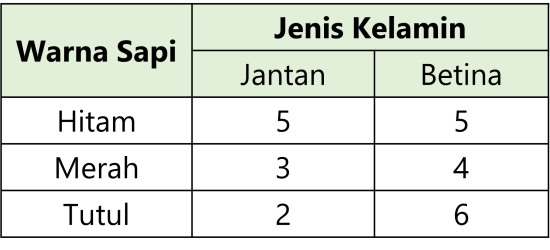
- A cow is selected randomly from the pen. If the selected cow is female, determine the probability that the cow is red.
- A cow is selected randomly from the pen. If the selected cow is black, determine the probability that the cow is male.
- Two cows are selected randomly from the pen. The cows are selected one at a time (without replacement). If the selected cows in the first and second selections are spotted cows, determine the probability that the cows are female.
Answer a)
Since the event of selecting a red cow occurs after it is confirmed that a female cow is selected, this is a conditional probability case. Suppose $E_1$ and $F_1$ respectively represent the events of selecting a red cow and selecting a female cow.
$$\begin{aligned} p(E_1 \mid F_1) & = \dfrac{n(E_1 \cap F_1)}{n(F_1)} \\ & = \dfrac{4}{5+4+6} \\ & = \dfrac{4}{15} \end{aligned}$$Thus, the probability that the cow is red given that the selected cow is female is $\boxed{\dfrac{4}{15}}$
Answer b)
Since the event of selecting a male cow occurs after it is confirmed that a black cow is selected, this is a conditional probability case. Suppose $E_2$ and $F_2$ respectively represent the events of selecting a male cow and selecting a black cow.
$$\begin{aligned} p(E_2 \mid F_2) & = \dfrac{n(E_2 \cap F_2)}{n(F_2)} \\ & = \dfrac{5}{5+5} \\ & = \dfrac{1}{2} \end{aligned}$$Thus, the probability that the cow is red given that the selected cow is female is $\boxed{\dfrac{1}{2}}$
Answer c)
Since the event of selecting a female cow occurs after it is confirmed that a spotted cow is selected, this is a conditional probability case. Suppose $E_3$ and $F_3$ respectively represent the events of selecting a female cow and selecting a spotted cow.
First selection:
$$\begin{aligned} p(E_3 \mid F_3) & = \dfrac{n(E_3 \cap F_3)}{n(F_3)} \\ & = \dfrac{6}{2+6} \\ & = \dfrac{3}{4} \end{aligned}$$
Suppose $E_3’$ and $F_3’$ respectively represent the events of selecting a female cow and selecting a spotted cow after one spotted female cow can no longer be selected (now only $6-1=5$ cows remain).
Second selection:
$$\begin{aligned} p(E_3 \mid F_3) & = \dfrac{n(E_3 \cap F_3)}{n(F_3)} \\ & = \dfrac{5}{2+5} \\ & = \dfrac{5}{7} \end{aligned}$$Thus, the probability that the cow is red given that the selected cow is female is $\boxed{\dfrac34 \cdot \dfrac57 = \dfrac{15}{28}}$
Problem Number 11
An electrical system contains four components arranged as shown in the figure below.
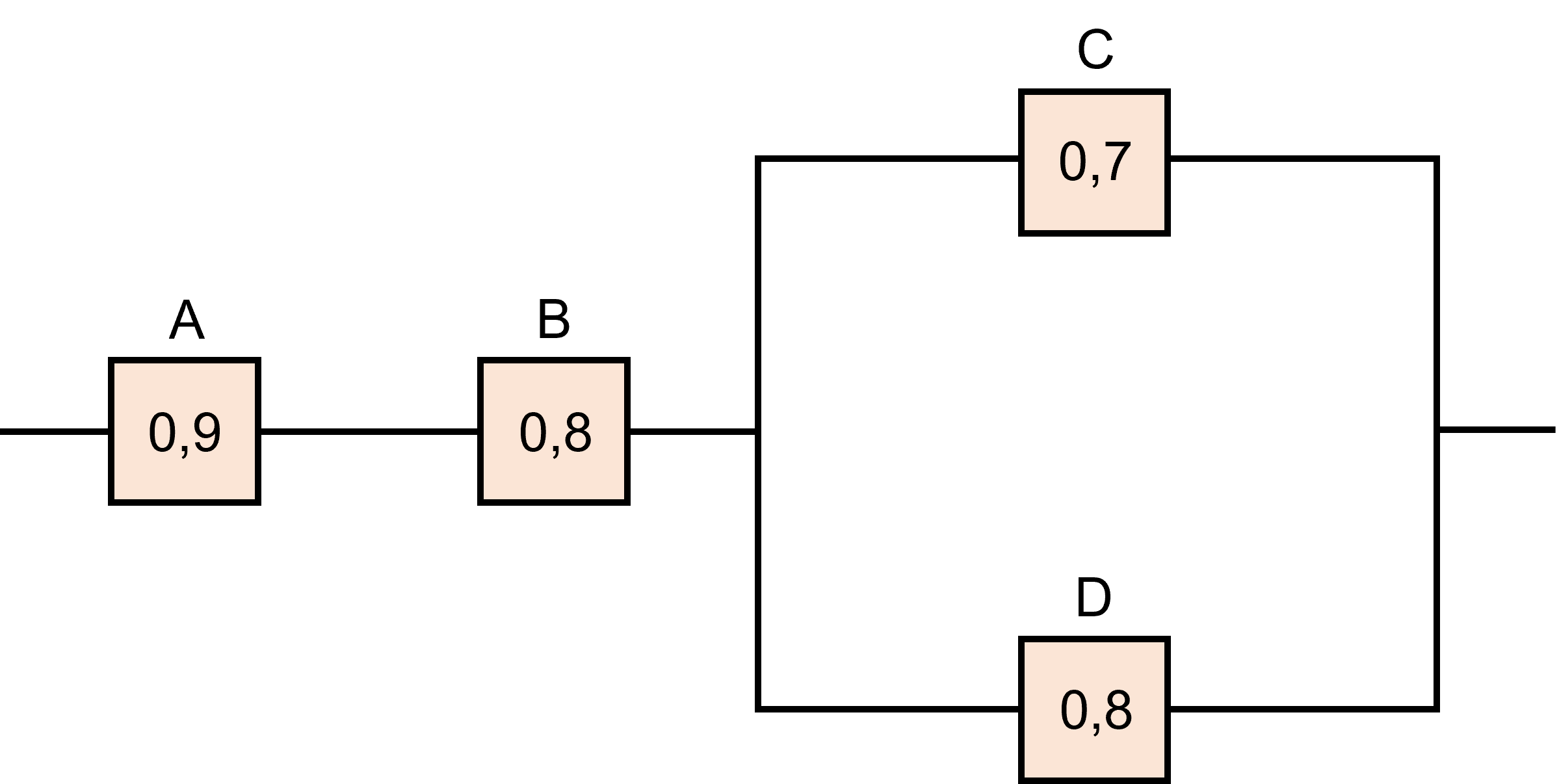
- Determine the probability that the electrical system operates.
- Determine the probability that component $C$ does not work given that the electrical system operates.
Suppose $A, B, C,$ and $D$ respectively represent the events that components $A, B, C,$ and $D$ work.
Answer a)
Because each component operates independently, we obtain
$$\begin{aligned} p(A \cap B \cap (C \cup D)) & = p(A) \cdot p(B) \cdot p(C \cup D) \\ & = p(A) \cdot p(B) \cdot (1-p(C^c \cap D^c)) \\ & = p(A) \cdot p(B) \cdot (1-p(C^c) \cdot p(D^c)) \\ & = 0,\!9 \cdot 0,\!8 \cdot (1-(1-0,\!7) \cdot (1-0,\!8)) \\ & = 0,\!6768. \end{aligned}$$Therefore, the probability that the electrical system operates is $\boxed{0,\!6768}$
Answer b)
The event that component $C$ does not work given that the electrical system operates is a conditional event. It is known that the probability the electrical system operates is $0,\!6768.$ Thus, the probability that component $C$ does not work given that the electrical system operates is expressed as
$$\begin{aligned} p & = \dfrac{p(A \cap B \cap C^c \cap D)}{0,\!6768} \\ & = \dfrac{p(A) \cdot p(B) \cdot p(C^c) \cdot p(D)}{0,\!6768} \\ & = \dfrac{0,\!9 \cdot 0,\!8 \cdot (1-0,\!7) \cdot 0,\!8}{0,\!6768} \\ & \approx 0,\!2553. \end{aligned}$$
Problem Number 12
An electrical system contains five components arranged as shown in the figure below.
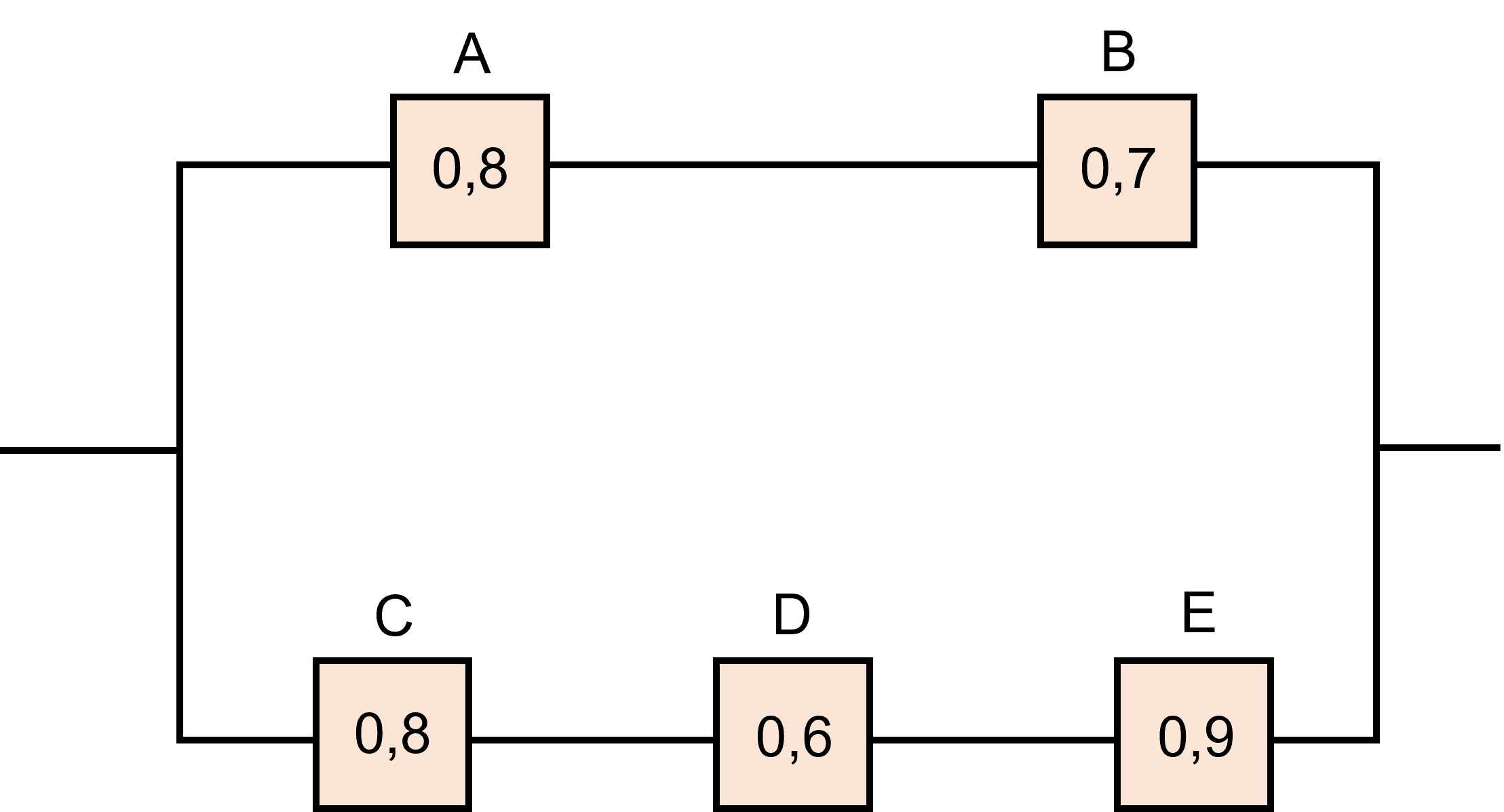 The system will operate if components $A$ and $B$ work or if components $C, D,$ and $E$ work. The probability that each component works is shown in the figure. Assume that each component operates independently of the others.
- Determine the probability that the electrical system operates.
- Determine the probability that component $A$ does not work given that the electrical system operates.
- Determine the probability that component $A$ does not work given that the electrical system does not operate.
Suppose $A, B, C, D$ and $E$ respectively represent the events that components $A, B, C, D$ and $E$ work.
Answer a)
Because each component operates independently, we obtain
$$\begin{aligned} p((A \cap B) \cup (C \cap D \cap E)) & = 1-\left[p((A \cap B)^c \cap (C \cap D \cap E)^c)\right] \\ & = 1-\left[p((A^c \cup B^c) \cap (C^c \cup D^c \cup E^c))\right] \\ & = 1-\left[p(A^c \cup B^c) \cdot p(C^c \cup D^c \cup E^c)\right] \\ & = 1-(1-p(A \cap B))(1-p(C \cap D \cap E)) \\ & = 1-(1-p(A)p(B))(1-p(C)p(D)p(E)) \\ & = 1-(1-0,\!8 \cdot 0,\!7)(1-0,\!8 \cdot 0,\!6 \cdot 0,\!9) \\ & = 0,\!75008. \end{aligned}$$Therefore, the probability that the electrical system operates is $\boxed{0,\!75008}$
Answer b)
The event that component $A$ does not work given that the electrical system operates is a conditional event. It is known that the probability the electrical system operates is $0,\!75008.$ Thus, the probability that component $A$ does not work given that the electrical system operates is expressed as
$$\begin{aligned} p & = \dfrac{p(A^c \cap C \cap D \cap E)}{0,\!75008} \\ & = \dfrac{p(A^c) \cdot p(C) \cdot p(D) \cdot p(E)}{0,\!75008} \\ & = \dfrac{(1-0,\!8) \cdot 0,\!8 \cdot 0,\!6 \cdot 0,\!9}{0,\!75008} \\ & \approx 0,\!11519. \end{aligned}$$Answer c)
Suppose $S$ represents the event that the electrical system operates so that $p(S) = 0,\!75008.$
In this case, we will determine the value of $p(A^c \mid S^c),$ namely
$$\begin{aligned} p(A^c \mid S^c) & = \dfrac{p(A^c \cap S^c)}{p(S^c)} \\ & = \dfrac{p(A^c)(1-p(C \cap D \cap E))}{1-p(S)} \\ & = \dfrac{(0,\!2)(1-(0,\!8)(0,\!6)(0,\!9)}{1-0,\!75008} \\ & \approx 0,\!45455. \end{aligned}$$Therefore, the probability that component $A$ does not work given that the electrical system does not operate is $\boxed{0,\!45455}$