

Understanding simple algebraic expressions is one of the most important foundations in mathematics. Through word problems, students learn how algebra can be applied to real-life situations such as shopping, age comparisons, distances, and daily calculations. By translating sentences into mathematical expressions, learners develop logical thinking, problem-solving skills, and a deeper understanding of how variables and numbers work together.
In this article, you will find a collection of simple algebraic expression word problems along with clear step-by-step solutions. Each problem is designed to help students practice identifying variables, forming algebraic expressions, and solving them correctly. Whether you are a middle school student, a teacher, or a parent helping with homework, these examples can make learning algebra easier and more engaging.
Read: Linear Equations in One Variable: Concepts, Formulas, and Solved Problems
Today Quote
Multiple Choice Section
Problem Number 1
A student bought $3$ pencils and $5$ books. The next day, he bought twice as many books as he bought on the previous day. If $x$ and $y$ respectively represent the price of a pencil and the price of a book, then the correct algebraic expression representing the student’s total expenditure is $\cdots \cdot$
A. $3x$ C. $3x + 15y$
B. $15y$ D. $15x + 3y$
Suppose $x$ and $y$ respectively represent the price of a pencil and the price of a book. Altogether, the student bought $3$ pencils and $5 + 2(5) = 15$ books. The total cost of the pencils is $3x,$ while the total cost of the books is $15y.$ Therefore, the total expenditure is $3x + 15y.$
(Answer C)
Problem Number 2
Which of the following figures can represent the algebraic expression $2x + 3x?$
Note: “Panjang dari ruas garis” means “Length of the line segment”, while “Luas dari bangun” means “Area of the figure”.

The length of the line segment in option A is equal to $x + 5,$ while the length of the line segment in option B is equal to $2 + 3 + x.$ Furthermore, the area of the figure in option C is equal to $2x + 3x,$ while the area of the figure in option D is equal to $5x + 5x.$
Therefore, the figure that can represent the algebraic expression $2x + 3x$ is the area of the figure in option C.
(Answer C)
Problem Number 3
One day, Monica sent $m$ emails every hour to her clients for $6$ hours. Meanwhile, Teresa sent $n$ emails every hour to her clients for $5$ hours. The following algebraic expression that represents the total number of emails sent by Monica and Teresa on that day is $\cdots \cdot$
A. $11mn$ C. $6m + 5n$
B. $30mn$ D. $5m + 6n$
Since Monica sent $m$ emails every hour to her clients for $6$ hours, the total number of emails she sent is
$$\underbrace{m + m + \cdots + m}_{6~\text{times}} \\ = 6m.$$Similarly, since Teresa sent $n$ emails every hour to her clients for $5$ hours, the total number of emails she sent is
$$\underbrace{n+ n + \cdots + n}_{5~\text{times}} \\ = 5n.$$Therefore, altogether, a total of $6m + 5n$ emails were sent by them on that day.
(Answer C)
Problem Number 4
A triangle has side lengths of $(2x + 1)~\text{m},$ $(3x-5)~\text{m},$ and $(x+3)~\text{m}.$ The perimeter of the triangle is $\cdots~\text{m}.$
A. $(6x-4)$
B. $(6x-1)$
C. $(6x+1)$
D. $(6x+2)$
The perimeter ($p$) of a plane figure is obtained by adding all of its side lengths. Therefore, we can write the perimeter of the triangle as follows.
$$\begin{aligned} p & = (2x + 1) + (3x-5) + (x+3) \\ & = (2x+3x+x) + (1+(-5) + 3) \\ & = 6x-1 \end{aligned}$$Therefore, the perimeter of the triangle is $\boxed{(6x-1)~\text{m}}.$
(Answer B)
Read: Relations and Functions: Middle School Math Problems with Step-by-Step Solutions
Problem Number 5
William is a technician who works at a mobile phone company. He handles damaged mobile phones from clients. Every week, William receives a number of mobile phones to repair. The number of mobile phones remaining to be repaired at the end of the day can be estimated by the equation $P = 120-24d$ where $P$ represents the number of remaining mobile phones and $d$ represents the number of days William has worked during that week. What does the value $120$ in the equation represent?
- William will finish his work within $120$ days.
- William starts his work with $120$ mobile phones to repair each week.
- William repairs $120$ mobile phones every day.
- William receives an additional $120$ mobile phones every day to repair.
Notice that in the equation $P = 120-24d,$ $P$ represents the number of remaining mobile phones, while $d$ represents the number of days William has worked during that week. As time passes, the value of $d$ increases, while the value of $P$ continues to decrease with a minimum value of $0.$ From the equation, it can be seen that William repairs $24$ mobile phones every day, so this expression is represented by $24d.$ Based on this fact, it can be concluded that the value $120$ in the equation represents the number of mobile phones William needs to repair each week. In other words, William starts his work with $120$ mobile phones to repair every week.
(Answer B)
Problem Number 6
Pediatrics is the branch of medicine concerning children’s health. A pediatrician is a doctor who specializes in that field. They are specially trained to diagnose and treat various illnesses and injuries experienced by children, as well as children’s growth and developmental problems. A pediatrician uses a model in the form of the equation $t = 8u + 73$ to estimate the height $(t)$ of boys (in cm) when they reach the age of $u$ years. The model applies to children aged $2$ to $5$ years.
Based on the model, the estimated increase in the height of boys each year within the age range of $2$ to $5$ years is $\cdots$ cm.
A. $8$ C. $32$
B. $10$ D. $73$
Notice that in the equation $t = 8u + 73,$ $t$ represents the height of boys (in cm), while $u$ represents their age (in years). As their age increases, their height also increases by $8$ cm. For illustration, if a boy reaches the age of $3$ years, then $u = 3$ so that $t = 8(3) + 73 = 97$ cm. Therefore, his height is $97$ cm. Meanwhile, the value $73$ in the equation represents the initial height. Thus, the estimated increase in the height of boys each year within the age range of $2$ to $5$ years based on the model is $\boxed{8}$ cm.
(Answer A)
Problem Number 7
Lili is currently $19+x$ years old. If Lili had been born $x+7$ years earlier, then her age three years from now would be $\cdots$ years.
A. $12$ C. $26 + 2x$
B. $15$ D. $29 + 2x$
The correct algebraic expression to determine Lili’s current age assuming that she had been born $x+7$ years earlier is
$$(19+x)+(x+7) = 2x+26$$years. Therefore, her age three years from now would be $(2x+26)+3=29+2x$ years.
(Answer D)
Problem Number 8
Mono, Fifi, and Rizal are three close friends. They each have a number of playing cards. Mono has $15$ more cards than Fifi. Meanwhile, Rizal has $3$ times as many cards as Mono. If Mono has $n$ cards, then the total number of their cards combined is $\cdots \cdot$
A. $3n+15$
B. $5n$
C. $5n-15$
D. $5n+15$
Since Mono has $n$ cards and it is known that Mono has $15$ more cards than Fifi, it can be said that Fifi has $n-15$ cards. Furthermore, it is known that Rizal has $3$ times as many cards as Mono, so the number of cards owned by Rizal is $3n.$
Therefore, the total number of cards is $\boxed{n + (n-15) + 3n = 5n-15}.$
(Answer C)
Problem Number 9
There is a square with side length $(3x-2)~\text{cm}.$ The area of the square is $\cdots~\text{cm}^2.$
A. $(9x^2-12x-4)$
B. $(9x^2-4)$
C. $(9x^2+4)$
D. $(9x^2-12x+4)$
The area of a square $(A)$ is obtained by multiplying its side lengths together (or squaring its side length).
$$\begin{aligned} A & = s \cdot s \\ & = (3x-2)(3x-2) \\ & = 3x(3x-2)-2(3x-2) \\ & = 9x^2-6x-6x+4 \\ & = 9x^2-12x+4 \end{aligned}$$Therefore, the area of the square is $\boxed{(9x^2-12x+4)~\text{cm}^2}.$
(Answer D)
Read: Linear Inequations in One Variable: Concepts, Formulas, and Solved Problems
Problem Number 10
A rectangle has length $(2x-1)~\text{m}$ and width $(x+3)~\text{m}.$ The area of the rectangle is $\cdots~\text{m}^2.$
A. $(2x^2-3)$
B. $(2x^2+5x+3)$
C. $(2x^2-5x-3)$
D. $(2x^2+5x-3)$
The area of a rectangle $(A)$ is obtained by multiplying its length $(\ell)$ and width $(w).$
$$\begin{aligned} A & = \ell \cdot w \\ & = (2x-1)(x+3) \\ & = 2x(x+3)-(x+3) \\ & = 2x^2 + 6x-x-3 \\ & = 2x^2+5x-3 \end{aligned}$$Therefore, the area of the rectangle is $\boxed{(2x^2+5x-3)~\text{m}^2}.$
(Answer D)
Problem Number 11
A box is designed in the shape of a rectangular prism. The length of the box is three times the width of the box minus $3$ cm. Meanwhile, the height of the box is four times the width of the box minus $5$ cm. If the width of the box is known to be $y$ cm, then the volume of the box in cm3 is $\cdots \cdot$
A.. $12y^3+27y^2-15y$
B. $12y^3-27y^2+15y$
C. $12y^2-27y+15$
D. $8y-8$
It is known that the width of the box = $y$ cm. The length of the box is three times the width minus $3$ cm, which is $3y-3$ cm. The height of the box is four times the width minus $5$ cm, which is $4y-5$ cm. Therefore, the volume of the box is
$$\begin{aligned} V & = \text{length} \times \text{width} \times \text{height} \\ & = (3y-3)(y)(4y-5) \\ & = (12y^3-27y^2+15y)~\text{cm}^3. \end{aligned}$$(Answer B)
Problem Number 12
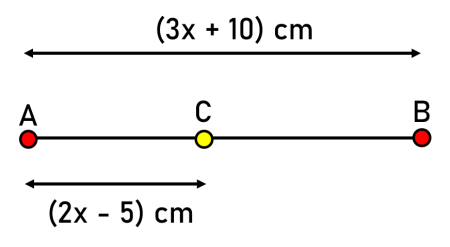
A rope is represented by the following line segment $AB$.
A. $17~\text{cm}$ C. $26~\text{cm}$
B. $24~\text{cm}$ D. $28~\text{cm}$
From the figure, it is known that the length of the line segment (the rope length) is equal to $(3x+10)$ cm so that the value of $x$ can be determined as follows.
$$\begin{aligned} 3x+10 & = 43 \\ 3x & = 33 \\ x & = 11 \end{aligned}$$The line segment $CB$ is equal to the total length of the line segment minus the length of the line segment $AC.$
$$\begin{aligned} CB & = AB-AC \\ & = (3x+10)-(2x-5) \\ & = (3x-2x) + (10-(-5)) \\ & = x + 15 \end{aligned}$$Since $x = 11,$ we obtain $CB = 11+15 = 26~\text{cm}.$ Therefore, the length of the rope segment from point $C$ to point $B$ is $\boxed{26~\text{cm}}.$
(Answer C)
Problem Number 13
The sum of six consecutive even integers is $c.$ What is the smallest integer?
A. $\dfrac{c-6}{5}$
B. $\dfrac{c-3}{6}$
C. $\dfrac{c-60}{6}$
D. $\dfrac{c-30}{6}$
Suppose $x$ is the smallest integer among the six consecutive even integers. Thus, the following integers are $(x+2), (x+4),$ $(x+6), (x+8),$ and $(x+10)$ so that we obtain
$$\begin{aligned} x + (x+2) + (x+4) + (x+6) + (x+8) + (x+10) & = c \\ (x+x+x+x+x+x) + (2+4+6+8+10) & = c \\ 6x + 30 & = c \\ 6x & = c-30 \\ x & = \dfrac{c-30}{6}. \end{aligned}$$Therefore, the smallest integer referred to is $\boxed{\dfrac{c-30}{6}}.$
(Answer D)
Problem Number 14
There are $7$ sacks containing gold bars. The first sack contains $1$ gold bar, the second sack contains $2$ gold bars, and so on until the seventh sack contains $7$ gold bars. It is known that there is $1$ sack containing fake gold among the seven sacks. If the weight of a genuine gold bar is $111$ kg and the weight of a fake gold bar is $99$ kg, and the total weight of all sacks is $3.060$ kg, then the fake gold is located in the $\cdots \cdot$ sack.
A. first
B. second
C. fourth
D. fifth
The total number of gold bars is $1 + 2 + 3 + \cdots + 7 = 28$ bars. Suppose there are $x$ fake gold bars, which means the remaining $(28-x)$ bars are genuine. It is known that the weight of a genuine gold bar is $111$ kg and the weight of a fake gold bar is $99$ kg, while the total weight of all sacks is $3.060$ kg. From here, we can construct an algebraic equation to determine the value of $x.$
$$\begin{aligned} 99x + 111(28-x) & = 3.060 \\ 99x + 3.108-111x & = 3.060 \\ -12x & = -48 \\ x & = 4 \end{aligned}$$Therefore, there are $4$ fake gold bars, so it can be concluded that the fake gold is located in the fourth sack.
(Answer C)
Read: System of Linear Equations in Two Variables: Complete Problems and Step-by-Step Solutions
Problem Number 15
A sack contains balls of $4$ different colors, namely $22$ balls that are not yellow, $23$ balls that are not red, $24$ balls that are not blue, and $21$ balls that are not green. The total number of balls in the sack is $\cdots \cdot$
A. $28$ C. $32$
B. $30$ D. $33$
Suppose the numbers of yellow, red, blue, and green balls are respectively represented by $K, M, B,$ and $H.$ Thus, we obtain the following algebraic equations.
$$\begin{cases} M+B+H & = 22 \\ K + B + H & = 23 \\ K + M + H & = 24 \\ K + M + B & = 21 \end{cases}$$Add the four equations above according to their corresponding sides so that we get
$$\begin{aligned} 3K + 3M + 3B + 3H & = 22+23+24+21 \\ 3(K+M+B+H) & = 90 \\ K + M + B + H & = 30 \end{aligned}$$Therefore, the total number of balls in the sack is $\boxed{30}.$
(Answer B)
Problem Number 16
It is known that $x, y, z$ are positive numbers satisfying $xy = \dfrac{z}{4}.$ If $x$ increases by $50\%$ and $y$ decreases by $25\%,$ then what change must occur to $z$ so that the relation $xy = \dfrac{z}{4}$ remains satisfied?
A. $z$ must decrease by $12,5\%.$
B. $z$ must decrease by $25\%.$
C. $z$ must increase by $12,5\%.$
D. $z$ must increase by $25\%.$
The equation above can be rewritten as $z = 4xy.$
Suppose $z’$ is the new value of $z$ after changes occur in the values of $x$ and $y.$
$$\begin{aligned} z’ & = 4(150\%x)(75\%y) \\ & = 4 \cdot \dfrac32x \cdot \dfrac34y \\ & = \dfrac92xy \end{aligned}$$Thus, the increase in value from $z$ to $z’$ is $\dfrac92-4 = \dfrac12.$ The percentage increase is $\dfrac{\frac12}{4} \times 100\% = 12,5\%.$
Therefore, the equation will remain satisfied if $z$ increases by $12,5\%.$
(Answer C)
Problem Number 17
An art performance was attended by $20\%$ child spectators, one-third adult male spectators, and the rest adult female spectators. If the number of adult female spectators is $200$ more than the number of adult male spectators, then the total number of spectators at the art performance is $\cdots \cdot$
A. $1.000$ people
B. $1.200$ people
C. $1.500$ people
D. $1.600$ people
Suppose $x$ represents the total number of spectators. Since $20\% = \dfrac15$ of $x$ are child spectators and $\dfrac13$ of $x$ are adult male spectators, we obtain $1-\dfrac15-\dfrac13 = \dfrac{7}{15}$ of $x$ as adult female spectators.
Since the number of adult female spectators is $200$ more than the number of adult male spectators, we obtain
$$\begin{aligned} \dfrac{7}{15}x & = \dfrac13x+200 \\ \dfrac{2}{15}x & = 200 \\ x & = 1.500. \end{aligned}$$Therefore, the total number of spectators at the art performance is $\boxed{1.500}$ people.
(Answer C)
Problem Number 18
Susi was born five years before the year $2000 + x.$ Susi’s seventeenth birthday falls in the year $\cdots \cdot$ From the given statement, the algebraic expression representing the year when Susi turns $17$ years old is
A. $2022 + x$ C. $2012 + x$
B. $2017 + x$ D. $2017-x$
$$\begin{aligned} ((2000 + x)-5) + 17 & = 2000 + x + 12 \\ & = 2012 + x. \end{aligned}$$Therefore, Susi’s birthday will fall in the year $\boxed{2012 + x}.$
(Answer C)
Problem Number 19
Father bought a can of paint weighing $x$ kg. When three-fifths of its contents had been used, the remaining weight was $y$ kg. The empty weight of the paint can in terms of $x$ and $y$ is $\cdots$ kg.
A. $\dfrac13(3y-2x)$
B. $\dfrac13(4y-2x)$
C. $\dfrac13(5y-2x)$
D. $\dfrac23(7y-2x)$
Notice that the total weight is the sum of the paint weight and the can weight. Suppose $c$ and $k$ respectively represent the weight of the paint and the weight of the can itself. After three-fifths of the paint has been used, the remaining paint is $1-\dfrac35=\dfrac25.$ The two equations representing this problem are as follows.
$$\begin{cases} x & = c + k && (\cdots 1) \\ y & = \dfrac25c + k && (\cdots 2) \end{cases}$$Add the two equations so that we obtain
$$x + y = \dfrac75c + 2k.$$The first equation is equivalent to $c=x-k$ so that we get
$$\begin{aligned} x + y & = \dfrac75(x-k) + 2k \\ x + y & = \dfrac75x-\dfrac75k + 2k \\ \dfrac35k & = y-\dfrac25x \\ k & = \dfrac13(5y-2x) \end{aligned}$$Therefore, the empty weight of the paint can in terms of $x$ and $y$ is $\boxed{\dfrac13(5y-2x)~\text{kg}}.$
(Answer C)
Problem Number 20
Ardi and Lily are students at the same school. They are currently in Grade X. They were assigned to record the number of male students in Grade X (without counting each other). Ardi recorded that $\dfrac{5}{17}$ of the Grade X students were male. Meanwhile, Lily recorded that $\dfrac27$ of the Grade X students were male. If they recorded correctly, then the number of female students in Grade X at the school is $\cdots$ people.
A. $35$ C. $65$
B. $55$ D. $85$
Suppose the total number of Grade X students is $n$ people and the number of male students is $L.$ Notice that they were assigned to record the number of male students in Grade X (without counting each other).
Based on Ardi’s record, we obtain the equation $\dfrac{5}{17}(n-1) = L$ because the remaining recorded students are $n-1$ people (without counting Lily). On the other hand, based on Lily’s record, we obtain the equation $\dfrac27(n-1) = L-1$ (without counting Ardi), or it can be rewritten as $\dfrac27(n-1)+1=L.$ Thus, we obtain the equation
$$\begin{aligned} \dfrac{5}{17}(n-1) & = \dfrac27(n-1)+1 \\ 35(n-1) & = 34(n-1) + 119 && (\text{Multiply by}~119) \\ n-1 & = 119 \\ n & = 120. \end{aligned}$$This means that the total number of Grade X students is $120$ people. Consequently, $$L = \dfrac{5}{17}(n-1) = \dfrac{5}{17}(120-1) = 35.$$Since the number of male students is $35,$ the rest are female students, namely $120-35=85$ people.
(Answer D)
Essay Section
Problem Number 1
The sum of two consecutive integers is $603.$ What is the smaller integer?
Suppose the smaller integer is $x$ so that the other integer is $(x+1).$ Since the sum of the two integers is $603,$ we write
$$\begin{aligned} x + (x + 1) & = 603 \\ 2x + 1 & = 603 \\ 2x & = 602 \\ x & = 301. \end{aligned}$$Therefore, the smaller integer is $\boxed{301}.$
Problem Number 2
This year, a younger sibling is 5 years younger than the older sibling. Five years later, the sum of their ages will be 35 years. Determine each of their current ages.
Suppose the older sibling’s age is $x$ years so that the younger sibling’s age is $(x-5)$ years.
Five years later, the older sibling’s age becomes $(x+5)$ years, while the younger sibling’s age becomes $x$ years.
Since the sum of their ages 5 years later is known to be $35$ years, we write
$$\begin{aligned} (x+5) + x & = 35 \\ 2x + 5 & = 35 \\ 2x & = 30 \\ x & = 15. \end{aligned}$$Therefore, the older sibling is $15$ years old, while the younger sibling is $10$ years old.
Problem Number 3
Mr. Bambang has three children. One day, Mr. Bambang gave 600 cents to his three children. The second child was given 25 cents more than the third child. The first child received three times as much as the second child. How much did each child receive?
Suppose the third child received $x$ cents so that
$$\begin{aligned} \text{Money received by the second child} & = x+25 \\ \text{Money received by the first child} & = 3(x+25) = 3x+75. \end{aligned}$$Since the total amount of money given was $600$ cents, we write
$$\begin{aligned} x + (x+25) + (3x+75) & = 600 \\ (x+x+3x)+(25+75) & = 600 \\ 5x + 100 & = 600 \\ 5x & = 500 \\ x & = 100. \end{aligned}$$Thus, we conclude that:
$$\begin{aligned} \text{Money received by the third child} & = x = 100~\text{cents} \\ \text{Money received by the second child} & = x+25 = 100+25=125~\text{cents} \\ \text{Money received by the first child} & = 3x+75 = 3(100)+75 = 375~\text{cents}. \end{aligned}$$
Problem Number 4
Two numbers differ by $48.$ One number is five times the other number. If $a$ is the current number of provinces in Indonesia, what is the value of $a$ added to the two numbers?
Suppose $x$ is the smaller number so that the larger number is $5x.$ Since the difference between the two numbers is $48,$ we write
$$\begin{aligned} 5x-x & = 48 \\ 4x & = 48 \\ x & = 12. \end{aligned}$$Therefore, the two numbers are $12$ and $60.$
Currently, Indonesia has $38$ provinces so that the value of $a = 38.$ Thus, the value of $a$ added to the two numbers is $\boxed{38 + 12 + 60 = 110}.$
Problem Number 5
A mother’s current age is equal to three times her child’s age. The difference between their current ages is 26 years. Determine the sum of their ages 5 years from now.
Suppose the child’s age is $x$ years so that the mother’s age is $3x$ years. Since the difference between their current ages is 26 years, we write
$$\begin{aligned} \text{Mother’s age}-\text{Child’s age} & = 26 \\ 3x-x & = 26 \\ 2x & = 26 \\ x & = 13. \end{aligned}$$Thus, the mother’s current age is $3x = 3(13) = 39$ years, while the child’s age is $13$ years. The sum of their ages 5 years from now is $$\boxed{(39+5) + (13 + 5) = 62~\text{years}}.$$
Problem Number 6
Five years ago, the age of a mother together with her twin children was $40$ years. If at that time the mother’s age was $30$ years, what is the current age of each twin child?
Suppose the ages of the twin children are each $x.$ It is known that five years ago, the mother’s age was $30$ years and the total age together with her twin children was $40$ years so that we obtain
$$\begin{aligned} 30 + x + x & = 40 \\ 30 + 2x & = 40 \\ 2x & = 10 \\ x & = 5. \end{aligned}$$The ages of the twin children were $5$ years old five years ago. In other words, their current ages are $\boxed{5+5=10~\text{years}}$
Problem Number 7
The sum of two numbers is $25.$ Three times the smaller number minus the larger number is $3.$ What are the numbers?
Suppose the smaller number is $x$ so that the larger number is $(3x-3).$ Since the sum of the two numbers is $25,$ we write
$$\begin{aligned} x + (3x-3) & = 25 \\ 4x-3 & = 25 \\ 4x & = 28 \\ x & = 7. \end{aligned}$$Therefore, the smaller number is $x = 7,$ while the larger number is $3x-3 = 3(7)-3 = 18.$
Problem Number 8
The price of $3$ books and $5$ pencils is Rp 42,000. If the price of a book is $3$ times the price of a pencil, determine the price of each pencil and book.
Suppose the price of a pencil is $x$ so that the price of a book becomes $3x.$
It is known that the price of $3$ books and $5$ pencils is Rp42,000.00 so that we write
$$\begin{aligned} 3(3x) + 5x & = 42.000 \\ 9x + 5x & = 42.000 \\ 14x & = 42.000 \\ x & = 3.000. \end{aligned}$$Therefore, the price of a pencil is Rp3,000.00, while the price of a book is Rp9,000.00.
Problem Number 9
Mr. Eska has a rectangular swimming pool. The width of the pool is 7 m less than its length. It is known that the perimeter of the pool is $86$ m. Determine the length and width of the pool.
Suppose the length of the pool is $\ell,$ then the width is $w = p-7.$ Since the perimeter of the pool is $86$ m, we write
$$\begin{aligned} p & = 86 \\ 2(\ell + w) & = 86 \\ \ell + w & = 43 \\ \ell + (\ell-7) & = 43 \\ 2\ell-7 & = 43 \\ 2\ell & = 50 \\ \ell & = 25. \end{aligned}$$Thus, the length of the pool is $25$ m, while the width is $25-7 = 18$ m.
Problem Number 10
The sum of three consecutive positive odd numbers is $21.$ Determine the three numbers.
Suppose the smallest odd number is $x,$ then the other two odd numbers are $(x+2)$ and $(x+4).$ Since the sum of the three consecutive positive odd numbers is $21,$ we write
$$\begin{aligned} x + (x+2) + (x+4) & = 21 \\ 3x + 6 & = 21 \\ 3x & = 15 \\ x & = 5. \end{aligned}$$Therefore, the three numbers are $\boxed{5, 7,~\text{and}~9}.$
Problem Number 11
There are three numbers whose sum is $96.$ The second number is three times the first number. The third number is four times the first number. Determine the three numbers.
Suppose $x$ is the first number, then the second number is $3x$ and the third number is $4x.$ Since the sum of the three numbers is $96,$ we write
$$\begin{aligned} x + 3x + 4x & = 96 \\ 8x & = 96 \\ x & = 12. \end{aligned}$$Therefore, the first number is $12,$ the second number is $36,$ and the third number is $48.$
Problem Number 12
The length of the hypotenuse of a right triangle is $(4x+5)~\text{cm}.$ If the lengths of the legs are $(7x-4)~\text{cm}$ and $(2x+2)~\text{cm},$ determine the perimeter and area of the triangle in terms of $x.$
The perimeter $(p)$ is the sum of the three side lengths of the right triangle.
$$\begin{aligned} p & = (4x +5) + (7x-4) + (2x+2) \\ & = (4x + 7x + 2x) + (5+(-4)+2) \\ & = 13x + 3 \end{aligned}$$Therefore, the perimeter in terms of $x$ is $\boxed{p = (13x+3)~\text{cm}}$
The area $(A)$ is obtained by multiplying the lengths of the two legs, then dividing by $2.$
$$\begin{aligned} A & = \dfrac{(7x-4)(2x+2)}{2} \\ &= \dfrac{(7x-4)\cancel{2}(x+1)}{\cancel{2}} \\ & = (7x-4)(x+1) \\ & = 7x(x+1)-4(x+1) \\ & = 7x^2+7x-4x-4 \\ & = 7x^2+3x-4 \end{aligned}$$Therefore, the area of the triangle in terms of $x$ is $\boxed{A = (7x^2+3x-4)~\text{cm}^2}.$
Problem Number 13
A triangle has three sides with lengths $(2x + 4)~\text{cm},$ $(4x-6)~\text{cm},$ and $(5x-1)~\text{cm},$ respectively. For $x = 5,$ determine whether the triangle is a scalene triangle, an isosceles triangle, or possibly an equilateral triangle.
For $x = 5,$ we obtain the side lengths of the triangle as follows.
$$\begin{aligned} S_1 & = 2x + 4 = 2(5) + 4 = 14~\text{cm} \\ S_2 & = 4x-6 = 4(5)-6 = 14~\text{cm} \\ S_3 & = 5x-1 = 5(5)-1 = 24~\text{cm} \end{aligned}$$Since there are two sides with equal lengths, namely $S_1 = S_2,$ we conclude that the triangle is an isosceles triangle.
Note: If all three sides had equal lengths, then the triangle would be an isosceles triangle, as well as an equilateral triangle. It should be noted that an equilateral triangle is an isosceles triangle in which the remaining side is also equal in length to the other two sides.
Problem Number 14
It is known that the length of a rectangle is $(2x -5)$ cm, while its width is $(3x + 1)~\text{cm}.$
- Determine the perimeter of the rectangle expressed in terms of $x.$
- Determine the dimensions of the rectangle if its perimeter is known to be $23$ cm.
Known:
$$\begin{aligned} \ell & = (2x-5)~\text{cm} \\ w & = (3x+1)~\text{cm} \end{aligned}$$Answer a)
The perimeter of a rectangle ($p$) can be calculated by adding the lengths of all four sides.
$$\begin{aligned} p & = \ell + \ell + w + w \\ & = 2(\ell + w) \\ & = 2((2x-5) + (3x + 1)) \\ & = 2(5x-4) \\ & = 10x-8 \end{aligned}$$Therefore, the perimeter of the rectangle in terms of $x$ is $\boxed{(10x-8)~\text{cm}}.$
Answer b)
It is known that $p = 23~\text{cm}$ so that
$$\begin{aligned} 10x-8 & = 23 \\ 10x & = 31 \\ x & = 3,\!1. \end{aligned}$$The length and width of the rectangle are as follows.
$$\begin{aligned} \ell & = 2x-5 = 2(3,\!1)-5 = 1,2 \\ w & = 3x+1 = 3(3,\!1)+1 = 10,\!3 \end{aligned}$$Therefore, the dimensions of the rectangle are $$\boxed{1,\!2~\text{cm} \times 10,\!3~\text{cm}}.$$
Problem Number 15
Mr. Budi traveled out of town. Initially, he rode a motorcycle for $3$ hours at an average speed of $(2x -5)$ km/h. After that, he continued the journey by bus for $4$ hours at an average speed of $(5x + 8)$ km/h.
- Determine the distance traveled by Mr. Budi in terms of $x.$
- Determine the value of $x$ if the total distance traveled is $329$ km.
Answer a)
Distance ($s$) is obtained by multiplying speed by travel time. Since the unit of time is already appropriate, we can directly multiply to obtain the distance.
$$\begin{aligned} \text{s} & = \text{Distance traveled by motorcycle} + \text{Distance traveled by bus} \\ & = 3(2x-5) + 4(5x+8) \\ & = 6x-15+20x+32 \\ & = 26x+17 \end{aligned}$$Therefore, the distance traveled by Mr. Budi is $\boxed{(26x+17)~\text{km}}.$
Answer b)
Since the total distance traveled is known to be $329$ km, we write
$$\begin{aligned} 26x+17 & = 329 \\ 26x & = 312 \\ x & = 12. \end{aligned}$$Therefore, the value of $x$ that satisfies the equation is $\boxed{12}.$
Problem Number 16
A cuboid frame model is made from wire with length $(2x -3)$ cm, width $(3x + 10)$ cm, and height $x$ cm.
- Determine the length of the wire in terms of $x.$
- Determine the value of $x$ if the wire length is $388$ cm.
- Determine the dimensions of the cuboid frame.
Known:
$$\begin{aligned} \ell & = (2x-3)~\text{cm} \\ w & = (3x+10)~\text{cm} \\ h & = x~\text{cm} \end{aligned}$$Answer a)
The wire length ($p$) is equal to the total length of all edges forming the cuboid. The length, width, and height edges of the cuboid each appear four times, so we write
$$\begin{aligned} p & = 4(\ell + w + h) \\ & = 4((2x-3) + (3x+10) + x) \\ & = 4((2x+3x+x) + (-3+10)) \\ & = 4(6x + 7) \\ & = 24x + 28. \end{aligned}$$Therefore, the wire length in terms of $x$ is $\boxed{(24x+28)~\text{cm}}.$
Answer b)
It is known that the wire length is $388$ cm, so
$$\begin{aligned} 24x + 28 & = 388 \\ 24x & = 360 \\ x & = 15. \end{aligned}$$Therefore, the value of $x$ is $\boxed{15}.$
Answer c)
For $x = 15,$ we obtain
$$\begin{aligned} \ell & = 2x-3 = 2(15)-3 = 27 \\ w & = 3x+10 = 3(15)+10 = 55 \\ h & = x = 15. \end{aligned}$$Therefore, the dimensions of the cuboid frame are $$\boxed{27~\text{cm} \times 55~\text{cm} \times 15~\text{cm}}.$$