
The following section contains a collection of probability problems and detailed solutions designed for middle school students or equivalent levels. These exercises are highly recommended for strengthening students’ understanding of fundamental probability concepts, including sample space, experimental probability, theoretical probability, and everyday applications of chance. Each problem is accompanied by clear explanations and step-by-step discussions to help learners develop logical thinking and problem-solving skills systematically.
These materials are also suitable for independent study, classroom practice, homework assignments, and preparation for quizzes, semester examinations, mathematics competitions, or other academic assessments. By practicing a variety of probability questions, students can improve both their conceptual understanding and their confidence in solving mathematics problems related to probability and statistics.
Read: Solved Probability and Combinatorics Problems for Senior High School
Today Quote
Multiple Choice Section
Problem Number 1
Consider the following events.
- Obtaining a die face of $7$ from rolling a die.
- The birth of a baby boy.
- Drawing a card numbered $11$ from a standard deck of cards.
- The death of a human being.
- The sun rising every day.
- The appearance of fire in the depths of the ocean.
- A cat being able to speak Indonesian.
From the events above, which ones have a probability of $0$?
A. 1, 3, 6, and 7
B. 2, 4, and 5
C. 1, 5, and 6
D. 3, 6, and 7
An event with probability $0$ means that the event is impossible to occur.
- Obtaining a die face of $7$ from rolling a die is impossible because the highest number on a die is $6$.
- The birth of a baby boy is a common/possible event.
- Drawing a card numbered $11$ from a standard deck of cards is impossible because the numbered cards only go up to $10$.
- Death is a certain event experienced by every human being (has probability $1$).
- The sun rising every morning is a certain event (has probability $1$).
- The appearance of fire in the depths of the ocean is impossible because fire cannot burn underwater.
- A cat being able to speak Indonesian is an impossible event.
Based on the explanation above, it can be concluded that the events with probability $0$ are 1, 3, 6, and 7.
(Answer A)
Problem Number 2
In an experiment of tossing $3$ coins, the probability of getting $2$ heads and $1$ tail is $\cdots \cdot$
A. $\dfrac18$ C. $\dfrac23$
B. $\dfrac38$ D. $\dfrac58$
Suppose $M$ is the event of obtaining $2$ heads ($H$) and $1$ tail $(T),$ then
$M = \{(H, H, T), (H, T, H), (T, H, H)\}$
with $n(M) = 3.$
The number of sample space members for $3$ coins, each having $2$ sides, is $n(S) = 2 \times 2 \times 2 = 8.$
Therefore, the probability is $\boxed{p(M) = \dfrac{n(M)} {n(S)} = \dfrac{3}{8}}.$
(Answer B)
Problem Number 3
In an experiment of tossing $3$ coins simultaneously, the probability of obtaining $1$ head is $\cdots \cdot$
A. $\dfrac38$ C. $\dfrac35$
B. $\dfrac23$ D. $\dfrac58$
Suppose $M$ is the event of obtaining $1$ head ($H$), which means the other coins show tails ($T$), so
$M = \{(H, T, T), (T, H, T), (T, T, H)\}$ with $n(M) = 3.$
The number of sample space members for $3$ coins, each having $2$ sides, is $n(S) = 2 \times 2 \times 2 = 8.$
Therefore, the probability is $\boxed{p(M) = \dfrac{n(M)} {n(S)} = \dfrac{3}{8}}.$
(Answer A)
Read: Pigeonhole Principle: Theory, Examples, and Problem Solving
Problem Number 4
In an experiment of tossing $3$ coins simultaneously for $80$ trials, the expected frequency of obtaining at least $1$ head is $\cdots \cdot$
A. $70$ times C. $50$ times
B. $60$ times D. $40$ times
Suppose $M$ is the event of obtaining at least $1$ head $(H)$ so that
$$\begin{aligned} & M = \{(H, T, T), (T, H, T), (T, T, H), \\ & (H, H, T), (H, T, H), (T, H, H), (H, H, H)\} \end{aligned}$$with $T$ representing tails and $n(M) = 7.$
The number of sample space members for $3$ coins, each having $2$ sides, is $n(S) = 2 \times 2 \times 2 = 8.$
Therefore, the probability is $p(M) = \dfrac{n(M)} {n(S)} = \dfrac{7}{8}.$
The expected frequency of obtaining at least $1$ head from the coin tosses is $\boxed{p(M) \times n = \dfrac{7}{8} \times 80 = 70~\text{times}}.$
(Answer A)
Problem Number 5
Two dice are rolled simultaneously. The probability that the sum of the dice is $4$ is $\cdots \cdot$
A. $\dfrac{1}{12}$ C. $\dfrac16$
B. $\dfrac18$ D. $\dfrac14$
Suppose $A$ is the event that the sum of the dice is $4$ so that
$A = \{(1, 3), (3, 1), (2, 2)\}$ with $n(A) = 3.$
The number of sample space members for $2$ dice, each having $6$ sides, is $n(S) = 6 \times 6 \times = 36.$
Therefore, the probability is $\boxed{p(A) = \dfrac{n(A)} {n(S)} = \dfrac{3}{36}= \dfrac{1}{12}}.$
(Answer A)
Problem Number 6
Two dice are rolled. The probability that the sum of the dice is greater than $7$ is $\cdots \cdot$
A. $\dfrac{7}{12}$ C. $\dfrac{5}{18}$
B. $\dfrac{5}{12}$ D. $\dfrac16$
A sum greater than $7$ means it can be $8, 9, 10, 11$, or $12$.
Suppose $A$ is the event that the sum of the dice is $8$ so that
$A = \{(2, 6), (6, 2), (3, 5), (5, 3), (4, 4)\}$ with $n(A) = 5.$
Suppose $B$ is the event that the sum of the dice is $9$ so that
$B = \{(3, 6), (6, 3), (4, 5), (5, 4)\}$ with $n(B) = 4.$
Suppose $C$ is the event that the sum of the dice is $10$ so that
$C = \{(4, 6), (6, 4), (5, 5)\}$ with $n(C) = 3.$
Suppose $D$ is the event that the sum of the dice is $11$ so that
$D = \{(5, 6), (6, 5)\}$ with $n(D) = 2.$
Suppose $E$ is the event that the sum of the dice is $12$ so that
$E = \{(6, 6)\}$ with $n(E) = 1.$
The number of sample space members for $2$ dice, each having $6$ sides, is $n(S) = 6 \times 6 = 36.$
Therefore, the probability is
$$\begin{aligned} & p(A \cup B \cup C \cup D \cup E) \\ & = \dfrac{n(A) + n(B) + n(C) + n(D) + n(E)} {n(S)} \\ & = \dfrac{5+4+3+2+1}{36} \\ & = \dfrac{15}{36} = \dfrac{5}{12}. \end{aligned}$$(Answer B)
Read: Conditional Probability: Definitions, Formulas, and Solved Problems
Problem Number 7
In an experiment of rolling two dice simultaneously, the probability that the sum of the dice is less than $5$ is $\cdots \cdot$
A. $\dfrac16$ C. $\dfrac{5}{36}$
B. $\dfrac14$ D. $\dfrac{7}{18}$
A sum less than $5$ means it can be $2, 3$, or $4.$
Suppose $A$ is the event that the sum of the dice is $2$ so that $A = \{(1, 1)\}$ with $n(A) = 1.$
Suppose $B$ is the event that the sum of the dice is $3$ so that
$B = \{(1, 2), (2, 1)\}$ with $n(B) = 2.$
Suppose $C$ is the event that the sum of the dice is $4$ so that
$C = \{(1, 3), (3, 1), (2, 2)\}$ with $n(C) = 3.$
The number of sample space members for 2 dice, each having $6$ sides, is $n(S) = 6 \times 6 \times = 36.$
Therefore, the probability is
$$\begin{aligned} p(A \cup B \cup C) & = \dfrac{n(A) + n(B) + n(C)} {n(S)} \\ & = \dfrac{1+2+3}{36} \\ & = \dfrac{6}{36} = \dfrac{1}{6} \end{aligned}$$(Answer A)
Problem Number 8
An egg seller has $200$ eggs. Due to carelessness, $10$ eggs break while being placed into a crate. If one egg is chosen at random, the probability of selecting an unbroken egg is $\cdots \cdot$
A. $\dfrac{19}{20}$ C. $\dfrac{15}{20}$
B. $\dfrac{18}{20}$ D. $\dfrac{1}{20}$
Known:
Total number of eggs = $200$
Number of broken eggs = $10$
Number of unbroken eggs = $190.$
The probability of selecting an unbroken egg is
$$\boxed{\dfrac{\text{Number of unbroken eggs}} {\text{Total number of eggs}} =\dfrac{190}{200} =\dfrac{19}{20}}$$(Answer A)
Problem Number 9
A bag contains $60$ identical marbles consisting of $8$ red marbles, $12$ yellow marbles, $16$ green marbles, and the rest are blue. If one marble is selected at random, the probability of selecting a blue marble is $\cdots \cdot$
A. $\dfrac{1}{24}$ C. $\dfrac25$
B. $\dfrac15$ D. $\dfrac12$
Suppose $B$ represents the event of selecting a blue marble from the bag.
The number of blue marbles in the bag is
$n(B) = 60 -8 -12 -16 = 24.$
The total number of marbles is $n(S) = 60.$
Therefore, the probability of selecting a blue marble is
$\boxed{p(B) = \dfrac{n(B)} {n(S)} = \dfrac{24}{60} = \dfrac25}.$
(Answer C)
Problem Number 10
A bag contains $30$ white marbles, $18$ blue marbles, and $32$ red marbles. If one marble is selected at random from the bag, the probability of selecting a red marble is $\cdots \cdot$
A. $0,\!32$ C. $0,\!60$
B. $0,\!40$ D. $0,\!80$
Suppose $M$ represents the event of selecting a red marble from the bag.
The number of red marbles in the bag is $n(M) = 32.$
The total number of marbles is
$n(S) = 30 + 18 + 32 = 80.$
Therefore, the probability of selecting a red marble is
$\boxed{p(M) = \dfrac{n(M)} {n(S)} = \dfrac{32}{80} = \dfrac{4}{10} = 0,\!40}$
(Answer B)
Problem Number 11
A cube has $2$ red faces, $2$ yellow faces, $1$ green face, and $1$ blue face. The cube is rolled. The probability that the top face is red is $\cdots \cdot$
A. $\dfrac23$ C. $\dfrac13$
B. $\dfrac12$ D. $\dfrac16$
There are $2$ red faces.
A cube has $6$ faces.
The probability that the top face is red is $\boxed{\dfrac26 = \dfrac13}$
(Answer C)
Problem Number 12
From $180$ people attending an event, $9$ door prizes are provided. The probability that an attendee gets a door prize is $\cdots \cdot$
A. $0,\!50$ C. $0,\!05$
B. $0,\!20$ D. $0,\!02$
Suppose $D$ represents the event that a person gets a door prize.
The number of door prizes provided is $n(D) = 9.$
The number of attendees is $n(S) = 180.$
Therefore, the probability that a person gets a door prize is $\boxed{p(D) = \dfrac{n(D)} {n(S)}= \dfrac{9}{180} = 0,\!05}$
(Answer C)
Problem Number 13
A die is rolled $120$ times. The expected frequency of obtaining a prime number on the die is $\cdots \cdot$
A. $20$ times C. $40$ times
B. $30$ times D. $60$ times
The possible outcomes when rolling a die are $\{1,2,3,4,5,6\},$ where $2, 3, 5$ (a total of $3$ numbers) are prime numbers.
Suppose the event of obtaining a prime number is denoted by $A$.
Thus, the probability of obtaining a prime number is $p(A) = \dfrac{3}{6} = \dfrac12.$
The expected frequency of obtaining a prime number from $n = 120$ rolls is
$\begin{aligned} f_h & = p(A) \times n \\ & = \dfrac12 \times 120 = 60. \end{aligned}$
Therefore, the expected frequency of obtaining a prime number is $\boxed{60~\text{times}}$
(Answer D)
Problem Number 14
A letter is chosen at random from the letters forming the word “INDONESIA”. The probability that the chosen letter is N is $\cdots \cdot$
A. $\dfrac19$ C. $\dfrac39$
B. $\dfrac29$ D. $\dfrac49$
The letter N appears 2 times in the word INDONESIA. The word consists of 9 letters. Therefore, the probability of selecting the letter N is $\dfrac29.$
(Answer B)
Problem Number 15
From a deck of bridge cards, one card is drawn at random. The probability of drawing an even-numbered card is $\cdots \cdot$
A. $\dfrac19$ C. $\dfrac{4}{13}$
B. $\dfrac{5}{52}$ D. $\dfrac{5}{13}$
In a bridge deck (playing cards), there are $52$ cards.
The numbered cards start from $1$ (ace card) to $10$, each consisting of $4$ suits, namely heart ♥, spade ♠, diamond ♦, and club ♣.
Since there are $5$ even numbers, namely $2, 4, 6, 8,$ and $10$, and each has $4$ suits, the total number of even-numbered cards is $4 \times 5 = 20.$
Suppose the event of drawing an even-numbered card is denoted by $A$, then $\boxed{P(A) = \dfrac{20}{52} = \dfrac{5}{13}}$
(Answer D)
Read: Expected Frequency in Probability: Definitions, Formulas, and Solved Problems
Problem Number 16
A mother wants to have $2$ children. The probabilities of having a boy or a girl are assumed to be equal. The probability that both children are girls is $\cdots \cdot$
A. $\dfrac14$ C. $\dfrac34$
B. $\dfrac12$ D. $1$
The probability of having a boy is equal to the probability of having a girl, namely $\dfrac12$.
The probability that both children are girls ($2$ events) is
$\underbrace{\dfrac12}_{\text{girl}} \times \underbrace{\dfrac12}_{\text{girl}} = \dfrac14.$
(Answer A)
Problem Number 17
In a bag, there are three red balls numbered $1 – 3$, five yellow balls numbered $4 – 8$, and four green balls numbered $9 – 12$. Three balls are drawn one by one randomly from the bag. On the first draw, a red ball with an even number appears and is not returned. On the second draw, a green ball with a prime number appears and is not returned. The probability of drawing an odd-numbered ball on the third draw is $\cdots \cdot$
A. $30\%$ C. $50\%$
B. $40\%$ D. $60\%$
Balls numbered $1, 2, 3$: red.
Balls numbered $4, 5, 6, 7, 8$: yellow.
Balls numbered $9, 10, 11, 12$: green.
On the first draw, a red ball with an even number appears, meaning ball number $2$ has been taken.
On the second draw, a green ball with a prime number appears, meaning ball number $11$ has been taken.
The remaining odd-numbered balls are: $1, 3, 5, 7, 9$ (there are $5$ balls).
The total number of balls remaining is $12 -2 = 10.$
Therefore, the probability of drawing an odd-numbered ball on the third draw is $\boxed{\dfrac{5}{10} = 50\%}$
(Answer C)
Problem Number 18
A box contains $18$ balls consisting of red, blue, and green balls. The red balls are numbered $1$ to $8$, the blue balls are numbered $9$ to $14$, and the green balls are numbered $15$ to $18$. Three balls are drawn randomly one by one without replacement. The first ball drawn is numbered $7$ and the second ball drawn is numbered $13$. The probability that the third ball drawn is an even-numbered green ball is $\cdots \cdot$
A. $\dfrac{2}{16}$ C. $\dfrac{7}{18}$
B. $\dfrac{4}{16}$ D. $\dfrac{7}{16}$
Balls numbered $1, 2, 3, 4, 5, 6, 7, 8$: red.
Balls numbered $9, 10, 11, 12, 13, 14$: blue.
Balls numbered $15, 16, 17, 18$: green.
The first draw produces ball number $7$.
The second draw produces ball number $13$.
The remaining even-numbered green balls are: $16, 18$ (there are $2$ balls).
The total number of balls remaining is $18 -2 = 16.$
Therefore, the probability that the third ball drawn is an even-numbered ball is $\boxed{\dfrac{2}{16}}$
(Answer A)
Problem Number 19
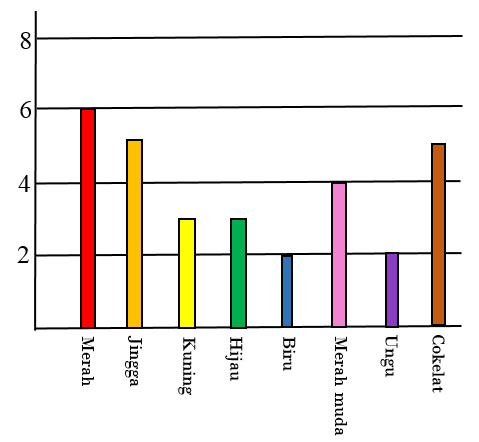
Dilla is allowed by her mother to take one candy from a bag. She cannot see the color of the candy. The number of candies of each color in the bag is shown in the following graph.
What is the probability that Dilla takes a red candy?
A. $10\%$ C. $25\%$
B. $20\%$ D. $50\%$
There are $6$ red candies.
The total number of candies is $6 + 5 + 3 + 3 + 2 + 4 + 2 + 5 = 30$ candies.
Therefore, the probability that Dilla takes a red candy is $\boxed{\dfrac{6}{30} = \dfrac{1}{5} = 20\%}$
(Answer B)
Problem Number 20
There are $40$ candies in a bag with colors and quantities as shown in the pie chart below.
 Flove takes one candy from the bag without looking at its color. The probability that Flove takes a red candy is $\cdots \cdot$
A. $54\%$ C. $10\%$
B. $15\%$ D. $5\%$
The quantity of red candies in degree units is
$$\begin{aligned} & 360^{\circ} -(18+36+108+36+18+90)^{\circ} \\ & = 360^{\circ} -306^{\circ} = 54^{\circ} \end{aligned}$$The number of red candies in the bag is
$\text{n}(\text{red}) = \dfrac{54^{\circ}} {\cancelto{9}{360}^{\circ}} \times \cancel{40} = 6.$
The probability of drawing a red candy is
$p(\text{red}) = \dfrac{\text{n(red)}} {\text{n} (S)} = \dfrac{6}{40} = 15\%.$
(Answer B)
Read: Compound Events in Probability: Definitions, Formulas, and Solved Problems
Problem Number 21
In a class, a class leader and vice class leader will be chosen. The class consists of $16$ male students and $24$ female students. The probability that a female student is chosen as class leader and a male student is chosen as vice class leader is $\cdots \cdot$
A. $\dfrac{13}{65}$ C. $\dfrac{16}{65}$
B. $\dfrac{14}{65}$ D. $\dfrac{19}{65}$
Suppose $A$ is the event that a female student is chosen as class leader, with $n(A) = 24$ and $n(S) = 40$ so that $p(A) = \dfrac{n(A)} {n(S)} = \dfrac{24}{40} = \dfrac35.$
Suppose $B$ is the event that a male student is chosen as vice class leader, with $n(B) = 16$ and $n(S) = 40 -1 = 39$ (reduced by $1$ because one female student has already been chosen as class leader) so that $p(B) = \dfrac{n(B)} {n(S)} = \dfrac{16}{39}.$
Thus, the probability that a female student is chosen as class leader and a male student is chosen as vice class leader is
$\boxed{\begin{aligned} p(A \cap B) & = \dfrac{n(A)} {n(S)} \times \dfrac{n(B)} {n(S)} \\ & = \dfrac{3}{5} \times \dfrac{16}{39} = \dfrac{16}{65} \end{aligned}}$
(Answer C)
Problem Number 22
Dilan and Milea shop at the same store during the same week for $5$ days (Monday to Friday). Each of them has the same probability of shopping at the store on those $5$ days. The probability that they shop at the store on consecutive days is $\cdots \cdot$
A. $0,\!20$ C. $0,\!32$
B. $0,\!25$ D. $0,\!50$
Observe the following table.

The blue-colored cells in the table represent events where both of them shop on consecutive days. From the table above, there are $8$ blue cells, while the total number of cells is $25$. Therefore, the probability is $\boxed{\dfrac{8}{25} = 0,\!32}$
(Answer C)
Problem Number 23
In a bag, there are $8$ balls numbered $1$ to $8$. If two balls are drawn simultaneously, the probability of drawing two balls with consecutive numbers is $\cdots \cdot$
A. $\dfrac17$ C. $\dfrac15$
B. $\dfrac16$ D. $\dfrac14$
Observe the following table.
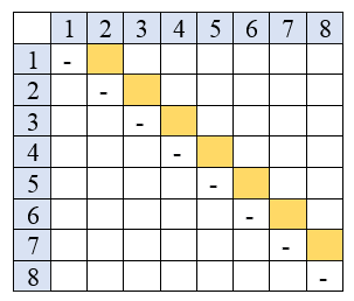 The pairs of consecutive numbers are
$$(1, 2), (2, 3), (3, 4), (4, 5), (5, 6), (6, 7), (7, 8).$$or vice versa. Since two balls are drawn simultaneously, $(1, 2)$ is considered the same as $(2, 1).$ Therefore, there are only $7$ possible cases.
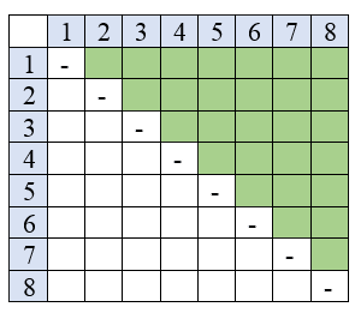 The total number of sample space members is $7 + 6 + 5 + 4 + 3 + 2 + 1 = 28$ (the number of green-colored cells in the table above).
Therefore, the probability of drawing two balls with consecutive numbers is $\boxed{\dfrac{7}{28} = \dfrac14}$
(Answer D)
Problem Number 24
A box contains $12$ balls numbered $1$ to $12$. If two balls are drawn simultaneously at random, the probability of drawing $2$ odd-numbered balls is $\cdots \cdot$
A. $\dfrac{30}{66}$ C. $\dfrac{15}{66}$
B. $\dfrac{45}{132}$ D. $\dfrac{15}{132}$
Alternative 1: Observe the following table.
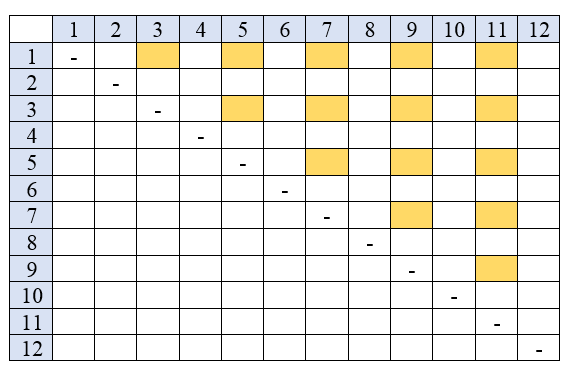 Pairs of odd-numbered balls are marked by orange-colored cells in the table above, totaling $5 + 4 + 3 + 2 + 1 = 15.$
Since two balls are drawn simultaneously, $(1, 3)$ is considered the same as $(3, 1).$
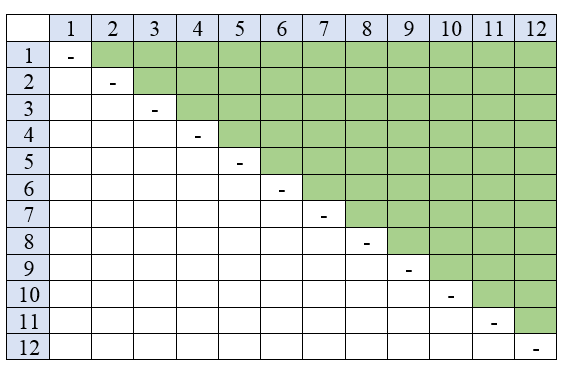 The total number of sample space members is
$\begin{aligned} 11 + 10 + & 9 + 8 + 7 + 6 + 5 + 4 +\\ & 3 + 2 + 1 = 66. \end{aligned}$
(see the number of green-colored cells in the table above).
Therefore, the probability of drawing two odd-numbered balls is $\boxed{\dfrac{15}{66}}$
Alternative 2:
From the numbers $1$ to $12$, there are $6$ odd numbers. The probability of drawing one odd number from those twelve numbers is $P(A) = \dfrac{6}{12}.$ The probability of drawing another odd number from the remaining eleven numbers is $P(B) = \dfrac{5}{11}.$ Thus,
$P(A \cap B) = \dfrac{6}{12} \times \dfrac{5}{11} = \dfrac{30}{132} = \dfrac{15}{66}.$
(Answer C)
Problem Number 25
The figure below is a spinning wheel divided into $24$ sections.
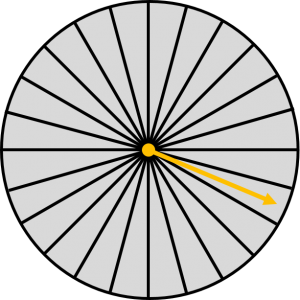 At an event, a guest spins an arrow that can stop at any section of the wheel. If $\dfrac{7}{24}$ of the sections are blue, $\dfrac18$ are purple, $\dfrac{5}{12}$ are yellow, and the rest are red, the color that is the hardest to obtain (pointed to by the arrow) is $\cdots \cdot$
A. blue C. yellow
B. purple D. red
Convert each fraction so that the denominator becomes $24.$
The blue sections are $\dfrac{7}{24}.$
The purple sections are $\dfrac18 = \dfrac{3}{24}.$
The yellow sections are $\dfrac{5}{12} = \dfrac{10}{24}.$
The red sections are the remainder, namely $\dfrac{24-7-3-10}{24} = \dfrac{4}{24}.$
From this, it is known that purple is the hardest color to obtain because it has the fewest sections, namely $3$ out of $24$ total sections. In other words, the probability that the arrow points to purple is the smallest.
(Answer B)
Problem Number 26
When rolling an unfair die, the probability of obtaining face $1$ is $\dfrac15$ of the probability of each other face. The probability of obtaining an even number on the die roll is $\cdots \cdot$
A. $\dfrac{1}{10}$ C. $\dfrac{15}{26}$
B. $\dfrac{3}{20}$ D. $\dfrac{1}{6}$
Suppose the probability of obtaining each die face other than $1$ is $x,$ so the probability of obtaining face $1$ is $\dfrac15x.$ Since the total probability of all events is $1,$ we obtain
$$\begin{aligned} \dfrac15x + x + x + x + x + x & = 1 \\ \dfrac{26}{5}x & = 1 \\ x & = \dfrac{5}{26}.\end{aligned}$$The probability of obtaining an even number $(2, 4, 6)$ is given by
$$\begin{aligned} P(\text{even}) & = \dfrac{5}{26}+ \dfrac{5}{26}+\dfrac{5}{26} \\ & = \dfrac{15}{26} \end{aligned}$$(Answer C)
Essay Section
Problem Number 1
From a group of children, $25$ children like mathematics, $20$ children like physics, and $15$ children like both. If each child has the same probability of being called, determine the probability of calling:
a. a child who likes both;
b. a child who only likes mathematics.
The number of children who only like mathematics is $n(M) = 25-15 = 10.$
The number of children who only like physics is $n(M) = 20-15 = 5.$
The total number of children in the group is $$n(S) = (25-15)+(20-15)+15 = 30.$$Answer a)
The number of children who like both subjects is $15$ people. The probability of calling them is $\dfrac{15}{30} = \dfrac12.$
Answer b)
The number of children who only like mathematics is $n(M) = 25-15 = 10.$
The probability of calling a child who only likes mathematics is $\dfrac{10}{30} = \dfrac13.$
Problem Number 2
Two dice are rolled together. If $A$ is the event of getting the number $4$ on the first die and $B$ is the event of getting the number $4$ on the second die, are events $A$ and $B$ independent events? Explain.
Two events are said to be independent if one event does not affect the possibility of the occurrence of the other event. When we roll two dice, the appearance or non-appearance of the number $4$ on the first die does not affect the possibility of the appearance of the number $4$ on the second die. In this case, the probability of getting the number $4$ on both dice is equal to the product of the probabilities of getting the number $4$ on each die, namely $P(A \cap B) = P(A) \times P(B)$.
It can be concluded that $A$ and $B$ are independent events.
Problem Number 3
From a deck of bridge cards, cards are drawn randomly with replacement $260$ times. Each time a card is drawn, it is returned to the deck. What is the expected frequency of drawing a King card?
The number of bridge cards is $52$, while King cards consist of $4$ cards, namely K spade ♠, K heart ♥, K diamond ♦, and K club ♣. Therefore, the probability of drawing a King card from the $52$ cards is $\color{blue}{\dfrac{4}{52} = \dfrac{1}{13}}.$
The expected frequency of drawing a King card from $\color{red}{260}$ draws is
$f_h = \color{blue}{\dfrac{1}{13}} \times \color{red}{260} = 20.$
This means that from $260$ draws, we are expected to get $20$ King cards.
Problem Number 4
Nine out of $10$ rocket launches are declared successful. If there will be $50$ rocket launches this year, how many rockets are expected to launch successfully?
The probability of a successful rocket launch is $\dfrac{9}{10}.$
Since there are $50$ rocket launches, the number of rockets expected to launch successfully is $\dfrac{9}{\cancel{10}} \times \cancelto{5}{50} = 45$ units.
Problem Number 5
Suppose we toss a coin and spin a spinner that has three colors: red, green, and blue simultaneously.
- What is the sample space of the coin toss?
- What is the sample space of the spinner result?
- What is the probability of getting the number side on the coin and the spinner pointing to blue?
Answer a)
The sample space of tossing a coin (having $2$ sides: heads and tails) is $\{H, T\}$.
Answer b)
The sample space of the spinner with $3$ colors, namely red, green, and blue, is $\{\text{red}, \text{green}, \text{blue}\}.$
Answer c)
The probability of getting the number side on the coin toss is $\dfrac12.$
The probability of the spinner pointing to blue is $\dfrac13.$
Thus, the probability that both events occur is
$P(A) = \dfrac12 \times \dfrac13 = \dfrac16.$
Problem Number 6
Jill is playing cards with her friend. One set of cards consists of $20$ cards numbered from $1$ to $20$. When Jill draws a card, determine the probability of drawing:
- a card numbered with a square number;
- a card numbered with a cube number;
- a card numbered less than $10$ and even;
- a card numbered greater than $14$ and odd.
It is known that $\text{n}(S) = 20.$
Answer a)
Square numbers are numbers resulting from squaring.
It is known that $A = \{1, 4, 9, 16\}$ so that $\text{n}(A) = 4$.
The probability of drawing a card numbered with a square number is
$P(A) = \dfrac{\text{n}(A)}{\text{n}(S)} = \dfrac{4}{20} = \dfrac15.$
Answer b)
Cube numbers are numbers resulting from cubing.
It is known that $B = \{1, 8\}$ so that $\text{n}(B) = 2$.
The probability of drawing a card numbered with a cube number is
$P(B) = \dfrac{\text{n}(B)}{\text{n}(S)} = \dfrac{2}{20} = \dfrac{1}{10}$.
Answer c)
The chosen card is numbered less than $10$ and even.
It is known that $C = \{2, 4, 6, 8\}$ so that $\text{n}(C) = 4$.
The probability of drawing a card numbered with a square number is
$P(C) = \dfrac{\text{n}(C)}{\text{n}(S)} = \dfrac{4}{20} = \dfrac15$.
Answer d)
The chosen card is numbered greater than $14$ and odd.
It is known that $D = \{15, 17, 19\}$ so that $\text{n}(D) = 3.$
The probability of drawing a card numbered with a square number is
$P(D) = \dfrac{\text{n}(D)}{\text{n}(S)} = \dfrac{3}{20}.$
Question Number 7
A magician is performing a card trick involving drawing one card from a deck of playing cards. Determine the probability of drawing:
a. a Queen card;
b. a card numbered $8$ or $9$;
c. an even-numbered card;
d. a card numbered $7$ or $♠$.
The total number of cards in one deck is $\text{n}(S) = 52.$
Answer a)
The number of Queen cards is $\text{n}(\text{Q}) = 4.$
The probability of drawing a Queen card is
$P(\text{Q}) = \dfrac{\text{n}(\text{Q})}{\text{n}(S)} = \dfrac{4}{52} = \dfrac{1}{13}.$
Answer b)
The number of cards numbered $8$ or $9$ is $\text{n}(8~\text{or}~9) = 4+4 = 8$.
The probability of drawing a card numbered $8$ or $9$ is
$$\begin{aligned} P(8~\text{or}~9) & = \dfrac{\text{n}(8~\text{or}~9)}{\text{n}(S)} \\ & = \dfrac{8}{52} = \dfrac{2}{13}. \end{aligned}$$Answer c)
The number of even-numbered cards $(2, 4, 6, 8, 10)$ is $\text{n}(\text{even}) = 5 \times 4 = 20.$
The probability of drawing an even-numbered card is
$P(\text{even}) = \dfrac{\text{n}(\text{even})}{\text{n}(S)} = \dfrac{20}{52} = \dfrac{5}{13}.$
Answer d)
The number of cards numbered $7$ is $\text{n}(7) = 4.$
The number of $♠$ cards is $\text{n}(♠) = 1 \times 13 = 13.$
Note that there is $1$ card that is both numbered $7$ and $♠$, so $\text{n}(7~\text{or spade}) = 4+13-1 = 16.$
The probability of drawing a card numbered $7$ or $♠$ is
$\begin{aligned} P(7~\text{or}~♠) & = \dfrac{\text{n}(7~\text{or}~♠)}{\text{n}(S)} \\ & = \dfrac{16}{52} = \dfrac{4}{13}. \end{aligned}$
Question Number 8
A student draws two cards randomly from a deck of playing cards. Determine the probability of drawing a non-face card (Jack, Queen, King) on the first draw and a face card on the second draw if:
- the card is returned after the first draw;
- the card is not returned after the first draw.
Answer a)
Total number of cards = $52$.
Number of face cards = $4 \times 3 = 12.$
The probability of drawing a non-face card (Jack, Queen, King) on the first draw is
$P(A) = \dfrac{52-12}{52} = \dfrac{40}{52} = \dfrac{10}{13}.$
The card is returned, so the total number of cards remains $52$.
The probability of drawing a face card on the second draw is
$P(B) = \dfrac{12}{52} = \dfrac{3}{13}.$
Therefore, the probability of both events occurring is
$\begin{aligned} P(A \cap B) & = P(A) \times P(B) \\ & = \dfrac{10}{13} \times \dfrac{3}{13} = \dfrac{30}{169}. \end{aligned}$
Answer b)
Total number of cards = $52$.
Number of face cards = $4 \times 3 = 12.$
The probability of drawing a non-face card (Jack, Queen, King) on the first draw is
$P(A) = \dfrac{52-12}{52} = \dfrac{40}{52} = \dfrac{10}{13}.$
The card is not returned, so the number of cards becomes $51$, where $1$ non-face card has already been drawn.
The probability of drawing a face card on the second draw is
$P(B) = \dfrac{12}{51} = \dfrac{4}{17}.$
Therefore, the probability of both events occurring is
$\begin{aligned} P(A \cap B) & = P(A) \times P(B) \\ & = \dfrac{10}{13} \times \dfrac{4}{17} = \dfrac{40}{221}. \end{aligned}$