
Probability theory is an important branch of mathematics that studies the measure of the likelihood of an event occurring by analyzing it numerically, while combinatorics studies the number of ways to arrange a collection of objects.
Both involve the concepts of permutations and combinations. This time, we will not discuss these concepts in detail. Readers are expected to have already studied the theory behind both concepts and be ready to work on problems related to them.
Especially for essay-type problems, the author intentionally created several subproblems so that readers can understand a case completely through the application of certain conditions. This is based on the author’s experience that sometimes students are unable to solve certain problems when the questions are modified. As an example of such a modification, consider the ways of arranging the word MATA: in the first subproblem, the arrangement is done without conditions, while in the second subproblem, the arrangement is subject to the condition that the two letter A’s must be adjacent.
Read: Probability Problems and Step-by-Step Solutions for Middle School
From this, readers are expected to gain a better understanding of how to solve problems related to the corresponding material. All problems here have also been provided with complete solutions, making them suitable as learning references. Even so, it is still possible that some parts of the explanations regarding this probability material may be unclear or difficult for readers to understand. Honestly, according to the author, probability material is indeed easier to explain verbally rather than through writing.
Multiple Choice Section
Question Number 1
Mrs. Erna, who lives in Jakarta, wants to travel to Europe via Turkey. There are 5 flight routes from Jakarta to Turkey. There are 6 flight routes from Turkey to Europe. The total number of round-trip flight route choices from Jakarta to Europe if the same route cannot be used is $\cdots \cdot$
A. $900$ D. $600$
B. $800$ E. $460$
C. $700$
Departure phase:
Jakarta to Turkey $\Rightarrow$ 5 routes.
Turkey to Europe $\Rightarrow$ 6 routes.
Return phase:
Europe to Turkey $\Rightarrow$ 5 routes.
Turkey to Jakarta $\Rightarrow$ 4 routes.
Using the multiplication principle, the number of round-trip flight route choices is $\boxed{5 \times 6 \times 5 \times 4 = 600}$
(Answer D)
Question Number 2
A student is asked to solve $8$ questions out of $18$ questions with the condition that questions number $1$ to $5$ must be answered. The number of possible sets of questions that can be chosen is $\cdots \cdot$
A. $1.716$ D. $286$
B. $816$ E. $56$
C. $626$
Based on the condition, the student only needs to choose $3$ other questions from the remaining $18-5 = 13$ questions because $5$ questions have already been fixed to be answered.
The selection of these questions, if rearranged, is considered the same (for example, choosing numbers $8$, $13$, and $18$ is the same as choosing numbers $18$, $13$, and $8$). Therefore, we use the combination principle.
$\begin{aligned} C^{13}_3 & = \dfrac{13!}{10! \cdot 3!} \\ & = \dfrac{13 \times \cancelto{2}{12} \times 11 \times \bcancel{10!}}{\bcancel{10!} \times \cancel{6}} \\ & = 13 \times 2 \times 11 = 286 \end{aligned}$
Thus, the number of possible question selections is $\boxed{286}$
(Answer D)
Question Number 3
A fruit shop sells oranges, mangoes, and bananas. Wawa wants to buy $20$ fruits from the shop. If Wawa wants to buy at least $5$ fruits of each type, then the number of possible fruit compositions that can be purchased is $\cdots \cdot$
A. $12$ C. $18$ E. $24$
B. $15$ D. $21$
Based on the condition, Wawa must buy $5$ oranges, $5$ mangoes, and $5$ bananas. This means that from the desired $20$ fruits, there are still $5$ additional fruits that can be chosen.
For the $16^\text{th}$ to $20^\text{th}$ fruits (there are $5$ fruits), each can be chosen from $3$ types of fruits without restriction. Therefore, we are asked to choose $5$ fruits from $3$ different fruit types. In other words, this case is a combination with repetition case (combination because the order of choosing fruits is considered the same; repetition because the same type of fruit can be selected again). For $n = 3$ and $r = 5$, we obtain
$$\begin{aligned} \displaystyle \binom{n+r-1}{r} & = \binom{3+5-1}{5} \\ & = \binom{7}{5} \\ & = \dfrac{7!}{2! \cdot 5!} \\ & = \dfrac{7 \times 6 \times \cancel{5!}}{2 \cdot \cancel{5!}} = 21. \end{aligned}$$Thus, there are 21 possible fruit compositions that can be purchased.
(Answer D)
Read: Pigeonhole Principle: Theory, Examples, and Problem Solving
Question Number 4
Due to limited funds, Kristy can only invite $10$ out of her $15$ friends for her birthday celebration. Among them are her close friends named Budi, Candra, Sandra, Susan, and Dewi. Kristy decides that Candra and Dewi must be invited. Sandra and Susan are definitely unable to attend because they are sick. The number of ways to invite her friends is $\cdots \cdot$
A. $303$ D. $165$
B. $286$ E. $120$
C. $196$
Out of the $15$ people, $2$ people are already निश्चितly selected (leaving $13$ choices to select $8$ more people).
From the $13$ people available, $2$ people cannot attend, leaving only $11$ possible choices.
Therefore, we calculate the number of ways to choose $8$ people from the available $11$ people.
This case is a combination case because the order of selecting people does not matter. Therefore, we obtain
$\begin{aligned} C_8^{11} & = \dfrac{11!}{3! \cdot 8!} \\ & = \dfrac{11 \cdot 10 \cdot 9 \cdot \cancel{8!}}{6 \cdot \cancel{8!}} \\ & = 165. \end{aligned}$
Thus, there are $\boxed{165}$ different ways to invite Kristy’s friends.
(Answer D)
Question Number 5
In the roll of a biased die, the probability of getting the number $1$ is $1/3$ of the probability of the other numbers. The probability of getting a prime number when rolling the die is $\cdots \cdot$
A. $\dfrac{5}{16}$ C. $\dfrac{7}{16}$ E. $\dfrac{9}{16}$
B. $\dfrac{6}{16}$ D. $\dfrac{8}{16}$
A biased die is an unbalanced die.
Suppose the probabilities of getting the numbers $2, 3, 4, 5,$ and $6$ are each $x$, then the probability of getting the number $1$ is $\dfrac13x$.
Since the total probability has a maximum value of $1$, we obtain
$$\begin{aligned} P(1) + P(2) + P(3) + P(4) + P(5) + P(6) & = 1 \\\dfrac13a +a+a+a+a+a & = 1 \\ \dfrac{16}{3}a & = 1 \\ a & = \dfrac{3}{16}. \end{aligned}$$The prime numbers that may appear are $2, 3,$ and $5$ so we get
$$\begin{aligned} P(2)+P(3)+P(5) & = \dfrac{3}{16} + \dfrac{3}{16} + \dfrac{3}{16} \\ & = \dfrac{9}{16}. \end{aligned}$$Thus, the probability of getting a prime number is $\boxed{\dfrac{9}{16}}$
(Answer E)
Question Number 6
From the digits $0, 1, 2, 3, 4,$ and $5$, three-digit numbers will be formed. The number of possible numbers that can be formed if the digit $2$ may not be repeated is $\cdots \cdot$
A. $125$ D. $225$
B. $165$ E. $281$
C. $170$
The number of three-digit numbers formed from the digits $0, 1, 2, 3, 4,$ and $5$ with repetition allowed is $5×6×6=180$. Notice that the hundreds digit cannot be filled with the digit $0$ (non-leading zero).
Suppose $A$ is a digit other than $2.$
- The number of three-digit numbers $\overline{22A}$ is $5.$
- The number of three-digit numbers $\overline{2A2}$ is $5.$
- The number of three-digit numbers $\overline{A22}$ is $4,$ because $A \neq 0.$
- The number of three-digit numbers $\overline{222}$ is $1.$
Using the complement principle, the number of three-digit numbers in which the digit $2$ may not be repeated is $\boxed{180-(5+5+4+1)=165}.$
(Answer B)
Question Number 7
In a bookstore, there are $5$ mathematics books, $4$ physics books, and $3$ chemistry books that can be used by students for studying. However, the student is only allowed to buy $5$ books. If the student chooses $2$ mathematics books, $2$ physics books, and $1$ chemistry book, how many ways can the student choose the $5$ books to buy?
A. $90$ D. $240$
B. $120$ E. $360$
C. $180$
The case of choosing several books from a collection of books is a combination case (for example, if A chooses book 1 and book 2, it is the same as A choosing book 2 and book 1).
The number of ways to choose $2$ from $5$ mathematics books is
$C_M = \dfrac{5!}{3! \cdot 2!} = 10.$
The number of ways to choose $2$ from $4$ physics books is
$C_F = \dfrac{4!}{2! \cdot 2!} = 6.$
The number of ways to choose $1$ from $3$ chemistry books is
$C_K = \dfrac{3!}{2! \cdot 1!} = 3.$
The number of ways to choose $2$ mathematics books, $2$ physics books, and $1$ chemistry book is
$C_M \times C_F \times C_K = 10 \times 6 \times 3 = 180.$
(Answer C)
Read: Conditional Probability: Definitions, Formulas, and Solved Problems
Question Number 8
The word LOKI is formed from the letters L, O, K, and I. If arranged alphabetically, then the word LOKI is in the $\cdots \cdot^\text{th}$ position.
A. $12$ C. $16$ E. $20$
B. $15$ D. $18$
The letters in alphabetical order are: I, K, L, O.
Suppose there are four empty boxes.
${\large \square \square \square \square}$
The first box can be filled with the letter I or K (there are $2$ choices), then the remaining $3$ letters can be arranged in $3! = 6$ ways each. This means that there are already $2 \times 6 = 12$ word arrangements formed.
Now: ${\large \text{L}~\square \square \square}$
The second box can be filled with the letter I or K, then the remaining $2$ letters can each be arranged in $2! = 2$ ways. This means that there are already $4$ word arrangements formed.
Next: ${\large \text{L}~\text{O}~ \square \square}$
The next word is LOIK (the $17^\text{th}$ position), followed by LOKI (the $18^\text{th}$ position).
Therefore, LOKI is in the $18^\text{th}$ position.
(Answer D)
Question Number 9
The number of $4$-digit numbers with the first digit $1$ and having exactly two identical digits is $\cdots \cdot$
A. $72$ D. $360$
B. $144$ E. $432$
C. $288$
The possible forms of the numbers are: $11AB$, $1A1B$, $1AB1$, $1AAB$, $1ABA$, and $1BAA$.
$A$ and $B$ are different digits and are not equal to $1$.
For $A$, there are $9$ possible digits.
For $B$, there are $8$ possible digits.
For each form, the number of possible numbers is $9 \times 8 = 72$.
The number of $4$-digit numbers referred to is $\boxed{6 \times 72 = 432}$
(Answer E)
Question Number 10
The number of $6$-digit numbers in which each digit on the left is always smaller than the digit on its right is $\cdots \cdot$
A. $84$ D. $10!/3!$
B. $120$ E. $9!-6!$
C. $9!/3!$
From the condition, we know that all digits must be different.
This case is actually the same as choosing $6$ digits from the available $9$ digits ($0$ cannot be chosen). For every arrangement of $6$ digits chosen arbitrarily, there is exactly $1$ number that satisfies the criteria.
For example, if we choose $7,8,4,1,5,2$, we obtain the $6$-digit number: $124578.$
Using the combination principle, we obtain the number of such numbers, namely
$\begin{aligned} C_6^9 & = \dfrac{9!}{3! \cdot 6!} \\ & = \dfrac{9 \times 8 \times 7 \times \cancel{6!}}{6 \cdot \cancel{6!}} = 84 \end{aligned}$
(Answer A)
Question Number 11
How many permutations are there of the word MISSISSIPI?
A. $6.300$ D. $525$
B. $2.100$ E. $200$
C. $1.050$
MISSISSIPI consists of $10$ letters with the letter S appearing $4$ times, the letter I appearing $4$ times, and the letters M and P each appearing once.
The number of permutations of these ten letters is determined by applying the repeated permutation principle, namely $\dfrac{n!}{k_1! \cdot k_2! \cdots k_m!}$ where $n$ represents the total number of letters and $k_i$ represents the number of occurrences of each composing letter.
Thus, we obtain
$$\begin{aligned} \dfrac{10!}{4! \cdot 4! \cdot 1! \cdot 1!} & = \dfrac{10 \cdot \cancelto{3}{9} \cdot \cancel{8} \cdot 7 \cdot 6 \cdot 5 \cdot \cancel{4!}}{\cancel{24} \cdot \cancel{4!}} \\ & = 6.300 \end{aligned}$$Thus, there are $6.300$ permutations of the word MISSISSIPI.
(Answer A)
Question Number 12
The word MATEMATIKA is formed from the letters M, A, T, E, M, A, T, I, K, and A. If arranged alphabetically, then the word MATEMATIKA is in the $\cdots \cdot^\text{th}$ position.
A. $97.662$ D. $98.122$
B. $98.002$ E. $99.262$
C. $98.122$
MATEMATIKA consists of $10$ letters including $2$ letters M, $3$ letters A, $2$ letters T, and one each of the letters E, I, and K.
We will arrange these $10$ letters alphabetically using the repeated permutation principle.
Letter arrangement: A _ _ _ _ _ _ _ _ _
The number of ways to arrange the other $9$ letters is
$\dfrac{9!}{\underbrace{2!}_{A} \times \underbrace{2!}_{T} \times \underbrace{2!}_{M}} = 45.360.$
Letter arrangement: E _ _ _ _ _ _ _ _ _
The number of ways to arrange the other $9$ letters is
$\dfrac{9!}{\underbrace{3!}_{A} \times \underbrace{2!}_{T} \times \underbrace{2!}_{M}} = 15.120.$
Letter arrangement: I _ _ _ _ _ _ _ _ _
The number of ways to arrange the other $9$ letters is
$\dfrac{9!}{\underbrace{3!}_{A} \times \underbrace{2!}_{T} \times \underbrace{2!}_{M}} = 15.120.$
Letter arrangement: K _ _ _ _ _ _ _ _ _
The number of ways to arrange the other $9$ letters is
$\dfrac{9!}{\underbrace{3!}_{A} \times \underbrace{2!}_{T} \times \underbrace{2!}_{M}} = 15.120.$
Letter arrangement: M A A _ _ _ _ _ _ _
The number of ways to arrange the other $7$ letters is
$\dfrac{7!}{\underbrace{2!}_{T} } = 2.520.$
Letter arrangement: M A E _ _ _ _ _ _ _
The number of ways to arrange the other $7$ letters is
$\dfrac{7!}{\underbrace{2!}_{T} \times \underbrace{2!}_{A}} = 1.260.$
Letter arrangement: M A I _ _ _ _ _ _ _
The number of ways to arrange the other $7$ letters is
$\dfrac{7!}{\underbrace{2!}_{T} \times \underbrace{2!}_{A}} = 1.260.$
Letter arrangement: M A K _ _ _ _ _ _ _
The number of ways to arrange the other $7$ letters is
$\dfrac{7!}{\underbrace{2!}_{T} \times \underbrace{2!}_{A}} = 1.260.$
Letter arrangement: M A M _ _ _ _ _ _ _
The number of ways to arrange the other $7$ letters is
$\dfrac{7!}{\underbrace{2!}_{T} \times \underbrace{2!}_{A}} = 1.260.$
Letter arrangement: M A T A _ _ _ _ _ _
The number of ways to arrange the other $6$ letters is $6! = 720.$
Letter arrangement: M A T E A _ _ _ _ _
The number of ways to arrange the other $5$ letters is $5! = 120.$
Letter arrangement: M A T E I _ _ _ _ _
The number of ways to arrange the other $5$ letters is $\dfrac{5!}{\underbrace{2!}_{A}} = 60.$
Letter arrangement: M A T E K _ _ _ _ _
The number of ways to arrange the other $5$ letters is $\dfrac{5!}{\underbrace{2!}_{A}} = 60.$
Letter arrangement: M A T E M A A _ _ _
The number of ways to arrange the other $3$ letters is $3! = 6.$
Letter arrangement: M A T E M A I _ _ _
The number of ways to arrange the other $3$ letters is $3! = 6.$
Letter arrangement: M A T E M A K _ _ _
The number of ways to arrange the other $3$ letters is $3! = 6.$
Letter arrangement: M A T E M A T A _ _
The number of ways to arrange the other $2$ letters is $2! = 2.$
Letter arrangement: M A T E M A T I A K
The number of letter arrangements is $1.$
Finally: M AT E M A T I K A
Position number:
$$45.360+3(15.120)+2.520+4(1.260)+720+120+2(60)+3(6)+2+1+1 = 99.262.$$Thus, the word MATEMATIKA is in the $99.262^\text{th}$ position.
(Answer E)
Question Number 13
The word INDONESIA is formed from the letters I, N, D, O, N, E, S, I, and A. If arranged alphabetically, then the word INDONESIA is in the $\cdots \cdot$-th position
A. $30.524$ D. $41.604$
B. $31.524$ E. $42.224$
C. $32.188$
INDONESIA consists of $9$ letters including $2$ letters I, $2$ letters N, and each of the letters D, O, E, S, and A appears once.
We will arrange these $9$ letters alphabetically using the principle of repeated permutations.
Letter arrangement: A _ _ _ _ _ _ _ _
The number of ways to arrange the other $8$ letters is
$\dfrac{8!}{\underbrace{2!}_{I} \times \underbrace{2!}_{N}} = 10.080.$
Letter arrangement: D _ _ _ _ _ _ _ _
The number of ways to arrange the other $8$ letters is
$\dfrac{8!}{\underbrace{2!}_{I} \times \underbrace{2!}_{N}} = 10.080.$
Letter arrangement: E _ _ _ _ _ _ _ _
The number of ways to arrange the other $8$ letters is
$\dfrac{8!}{\underbrace{2!}_{I} \times \underbrace{2!}_{N}} = 10.080.$
Letter arrangement: I A _ _ _ _ _ _ _
The number of ways to arrange the other $7$ letters is
$\dfrac{7!}{\underbrace{2!}_{N}} = 2.520.$
Letter arrangement: I D _ _ _ _ _ _ _
The number of ways to arrange the other $7$ letters is
$\dfrac{7!}{\underbrace{2!}_{N}} = 2.520.$
Letter arrangement: I E _ _ _ _ _ _ _
The number of ways to arrange the other $7$ letters is
$\dfrac{7!}{\underbrace{2!}_{N}} = 2.520.$
Letter arrangement: I I _ _ _ _ _ _ _
The number of ways to arrange the other $7$ letters is
$\dfrac{7!}{\underbrace{2!}_{N}} = 2.520.$
Letter arrangement: I N A _ _ _ _ _ _
The number of ways to arrange the other $6$ letters is $6! = 720.$
Letter arrangement: I N D A _ _ _ _ _
The number of ways to arrange the other $5$ letters is $5! = 120.$
Letter arrangement: I N D E _ _ _ _ _
The number of ways to arrange the other $5$ letters is $5! = 120.$
Letter arrangement: I N D I _ _ _ _ _
The number of ways to arrange the other $5$ letters is $5! = 120.$
Letter arrangement: I N D N _ _ _ _ _
The number of ways to arrange the other $5$ letters is $5! = 120.$
Letter arrangement: I N D O A _ _ _ _
The number of ways to arrange the other $4$ letters is $4! = 24.$
Letter arrangement: I N D O E _ _ _ _
The number of ways to arrange the other $4$ letters is $4! = 24.$
Letter arrangement: I N D O I _ _ _ _
The number of ways to arrange the other $4$ letters is $4! = 24.$
Letter arrangement: I N D O N A _ _ _
The number of ways to arrange the other $3$ letters is $3! = 6.$
Letter arrangement: I N D O N E A _ _
The number of ways to arrange the other $2$ letters is $2! = 2.$
Letter arrangement: I N D O N E I _ _
The number of ways to arrange the other $2$ letters is $2! = 2.$
Letter arrangement: I N D O N E S A _
The number of ways to arrange the remaining $1$ letter is $1! = 1.$
Finally: I N D O N E S I A
Position:
$3(10.080)+4(2.520)+720+4(120)$ $ +3(24)+6+2(2)+1+1 = 41.604.$
Therefore, the word INDONESIA is in the $41.604$-th position.
(Answer D)
Read: Expected Frequency in Probability: Definitions, Formulas, and Solved Problems
Question Number 14
A delegation consists of $3$ men and $3$ women selected from a set of $5$ men of different ages and $5$ women of different ages as well. The delegation may include at most only one youngest member from each group. Under these conditions, the number of ways to form the delegation is $\cdots \cdot$
A. $52$ C. $60$ E. $72$
B. $56$ D. $64$
From the $5$ men and $5$ women, there is respectively $1$ youngest man and $1$ youngest woman.
The condition given is that the delegation includes AT MOST (meaning it may be fewer than) one youngest member from each group.
Possibility 1: No youngest member from either group is selected
There remain $4$ men and $4$ women, then $3$ men and $3$ women are selected.
The number of ways to choose them respectively uses the combination rule, namely
$\begin{aligned} C^4_3 \times C^4_3 & = \dfrac{4!}{3! \cdot 1!} \times \dfrac{4!}{3! \cdot 1!} \\ & = 4 \times 4 = 16. \end{aligned}$
Possibility 2: The youngest man is selected
There remain $4$ men and $4$ women, then $2$ men are selected (the youngest man has already been selected) and $3$ women.
The number of ways to choose them respectively uses the combination rule, namely
$\begin{aligned} C^4_2 \times C^4_3 & = \dfrac{4!}{2! \cdot 2!} \times \dfrac{4!}{3! \cdot 1!} \\ & = 6 \times 4 = 24. \end{aligned}$
Possibility 3: The youngest woman is selected
There remain $4$ men and $4$ women, then $3$ men and $2$ women are selected (the youngest woman has already been selected).
The number of ways to choose them respectively uses the combination rule, namely
$\begin{aligned} C^4_3 \times C^4_2 & = \dfrac{4!}{3! \cdot 1!} \times \dfrac{4!}{2! \cdot 2!} \\ & = 4 \times 6= 24. \end{aligned}$
Therefore, the number of ways to form the delegation is $\boxed{16+24+24=64}$
(Answer D)
Question Number 15
Two classes each consist of $30$ students. One student is selected from each class. The probability that both selected students are boys is $\dfrac{7}{36}$. The probability that both selected students are girls is $\cdots \cdot$
A. $\dfrac{23}{180}$ D. $\dfrac{32}{180}$
B. $\dfrac{26}{180}$ E. $\dfrac{35}{180}$
C. $\dfrac{29}{180}$
Each class consists of $30$ students.
The probability that both selected students are boys is
$P(L) = \dfrac{7}{36} = \dfrac{7 \times 25}{900} = \dfrac{7}{30} \times \dfrac{25}{30}.$
From the form above, we can determine that out of $30$ students, there are $7$ boys in the first class and $25$ boys in the second class.
Thus, the probability that both selected students are girls is
$\begin{aligned} P(P) & = \dfrac{30-7}{30} \times \dfrac{30-25}{30} \\ & = \dfrac{23}{30} \times \dfrac{\cancel{5}}{\cancelto{6}{30}} = \dfrac{23}{180}. \end{aligned}$
(Answer A)
Question Number 16
In a tourist attraction parking area, there are $52$ visitor cars, among which there are $4$ Avanza cars and $4$ Kijang cars. Each car can leave at any time without being blocked by another car. There is only one exit gate that can be used alternately. In the first sequence, two cars leave consecutively. The probability that the first car to leave is an Avanza car, followed by a Kijang car, is $\cdots \cdot$
A. $\dfrac{4}{663}$ D. $\dfrac{4}{169}$
B. $\dfrac{16}{663}$ E. $\dfrac{16}{169}$
C. $\dfrac{1}{169}$
The probability of an Avanza car leaving is equal to the number of Avanza cars divided by the total number of cars, namely
$P(\text{Avanza}) = \dfrac{4}{52} = \dfrac{1}{13}.$
Assume one Avanza car has already left the parking area so that now only $51$ cars remain.
The probability of a Kijang car leaving is equal to the number of Kijang cars divided by the remaining number of cars, namely
$P(\text{Kijang}) = \dfrac{4}{51}.$
Thus, the probability that an Avanza car leaves first, followed by a Kijang car, is
$\boxed{\begin{aligned} P(\text{Avanza}~\cap~\text{Kijang}) & = \dfrac{1}{13} \times \dfrac{4}{51} \\ & = \dfrac{4}{663}. \end{aligned}}$
(Answer A)
Problem Number 17
Siska is a high school student who really loves ice cream. While visiting the city of Probolinggo, she saw a store that provided $6$ ice cream flavors. If Siska wants to buy $10$ ice creams and they must contain exactly $3$ ice cream flavors, and she also wants to buy at least $2$ ice creams for each of those $3$ flavors, then the number of combinations of ways Siska can buy the ice cream is $\cdots$ ways.
A. $15$ D. $150$
B. $20$ E. $300$
C. $75$
The number of ways to choose $3$ out of $6$ flavors can be determined using the combination rule, namely
$\begin{aligned} C^6_3 & = \dfrac{6!}{3! \cdot 3!} \\ & = \dfrac{\bcancel{6} \cdot 5 \cdot 4 \cdot \cancel{3!}}{\cancel{3!} \cdot \bcancel{6}} = \color{red}{20}. \end{aligned}$
Suppose the $3$ ice cream flavors are symbolized as $A, B$, and $C$. We can create a table that informs the number of ice creams for those $3$ flavors under the condition that each must be at least $2$ and the total is $10$.
$\begin{array}{|c|c|c|c|} \hline A & B & C & \text{Number of Arrangements} \\ \hline 2 & 3 & 5 & 3! = 6 \\ \hline 2 & 2 & 6 & \dfrac{3!}{2!} = 3 \\ \hline 2 & 4 & 4 & \dfrac{3!}{2!} = 3 \\ \hline 3 & 3 & 4 & \dfrac{3!}{2!} = 3 \\ \hline \end{array}$
Hint: Number of arrangements means the number of ways we arrange the $3$ numbers. For example, to arrange $334$ (there are $3$ digits and $2$ identical digits), there are $\dfrac{3!}{2!} = 3$ ways.
The total number of all those arrangements is $6+3+3+3=\color{blue}{15}$.
Therefore, the number of combinations of ways Siska can buy the ice cream is $\boxed{\color{red}{20} \times \color{blue}{15} = 300}$
(Answer E)
Problem Number 18
From the colors red, orange, yellow, green, blue, indigo, and violet, several new colors will be made. The new colors are obtained by mixing two different colors. By considering color combinations, the number of new colors that can be made is $\cdots \cdot$
A. $18$ C. $28$ E. $56$
B. $21$ D. $42$
There are $7$ colors given and two colors will be combined to form a new color.
Use the combination rule because color mixing does not consider the order of choosing the first and second colors.
The number of color combinations is
$C^7_2 = \dfrac{7!}{5! \cdot 2!} = \dfrac{7 \times \cancelto{3}{6}}{\cancel{2}} = 21.$
In color mixing theory, we must know that there are $3$ kinds of combinations of two colors that produce an already existing color, namely:
red + yellow = orange,
yellow + blue = green,
red + blue = violet.
Therefore, the $21$ combinations that we obtained earlier must be reduced by $3$.
So, there are only $\boxed{21-3=18}$ new colors that we will obtain.
(Answer A)
Problem Number 19
At a party, there were $55$ handshakes. If every $2$ people shake hands exactly once, then the number of people attending the party is $\cdots \cdot$
A. $11$ C. $17$ E. $23$
B. $14$ D. $20$
Suppose there are $n$ people at the party.
A handshake involves $2$ people and reversing the positions of the people is still counted the same (for example: A shakes hands with B is the same as B shakes hands with A), so we use the combination principle to solve this.
The combination of $2$ objects from $n$ objects represents the number of handshakes that occur.
$\begin{aligned} C^n_2 & = 55 \\ \dfrac{n!}{(n-2)! \cdot 2!} & = 55 \\ \dfrac{n \cdot (n-1) \cdot \cancel{(n-2)!}}{\cancel{(n-2)!}} & = 110 \\ n(n-1) & = 110 \\ n^2-n-110 & = 0 \\ (n-11)(n+10) & = 0 \end{aligned}$
We obtain $n=11$ or $n=-10$.
Since $n$ represents the number of people, its value cannot be negative. Therefore, we take $n = 11$. This means that there were $11$ people attending the party.
Another method:
This method is commonly used by elementary school olympiad participants.
Illustration: When there are $5$ people named A, B, C, D, and E who will shake hands with one another exactly once, then the following idea/assumption can be made.
A shakes hands $4$ times, namely with B, C, D, and E.
B shakes hands $3$ times, namely with C, D, and E.
C shakes hands $2$ times, namely with D and E.
D shakes hands $1$ time, namely with E.
E does not shake hands.
Notice that when A shakes hands with E, at the same time E also shakes hands with A, so we do not need to count it twice (we assume “E does not shake hands”).
Number of handshakes: $1+2+3+4=10.$
Using the same principle, if there are $n$ people and there are $55$ handshakes, then we obtain the algebraic equation $1+2+3+\cdots+(n-1) = 55.$
Without needing to use the formula $\text{S}_n$ (arithmetic series), it is more effective if we directly guess the value of $n.$
Check that when $n = 11$, then $1+2+3+\cdots+(11-1) = 55$ and it is indeed true that the sum from $1$ to $10$ is $55.$
Therefore, there were $11$ people attending the party.
(Answer A)
Read: Compound Events in Probability: Definitions, Formulas, and Solved Problems
Problem Number 20
The license plate number of cars in a country consists of $4$ digits. If the sum of the four digits on every plate number must be even, then the maximum number of cars that can be registered in that country is $\cdots$ units.
A. $600$
B. $1.800$
C. $2.000$
D. $4.500$
E. $5.000$
The digit $0$ may not appear at the beginning of the car license plate number and the digits may be repeated.
The sum of the four digits on the license plate will be even when:
- All four digits are even.
- All four digits are odd.
- Consists of $2$ even digits and $2$ odd digits.
Possibility 1:
The first digit can be filled by $2, 4, 6$, and $8$. The second, third, and fourth digits can be filled by $0, 2, 4, 6$, and $8$. Number of plates = $4 \times 5 \times 5 \times 5 = 500.$
Possibility 2:
The first, second, third, and fourth digits can be filled by $1, 3, 5, 7$, and $9$. Number of plates = $5 \times 5 \times 5 \times 5 = 625.$
Possibility 3:
Suppose $p$ is an even digit and $q$ is an odd digit.
The possible arrangements if the four digits must contain $2$ odd digits and $2$ even digits are $ppqq$, $qqpp$, $pqpq$, $qpqp$, $pqqp$, and $qppq$.
When an even digit is at the front, namely $ppqq$, $pqpq$, and $pqqp$ (there are $3$), the number of plates that can be made is $3 \times (4 \times 5 \times 5 \times 5) = 1.500$.
When an odd digit is at the front, namely $qqpp$, $qpqp$, and $qppq$ (there are $3$), the number of plates that can be made is $3 \times (5 \times 5 \times 5 \times 5) = 1.875$.
The number of cars that can be registered in that country is equal to the total number of plates, namely $\boxed{500+625+1.500+1.875=4.500}$
(Answer D)
Problem Number 21
In a certain country, vehicle license plates consist of $2$ digits followed by $3$ letters. Assume that the digit $0$ may be placed at the front. What is the maximum number of license plates that can be made in that country?
A. $1.757.600$
B. $1.423.656$
C. $1.404.000$
D. $1.265.625$
E. $1.080.000$
The first two characters can be filled by any two digits (from $0$ to $9$, there are $10$ digits) so there will be $10 \times 10 = \color{blue}{100}$ different arrangements.
The last three characters are filled by three letters (from $a$ to $z$, there are $26$ letters) so there will be $26 \times 26 \times 26 = \color{red}{17.576}$ arrangements.
Overall, the maximum number of license plates that can be made in that country is $\boxed{\color{blue}{100} \times \color{red}{17.576} = 1.757.600}$
(Answer A)
Problem Number 22
In an international event, there are $2$ Americans, $4$ French people, $4$ Germans, and $2$ Italians. They are seated in a circle with the condition that people of the same nationality must sit together. The number of ways to arrange their seating is $\cdots \cdot$
A. $1.152$
B. $2.304$
C. $4.608$
D. $13.824$
E. $27.648$
Their seating positions form a circle so the arrangement uses the principle of circular permutation.
People of the same nationality must sit together. Therefore, we consider the $2$ Americans as one object, the $4$ French people as one object, the $4$ Germans as one object, and the $2$ Italians as one object so that there are a total of $4$ objects.
The number of ways to arrange these $4$ objects based on the principle of circular permutation is $\color{red}{(4-1)! = 3!}$.
To arrange the seating positions of the $2$ Americans, use the ordinary permutation principle: $\color{red}{2!}$.
Similarly, the number of ways to arrange the seating positions of the $4$ French people, $4$ Germans, and $2$ Italians respectively are $\color{red}{4!, 4!}$, and $\color{red}{2!}$.
Therefore, the total number of ways to arrange all of their seats is
$\begin{aligned} & 3! \cdot 2! \cdot 4! \cdot 4! \cdot 2! \\ & = 6 \cdot 2 \cdot 24 \cdot 24 \cdot 2 = 13.824. \end{aligned}$
(Answer D)
Problem Number 23
Zaki will create an electronic mail (email) account. For this purpose, he needs a password consisting of eight characters. A password is considered good if it combines letters and numbers. Zaki will use his name in the first four or last four consecutive characters, then add four distinct digits from $0, 1, 2, \cdots, 9$ randomly, for example $\text{ZAKI}1234$, $\text{ZAKI}4321$, $0321\text{ZAKI}$, $3214\text{ZAKI}$, and so on. The number of email passwords that Zaki can use is $\cdots \cdot$
A. $5.040$
B. $10.080$
C. $15.120$
D. $20.000$
E. $20.160$
The number of arrangements of 4-digit numbers whose digits are formed from the digits $0$ to $9$ and all digits are distinct is $10 \times 9 \times 8 \times 7 = 5.040$.
Since the word $\text{ZAKI}$ can be placed at the front or at the back (there are $2$ positions), overall there are $\boxed{2 \times 5.040 = 10.080}$ email passwords that can be created by him.
(Answer B)
Problem Number 24
In a cellphone store there are $10$ cellphones in good condition and $2$ cellphones in damaged condition. All cellphones are placed into one cardboard package. To obtain the damaged cellphones, testing is carried out by randomly taking and testing them one by one without replacement. The probability of obtaining the $2$ damaged cellphones in the first two tests is $\cdots \cdot$
A. $\dfrac{1}{132}$ C. $\dfrac{1}{66}$ E. $\dfrac16$
B. $\dfrac{1}{72}$ D. $\dfrac{1}{36}$
In the first draw, the number of damaged cellphones is $n(A) = 2$, while the total number of cellphones is $n(S_1) = 10+2 = 12$.
In the second draw, the number of damaged cellphones becomes $n(B) = 1$, while the total number of cellphones is $n(S_2) = 11$.
Thus, the probability of drawing two damaged cellphones one by one without replacement is
$$\boxed{\dfrac{n(A)}{n(S_1)} \times \dfrac{n(B)}{n(S_2)} = \dfrac{\cancel{2}}{\cancelto{6}{12}} \times \dfrac{1}{11} = \dfrac{1}{66}}$$(Answer C)
Problem Number 25
A motorcycle dealer sells four motorcycle brands, namely Yamaha, Honda, Suzuki, and Kawasaki motorcycles. A person wants to buy $4$ motorcycles. The number of ways to choose the motorcycles is $\cdots \cdot$
A. $31$ C. $38$ E. $46$
B. $35$ D. $42$
The person can choose from the four available motorcycle brands. This selection does not consider order, so it belongs to the case of combinations.
Notice that the selection of motorcycle brands may be repeated. For example, (Suzuki, Suzuki, Suzuki, Kawasaki) may be selected. The number of ways to choose them can be calculated using the repeated combination formula (from $4$ objects $(n=4)$, choose $4$ objects $(k=4)$).
$\begin{aligned} \dfrac{(n+k-1)!}{k! \cdot (n-1)!} & = \dfrac{(4+4-1)!}{4! \cdot (4-1)!} \\ & = \dfrac{7 \times \bcancel{6} \times 5 \times \cancel{4!}}{\cancel{4!} \cdot \bcancel{3!}} \\ & = 7 \times 5 = 35 \end{aligned}$
Therefore, there are $\boxed{35}$ ways to choose the motorcycles.
(Answer B)
Problem Number 26
A six-faced die that is made unfair is designed so that the probability of obtaining an even number is equal to twice the probability of obtaining an odd number. The probability of obtaining the face value $4$ from a single roll of the die is $\cdots \cdot$
A. $\dfrac16$ C. $\dfrac14$ E. $\dfrac29$
B. $\dfrac15$ D. $\dfrac13$
The probability of obtaining an even face is denoted by $P(E)$, while the probability of obtaining an odd face is denoted by $P(O).$
It is known that $P(E) : P(O) = 2 : 1.$
Since the number of sample points in rolling a die is $6$ and there are $3$ even faces and $3$ odd faces, then $P(E) = \dfrac23$ and $P(O) = \dfrac13.$
The probability of obtaining the face value $4$ from the three even faces available ($2, 4, 6$) is
$\boxed{P(X = 4) = \dfrac23 \times \dfrac13 = \dfrac29}.$
(Answer E)
Problem Number 27
A password consists of $4$ different uppercase letters and $4$ different digits arranged freely. The number of passwords that can be formed is $\cdots \cdot$
A. $C_4^{26} \times C_4^{10}$
B. $C_4^{26} \times C_4^{10} \times 4! \times 4!$
C. $C_4^{26} \times C_4^{10} \times 8!$
D. $(C_4^{26} + C_4^{10}) \times 4!$
E. $(C_4^{26} + C_4^{10}) \times 8!$
The password must consist of $8$ characters: $4$ characters are digits and the other $4$ characters are uppercase letters.
From the $10$ available digits ($0, 1, \cdots, 9$), the number of ways to choose these digits to fill $4$ characters is $C_4^{10}$.
From the $26$ available uppercase letters (A, B, …, Z), the number of ways to choose these letters to fill the remaining $4$ characters is $C_4^{26}$.
Now, we have $8$ different characters to arrange into a password. Using the permutation principle, there are $P_8^8 = 8!$ ways to arrange the positions of these $8$ characters. Therefore, the number of passwords that can be formed is $\boxed{C_4^{26} \times C_4^{10} \times 8!}$
(Answer C)
Problem Number 28
Observe the following figure.

It is known that $A, B, C, D, E, F$ are points located on line $(1)$, while $G, H, I, J$ are points located on line $(2)$. If the points on line $(1)$ are connected to the points on line $(2)$ to form triangles, then how many triangles can be formed by connecting those points?
A. $32$ C. $60$ E. $120$
B. $36$ D. $96$
The number of points on line $(1)$ is $6$, while the number of points on line $(2)$ is $4$.
A triangle can be formed from $3$ non-collinear points. When we choose any $3$ points, we do not consider the order of choosing the points to form a triangle. Therefore, for example, $\triangle ABC$ is considered the same as $\triangle BAC$ (reversed order is considered identical), so this is a combination case.
Possibility 1:
Choose two points on line $(1)$ and one point on line $(2)$. It should be noted that when, for example, we choose points $A$ and $C$, then point $B$ is automatically included because the three points are collinear. We still consider that we only choose two points.
Using the combination rule, we obtain
$\begin{aligned} C_2^6 \times C_1^4 & = \dfrac{6!}{4! \cdot 2!} \times \dfrac{4!}{3! \cdot 1!} \\ & = 15 \times 4 = 60. \end{aligned}$
Therefore, there are $60$ triangles that can be formed from this possibility.
Possibility 2:
Choose one point on line $(1)$ and two points on line $(2)$.
Using the combination rule, we obtain
$\begin{aligned} C_1^6 \times C_2^4 & = \dfrac{6!}{5! \cdot 1!} \times \dfrac{4!}{2! \cdot 2!} \\ & = 6 \times 6 = 36. \end{aligned}$
Therefore, there are $36$ triangles that can be formed from this possibility.
Overall, there are $\boxed{60 + 36 = 96}$ triangles that can be formed.
(Answer D)
Problem Number 29
The number of seven-digit odd numbers formed from all digits $1, 2, 4$, and $8$ where all digits except $1$ appear exactly twice is $\cdots \cdot$
A. $60$ D. $720$
B. $90$ E. $5.040$
C. $360$
To obtain an odd number, the units digit must be odd. Since only $1$ is an odd digit, $1$ must be placed in the units position. Thus, the remaining digits $2, 4$, and $8$ fill the other positions with each digit appearing $2$ times: $\overline{ABCDEF1}$.
This case is equivalent to finding the number of arrangements of $6$ characters with repeated characters, so we use the repeated permutation formula.
$\begin{aligned} \binom{6}{2, 2, 2} & = \dfrac{6!}{2! \cdot 2! \cdot 2!} \\ & = \dfrac{6 \cdot 5 \cdot 4 \cdot 3 \cdot 2}{2 \cdot 2 \cdot 2} \\ & = 90 \end{aligned}$
Therefore, there are $\boxed{90}$ odd numbers that satisfy the given criteria.
(Answer B)
Problem Number 30
How many ways are there to cover a $1 \times 10$ domino board using $1 \times 1$, $1 \times 2$, and $1 \times 4$ dominoes?
The following are two examples of covering the domino board.
 A. $169$ C. $45$ E. $10$
B. $81$ D. $24$
Suppose the numbers of $1 \times 1$, $1 \times 2$, and $1 \times 4$ dominoes are denoted respectively by $x, y, z$ so that to fill the $1 \times 10$ domino board, we must find ordered triples $(x, y, z)$ satisfying the equation $x + 2y + 4z = 10$ for whole numbers $x, y, z.$
We will use tabulation to determine the values of $(x, y, z).$
Take $z = 0$: we obtain $x + 2y = 10.$
$$\begin{array}{|c|c|c|} \hline \text{Value of}~x & \text{Value of}~y & \text{Number of Per}\text{mutations} \\ \hline 0 & 5 & 1 \\ 2 & 4 & 15 \\ 4 & 3 & \color{red}{35} \\ 6 & 2 & 28 \\ 8 & 1 & 9 \\ 10 & 0 & 1 \\ \hline \end{array}$$Total: $1 + 15 + 35 + 28 + 9 + 1 = 89.$
Take $z = 1$: we obtain $x + 2y = 6.$
$$\begin{array}{|c|c|c|} \hline \text{Value of}~x & \text{Value of}~y & \text{Number of Per}\text{mutations} \\ \hline 0 & 3 & 4 \\ 2 & 2 & 30 \\ 4 & 1 & 30 \\ 6 & 0 & 7 \\ \hline \end{array}$$Total: $4 + 30 + 30 + 7 = 71.$
Take $z = 2$: we obtain $x + 2y = 2.$
$$\begin{array}{|c|c|c|} \hline \text{Value of}~x & \text{Value of}~y & \text{Number of Per}\text{mutations} \\ \hline 0 & 1 & 3 \\ 2 & 0 & 6 \\ \hline \end{array}$$Total: $3 + 6 = 9.$
If $z = 3$, the equation has no solution.
Note: The method of finding the number of permutations is by using the repeated permutation formula. For example, arranging the positions of $4$ domino boards of size $1 \times 1$ and $3$ dominoes of size $1 \times 2$ is analogous to arranging the letters $XXXXYYY$, which can be done in $\dfrac{7!}{4! \cdot 3!} = \color{red}{35}$ ways.
Overall, we find that there are $\boxed{89 + 71 + 9 = 169}$ ordered triples $(x, y, z)$ satisfying the equation, meaning there are $\boxed{169}$ ways to cover the $1 \times 10$ domino board.
(Answer A)
Problem Number 31
The following Venn diagram shows the number of elements in events $A$ and $B$.
 If it is known that $P(A \cap B) = \dfrac15$, $P(A \cup B)’ = P(A)-P(A \cap B)$, and $z = 2x$, then $P(B) = \cdots \cdot$
A. $\dfrac13$ C. $\dfrac15$ E. $\dfrac35$
B. $\dfrac23$ D. $\dfrac25$
The number of elements in the universal set is $\text{n}(S) = x+y+z+3.$ Since $z = 2x$, it can be written as $\text{n}(S) = 3x+y+3$.
It is known that $P(A \cap B) = \dfrac15$. Based on the Venn diagram, we obtain
$\begin{aligned} P(A \cap B) & = \dfrac{y}{3x+y+3} \\ \dfrac15 & = \dfrac{y}{3x+y+3} \\ 5y & = 3x+y+3 \\ 4y-3x & = 3 && (\cdots 1) \end{aligned}$
Next,
$$\begin{aligned} P(A \cup B)’ & = P(A)-P(A \cap B) \\ \dfrac{3}{3x+y+3} & = \dfrac{x+y}{3x+y+3}-\dfrac{y}{3x+y+3} \\ \dfrac{3}{\cancel{3x+y+3}} & = \dfrac{x}{\cancel{3x+y+3}}. \end{aligned}$$Thus, $\color{red}{x = 3}$ is obtained. Based on Equation $(1),$ we obtain $4y-3(\color{red}{3}) = 3 \Leftrightarrow y = 3.$
Since $z = 2x$ and $x = 3$, we get $z=2(3)=6.$
Therefore,
$\begin{aligned} P(B) & = \dfrac{y+z}{3x+y+3} \\ & = \dfrac{3+6}{3(3)+3+3} = \dfrac{9}{15} = \dfrac35. \end{aligned}$
Thus, the value of $\boxed{P(B)=\dfrac35}$
(Answer E)
Question Number 32
Given the point $(a, b)$ where $a$ and $b$ are positive integers not greater than $5$. If $1$ point $(a, b)$ is selected, then the probability that the selected point satisfies $3x+4y<24$ is $\cdots \cdot$
A. $\dfrac{19}{25}$ C. $\dfrac{17}{25}$ E. $\dfrac{15}{25}$
B. $\dfrac{18}{25}$ D. $\dfrac{16}{25}$
Given the point $(a, b)$ with $a, b = 1, 2, 3, 4, 5.$
This means there are $\text{n}(S) = 5 \times 5 = 25$ points satisfying $(a, b)$.
Now, we will determine the points satisfying the inequality $3x+4y<24$.
We focus on the value of $x$, and determine the maximum value of $y$ that still satisfies the inequality.
- If $x = 1$, then $y_{\text{max}} = 5$. This means the points $(1, 1), (1, 2), (1, 3), (1, 4), (1, 5)$ all satisfy the inequality.
- If $x = 2$, then $y_{\text{max}} = 4$, meaning there are $4$ satisfying points.
- If $x = 3$, then $y_{\text{max}} = 3$, meaning there are $3$ satisfying points.
- If $x = 4$, then $y_{\text{max}} = 2$, meaning there are $2$ satisfying points.
- If $x = 5$, then $y_{\text{max}} = 2$, meaning there are $2$ satisfying points.
Overall, there are $\text{n}(A) = 5+4+3+2+2=16$ points satisfying the inequality. Therefore, the probability of selecting such a point is $\boxed{\dfrac{\text{n}(A)}{\text{n}(S)} = \dfrac{16}{25}}$
(Answer D)
Question Number 33
How many parallelograms can be formed by a set of $4$ parallel lines intersecting another set of $7$ parallel lines?
A. $12$ D. $126$
B. $54$ E. $128$
C. $56$
A parallelogram is a quadrilateral formed by two parallel lines intersected by another two parallel lines.
Therefore, we choose $2$ lines from the set of $4$ parallel lines, then choose $2$ lines from the other set of $7$ parallel lines. Note that the selection of lines does not consider order, so this is a combination case.
$$\begin{aligned} C^4_2 \times C^7_2 & = \dfrac{4!}{2! \cdot 2!} \times \dfrac{7!}{5! \cdot 2!} \\ & = \dfrac{4 \times 3 \times \cancel{2!}}{\cancel{2!} \cdot 2} \times \dfrac{7 \times 6 \times \cancel{5!}}{\cancel{5!} \cdot 2} \\ & = 6 \times 21 = 126 \end{aligned}$$Therefore, the number of parallelograms that can be formed is $\boxed{126}$
(Answer D)
Question Number 34
A viewer participates in a television quiz show. The short quiz consists of $3$ questions: two true-false questions and one multiple-choice question with four options. Assuming all choices are equally likely, the probability that the viewer answers all questions correctly is $\cdots \cdot$
A. $\dfrac13$ C. $\dfrac18$ E. $\dfrac{1}{32}$
B. $\dfrac14$ D. $\dfrac{1}{16}$
A true-false question has a probability of $\dfrac12$ of being answered correctly, while a multiple-choice question with four options has a probability of $\dfrac14$ of being answered correctly. These answering events are independent events. Therefore, the probability that all questions are answered correctly is $\boxed{\dfrac12 \times \dfrac12 \times \dfrac14 = \dfrac{1}{16}}$
(Answer D)
Question Number 35
For a particular pair of dice, the probabilities of obtaining $1, 2, 3, 4, 5,$ and $6$ on each die are in the ratio $1 : 2 : 3 : 4 : 5 : 6.$ The probability of obtaining a total sum of $7$ when rolling the pair of dice is $\cdots \cdot$
A. $\dfrac18$ D. $\dfrac{4}{63}$
B. $\dfrac16$ E. $\dfrac{8}{63}$
C. $\dfrac37$
The total of the ratio values is $1+2+3+4+5+6=21$ so we may assume that the probabilities of obtaining $1, 2, 3, 4, 5,$ and $6$ on each die are respectively as follows.
$$\begin{array}{cc} P(1) = \dfrac{1}{21} & P(4) = \dfrac{4}{21} \\ P(2) = \dfrac{2}{21} & P(5) = \dfrac{5}{21} \\ P(3) = \dfrac{3}{21} & P(6) = \dfrac{6}{21} \end{array}$$There are several possibilities for the sum of the two dice to equal $7.$ They are presented in the table below along with their probabilities.
$$\begin{array}{|c|c|} \hline \text{Possibility} & \text{Probability} \\ \hline (1, 6), (6, 1) & 2 \cdot \dfrac{1}{21} \cdot \dfrac{6}{21} = \dfrac{12}{441} \\ (2, 5), (5,2) & 2 \cdot \dfrac{2}{21} \cdot \dfrac{5}{21} = \dfrac{20}{441} \\ (3, 4), (4, 3) & 2 \cdot \dfrac{3}{21} \cdot \dfrac{4}{21} = \dfrac{24}{441} \\ \hline \end{array}$$Therefore, the probability of obtaining a total sum of $7$, denoted by $P(7),$ is the sum of the probabilities for each possibility above, namely
$$\begin{aligned} P(7) & = \dfrac{12}{441} + \dfrac{20}{441} + \dfrac{24}{441} \\ & = \dfrac{56}{441} \\ & = \dfrac{8}{63}. \end{aligned}$$Therefore, the probability of obtaining a total sum of $7$ when rolling the pair of dice is $\boxed{\dfrac{8}{63}}$
(Answer E)
Question Number 36
A farewell event at the Faculty of Mathematics and Natural Sciences (FMIPA) is attended by the dean, two vice deans, and the graduating students. The event takes place in one of the rooms in FMIPA that uses a round table. In this graduation period, there are three physics students, three chemistry students, and two mathematics students who graduated. If the dean and vice deans must sit together, and students from the same major must sit together, then the number of different seating arrangements that can be made by the committee is $\cdots$ arrangements.
A. $24$ D. $2.592$
B. $720$ E. $4.320$
C. $864$
When several people must sit together, we treat those people as one object, then permute those objects.
There are $1$ dean, $2$ vice deans, $3$ physics students, $3$ chemistry students, and $2$ mathematics students, for a total of $11$ people.
- The dean and vice deans must sit together, so we treat them as one object. There are $3$ people, so the permutations are $3! = \color{red}{6}$ arrangements.
- The physics students must sit together, so we treat them as one object. There are $3$ people, so the permutations are also $3! = \color{red}{6}$ arrangements.
- The chemistry students must sit together, so we treat them as one object. There are $3$ people, so the permutations are also $3! = \color{red}{6}$ arrangements.
- The mathematics students must sit together, so we treat them as one object. There are $2$ people, so the permutations are also $2! = \color{red}{2}$ arrangements.
Observe the following sketch for clarity.
 Permute these $4$ objects cyclically so that there are $(4-1)! = \color{red}{6}$ arrangements. Therefore, in total there are $\color{red}{6} \cdot \color{red}{6} \cdot \color{red}{6} \cdot \color{red}{2} \cdot \color{red}{6} = 2.592$ arrangements.
(Answer D)
Question Number 37
Suppose $a_1, a_2, \cdots, a_n$ represent all permutations of the word SAYANG arranged alphabetically as in a dictionary, for example $a_1 =$ AAGNSY, $a_2 =$ AAGNYS, $a_3 =$ AAGSNY, and so on. If it is known that $a_k =$ SAYANG, then the value of $n + k$ is $\cdots \cdot$
A. $260$ D. $620$
B. $360$ E. $720$
C. $540$
The word SAYANG contains 6 letters consisting of 2 identical letters, namely A. Therefore, use the repeated permutation concept so that the number of permutations is $n = \dfrac{6!}{2!} = 360.$
Next, we will arrange these six letters following alphabetical order.
- If the first letter is A, then we only need to arrange the remaining 5 letters behind it (A-S-Y-N-G), which can be done in $5! = 120.$
- If the first letter is G, then we only need to arrange the remaining 5 letters behind it (A-S-Y-N-A), which can be done in $\dfrac{5!}{2!} = 60.$
- If the first letter is N, then we only need to arrange the remaining 5 letters behind it (A-S-Y-G-A), which can be done in $\dfrac{5!}{2!} = 60.$
- Next, the first letter is S. The first three letters SAA, SAG, SAN: in total there are $3 \cdot 3! = 18$ permutations.
- The next word is SAYAGN, then SAYANG.
Therefore, overall, we obtain $k =120+60+60+18+2 = 260$ so that the value of $n+k = 360+260 = 620.$
(Answer D)
Problem Number 38
In a room consisting of $7$ people, $4$ of them each have $1$ friend in the room, while the other $3$ people each have $2$ friends in the room. If $2$ people are selected randomly, what is the probability that the two selected people are friends?
A. $\dfrac{5}{21}$ D. $\dfrac47$
B. $\dfrac{16}{21}$ E. $\dfrac57$
C. $\dfrac37$
Suppose the $7$ people are named $A, B, C, D, E, F,$ and $G$ where $A, B, C, D$ each have $1$ friend and $E, F, G$ each have $2$ friends.
Let $K$ be the event of selecting $2$ people who are friends with each other.
The possible friendship arrangements are as follows.
- $A$ is friends with $E.$
- $B$ is friends with $E.$
- $C$ is friends with $F.$
- $F$ is friends with $G.$
- $D$ is friends with $G.$
Thus, there are $n(K) = 5$ possible friendships between $2$ people.
The number of members in the sample space = the number of ways to choose $2$ out of $7$ people is $n(S) = 7C2 = \dfrac{7!}{5! \cdot 2!} = 21.$ Therefore, the probability of selecting $2$ people who are friends with each other is $\boxed{\dfrac{n(K)}{n(S)}= \dfrac{5}{21}}$
(Answer A)
Problem Number 39
A sack contains $2.116$ balls consisting of white and red balls mixed randomly. If $2$ balls are drawn one by one randomly without replacement, then the probability that both balls drawn are white or both are red is $\dfrac12.$ The minimum and maximum possible numbers of white balls in the sack such that the probability statement is satisfied are respectively $\cdots \cdot$
A. $890$ and $1.226$
B. $990$ and $1.126$
C. $1.035$ and $1.081$
D. $1.050$ and $1.066$
E. $1.058$ and $1.058$
Suppose the number of white balls is $P$ and the total number of balls is $X = 2.116.$
It is known that the probability of drawing two white balls or two red balls is $\dfrac12$ so we write
$$\begin{aligned} \dfrac{P}{X} \cdot \dfrac{P-1}{X-1} + \dfrac{X-P}{X} \cdot \dfrac{X-P-1}{X-1} & = \dfrac12 \\ \dfrac{P^2-P}{X(X-1)} + \dfrac{X^2-2XP+P^2-X+P}{X(X-1)} & = \dfrac12 \\ 2(2P^2-2XP + X^2-X) & = X(X-1) \\ 4P^2-4XP+2X^2-2X & = X^2-X \\ 4P^2-4XP+X^2 & = X \\ (2P-X)^2 & = X \\ (2P-2.116)^2 & = 2.116 \\ 2P-2.116 & = \pm 46 \\ P-1.058 & = \pm 23. \end{aligned}$$Next, by taking the positive and negative signs, we obtain $P_{\text{max}} = 23 + 1.058 = 1.081$ and $P_{\text{min}} = -23 + 1.058 = 1.035.$ Therefore, the minimum and maximum numbers of white balls respectively are $1.035$ and $1.081.$
(Answer C)
Problem Number 40
In a chess tournament, each of the 10 participants plays against every other participant exactly once. After several matches have been played, it is known that whenever any three participants are chosen, at least two of them have already played against each other. The minimum number of games that have been played so far is $\cdots \cdot$
A. $15$ C. $25$ E. $30$
B. $20$ D. $29$
Suppose the 10 participants are labeled A, B, C, …, J. Whenever 3 participants are selected randomly, there are 2 among them who have played against each other. The idea is to divide the 10 participants into two groups: the first group (A, B, C, D, E) and the second group (F, G, H, I, J). If the first participant is from the first group and the second participant is from the second group, then the third participant must belong to the same group as either the first or second participant. Therefore, we only need to pay attention to the number of matches among $2$ participants within each group. For example, if (A, B) have played, then the third participant no longer matters as long as the participant belongs to either group because the condition has already been satisfied.
The number of matches played against each other within each group is $C^5_2 = 10,$ namely (A, B), (A, C), (A, D), (A, E), (B, C), (B, D), (B, E), (C, D), (C, E), and (D, E).
Since there are two groups, the minimum number of matches is $2 \times 10 = 20.$
(Answer B)
Problem Number 41
Lili decorates her room using colorful balloons. Lili has $5$ red balloons, $3$ blue balloons, and $4$ yellow balloons. The balloons will be arranged in a row along one side of her room. The three blue balloons must be adjacent to each other and both ends of the arrangement must always be yellow balloons. The number of possible arrangements of the balloons is $\cdots \cdot$
A. $336$
B. $268$
C. $198$
D. $168$
E. $136$
Since the yellow balloons must be placed at both ends of the arrangement, we only need to arrange the $5$ red balloons, the $3$ blue balloons, and the remaining $4-2 = 2$ yellow balloons. Then, because the blue balloons must be adjacent to each other, we can analogize this case as arranging the letters $MMMMMBKK$ where $M, B,$ and $K$ respectively represent $1$ red balloon, $3$ blue balloons, and $1$ yellow balloon. In total there are $8$ letters consisting of $5$ letters $M,$ $1$ letter $B,$ and $2$ letters $K.$ The number of ways to arrange them can be determined using the concept of repeated permutations, namely
$$n = \dfrac{8!}{5! \cdot 2!} = \dfrac{8 \cdot 7 \cdot 6}{2} = 168.$$Therefore, the number of arrangements of the balloons is $\boxed{168}.$
Essay Section
Problem Number 1
A child visits a store that provides several skateboard models. The store offers three kinds of boards, two kinds of wheel sets, two kinds of small equipment sets, and four kinds of axle sets.
Determine the number of different skateboard types that can be chosen by the child if:
- without conditions;
- $2$ of the $4$ axle sets will not be chosen by the child.
The number of skateboard types that can be formed is equal to the product of the number of each component, namely
$$\underbrace{3}_{\text{boards}} \times \underbrace{2}_{\text{wheel sets}} \times \underbrace{2}_{\text{equipment}} \times \underbrace{4}_{\text{axle sets}}= 48$$Therefore, there are $48$ different skateboard types that can be selected.
Since $2$ of the $4$ axle sets are not selected, using the multiplication rule as in Solution (a), we obtain
$$\underbrace{3}_{\text{boards}} \times \underbrace{2}_{\text{wheel sets}} \times \underbrace{2}_{\text{equipment}} \times \underbrace{2}_{\text{axle sets}}= 24$$Therefore, there are only $24$ different skateboard types that can be selected.
Problem Number 2
A family plans to have three children. Determine the probability that the family has:
a. $3$ boys;
b. at least $2$ boys;
c. at most $2$ girls.
In this case, the probabilities of having a boy and a girl are assumed to be ideal, namely both are $\dfrac12$. The number of sample points is $2^3 = 8$.
The family wants all three children to be boys: BBB.
Therefore, the probability is $\boxed{\dfrac18}$
In this case, the probabilities of having a boy and a girl are assumed to be ideal, namely both are $\dfrac12$. The number of sample points is $2^3 = 8.$
The family wants at least $2$ boys.
There are $2$ possibilities:
1. Two boys: BBG, BGB, GBB.
The probability of having two boys is $\dfrac{3}{8}$.
2. All three are boys: BBB
From Solution (a), it is known that the probability is $\dfrac18$.
Therefore, the probability of having at least two boys is $\dfrac38 + \dfrac18 = \dfrac12.$
The family wants at most $2$ girls (not allowed to have $3$).
The probability of having $3$ girls is equal to the probability of having $3$ boys, namely $\color{red}{\dfrac18}$.
Therefore, the probability of having at most $2$ girls is $1-\color{red}{\dfrac18} = \dfrac78$.
Problem Number 3
A number consists of $4$ digits arranged from the digits $1, 2, 3, 5, 6,$ and $7$. Determine the number of arrangements if:
a. the digits are distinct;
b. the digits may repeat.
An arrangement of digits like this is considered different even if the digits are reversed (for example, $123 \neq 321$), so we apply the permutation principle.
A 4-digit number: XXXX, filled by the digits $1, 2, 3$, $5, 6, 7$ with the condition that the digits are distinct (cannot repeat). Using the filling slot method:
- The thousands place can be filled by $6$ digits.
- The hundreds place can be filled by $5$ digits.
- The tens place can be filled by $4$ digits.
- The units place can be filled by $3$ digits.
The number of possible arrangements is $6 \cdot 5 \cdot 4 \cdot 3 = 360.$
In addition, the calculation can also use the permutation formula.
$\begin{aligned} P^6_4 & = \dfrac{6!}{(6-4)!} \\ & = \dfrac{6 \cdot 5 \cdot 4 \cdot 3 \cdot \cancel{2!}}{\cancel{2!}} = 360 \end{aligned}$
A 4-digit number: XXXX, filled by the digits $1, 2, 3$, $5, 6, 7$ and the digits may repeat.
- The thousands place can be filled by $6$ digits.
- The hundreds place can be filled by $6$ digits.
- The tens place can be filled by $6$ digits.
- The units place can be filled by $6$ digits.
The number of possible arrangements is $6 \cdot 6 \cdot 6 \cdot 6 = 1.296$.
Question Number 5
Box $A$ contains $2$ red balls and $3$ white balls. Box $B$ contains $5$ red balls, $2$ yellow balls, and $3$ white balls. One ball is drawn from each box. Determine the probability of each of the following events.
- A red ball is drawn from box $A$ and a white ball is drawn from box $B$;
- A white ball is drawn from both boxes;
- A white ball is drawn from box $A$ and not a yellow ball from box $B$.
Drawing $1$ ball from each box involves the multiplication rule of probability.
Number of balls in box A = $\color{red}{5}$
Number of balls in box B = $\color{blue}{10}$
Box A: Red
Box B: White
There are $2$ red balls in box A so the probability of drawing $1$ red ball from box A is $P(A = \text{red}) = \dfrac{2}{\color{red}{5}}$.
There are $3$ white balls in box B so the probability of drawing $1$ white ball from box B is $P(B = \text{white}) = \dfrac{3}{\color{blue}{10}}$.
Therefore, the probability of drawing $1$ red ball from box A and $1$ white ball from box B is
$\begin{aligned} & P(A = \text{red}) \times P(B = \text{white}) \\ & = \dfrac{2}{5} \times \dfrac{3}{10} = \dfrac{3}{25}. \end{aligned}$
Box A: White
Box B: White
There are $3$ white balls in box A so the probability of drawing $1$ white ball from box A is $P(A = \text{white}) = \dfrac{3}{\color{red}{5}}$.
There are $3$ white balls in box B so the probability of drawing $1$ white ball from box B is $P(B = \text{white}) = \dfrac{3}{\color{blue}{10}}$.
Therefore, the probability of drawing $1$ white ball from box A and $1$ white ball from box B is
$\begin{aligned} & P(A = \text{white}) \times P(B = \text{white}) \\ & = \dfrac{3}{5} \times \dfrac{3}{10} = \dfrac{9}{50}. \end{aligned}$
Box A: White
Box B: Not Yellow, meaning Red or White
There are $3$ white balls in box A so the probability of drawing $1$ white ball from box A is $P(A = \text{red}) = \dfrac{3}{\color{red}{5}}$.
There are $5+3=8$ non-yellow balls in box B so the probability of drawing $1$ non-yellow ball from box B is $P(B = \text{not yellow}) = \dfrac{8}{\color{blue}{10}} = \dfrac45$.
Therefore, the probability of drawing $1$ white ball from box A and $1$ non-yellow ball from box B is
$$\begin{aligned} & P(A = \text{white}) \times P(B = \text{not yellow}) \\ & = \dfrac{3}{5} \times \dfrac{4}{5} = \dfrac{12}{25}. \end{aligned}$$
Question Number 6
From $10$ candidates for village administrators, a chairperson, vice chairperson, secretary, and treasurer will be selected. Determine the number of ways to choose them if:
- there are no conditions;
- only $4$ candidates are willing to become chairperson.
We pay attention to the order of selecting the village administrator candidates because there are position/job elements involved (for example, AB = A as chairperson and B as vice chairperson, clearly different from BA = B as chairperson and A as vice chairperson), so this is a permutation case, namely $\color{red}{4}$ out of $10$ objects (the number $\color{red}{4}$ comes from the number of available positions).
$\begin{aligned} P^{10}_4 & = \dfrac{10!}{6!} \\ & = \dfrac{10 \times 9 \times 8 \times 7 \times \cancel{6!}}{\cancel{6!}} = 5.040 \end{aligned}$
Therefore, there are $\boxed{5.040}$ possible ways to choose them.
The chairperson position can only be filled by $4$ out of the $10$ candidates.
Therefore, we use the filling slot method to determine the number of selections.
Chairperson Slot: $4$
After choosing $1$ candidate, there are $9$ remaining candidates to become vice chairperson.
Vice Chairperson Slot: $9$
After choosing $1$ candidate, there are $8$ remaining candidates to become secretary.
Secretary Slot: $8$
After choosing $1$ candidate, there are $7$ remaining candidates to become treasurer.
Treasurer Slot: $7$
Therefore, the number of possible selections is $\boxed{4 \times 9 \times 8 \times 7 = 36×56 = 2016}$
Question Number 7
There are $6$ people and $3$ chairs. Determine the number of possible seating arrangements if:
- without conditions;
- $1$ person always sits on a certain chair;
- $2$ certain people must either both sit or both stand.
In arranging seating positions in this case, we do not pay attention to the order of selection. For example, when A, B, C are chosen to sit, it is considered the same as choosing B, A, C (reversing the order is considered identical), because the issue concerns sitting and standing positions. Therefore, this is a combination case.
The number of ways for $6$ people to sit on $3$ chairs without any conditions is
$\begin{aligned} C^6_3 & = \dfrac{6!}{3! \cdot 3!} \\ & = \dfrac{\bcancel{6} \cdot 5 \cdot 4 \cdot \cancel{3!}}{\cancel{3!} \cdot \bcancel{6}} = 20. \end{aligned}$
There are $6$ people and $3$ chairs.
It is known that $1$ person always sits on a certain chair, meaning there are $5$ people and $2$ chairs left that can be arranged using the combination rule.
$\begin{aligned} C^5_2 & = \dfrac{5!}{3! \cdot 2!} \\ & = \dfrac{5 \cdot \cancelto{2}{4} \cdot \bcancel{3!}}{\bcancel{3!} \cdot \cancel{2}} = 10 \end{aligned}$
Therefore, there are $10$ ways to arrange their seating positions.
There are $6$ people and $3$ chairs.
It is known that $2$ certain people must either both sit or both stand. Suppose these two people are denoted by A and B.
Case 1: A and B sit
If so, there are only $4$ people and $1$ chair left. Clearly, there are only $4$ ways to arrange their seating positions.
Case 2: A and B stand
If so, there are only $4$ people and $3$ chairs left. The number of ways to arrange their seating positions is
$\begin{aligned} C^4_3 & = \dfrac{4!}{1! \cdot 3!} \\ & = \dfrac{4 \cdot \bcancel{3!}}{1 \cdot \bcancel{3!}} = 4 \end{aligned}$
Therefore, overall there are $4+4 = 8$ ways to arrange their seating positions.
Question Number 8
From $10$ student council candidates, $3$ candidates will be selected to attend training. Determine the number of possible selections if:
a. without conditions;
b. $1$ person is unwilling to be selected;
We do not pay attention to the order of selecting student council candidates attending the training (for example, A, B, C attending the training is considered the same as B, A, C attending the training), so this is a combination case, namely $3$ out of $10$ objects.
$\begin{aligned} C^{10}_3 & = \dfrac{10!}{7! \cdot 3!} \\ & = \dfrac{10 \times 9 \times 8 \times \cancel{7!}}{\cancel{7!} \cdot 6} = 120 \end{aligned}$
Therefore, there are $120$ possible ways to choose them.
Because $1$ person is unwilling to be selected, we can assume there are only $9$ student council candidates. The number of arrangements is solved using the combination principle, namely $3$ out of $9$ objects.
$\begin{aligned} C^{9}_3 & = \dfrac{9!}{6! \cdot 3!} \\ & = \dfrac{9 \times 8 \times \times 7 \cancel{6!}}{\cancel{6!} \cdot 6} = 84 \end{aligned}$
Therefore, there are $84$ possible ways to choose them.
Problem Number 9
From $8$ female students and $6$ male students, $5$ people will be selected to become the core committee. Determine the number of ways to choose the core committee if:
a. without conditions;
b. at most $3$ female students are selected;
c. at least $2$ male students are selected.
Students are selected to occupy the core committee positions (in this case, no specific position/title is mentioned and it is general). This means that if students A and B are selected, it is the same as selecting students B and A (the order of selection does not matter), so the number of selections follows the combination rule.
Answer a)
Overall, there are $14$ people who can be selected to fill $5$ positions as the core committee. Based on the combination rule, the number of ways to choose them is
$\begin{aligned} C^{14}_5 & = \dfrac{14!}{9! \cdot 5!} \\ & = \dfrac{14 \cdot 13 \cdot \bcancel{12} \cdot 11 \cdot \bcancel{10} \cdot \cancel{9!}}{\cancel{9!} \cdot \bcancel{120}} \\ & = 14 \cdot 13 \cdot 11 = 2.002. \end{aligned}$
Therefore, there are $2.002$ ways to choose the core committee.
Answer b)
At most $3$ female students indicates that there will be $4$ possibilities: no female student is selected, $1$ female student is selected, $2$ female students are selected, and $3$ female students are selected.
Possibility 1:
When no female student is selected, then all five selected people are $5$ male students, so the number of ways to choose is
$C^6_5 = \dfrac{6!}{5! \cdot 1!} = 6.$
Possibility 2:
One female student is selected, while the other four are male students. The number of ways to choose is
$\begin{aligned} C^8_1 \times C^6_4 & = \dfrac{8!}{7! \cdot 1!} \times \dfrac{6!}{2! \cdot 4!} \\ & = 8 \times 15 = 120. \end{aligned}$
Possibility 3:
Two female students are selected, while the other three are male students. The number of ways to choose is
$\begin{aligned} C^8_2 \times C^6_3 & = \dfrac{8!}{6! \cdot 2!} \times \dfrac{6!}{3! \cdot 3!} \\ & = 28 \times 20 = 560. \end{aligned}$
Possibility 4:
Three female students are selected, while the other two are male students. The number of ways to choose is
$\begin{aligned} C^8_3 \times C^6_2 & = \dfrac{8!}{5! \cdot 3!} \times \dfrac{6!}{4! \cdot 2!} \\ & = 56 \times 15 = 840 \end{aligned}$
Overall, there are $6 + 120 + 560 + 840 = 1.526$ ways to choose.
Answer c)
At least $2$ male students indicates that there will be $4$ possibilities: $2$ male students, $3$ male students, $4$ male students, or $5$ male students.
Possibility 1:
When two male students are selected, then the other three selected people are $3$ female students, so the number of ways to choose is
$\begin{aligned} C^6_2 \times C^8_3 & = \dfrac{6!}{4! \cdot 2!} \times \dfrac{8!}{5! \cdot 3!} \\ & = 15 \times 56 = 840. \end{aligned}$
Possibility 2:
Three male students are selected, while the other two are female students. The number of ways to choose is
$\begin{aligned} C^6_3 \times C^8_2 & = \dfrac{6!}{3! \cdot 3!} \times \dfrac{8!}{6! \cdot 2!} \\ & = 20 \times 28 = 560. \end{aligned}$
Possibility 3:
Four male students are selected, while the other one is a female student. The number of ways to choose is
$\begin{aligned} C^6_4 \times C^8_1 & = \dfrac{6!}{2! \cdot 4!} \times \dfrac{8!}{7! \cdot 1!} \\ & = 15 \times 8 = 120. \end{aligned}$
Possibility 4:
All five selected people are male students. The number of ways to choose is $C^6_5 = \dfrac{6!}{5! \cdot 1!} = 6.$
Overall, there are $840+560+120+6 = 1.526$ ways to choose.
Problem Number 10
Mathematics and chemistry tests are conducted in a class consisting of $80$ students. The probability that a student passes only the mathematics test is $0,\!3$. The probability that a student passes only the chemistry test is $0,\!4$. It is certain that every student passes at least one test. Determine the estimated number of students who meet the following criteria:
- pass both the mathematics and chemistry tests;
- pass the mathematics test or the chemistry test.
Based on set theory, we can create the following Venn diagram.
 Answer a)
The probability of passing both mathematics and chemistry tests is represented by the intersection of the Venn diagram above, namely $1-0,\!3-0,\!4 = 0,\!3.$
Since there are $80$ students, the estimated number of students who pass both tests is
$\begin{aligned} 0,\!3 \times 80 & = \dfrac{3}{\cancel{10}} \times \cancelto{8}{80} \\ & = 24~\text{students}. \end{aligned}$
Answer b)
The probability of passing only one test is $0,\!3+0,\!4 = 0,\!7$ so the estimated number of students who pass is $0,\!7 \times 80 = 56$ students.
Problem Number 11
Six children named $A, B, C, D, E$, and $F$ will line up in a row for a photo. Determine the number of arrangements if:
a. without conditions;
b. $B, C$, and $D$ must stand together;
c. $A$ and $B$ must not stand together.
Observe the following sketch.
 The six children can switch places in $6$ different positions.
The number of ways they can take the photo is $\boxed{6! = 720}$
Observe the following sketch ($BCD$ together).
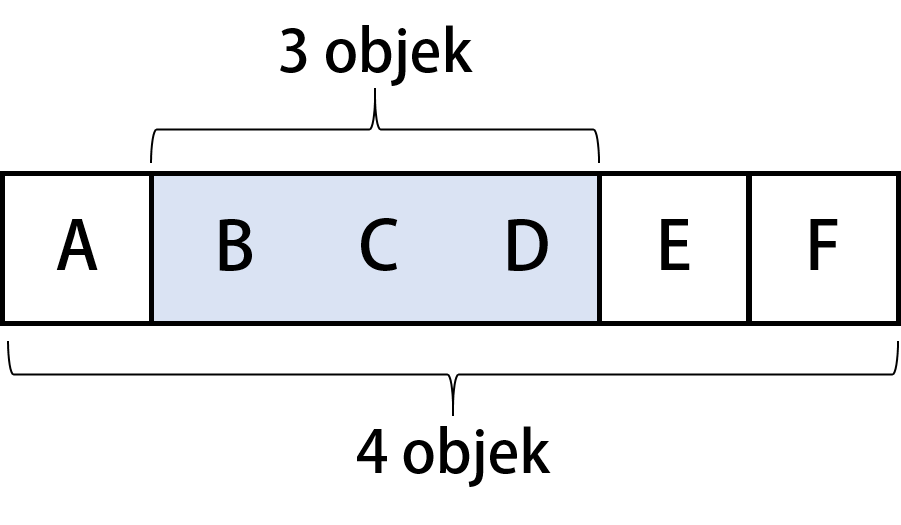 By considering $BCD$ as one object, we can assume that there are only $4$ objects arranged for the photo, namely $A$, $BCD$, $E$, and $F$.
The number of ways they can take the photo is $4! = 24$.
Also note that $BCD$ can rearrange themselves within their own group (for example becoming $CDB$), and we know there are $3! = 6$ ways for them to do so.
Therefore, the total number is $\boxed{24 \times 6 = 144}$
Observe the following sketch ($AB$ together).
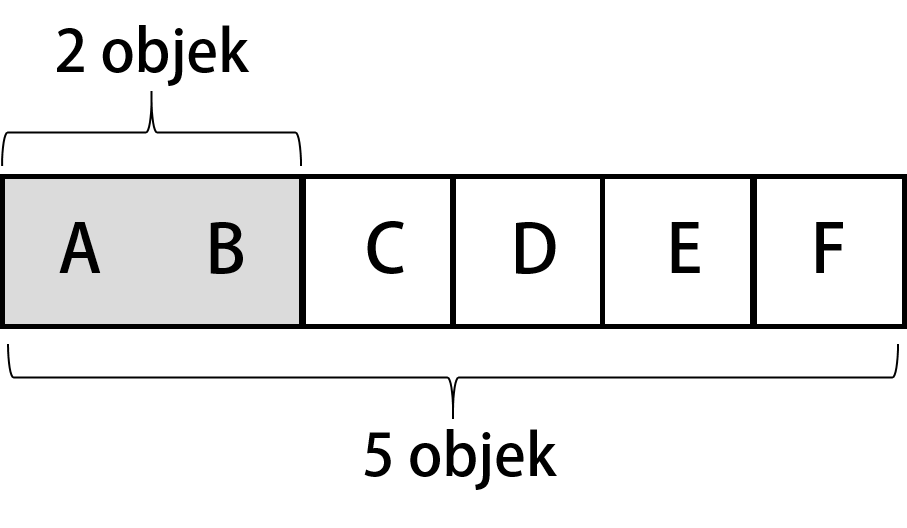 We will first find the number of arrangements when $AB$ are together.
By considering $AB$ as one object, we can assume that there are only $5$ objects arranged for the photo, namely $AB$, $C$, $D$ $E$, and $F$.
The number of ways they can take the photo is $5! = 120$.
Also note that $AB$ can exchange positions within their own group, namely becoming $BA$, so there are $2$ ways for them to take the photo.
Therefore, the total number is $120 \times 2 = 240.$
Based on Solution (a), the number of ways they can take the photo without conditions is $720$.
Therefore, the number of ways to take the photo with the condition that $A$ and $B$ are not together is $\boxed{720-240 = 480}$
Problem Number 12
A family consisting of a father, a mother, $2$ sons, and $2$ daughters will take a photo together in one row. Determine the number of arrangements if:
- without conditions;
- the father and mother are always in the middle;
- the father and mother are always side by side;
- each pair of the two sons and the two daughters must always stand together.
The way to arrange positions for taking photos is actually analogous (similar) to arranging letters/numbers.
Answer a)


 The number of ways to arrange the family consisting of $6$ people for the photo is
$6! = 6 \times 5 \times 4 \times 3 \times 2 \times 1 = 720.$
Answer b)
Observe the following slot sketch.
When the father and mother are in the middle, we only need to count the arrangements of the other four people, then multiply by $2$ (because the arrangements father-mother and mother-father are considered different).
Therefore, the number of photo arrangements is $4! \times 2 = (4 \times 3 \times 2 \times 1) \times 2 = 48.$
Answer c)
 When the father and mother stand side by side, we consider them as one unit (one object). Therefore, it is as if we are arranging photos of $5$ people. The number of arrangements obtained must later be multiplied by $2$ because the arrangements father-mother and mother-father are different.
Therefore, the number of photo arrangements is $5! \times 2 = (5 \times 4 \times 3 \times 2 \times 1) \times 2$ $= 240.$
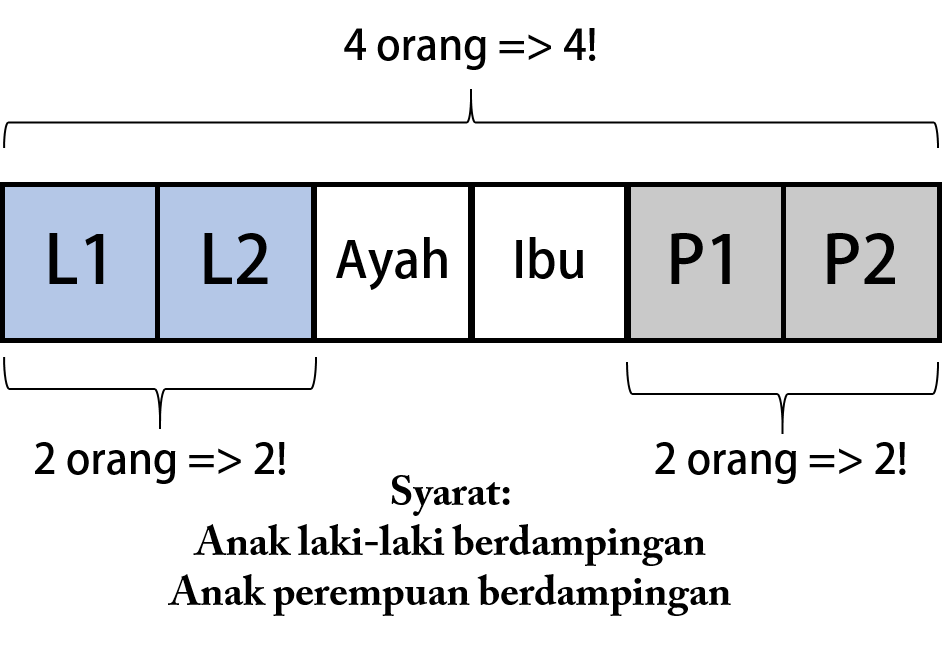
Answer d)
When each pair of the two sons and the two daughters must always stand together, we consider the two sons and the two daughters as one unit (one object). It is as if we are arranging a photo of $4$ people.
The number of photo arrangements obtained must later be multiplied by $2$, then multiplied by another $2$ because the positions S1-S2 and S2-S1 are different, including D1-D2 and D2-D1.
Therefore, the number of photo arrangements is $4! \times 2 \times 2 = (4 \times 3 \times 2 \times 1) \times 2 \times$ $2 = 96.$
Question Number 13
Determine the number of different word arrangements that can be formed from the letters of the word:
a. WISUDA;
b. MATEMATIKA;
c. INDONESIA;
d. PANCASILA.
The word WISUDA consists of $6$ letters, all of which are different.
Using the permutation rule, the number of word arrangements is
$\boxed{6! = 6 \times 5 \times 4 \times 3 \times 2 \times 1 = 720}$
The word MATEMATIKA consists of $10$ letters with $2$ occurrences of the letter M, $2$ occurrences of the letter T, and $3$ occurrences of the letter A.
Using the repeated permutation rule, the number of word arrangements is
$$\boxed{\dfrac{10!}{2! \cdot 3! \cdot 2!} = \dfrac{10 \cdot \cancelto{3}{(9 \cdot 8)} \cdot 7!}{\cancel{24}} = 10 \cdot 3 \cdot 5.040 = 151.200}$$
The word INDONESIA consists of $9$ letters with $2$ occurrences of the letter N and $2$ occurrences of the letter I.
Using the repeated permutation rule, the number of word arrangements is
$$\boxed{\dfrac{8!}{2! \cdot 2!} = \dfrac{\cancelto{2}{8} \cdot 7!}{\cancel{4}} = 2 \cdot 5.040 = 10.080}$$
The word PANCASILA consists of $9$ letters with $3$ occurrences of the letter A.
Using the repeated permutation rule, the number of word arrangements is
$$\boxed{\dfrac{9!}{3!} = \dfrac{\cancelto{12}{(9 \cdot 8)} \cdot 7!}{\cancel{6}} = 12 \cdot 5.040 = 60.480}$$
Question Number 14
Determine the number of different digit arrangements that can be formed from the digits of the number:
a. $123456$;
b. $087818001796$;
c. $3334445555$.
Answer a)
$123456$ consists of $6$ digits, all of which are different.
Using the permutation rule, the number of arrangements that can be formed is $6! = 720$.
Answer b)
$087818001796$ consists of $12$ digits: $8$ appears $3$ times, $0$ appears $3$ times, $1$ appears $2$ times, and $7$ appears $2$ times.
Using the repeated permutation rule, the number of arrangements that can be formed is $\dfrac{12!}{3! \cdot 3! \cdot 2! \cdot 2!}$.
Answer c)
$3334445555$ consists of $10$ digits: $3$ appears $3$ times, $4$ appears $3$ times, and $5$ appears $4$ times.
Using the repeated permutation rule, the number of arrangements that can be formed is $\dfrac{10!}{3! \cdot 3! \cdot 4!}$.
Question Number 15
A student is required to answer $8$ out of $12$ questions. Determine the number of choices available to the student if:
- without conditions;
- questions number 1 to 4 must be answered;
- odd-numbered questions must be answered.
Answer a)
Notice that when a student chooses to answer questions number $1$ and $2$, it is the same as answering questions number $2$ and $1$ (the order of answering is not considered), so this is a combination case.
Out of $12$ questions, the student must answer $8$ questions. Therefore, the number of ways to choose the questions to be answered is
$\begin{aligned} C^{12}_8 & = \dfrac{12!}{8! \cdot 4!} \\ & = \dfrac{12 \cdot 11 \cdot 10 \cdot 9 \cdot \cancel{8!}}{\cancel{8!} \cdot 4!} \\ & = 495 \end{aligned}$
Answer b)
Questions number $1$ to $4$ must be answered. This means that out of the $8$ questions, the student only needs to choose $\color{blue}{4}$ other questions to answer from questions number $5$ to $12$ (there are $\color{red}{8}$ questions).
The number of ways to choose the questions to be answered is
$C^{\color{red}{8}}_{\color{blue}{4}} = \dfrac{8!}{4! \cdot 4!} = \dfrac{8 \cdot 7 \cdot 6 \cdot 5 \cdot \cancel{4!}}{\cancel{4!} \cdot 4!} = 70$
Answer c)
Odd-numbered questions must be answered, namely questions number $1, 3, 5, 7, 9$, and $11$. Out of the $8$ questions that must be answered, there are now only $\color{blue}{2}$ questions left to choose from the $\color{red}{6}$ available questions.
The number of ways to choose the questions to be answered is
$C^{\color{red}{6}}_{\color{blue}{2}} = \dfrac{6!}{4! \cdot 2!} = \dfrac{6 \cdot 5 \cdot \cancel{4!}}{\cancel{4!} \cdot 2!} = 15$
Question Number 16
At a dinner party, a family consists of a husband, a wife, and their four children. Determine the number of ways they can sit around the dining table if:
- without conditions;
- the husband and wife must sit next to each other;
- the husband and wife must not sit next to each other.
Answer a)
Circular seating arrangements indicate the use of circular permutations.
There are $\color{blue}{6}$ people whose seating positions will be arranged in a circle, so the number of seating arrangements is $(\color{blue}{6}-1)! = 5! = 120.$
Answer b)
The husband and wife must sit next to each other, so we consider them as one object.
This means we only need to arrange $\color{red}{5}$ objects.
Based on the circular permutation rule, the number of seating arrangements is $(\color{red}{5}-1)! = 4! = 24$.
Also note that the husband and wife can swap places to become wife-husband (there are $\color{green}{2}$ seating arrangements) in their seating positions, so the total is $\color{green}{2} \times 24 = 48$.
Answer c)
To calculate the number of seating arrangements when the husband and wife do not sit next to each other, we only need to subtract the total number of seating arrangements (without conditions) by the number of seating arrangements when the husband and wife must sit together.
Based on the previous answer, we obtain $120-48 = 72$.
Question Number 17
A gift coupon code for shopping at a supermarket named Mathmart is in the form of a number arranged from the digits $2, 3, 3, 5, 8.$
 If the coupon codes are arranged in order from the smallest to the largest number, determine the position of the coupon with code:
a. $28533$;
b. $53283$.
Number arrangements using the digits $2, 3, 3, 5, 8$.
Answer a)
Number of coupon codes: $23XXX$
$= 3 \cdot 2 \cdot 1 = 6.$
Number of coupon codes: $25XXX$
there are $3$, namely $23558, 25383, 25833.$
Next, followed by $\underbrace{28335}_{10},$ $\underbrace{28353}_{11}$, and $\underbrace{28533}_{12}.$
Therefore, the coupon with number $28533$ is in the $12$th position.
Answer b)
Number of coupon codes: $2XXXX$ (the digit $3$ appears $\color{blue}{2}$ times)
$= \dfrac{4!}{\color{blue}{2}!} = 4 \times 3 = 12.$
Number of coupon codes: $3XXXX$
$= 4! = 24$.
Number of coupon codes: $52XXX$ (the digit $3$ appears $\color{blue}{2}$ times)
$= \dfrac{3!}{\color{blue}{2}!} = 3.$
Next, followed by $\underbrace{53238}_{40}$ and $\underbrace{53283}_{41}.$
Therefore, the coupon with number $53283$ is in the $41$st position.
Problem Number 18
A child enters a building that has $5$ entrance-exit doors.

Determine the number of possible ways to enter and exit the building if:
- he is not allowed to pass through the same door;
- he is allowed to pass through the same door;
- there is $1$ secret door that may only be used to exit the building and he is not allowed to pass through the same door;
- there are $2$ secret doors that may only be used to enter the building and he is allowed to pass through the same door.
Answer a)
Entering through $5$ doors, but exiting can only be done through $4$ doors because entering and exiting through the same door is not allowed. The number of ways to enter and exit is $5 \times 4 = 20.$
Answer b)
Entering through $5$ doors and exiting also through $5$ doors. The number of ways to enter and exit is $5 \times 5 = 25$.
Answer c)
Entering through $\color{red}{5}$ doors and exiting only through $4$ doors, but because there is $1$ secret exit door, this means there are $\color{blue}{5}$ doors that can be used for exiting.
The number of ways to enter and exit is $\color{red}{5} \times \color{blue}{5} = 25.$
Answer d)
Entering through $7$ doors ($5$ regular doors plus $2$ secret doors) and exiting through $5$ doors.
The number of ways to enter and exit is $\color{red}{7} \times \color{blue}{5} = 35$.
Problem Number 19
A basket contains $6$ apples, $5$ oranges, and $2$ mangoes. If a child randomly picks $3$ fruits from the basket, determine the probability that at least one of the selected fruits is:
a. an orange;
b. a mango;
c. an apple?
The total number of fruits is $6+5+2 = 13.$ This case is a combination case because the order of selecting the fruits does not matter (for example: choosing an orange, apple, and mango is the same as choosing an apple, mango, and orange).
Answer a)
The event of at least one (minimum one, not less than that) of the $3$ selected fruits being an orange has the complement event that no orange is selected.
Since $\color{red}{3}$ fruits are selected and there are $\color{blue}{6+2 = 8}$ non-orange fruits, by using the complement rule and combinations, we obtain
$\begin{aligned} P(A) & = 1-\dfrac{C^8_3}{C^{13}_3} \\ & = 1-\dfrac{\dfrac{8!}{5! \cdot 3!}}{\dfrac{13!}{10! \cdot 3!}} \\ & = 1-\dfrac{8 \cdot 7 \cdot 6}{13 \cdot 12 \cdot 11} \\ & = 1-\dfrac{28}{143} = \dfrac{115}{143}. \end{aligned}$
Therefore, the probability that at least one orange is among the $3$ selected fruits is $\boxed{\dfrac{115}{143}}$
Answer b)
The event of at least one (minimum one, not less than that) of the $3$ selected fruits being a mango has the complement event that no mango is selected.
Since $\color{red}{3}$ fruits are selected and there are $\color{blue}{6+5 = 11}$ non-mango fruits, by using the complement rule and combinations, we obtain
$\begin{aligned} P(B) & = 1-\dfrac{C^{11}_3}{C^{13}_3} \\ & = 1-\dfrac{\dfrac{11!}{8! \cdot 3!}}{\dfrac{13!}{10! \cdot 3!}} \\ & = 1-\dfrac{\cancel{11} \cdot 10 \cdot \cancelto{3}{9}}{13 \cdot \cancelto{4}{12} \cdot \cancel{11}} \\ & = 1-\dfrac{15}{26} = \dfrac{11}{26}. \end{aligned}$
Therefore, the probability that at least one mango is among the $3$ selected fruits is $\boxed{\dfrac{11}{26}}$
Answer c)
The event of at least one (minimum one, not less than that) of the $3$ selected fruits being an apple has the complement event that no apple is selected.
Since $\color{red}{3}$ fruits are selected and there are $5+2 = 7$ non-apple fruits, by using the complement rule and combinations, we obtain
$\begin{aligned} P(A) & = 1-\dfrac{C^7_3}{C^{13}_3} \\ & = 1-\dfrac{\dfrac{7!}{4! \cdot 3!}}{\dfrac{13!}{10! \cdot 3!}} \\ & = 1-\dfrac{7 \cdot \cancel{6} \cdot 5}{13 \cdot \cancelto{2}{12} \cdot 11} \\ & = 1-\dfrac{35}{286} = \dfrac{251}{286}. \end{aligned}$
Therefore, the probability that at least one apple is among the $3$ selected fruits is $\boxed{\dfrac{251}{286}}$
Problem Number 20
Inside a box there are $5$ balls numbered $1, 2, 3, 4$, and $5$. A child randomly draws a ball, records its number, and then returns it to the box. He repeats the same process $5$ times. Determine the probability that the sum of the five selected numbers is:
a. six;
b. seven.
Answer a)
Based on the experiment, we must determine the values of $(a, b, c, d, e)$ with $a, b, c, d, e \in \{1, 2, 3, 4, 5\}$ such that $a+b+c+d+e = 6$.
The only formation satisfying the equation is one $2$ and four $1$s, namely $(2, 1, 1, 1, 1)$ along with its other permutations. In total there are $\dfrac{5!}{\underbrace{4!}_{\text{from the number of 1s}}} = \color{red}{5}$.
Because the balls are drawn one by one and returned $5$ times, the probability is $P(A’) = \left(\dfrac15\right)^5.$
The total probability after multiplying by $\color{red}{5}$ is
$\boxed{P(A) = 5 \times \left(\dfrac15\right)^5 = \dfrac{1}{625}}$
Answer b)
Based on the experiment, we must determine the values of $(a, b, c, d, e)$ with $a, b, c, d, e \in \{1, 2, 3, 4, 5\}$ such that $a+b+c+d+e = 7.$
There are two formations satisfying the equation, namely:
- two $2$s and three $1$s, namely $(2, 2, 1, 1, 1)$ with the number of permutations $\dfrac{5!}{2! \cdot 3!} = 10$.
- one $3$ and four $1$s, namely $(3, 1, 1, 1, 1)$ with the number of permutations $\dfrac{5!}{4!} = 5$.
Total permutations = $10+5 = \color{red}{15}$. Because the balls are drawn one by one and returned $5$ times, the probability is $P(B’) = \left(\dfrac15\right)^5.$
The total probability after multiplying by $\color{red}{15}$ is $\boxed{P(B) = 15 \times \left(\dfrac15\right)^5 = \dfrac{3}{125}}$
Problem Number 21
Determine the number of ways to arrange the letters forming the word MATEMATIKA if:
- without any condition;
- the two T letters must be adjacent;
- the two M letters must be at the ends;
- no vowels may be adjacent;
- consonants appear first.
Answer a)
 MATEMATIKA consists of $10$ letters. The letters that appear more than once are M appearing $2$ times, T appearing $2$ times, and A appearing $3$ times.
Using the repeated permutation rule, the number of ways to arrange the letters forming the word is
$\begin{aligned} \dfrac{10!}{2! \cdot 2! \cdot 3!} & = \dfrac{10 \cdot \cancelto{3}{9 \cdot 8} \cdot 7!}{\cancel{2 \cdot 2 \cdot 6}} \\ & = 30 \cdot 5.040 \\ & = 151.200. \end{aligned}$
Answer b)
 Because the two T letters must be adjacent, we may consider TT as a single letter. In other words, the letters forming the word MATEMATIKA are considered to consist of only $9$ letters, with A appearing $3$ times and M appearing twice. Using the repeated permutation rule, the number of ways to arrange the letters forming the word is
$\begin{aligned} \dfrac{9!}{2! \cdot 3!} & = \dfrac{\cancelto{6}{9 \cdot 8} \cdot 7!}{\cancel{2 \cdot 6}} \\ & = 6 \cdot 5.040 = 30.240. \end{aligned}$
Answer c)
The two M letters must be at the ends.
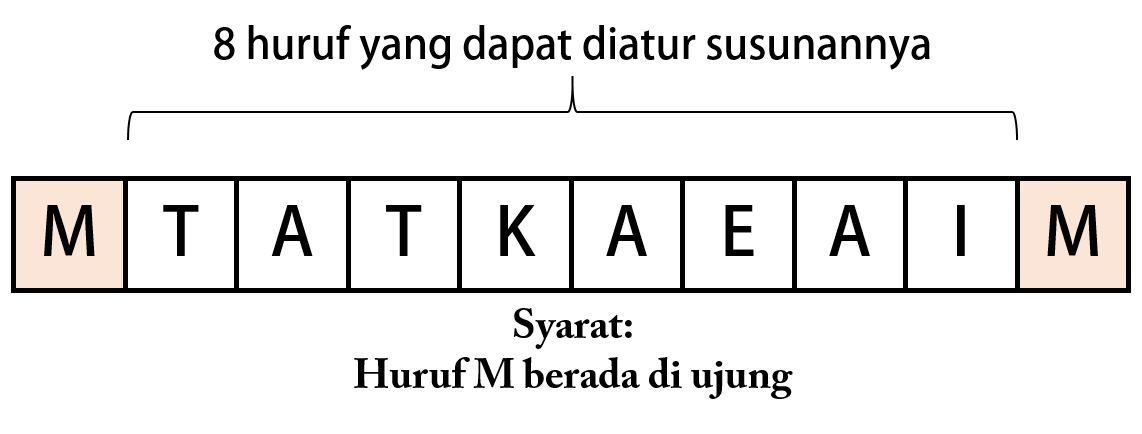 We only need to arrange the remaining $8$ letters, where there are letters appearing more than once, namely A appearing $3$ times and T appearing $2$ times. Using the repeated permutation rule, the number of ways to arrange the letters forming the word is
$\dfrac{8!}{2! \cdot 3!} = \dfrac{\cancelto{4}{8} \cdot 7 \cdot \bcancel{6} \cdot 5!}{\cancel{2} \cdot \bcancel{3!}} = 3.360.$
Answer d)
Observe the following slot sketch.
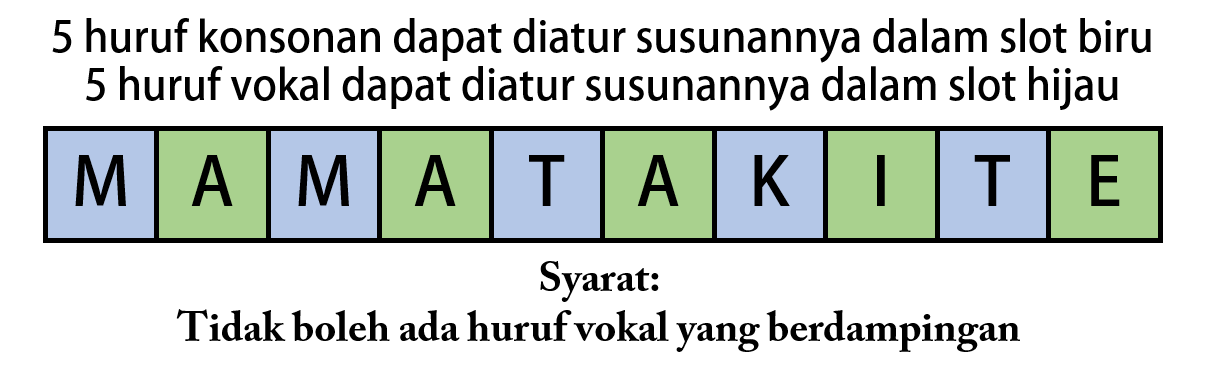
Based on the sketch above, the number of ways to arrange consonants in the blue slots above (letters M and T appear twice) is $\dfrac{5!}{2! \cdot 2!} = \dfrac{120}{4} = 30$, while the number of ways to arrange vowels in the green slots (letter A appears three times) is $\dfrac{5!}{3!} = 20$.
In addition, we can also swap the positions of vowels and consonants (example: MAMA becomes AMAM), so the permutation result must be multiplied by $2.$ Overall, there are $\boxed{30 \times 20 \times 2= 1.200}$ ways to arrange the letters of MATEMATIKA under the condition that no vowels may be adjacent.
Answer e)
Observe the following slot sketch.

The word MATEMATIKA consists of $5$ consonants and $5$ vowels. To arrange the $5$ consonants in front such that letters M and T appear $2$ times, the number of possible arrangements is $\dfrac{5!}{2! \cdot 2!} = 30$.
To arrange the $5$ vowels at the back such that letter $A$ appears $3$ times, the number of possible arrangements is $\dfrac{5!}{3!} = 20.$
Overall, there are $\boxed{30 \times 20 = 600}$ ways to arrange those letters.
Problem Number 22
Determine the number of triangles that can be formed from:
a. $5$ points;
b. $12$ points;
c. $100$ points.
Note: Assume that no $3$ points are collinear.
A triangle is a plane figure that can be formed from $3$ non-collinear points.
A triangle is still considered the same even if it is named starting from different points among the same $3$ points (for example, triangle $ABC$ and $BAC$ are the same), so this is a combination case.
There are $5$ non-collinear points and forming a triangle requires $3$ points. Use the combination formula for choosing $3$ objects from $5$ objects.
$\begin{aligned} C^5_3 & = \dfrac{5!}{3! \cdot 2!} \\ & = \dfrac{5 \cdot 4 \cdot \cancel{3!}}{\cancel{3!} \cdot 2} = 10 \end{aligned}$
There are $10$ different triangles that can be formed.
Illustration: Suppose there are points $A, B, C, D$, and $E$ (with no $3$ points collinear). The ten triangles are
$\triangle ABC, \triangle ABD, \triangle ABE, \triangle ACD$, $\triangle ACE, \triangle ADE,\triangle BCD, \triangle BCE$,$\triangle BDE, \triangle CDE$.
Using the same method:
$\begin{aligned} C^{12}_3 & = \dfrac{12!}{9! \cdot 3!} \\ & = \dfrac{\cancelto{2}{12} \cdot 11 \cdot 10 \cdot \cancel{9!}}{\cancel{9!} \cdot \cancel{6}} = 220 \end{aligned}$
There are $\boxed{220}$ triangles that can be formed from $12$ non-collinear points.
Using the same method:
$\begin{aligned} C^{100}_3 & = \dfrac{100!}{97! \cdot 3!} \\ & = \dfrac{100 \cdot 99 \cdot 98 \cdot \cancel{97!}}{\cancel{97!} \cdot 6} = 161.700 \end{aligned}$
There are $\boxed{161.700}$ triangles that can be formed from $100$ non-collinear points.
Problem Number 23
The Tangkas badminton club has $24$ members divided into two age groups, namely the children group and the teenagers group. The children group consists of $15$ players, with $8$ of them being boys. The total number of female members in the Tangkas badminton club is $10$ players. Determine the number of mixed doubles formations that can be formed by the club under each of the following conditions.
- Both players come from the teenagers group.
- One player comes from each group.
From the given information, the number of members in each group can be represented in the following table.
$$\begin{array}{|c|c|c|c|} \hline & \text{Children} & \text{Teenagers} & \text{Total} \\ \hline \text{Boys} & 8 & 6 & 14 \\ \hline \text{Girls} & 7 & 3 & 10 \\ \hline \text{Total} & 15 & 9 & 24 \\ \hline \end{array}$$In badminton, a mixed doubles formation consists of $2$ people, namely one male player and one female player.
Answer a)
In the teenagers group, there are $6$ male players, while the number of female players is $3$.
The number of possible mixed doubles formations is $6 \times 3 = 18$.
Answer b)
In the children group there are $8$ boys and in the teenagers group there are $3$ girls.
The number of possible formations is $8 \times 3 = 24$.
In the children group there are $7$ girls and in the teenagers group there are $6$ boys.
The number of possible formations is $7 \times 6 = 42$.
Therefore, the total number of formations is $\boxed{24+42=66}$.
Problem Number 24
A competition committee has $40$ notebooks to be distributed as prizes for first, second, and third place winners. Each prize recipient must receive at least $10$ notebooks, and participants with higher rankings must receive more notebooks. How many possible prize compositions are there?
Each winner is assumed to have already been given $10$ notebooks, so now there are only $40-3(10) = 10$ notebooks left to distribute among them.
Based on the condition that participants with higher rankings receive more notebooks, we can list all prize compositions in the following table.
$\begin{array}{|c|c|c|} \hline \text{Third Place} & \text{Second Place} & \text{First Place} \\ \hline 0 & 1 & 9 \\ \hline 0 & 2 & 8 \\ \hline 0 & 3 & 7 \\ \hline 0 & 4 & 6 \\ \hline 1 & 2 & 7 \\ \hline 1 & 3 & 6 \\ \hline 1 & 4 & 5 \\ \hline 2 & 3 & 5 \\ \hline \end{array}$
Therefore, we find that there are $\boxed{8}$ possible prize compositions.
Problem Number 25
A competition committee has $53$ notebooks to be distributed as prizes for first, second, and third place winners, as well as first and second honorable mention winners. Each prize recipient must receive at least $8$ notebooks, and participants with higher rankings must receive more notebooks. How many possible prize compositions are there?
Each winner is assumed to have already been given $8$ notebooks, so now there are only $53-5(8) = 13$ notebooks left to distribute among them. Based on the condition that participants with higher rankings receive more notebooks, we can list all prize compositions in the following table.
$$\begin{array}{|c|c|c|c|c|} \hline \text{Honorable Mention II} & \text{Honorable Mention I} & \text{Third Place} & \text{Second Place} & \text{First Place} \\ \hline 0 & 1 & 2 & 3 & 7 \\ \hline 0 & 1 & 2 & 4 & 6 \\ \hline 0 & 1 & 3 & 4 & 5 \\ \hline \end{array}$$Therefore, we find that there are only $\boxed{3}$ possible prize compositions.
Problem Number 26
Players A and B play chess for $12$ rounds with $6$ wins by player A, $4$ wins by player B, and $2$ draws. In a match consisting of $3$ rounds, calculate the probability if:
- Players A and B win alternately;
- Player B wins at least one round.
Based on the first information, the probability of A winning is $\dfrac{6}{12} = \dfrac12$, the probability of B winning is $\dfrac{4}{12} = \dfrac13$, and the probability of a draw is $\dfrac{2}{12} = \dfrac16$.
Answer a)
Possibility 1:
A wins in the first round, then B wins in the second round, and A wins again in the third round. The probability that these three events occur consecutively is
$P(X) = \dfrac12 \times \dfrac13 \times \dfrac12 = \dfrac{1}{12}$
Possibility 2:
B wins in the first round, then A wins in the second round, and B wins again in the third round.
The probability that these three events occur consecutively is $P(Y) = \dfrac13 \times \dfrac12 \times \dfrac13 = \dfrac{1}{18}.$
The total probability is
$\begin{aligned} P(X \cup Y) & = P(X) + P(Y) \\ & = \dfrac{1}{12} + \dfrac{1}{18} = \dfrac{5}{36} \end{aligned}$
Therefore, the probability that A and B win alternately is $\boxed{\dfrac{5}{36}}$
Answer b)
Player B winning at least one round indicates three mutually exclusive events, namely B wins one round, B wins two rounds, and B wins all three rounds.
Instead of calculating the probabilities of these three events directly, it is more effective to calculate the probability that B never wins in the $3$ rounds, then subtract the result from $1$ (complement probability).
The probability that B never wins (meaning either a draw or A wins) is
$\begin{aligned} P(X) & = \dfrac{6+2}{12} \times \dfrac{6+2}{12} \times \dfrac{6+2}{12} \\ & = \dfrac{2}{3} \times \dfrac23 \times \dfrac23 = \dfrac{8}{27} \end{aligned}$
The probability that B wins at least one round is
$\begin{aligned} P(X^C) & = 1-P(X) \\ & = 1-\dfrac{8}{27} = \dfrac{19}{27}. \end{aligned}$
Problem Number 27
There are five yellow balls in the first bag. One ball is transferred to the second bag which contains a number of green balls. From the second bag, one ball is chosen at random and then transferred to the first bag. From the first bag, one ball is chosen randomly again and then transferred to the second bag. Finally, a ball is chosen randomly from the second bag. If the probability of obtaining a green ball in this final draw is $\dfrac35,$ how many green balls were originally in the second bag?
Suppose $K$ and $H$ represent the number of yellow and green balls respectively. Also suppose that the number of green balls in bag $2$ is $x.$
Initial condition:
$$\begin{array}{cc} \hline \text{Bag 1} & \text{Bag 2} \\ K = 5 & H = x \\ \hline \end{array}$$One ball is transferred from bag $1$ to bag $2.$
$$\begin{array}{cc} \hline \text{Bag 1} & \text{Bag 2} \\ K = 4 & H = x \\ & K = 1 \\ \hline \end{array}$$One ball is transferred from bag $2$ to bag $1.$
Case 1: A yellow ball is selected
The probability of selecting a yellow ball from bag $2$ is $\dfrac{1}{x+1}.$ After being transferred to bag $1,$ bag $1$ now contains $5$ yellow balls, while bag $2$ contains $x$ green balls.
$$\begin{array}{cc} \hline \text{Bag 1} & \text{Bag 2} \\ K = 5 & H = x \\ \hline \end{array}$$In the next step, another ball is selected from bag $1$ (certainly a yellow ball) and transferred to bag $2$ so that bag $1$ has $4$ yellow balls left, while bag $2$ contains $x$ green balls and $1$ yellow ball.
$$\begin{array}{cc} \hline \text{Bag 1} & \text{Bag 2} \\ K = 4 & H = x \\ & K = 1 \\ \hline \end{array}$$The probability of selecting a green ball for this case is expressed by
$$P(A) = \dfrac{1}{x+1} \cdot \dfrac{x}{x+1} = \dfrac{x}{x^2+2x+1}.$$
Case 2: A green ball is selected
The probability of selecting a green ball from bag $2$ is $\dfrac{x}{x+1}.$ After being transferred to bag $1,$ bag $1$ now contains $4$ yellow balls and $1$ green ball, while bag $2$ contains $(x-1)$ green balls and $1$ yellow ball.
$$\begin{array}{cc} \hline \text{Bag 1} & \text{Bag 2} \\ H = 1 & H = x-1 \\ K = 4 & K = 1 \\ \hline \end{array}$$In the next step, another ball is selected from bag $1$ and transferred to bag $2.$ There are two more cases to consider.
Case 2A: A yellow ball is selected
The probability of selecting a yellow ball from bag $1$ is $\dfrac{4}{5}.$ After being transferred to bag $2,$ bag $1$ now contains $3$ yellow balls and $1$ green ball, while bag $2$ contains $(x-1)$ green balls and $2$ yellow balls.
$$\begin{array}{cc} \hline \text{Bag 1} & \text{Bag 2} \\ H = 1 & H = x-1 \\ K = 3 & K = 2 \\ \hline \end{array}$$The final step is selecting a green ball from bag $2$ with probability $\dfrac{x-1}{x+1}.$ Overall, the probability of selecting a green ball for this case is
$$P(B) = \dfrac{x}{x+1} \cdot \dfrac45 \cdot \dfrac{x-1}{x+1} = \dfrac{4x^2-4x}{5(x^2+2x+1)}.$$Case 2B: A green ball is selected’
The probability of selecting a green ball from bag $1$ is $\dfrac{1}{5}.$ After being transferred to bag $2,$ bag $1$ now contains $4$ yellow balls, while bag $2$ contains $x$ green balls and $1$ yellow ball.
$$\begin{array}{cc} \hline \text{Bag 1} & \text{Bag 2} \\ H = 0 & H = x \\ K = 4 & K = 1 \\ \hline \end{array}$$The final step is selecting a green ball from bag $2$ with probability $\dfrac{x}{x+1}.$
Overall, the probability of selecting a green ball for this case is
$$P(C) = \dfrac{x}{x+1} \cdot \dfrac15 \cdot \dfrac{x}{x+1} = \dfrac{x^2}{5(x^2+2x+1)}.$$Combine the probabilities for each case above. We obtain
$$\begin{aligned} P(A) + P(B) + P(C) & = \dfrac35 \\ \dfrac{x}{x^2+2x+1} + \dfrac{4x^2-4x}{5(x^2+2x+1)} + \dfrac{x^2}{5(x^2+2x+1)} & = \dfrac35 \\\dfrac{5x}{5(x^2+2x+1)} + \dfrac{4x^2-4x}{5(x^2+2x+1)} + \dfrac{x^2}{5(x^2+2x+1)} & = \dfrac35 \\ \dfrac{5x^2+x}{\cancel{5}(x^2+2x+1)} & = \dfrac{3}{\cancel{5}} \\ 5x^2+x & = 3(x^2+2x+1) \\ 2x^2-5x-3 & = 0 \\ (2x+1)(x-3) & = 0 \\ x = -\dfrac12~\text{or}~x & = 3 \end{aligned}$$Since $x$ represents the number of balls, its value must be a nonnegative integer. Therefore, the value of $x$ that satisfies is $3,$ meaning that the number of green balls originally in bag $2$ is $\boxed{3}$
Problem Number 28
Adi and Bobi choose a number from the set $\{1, 2, 3, 4, 5\}$ randomly (each number may be chosen twice). If $p$ is the probability that the number chosen by Adi is greater than the number chosen by Budi, what is the value of $\lfloor 100p \rfloor$?
Suppose $A$ and $B$ respectively represent the numbers chosen by Adi and Budi so that we can denote $P(A > B) = p.$ From this condition, the value of $A$ clearly cannot be $1.$ The possible values of $A$ and $B$ can then be represented as follows.
$$\begin{array}{cc} \hline A & B \\ \hline 2 & 1 \\ 3 & 1, 2 \\ 4 & 1, 2, 3 \\ 5 & 1,2,3,4 \\ \hline \end{array}$$Therefore, in total there are $n(A > B) = 1+2+3+4 = 10$ possibilities. Since there are $5$ numbers that can be chosen and each number may be chosen twice, then $n(S) = 5 \cdot 5 = 25.$
Thus, we obtain
$$\begin{aligned} p & = \dfrac{n(A > B)}{n(S)} \\ & = \dfrac{10}{25}. \end{aligned}$$Therefore, we get
$$\begin{aligned} \lfloor 100p \rfloor & = \left\lfloor \cancelto{4}{100} \cdot \dfrac{10}{\cancel{25}} \right\rfloor \\ & = 40. \end{aligned}$$Note: The notation $\lfloor x \rfloor$ represents the greatest integer less than or equal to $x.$ For example: $\lfloor 2,\!89 \rfloor = 2$ and $\lfloor 3,\!429 \rfloor = 3$ (always rounded down).
Problem Number 29
Ten students have different heights. The sports teacher wants them to stand in a horizontal line under the condition that no student is flanked by two other students who are taller than them. How many ways are there to form such a line?
Create $10$ positions to be occupied by the ten students.
 The shortest student must be at the edge so that they are not flanked by taller students. They can choose $2$ positions (left end or right end).
Next, there are $9$ students left. The second shortest student is the same. They must choose $2$ edge positions (from the remaining $9$ positions) so that they are not flanked by taller students.
This continues until the ninth student with $2$ remaining positions. They are free to choose either position, while the tenth student takes the remaining position. Therefore, there are $\boxed{\underbrace{2 \cdot 2 \cdot \cdots \cdot 2}_{\text{there are}~9} = 2^9 = 512}$ ways to form the line.
Problem Number 30
Use the multiplication rule to show that the number of distinct subsets of a set $S$ is $2^{|S|}.$
Suppose the set $S = \{a_1, a_2, a_3, \cdots, a_S\}.$ Let us say that we have $|S|$ positions. The first position may only be filled by $a_1.$ This means we have two choices: include $a_1$ as a member of the subset or not. The second position may only be filled by $a_2$. In a similar way, we also have two choices. This continues until the last position which may only be filled by $a_S.$ We also have two choices there. If we do not include every element in its position, we obtain the empty set (which is also a subset of $S$).
Therefore, the number of choices which is analogous to the number of subsets is $$\underbrace{2 \times 2 \times \cdots \times 2}_{\text{as many as}~|S|} = 2^{|S|}.$$ $\blacksquare$
Problem Number 31
A building with $21$ floors has an elevator. Ten people enter the elevator from the $1^\text{st}$ floor.
- Determine the probability that they all get off on different floors.
- Determine the probability that they all get off on the same floor.
- Determine the probability that they all get off on different even-numbered floors.
- Determine the probability that they all get off on floors below $11.$
Answer a)
We must ‘choose’ $10$ people to be placed on $20$ floors (because the $1^\text{st}$ floor is not counted) so that one floor can only be chosen by one person. Therefore, we use the permutation rule, namely $P(20, 10).$ If there are no conditions at all, each person may choose any of the $20$ floors to get off. Since there are $10$ people, the number of possibilities is $20^{10}.$
Therefore, the probability that they all get off on different floors is $\boxed{\dfrac{P(20, 10)}{20^{10}}}$
Answer b)
Since there are $20$ floors, this means there are $20$ possibilities for them all to get off on the same floor. If there are no conditions at all, each person may choose any of the $20$ floors to get off. Since there are $10$ people, the number of possibilities is $20^{10}.$ Therefore, the probability that they all get off on the same floor is $\boxed{\dfrac{20}{20^{10}}}$
Answer c)
From floor $2$ to floor $21,$ there are $10$ even-numbered floors. This means we need to ‘place’ the $10$ people on these $10$ even-numbered floors so that no two people are on the same floor. Therefore, we use the permutation rule, namely $P(10, 10) =10!.$
If there are no conditions at all, each person may choose any of the $20$ floors to get off. Since there are $10$ people, the number of possibilities is $20^{10}.$
Therefore, the probability that they all get off on different even-numbered floors is $\boxed{\dfrac{10!}{20^{10}}}$
Answer d)
From floor $2$ to floor $10,$ there are $9$ floors that may be chosen to get off the elevator. Since there are $10$ people, there will be $9^{10}$ possible ways for them all to get off on floors below $11.$
If there are no conditions at all, each person may choose any of the $20$ floors to get off. Since there are $10$ people, the number of possibilities is $20^{10}.$
Therefore, the probability that they all get off on different even-numbered floors is $\boxed{\dfrac{9^{10}}{20^{10}}}$
Problem Number 32
Ten pairs of shoes are stored in a cardboard box.
- If $2$ shoes are chosen randomly, determine the probability that a matching pair of shoes is selected.
- If $3$ shoes are chosen randomly, determine the probability that a matching pair of shoes is selected.
- If $6$ shoes are chosen randomly, determine the probability that three matching pairs of shoes are selected.
Answer a)
Since there are $10$ pairs of shoes, the number of possible ways to obtain a matching pair from selecting $2$ shoes is $10.$ From the existing $10 \cdot 2 = 20$ shoes, $2$ shoes are selected at once so that the number of possibilities is $C(20, 2) = \dfrac{20!}{18! \cdot 2!} = 190.$ Therefore, the probability of selecting a matching pair of shoes is $\boxed{\dfrac{10}{190} = \dfrac{1}{19}}$
Answer b)
In this case, we choose one pair of shoes (there are $10$ choices), then the third shoe may only be chosen from the remaining $18$ shoes. Therefore, the number of possibilities is $10 \times 18 = 180.$ From the existing $10 \cdot 2 = 20$ shoes, $3$ shoes are selected at once so that the number of possibilities is $C(20, 3) = \dfrac{20!}{17! \cdot 3!} = 1.140.$ Therefore, the probability of selecting a matching pair of shoes is $\boxed{\dfrac{180}{1.140} = \dfrac{3}{19}}$
Answer c)
In this case, we actually only need to choose $3$ from the $10$ pairs of shoes that are mutually different. By using the combination rule, the number of possibilities obtained is $C(10, 3) = 120.$
From the existing $10 \cdot 2 = 20$ shoes, $6$ shoes are selected at once so that the number of possibilities is $C(20, 6) = \dfrac{20!}{14! \cdot 6!} = 38.760.$
Therefore, the probability of selecting matching pairs of shoes is $\boxed{\dfrac{120}{38.760} = \dfrac{1}{323}}$
Problem Number 33
Determine the probability of obtaining heads and tails with the same frequency in tossing a coin $n$ times.
For the frequencies to be the same, the occurrences of heads and tails must each appear $\dfrac{n}{2}$ times.
The sample space members of the event where heads and tails appear with the same frequency in tossing a coin $n$ times take the form
$$(\underbrace{A, A, \cdots, A}_{\text{as many as}~\frac{n}{2}}, \underbrace{G, G, \cdots, G}_{\text{as many as}~\frac{n}{2}}).$$The number of distinct permutations of $n$ objects with $A$ appearing $\dfrac{n}{2}$ times, and likewise for $B,$ is $$\dfrac{n!}{\left(\dfrac{n}{2}\right)! \cdot \left(\dfrac{n}{2}\right)!} = \displaystyle \binom{n}{\frac{n}{2}}.$$Since the sample space members from tossing a coin $n$ times amount to $2^n,$ the probability of the expected event is $\boxed{\displaystyle \dfrac{\binom{n}{\frac{n}{2}}}{2^n} = \dfrac{1}{2^n} \cdot \binom{n}{\frac{n}{2}}}$
[Minimum Competency Assessment (AKM) Type Questions – Numeracy Section]
Read the following stimulus to answer questions number 33 and 34.
Albino Gene
Albino, also called albinism, is caused by a deficiency or absence of melanin in the body. Albinism does not only occur in humans, but also occurs in animals as shown in the picture.
 Research shows that this albino trait is inherited through genes. The gene causing albino is a recessive gene, suppose this gene is carried by allele a. Meanwhile, its paired allele, namely the dominant allele, does not cause albino. If there is a person with heterozygous Aa, then that person does not have the albino trait, but carries the albino gene. We can calculate the percentages of alleles A and a in a population using the following formula.
Suppose $p =$ percentage of allele A in the population and $q =$ percentage of allele a in the population with $p + q = 1$ so that the following table is obtained.
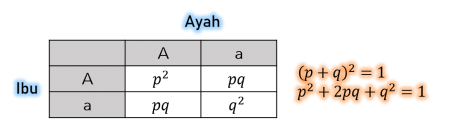 In a population, the percentage of people having the albino trait is $64\%.$
Problem Number 33
Observe the stimulus above. Match the following statements with the correct answers.

Statement 1: Value of $q$
It is known that the percentage of people having the albino trait is $64\%.$ Notice that the albino trait is only carried by recessive genes. In other words, a person who has the albino trait has genotype aa. Therefore, based on the table above, we can write that
$$\begin{aligned} q^2 & = 64\% = \dfrac{64}{100} \\ q & = \sqrt{\dfrac{64}{100}} = \dfrac{8}{10} = 0,\!80. \end{aligned}$$Statement 2: Value of $p$
Since $p + q = 1$ and $q = 0,\!80,$ then clearly the value of $p = 1-0,\!80 = 0,\!20.$
Statement 3: Probability that a person has a normal trait
It is known that the percentage of people having the albino trait is $64\%.$ From this, it can be concluded that the percentage of people not having the albino trait (which means they are normal) is $1-64\% = 0,\!36.$
Statement 4: Probability that a person has genotype AA
From the table, the probability that a person has genotype AA is equal to $p^2,$ namely $(0,\!20)^2 = 0,\!04.$
Statement 5: Probability that a person has genotype Aa
From the table, the probability that a person has genotype Aa is equal to $2pq,$ namely $2(0,\!20)(0,\!80) = 0,\!32.$
Therefore, the matching of statements and correct answers can be seen in the table below.

Problem Number 34
Observe the stimulus above again. If there are $320$ people in the area who have the albino trait, put a check mark ($\checkmark$) in the box in front of the correct statement.
- The number of people in the population in the area is $500$ people.
- The number of people who have normal traits is $160$ people.
- The number of people who have genotype AA is $20$ people.
- The number of people who have genotype Aa is $160$ people.
- The ratio of the number of residents with normal traits and albino traits is $1 : 2.$
Statement 1:
It is known that the percentage of people having the albino trait is $64\%$ and there are $320$ people who have the albino trait in the area. Thus, the total number of people $(n)$ can be determined as follows.
$$\begin{aligned} 64\% \cdot n & = 320 \\ n & = \dfrac{100}{64} \cdot 320 \\ n & = 500 \end{aligned}$$Therefore, the statement that “The number of people in the population in the area is $500$ people” is TRUE and the box must be checked.
Statement 2:
It is known that there are $500$ people in total and $320$ of them have the albino trait. Therefore, the remaining people are those who have normal traits, namely $500-320 = 180$ people. Therefore, the statement that “The number of people who have normal traits is $160$ people” is FALSE and the box should not be checked.
Statement 3:
It is known that there are $500$ people in total and based on the answer to the previous question, we know that the probability of a person having genotype AA is $0,\!04.$ Therefore, the number of people with genotype AA is $0,\!04 \cdot 500 = 20$ people. Therefore, the statement that “The number of people who have genotype AA is $20$ people” is TRUE and the box must be checked.
Statement 4:
It is known that there are $500$ people in total and based on the answer to the previous question, we know that the probability of a person having genotype Aa is $0,\!32.$ Therefore, the number of people with genotype Aa is $0,\!32 \cdot 500 = 160$ people. Therefore, the statement that “The number of people who have genotype Aa is $160$ people” is TRUE and the box must be checked.
Statement 5:
The number of people who have normal and albino traits is already known, namely $180$ people and $320$ people respectively. Their ratio is $180 : 320 = 9 : 16.$ Therefore, the statement that “The ratio of the number of residents with normal traits and albino traits is $1 : 2$” is FALSE and the box should not be checked.