

A system of linear equations in two variables is one of the most important topics in algebra because it helps students solve real-life problems involving two unknown quantities. From calculating prices and distances to analyzing business and financial situations, these equations are widely used in mathematics and everyday applications. Understanding how to solve systems of equations using substitution, elimination, and graphing methods is essential for building strong problem-solving skills.
In this article, you will find a super complete collection of Systems of Linear Equations in Two Variables (SLETV) problems along with detailed step-by-step solutions and explanations. The exercises range from basic to advanced levels, making them suitable for middle school, high school, and exam preparation. By studying these examples carefully, students can improve their understanding of algebraic concepts and become more confident in solving mathematical problems accurately and efficiently.
Read: Linear Equations in One Variable: Concepts, Formulas, and Solved Problems
Quote by Nuril Baskan
When you are in a crowd, control your words.
When you are facing problems, control your emotions.
When you are successful, control your ego.
Multiple Choice Section
Problem Number 1
The following equation is classified as a linear equation in two variables, except $\cdots \cdot$
A. $7x+15=4y$
B. $6x-\dfrac{2y}{3} = 4$
C. $4x-12=3xy$
D. $\dfrac{5x}{2}+\dfrac{3y}{4}=10$
The equation $4x-12=3\color{red}{xy}$ is not classified as a linear equation in two variables because it contains a term that is the product of two different variables (marked in red).
(Answer C)
Problem Number 2
The solution set of the equation $2x+4y=8$ for $x \in \{0, 1, 2, 3, 4, 5\}$ and $y \in \mathbb{Z}$ is $\cdots \cdot$
A. $\{(2, 0), (1, 2), (0, 4)\}$
B. $\{(0, 2), (2, 3), (4, 4)\}$
C. $\{(0, -2), (2, -1), (4, 0)\}$
D. $\{(0, 2), (2, 1), (4, 0)\}$
Given $2x + 4y = 8$.
This equation can be simplified and rewritten as follows.
$\begin{aligned} 2x + 4y & = 8 \\ \text{Divide both sides}&~\text{by}~2 \\ x + 2y & = 4 \\ 2y & = 4-x \\ y & = \dfrac{4-x}{2} \end{aligned}$
If $x = 0$, then $y = \dfrac{4-0}{2} = 2$.
If $x = 1$, then $y = \dfrac{4-1}{2} = \dfrac32$.
If $x = 2$, then $y = \dfrac{4-2}{2} = 1$.
If $x = 3$, then $y = \dfrac{4-3}{2} = \dfrac12$.
If $x = 4$, then $y = \dfrac{4-4}{2} = 0$.
If $x = 5$, then $y = \dfrac{4-5}{2} = -\dfrac12$.
Since $y \in$ integers, the solution set of the equation is $\{(0, 2), (2, 1), (4, 0)\}.$
(Answer D)
Problem Number 3
The solution of the system of equations $2x-3y=-13$ and $x+2y=4$ is $\cdots \cdot$
A. $x=-2$ and $y=-3$
B. $x=-2$ and $y=3$
C. $x=2$ and $y=-3$
D. $x=2$ and $y=3$
Given the system of linear equations:
$\begin{cases} 2x-3y & = -13 && (\cdots 1) \\ x+2y & = 4 && (\cdots 2) \end{cases}$
Using the elimination method, we obtain
$\begin{aligned} \! \begin{aligned} 2x-3y & = 13 \\ x + 2y & = 4 \end{aligned} \left| \! \begin{aligned} \times 1 \\ \times 2 \end{aligned} \right| & \! \begin{aligned}~2x-3y & = -13 \\ 2x+4y & = 8 \end{aligned} \\ & \rule{3 cm}{0.6pt} – \\ & \! \begin{aligned} -7y & = -21 \\ y & = 3 \end{aligned} \end{aligned}$
Substitute $y = 3$ into one of the equations, for example Equation $(2)$.
$\begin{aligned} x+2\color{red}{y} & = 4 \\ x+2(3) & = 4 \\ x+6 & = 4 \\ x & = -2 \end{aligned}$
Therefore, the solution of the system of equations is $x=-2$ and $y=3$.
(Answer B)
Read: Simple Algebraic Expressions: Word Problems and Step-by-Step Solutions
Problem Number 4
If $x$ and $y$ are the solutions of the system of equations $2x-y=7$ and $x+3y=14$, then the value of $x+2y$ is $\cdots \cdot$
A. $8$ C. $11$
B. $9$ D. $13$
Given the system of linear equations in two variables
$\begin{cases} 2x-y & = 7 && (\cdots 1) \\ x+3y& = 14 && (\cdots 2) \end{cases}$
Eliminate $y$ from Equation $(1)$ and Equation $(2)$.
$\begin{aligned} \! \begin{aligned} 2x -y & = 7 \\ x + 3y & = 14 \end{aligned} \left| \! \begin{aligned} \times 3 \\ \times 1 \end{aligned} \right| & \! \begin{aligned}~6x -3y & = 21 \\ x+3y & = 14 \end{aligned} \\ & \rule{2.8 cm}{0.6pt} + \\ & \! \begin{aligned} 7x & = 35 \\ x & = 5 \end{aligned} \end{aligned}$
Substitute $x = 5$ into one of the equations, for example into Equation $(1)$.
$\begin{aligned} 2\color{red}{x} -y & = 7 \\ 2(5) -y & = 7 \\ 10 -y & = 7 \\ y & = 3 \end{aligned}$
The value of $y = 3$ is obtained, therefore $\boxed{x+2y=5+2(3)=11}.$
(Answer C)
Problem Number 5
If $x$ and $y$ are the solutions of the system of equations $2x+3y=3$ and $3x-y=10$, then the value of $2x-y = \cdots \cdot$
A. $3$ C. $5$
B. $4$ D. $7$
Given the system of linear equations in two variables
$\begin{cases} 2x+3y & = 3 && (\cdots 1) \\ 3x-y & = 10 && (\cdots 2) \end{cases}$
Eliminate $y$ from Equation $(1)$ and Equation $(2)$.
$\begin{aligned} \! \begin{aligned} 2x + 3y & = 3 \\ 3x -y & = 10 \end{aligned} \left| \! \begin{aligned} \times 1 \\ \times 3 \end{aligned} \right| & \! \begin{aligned}~2x+3y & = 3 \\~9x-3y & = 30 \end{aligned} \\ & \rule{2.8 cm}{0.6pt} + \\ & \! \begin{aligned} 11x & = 33 \\ x & = 3 \end{aligned} \end{aligned}$
Substitute $x = 3$ into one of the equations, for example into Equation $(1)$.
$\begin{aligned} 2\color{red}{x} + 3y & = 3 \\ 2(3) + 3y & = 3 \\ 6 + 3y & = 3 \\ 3y & = -3 \\ y & = -1 \end{aligned}$
The value of $y = -1$ is obtained, therefore $\boxed{2x-y = 2(3)-(-1) = 7}.$
(Answer D)
Problem Number 6
The solution set of the system of linear equations in two variables $\begin{cases} 7x+3y=-5 \\ 5x+2y=1 \end{cases}$ is $\cdots \cdot$
A. $\{(13,-32)\}$
B. $\{(-13,-32)\}$
C. $\{(32,-13)\}$
D. $\{(-32,-13)\}$
Given the system of linear equations in two variables
$\begin{cases} 7x+3y & =-5 && (\cdots 1) \\ 5x+2y & =1 && (\cdots 2) \end{cases}$
Eliminate $y$ from Equation $(1)$ and Equation $(2)$.
$\begin{aligned} \! \begin{aligned} 7x+3y & = -5 \\ 5x+2y & = 1 \end{aligned} \left| \! \begin{aligned} \times 2 \\ \times 3 \end{aligned} \right| & \! \begin{aligned}~14x+6y & = -10 \\~15x+6y & = 3 \end{aligned} \\ & \rule{3.2 cm}{0.6pt} – \\ & \! \begin{aligned} -x & = -13 \\ x & = 13 \end{aligned} \end{aligned}$
Substitute $x = 13$ into one of the equations, for example into Equation $(1)$.
$\begin{aligned} 7\color{red}{x}+3y & = -5 \\ 7(13) + 3y & = -5 \\ 3y & = -96 \\ y & = -32 \end{aligned}$
Therefore, the solution set of the system of linear equations in two variables is $\boxed{\{(13, -32)\}}.$
(Answer A)
Problem Number 7
The solution set of the system of equations
$\begin{cases} x- y & = 5 \\ 3x -5y & = 5 \end{cases}$
is $\cdots \cdot$
A. $\{(-2,9)\}$
B. $\{(10,5)\}$
C. $\{(-5, 10)\}$
D. $\{(5, 10)\}$
Given the system of linear equations
$\begin{cases} x- y & = 5 && (\cdots 1) \\ 3x -5y & = 5 && (\cdots 2) \end{cases}$
Eliminate $x$ from Equations $(1)$ and $(2)$.
$\begin{aligned} \! \begin{aligned} x-y & = 5 \\ 3x -5y & = 5 \end{aligned} \left| \! \begin{aligned} \times 3 \\ \times 1 \end{aligned} \right| & \! \begin{aligned}~3x-3y & = 15 \\~3x-5y & = 5 \end{aligned} \\ & \rule{2.7 cm}{0.6pt} – \\ & \! \begin{aligned} 2y & = 10 \\ y & = 5 \end{aligned} \end{aligned}$
Substitute $y = 5$ into one of the equations, for example Equation $(1)$.
$\begin{aligned} x-\color{red}{y} & = 5 \\ x-5 & = 5 \\ x & = 10 \end{aligned}$
Therefore, the solution set of the system of linear equations is $\boxed{\{(10, 5)\}}.$
(Answer B)
Problem Number 8
The solution of the system of equations $\dfrac{p}{2}+\dfrac{q}{4} = 1\dfrac34$ and $\dfrac{p}{4}+\dfrac{q}{3} = \dfrac14$ is $\cdots \cdot$
A. $p=5$ and $q=3$
B. $p=5$ and $q=-3$
C. $p=-5$ and $q=3$
D. $p=-5$ and $q=-3$
Given the system of linear equations: $\begin{cases} \dfrac{p}{2}+\dfrac{q}{4} & = \dfrac74 && (\cdots 1) \\ \dfrac{p}{4}+\dfrac{q}{3} & = \dfrac14 && (\cdots 2) \end{cases}$
Multiply both sides by $4$ in the first equation, while both sides are multiplied by $12$ in the second equation so that we obtain
$\begin{cases} 2p + q & = 7 && (\cdots 1) \\ 3p+4q & = 3 && (\cdots 2) \end{cases}$
Using the elimination method, we obtain
$\begin{aligned} \! \begin{aligned} 2p+q & = 7 \\ 3p+4q & = 3 \end{aligned} \left| \! \begin{aligned} \times 4 \\ \times 1 \end{aligned} \right| & \! \begin{aligned}~8p+4q & = 28 \\ 3p+4q & = 3 \end{aligned} \\ & \rule{2.8 cm}{0.6pt} – \\ & \! \begin{aligned} 5p & = 25 \\ p & = 5 \end{aligned} \end{aligned}$
Substitute $p=5$ into one of the equations, for example Equation $(1)$.
$\begin{aligned} 2\color{red}{p}+q & = 7 \\ 2(5)+q & = 7 \\ 10+q & = 7 \\ q & = -3 \end{aligned}$
Therefore, the solution of the system of equations is $p=5$ and $q=-3.$
(Answer B)
Read: Relations and Functions: Middle School Math Problems with Step-by-Step Solutions
Problem Number 9
The roots of the system of equations
$\begin{cases} \dfrac{x+3}{4}-\dfrac{y-2}{3} & = 3\dfrac{1}{12} \\ \dfrac{x-3}{2}-\dfrac{y+4}{3} & = -\dfrac16 \end{cases}$ are $\cdots \cdot$
A. $x=-2$ and $y=4$
B. $x=2$ and $y=4$
C. $x=4$ and $y=-2$
D. $x=4$ and $y=2$
Given the system of linear equations: $\begin{cases} \dfrac{x+3}{4}-\dfrac{y-2}{3} & = \dfrac{37}{12} && (\cdots 1) \\ \dfrac{x-3}{2}-\dfrac{y+4}{3} & = -\dfrac16 && (\cdots 2) \end{cases}$
In Equation $(1)$, multiply both sides by $12$ to obtain
$\begin{aligned} 3(x+3)-4(y-2) & = 37 \\ 3x+9-4y+8 & = 37 \\ 3x-4y+17 & = 37 \\ 3x-4y & = 20 \end{aligned}$
In Equation $(2)$, multiply both sides by $6$ to obtain
$\begin{aligned} 3(x-3)-2(y+4) & = -1 \\ 3x-9-2y-8 & = -1 \\ 3x-2y-17 & = -1 \\ 3x-2y & = 16. \end{aligned}$
We obtain a simpler system of linear equations.
$\begin{cases} 3x-4y & = 20 && (\cdots 1) \\ 3x-2y & = 16 && (\cdots 2) \end{cases}$
Eliminate $x$ from the two equations above so that we obtain
$\begin{aligned} -4y-(-2y) & = 20-16 \\ -2y & = 4 \\ y & = -2. \end{aligned}$
Substitute $y=-2$ into one of the equations, for example Equation $(2)$.
$\begin{aligned} 3x-2\color{red}{y} & = 16 \\ 3x-2(-2) & = 16 \\ 3x+4 & = 16 \\ 3x & = 12 \\ x & = 4 \end{aligned}$
Therefore, the roots (solutions) of the system of equations are $x = 4$ and $y = -2.$
(Answer C)
Problem Number 10
If $p$ and $q$ are the roots of the system of equations $2p+3q=2$ and $4p-q=18$, then the value of $5p-2q^2 = \cdots \cdot$
A. $4$ C. $28$
B. $12$ D. $36$
Given the system of linear equations in two variables: $\begin{cases} 2p+3q & = 2 && (\cdots 1) \\ 4p-q & = 18 && (\cdots 2) \end{cases}$.
Using the elimination method, we obtain
$\begin{aligned} \! \begin{aligned} 2p+3q & = 2 \\ 4p-q & = 18 \end{aligned} \left| \! \begin{aligned} \times 2 \\ \times 1 \end{aligned} \right| & \! \begin{aligned}~4p+6q & = 4 \\ 4p-q & = 18 \end{aligned} \\ & \rule{2.8 cm}{0.6pt} – \\ & \! \begin{aligned} 7q & = -14 \\ q & = -2. \end{aligned} \end{aligned}$
Substitute $q = -2$ into one of the equations, for example Equation $(2)$.
$\begin{aligned} 4p-\color{red}{q} & = 18 \\4p-(-2) & = 18 \\ 4p & = 16 \\ p & = 4 \end{aligned}$
Thus, the roots (solutions of the system of equations) are $p=4$ and $q=-2$.
Therefore, the value of $\boxed{\begin{aligned} 5p-2q^2 & =5(4)-2(-2)^2 \\ & =20-8=12. \end{aligned}}$
(Answer B)
Problem Number 11
If $x$ and $y$ are the roots of the system of equations $x^2-2y^2=-2$ and $3x^2+y^2=57$, then the value of $2x^2-3y^2=\cdots \cdot$
A. $-30$ C. $5$
B. $-5$ D. $30$
The system of equations above is not actually a system of linear equations in two variables, but it can be transformed into one by letting $x^2 = a$ and $y^2 = b$, so that we obtain
$\begin{cases} a-2b &= -2 && (\cdots 1) \\ 3a+b & = 57 && (\cdots 2) \end{cases}$
Using the elimination method, we obtain
$\begin{aligned} \! \begin{aligned} a-2b & = -2 \\ 3a+b & = 57 \end{aligned} \left| \! \begin{aligned} \times 1 \\ \times 2 \end{aligned} \right| & \! \begin{aligned}~a-2b & = -2 \\~6a+2b & = 114 \end{aligned} \\ & \rule{3 cm}{0.6pt} + \\ & \! \begin{aligned} 7a & = 112 \\ a & = 16 \end{aligned} \end{aligned}$
Substitute $a = 16$ into one of the equations, for example Equation $(2)$.
$\begin{aligned} 3\color{red}{a}+b & = 57 \\ 3(16) + b & = 57 \\ b & = 9 \end{aligned}$
Therefore, the value of $\boxed{\begin{aligned} 2x^2-3y^2 & = 2a-3b \\ & = 2(16)-3(9) \\ &= 32-27=5. \end{aligned}}$
(Answer C)
Problem Number 12
It is known that $a$ and $b$ satisfy the following system of equations.
$\begin{cases} \dfrac{7}{a+b}+\dfrac{6}{a-b} & = 3 \\ \dfrac{7}{a+b}-\dfrac{3}{a-b} & = 0 \end{cases}$
The value of $a^2-b^2=\cdots \cdot$
A. $-29$ C. $21$
B. $-21$ D. $29$
Let $x = \dfrac{1}{a+b}$ and $y = \dfrac{1}{a-b}$ so that we obtain the following system of linear equations in two variables
$\begin{cases} 7x+6y & = 3 && (\cdots 1) \\ 7x-3y & = 0 && (\cdots 2) \end{cases}$
We will find the value of $a^2-b^2=(a+b)(a-b) = \dfrac{1}{xy}$, which requires us to first determine the values of $x$ and $y$.
From the system of linear equations above, we can directly eliminate $x$ by subtracting the two equations.
$\begin{aligned} (7x+6y)-(7x-3y) & = 3-0 \\ 9y & = 3 \\ y & = \dfrac13 \end{aligned}$
Substitute $y = \dfrac13$ into one of the equations, for example Equation $(2)$.
$\begin{aligned} 7x-3\color{red}{y} & = 0 \\ 7x-3\left(\dfrac13\right) & = 0 \\ 7x-1 & = 0 \\ x & = \dfrac17 \end{aligned}$
Therefore, we obtain $\dfrac{1}{xy} = \dfrac{1}{\frac17 \cdot \frac13} = 21$. Thus, the value of $\boxed{a^2-b^2=21}.$
(Answer C)
Problem Number 13
Observe the following graph.
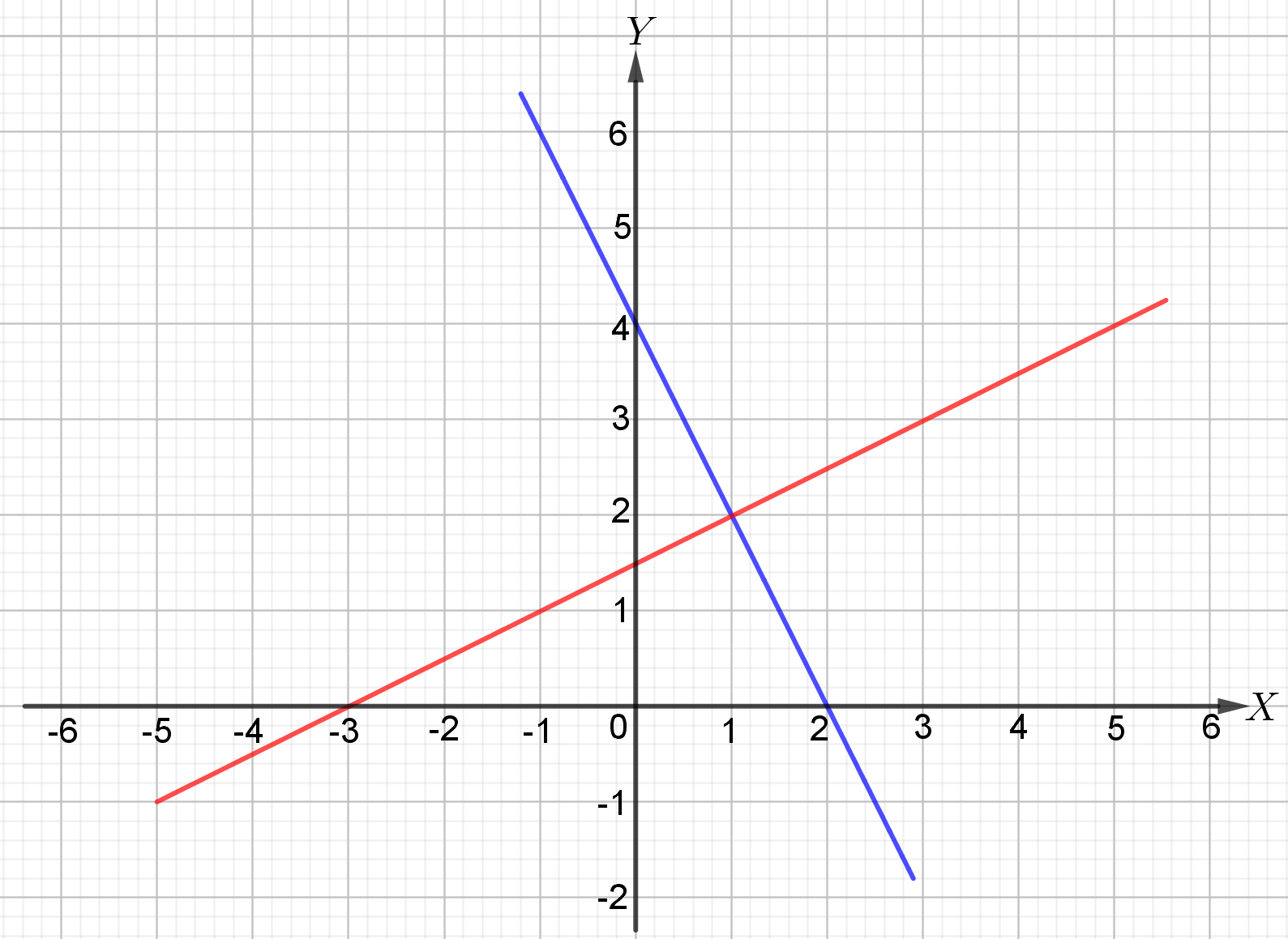
The point $(1, 2)$ is the intersection point of the two lines. In other words, that point will be the solution of the system of equations $\cdots \cdot$
A. $x+2y=-3$ and $2x-y=-4$
B. $x-2y=-3$ and $2x-y=-4$
C. $x+2y=-3$ and $2x+y=4$
D. $x-2y=-3$ and $2x+y=4$
We will determine the two line equations shown in the graph above.
The first line passes through the points $(2, 0)$ and $(0, 4)$. Since we know the coordinates of the intercepts on the coordinate axes, it will be easier to determine the equation of the line.
The equation of the first line is $2x + y = 4$.
The second line passes through the points $(-3, 0)$ and $(1, 2)$. To find the equation of the line, we can use the following quick method.
 The equation of the second line is $x-2y=-3.$
Therefore, the point $(1, 2)$ is the solution of the system of equations $x-2y=-3$ and $2x+y=4.$
(Answer D)
Problem Number 14
The sum of two whole numbers is $27$ and the difference between the two numbers is $3$. The product of the two numbers is $\cdots \cdot$
A. $81$ C. $180$
B. $176$ D. $182$
Suppose the whole numbers are $a$ and $b$ with $a > b$ so that we obtain the following system of linear equations
$\begin{cases} a+b & = 27 && (\cdots 1) \\ a-b & = 3 && (\cdots 2) \end{cases}$
Add the two equations and we obtain $2a = 30$, which means $a = 15$, and $b = 12$.
The product of $a$ and $b$ is $ab = 15(12) = 180$.
Therefore, the product of the two numbers is $\boxed{180}.$
(Answer C)
Problem Number 15
The price of $5$ pencils and $2$ books is Rp26,000, while the price of $3$ pencils and $4$ books is Rp38,000. If the price of $1$ pencil is represented by $a$ and the price of $1$ book is represented by $b$, then the correct system of linear equations in two variables according to the problem above is $\cdots \cdot$
- $5a+2b=26.000$ and $4a+3b=38.000$
- $5a+2b=26.000$ and $3a+4b=38.000$
- $2a+5b=26.000$ and $3a+4b=38.000$
- $2a+5b=26.000$ and $4a+3b=38.000$
The price of $5$ pencils and $2$ books is Rp26,000, which we write as $5a + 2b = 26.000.$
The price of $3$ pencils and $4$ books is Rp38,000, which we write as $3a + 4b = 38.000.$
Therefore, the corresponding system of linear equations is
$\begin{cases} 5a+2b=26.000 \\ 3a+4b=38.000 \end{cases}$
(Answer B)
Read: Linear Inequations in One Variable: Concepts, Formulas, and Solved Problems
Problem Number 16
Andi bought $2$ notebooks and $3$ pencils for Rp8,500, while Didit bought $3$ notebooks and $2$ pencils for Rp9,000. If Anita buys $1$ notebook and $1$ pencil, then she must pay $\cdots \cdot$
A. Rp5,000
B. Rp4,500
C. Rp4,000
D. Rp3,500
Suppose $x$ = the price of $1$ notebook and $y$ = the price of $1$ pencil so that a mathematical model in the form of a system of linear equations can be formed as follows.
$\begin{cases} 2x + 3y & = 8.500 && (\cdots 1) \\ 3x + 2y & = 9.000 && (\cdots 2) \end{cases}$
Add Equations $(1)$ and $(2)$.
$\begin{aligned} \! \begin{aligned} 2x+3y & = 8.500 \\ 3x+2y & = 9.000 \end{aligned} \\ \rule{3.4 cm}{0.6pt} + \\ \! \begin{aligned} 5x + 5y& = 17.500 \\ x + y & = 3.500 \end{aligned} \end{aligned}$
Therefore, Anita must pay Rp3,500 to buy $1$ notebook and $1$ pencil.
(Answer D)
Problem Number 17
Amar’s age is $\dfrac23$ of Bondan’s age. Six years from now, the sum of their ages will be $42$ years. The difference between Amar’s and Bondan’s ages is $\cdots \cdot$
A. $2$ years
B. $3$ years
C. $4$ years
D. $6$ years
Let Amar’s age = $A$ and Bondan’s age = $B$.
We obtain the following system of linear equations in two variables.
$$\begin{cases} A & = \dfrac23B && (\cdots 1) \\ (A+6)+(B+6) & = 42 && (\cdots 2) \end{cases}$$Substitute Equation $(1)$ into Equation $(2)$.
$\begin{aligned} (\color{red}{A}+6)+(B+6) & = 42 \\ \dfrac23B+6+B+6 & = 42 \\ \dfrac53B & = 30 \\ B & = 30 \times \dfrac35 = 18 \end{aligned}$
Bondan’s current age is $18$ years, which means Amar’s current age is $\dfrac23(18) = 12$ years.
The difference between their ages is $\boxed{18-12=6~\text{years}}.$
(Answer D)
Problem Number 18
The price of $5$ kg of granulated sugar and $30$ kg of rice is Rp410,000, while the price of $2$ kg of granulated sugar and $60$ kg of rice is Rp740,000. The price of $2$ kg of granulated sugar and $5$ kg of rice is $\cdots \cdot$
A. Rp154,000
B. Rp80,000
C. Rp74,000
D. Rp32,000
Let $x$ = the price of granulated sugar per kg and $y$ = the price of rice per kg so that a mathematical model in the form of a system of linear equations in two variables can be formed as follows.
$\begin{cases} 5x + 30y & = 410.000 && (\cdots 1) \\ 2x + 60y & = 740.000 && (\cdots 2) \end{cases}$
Eliminate $y$ from Equation $(1)$ and Equation $(2)$.
$$\begin{aligned} \! \begin{aligned} 5x+30y & = 410.000 \\ 2x+60y & = 740.000 \end{aligned} \left| \! \begin{aligned} \times 2 \\ \times 1 \end{aligned} \right| & \! \begin{aligned} 10x+60y & = 820.000 \\ 2x+60y & = 740.000 \end{aligned} \\ & \rule{4 cm}{0.6pt} – \\ & \! \begin{aligned} 8x & = 80.000 \\ x & = 10.000 \end{aligned} \end{aligned}$$Substitute $x = 10.000$ into one of the equations, for example Equation $(1)$.
$\begin{aligned} 5\color{red}{x} +30y & = 410.000 \\ 5(10.000) + 30y & = 410.000 \\ 50.000 + 30y & = 410.000 \\ 30y & = 360.000 \\ y & = 12.000 \end{aligned}$
Thus, the price of $1$ kg of granulated sugar is Rp10,000 and the price of $1$ kg of rice is Rp12,000.
Therefore, the price of $2$ kg of granulated sugar and $5$ kg of rice is
$2 \times 10.000 + 5 \times 12.000 =$ $\boxed{\text{Rp}80.000}.$
(Answer B)
Problem Number 19
The price of $2$ kg of granulated sugar and $3$ kg of rice is Rp27,000, while the price of $3$ kg of granulated sugar and $3$ kg of rice is Rp33,000. The prices of $1$ kg of granulated sugar and $1$ kg of rice (respectively) are $\cdots \cdot$
A. Rp6,000 and Rp5,000
B. Rp5,000 and Rp6,000
C. Rp5,000 and Rp7,000
D. Rp7,000 and Rp5,000
Let $x$ = the price of granulated sugar per kg and $y$ = the price of rice per kg so that a mathematical model in the form of a system of linear equations in two variables can be formed as follows.
$\begin{cases} 2x + 3y & = 27.000 && (\cdots 1) \\ 3x + 3y & = 33.000 && (\cdots 2) \end{cases}$
Eliminate $y$ from Equation $(1)$ and Equation $(2)$.
$\begin{aligned} \! \begin{aligned} 2x+3y & = 27.000 \\ 3x+3y & = 33.000 \end{aligned} \\ \rule{3.3 cm}{0.6pt} – \\ \! \begin{aligned} -x & = -6.000 \\ x & = 6.000 \end{aligned} \end{aligned}$
Substitute $x = 6.000$ into one of the equations, for example Equation $(1)$.
$\begin{aligned} 2\color{red}{x} +3y & = 27.000 \\ 2(6.000) + 3y & = 27.000 \\ 12.000 + 3y & = 27.000 \\ 3y & = 15.000 \\ y & = 5.000 \end{aligned}$
Thus, the price of $1$ kg of granulated sugar is Rp6,000 and the price of $1$ kg of rice is Rp5,000.
(Answer A)
Problem Number 20
The perimeter of a rectangular field is $58$ meters. If the difference between its length and width is $9$ meters, then the area of the field is $\cdots~\text{m}^2$.
A. $95$ C. $261$
B. $190$ D. $380$
It is known that the perimeter of the rectangle is $58$ meters, so we write
$2(p + l) = 58 \Leftrightarrow p + l = 29.$
It is also known that the difference between the length and width is $9$ meters, so we write $p -l = 9.$
Thus, we obtain the following system of linear equations in two variables
$\begin{cases} p + l &= 29 && (\cdots 1) \\ p -l &= 9 && (\cdots 2) \end{cases}$
Eliminate $l$ from Equations $(1)$ and $(2).$
$\begin{aligned} \! \begin{aligned} p + l &= 29 \\ p -l&= 9 \end{aligned} \\ \rule{2.3 cm}{0.6pt} + \\ \! \begin{aligned} 2p &= 38 \\ p &= 19 \end{aligned} \end{aligned}$
For $p=19$, we obtain $19-l = 9$, which means $l = 10$.
Therefore, the area is $\boxed{L = pl = 19(10) = 190~\text{m}^2}.$
(Answer B)
Problem Number 21
Sukardi bought cakes to celebrate his girlfriend’s birthday party. There were $2$ types of cakes purchased, namely nastar cakes and cheese cakes. The price of $1$ jar of nastar cake is equal to twice the price of $1$ jar of cheese cake. If the price of $3$ jars of nastar cake and $2$ jars of cheese cake is Rp480.000, then the amount of money Sukardi must pay after deciding to buy $2$ jars of nastar cake and $3$ jars of cheese cake is $\cdots \cdot$
A. Rp480.000
B. Rp420.000
C. Rp360.000
D. Rp180.000
Suppose $x =$ the price of one jar of nastar cake and $y =$ the price of one jar of cheese cake. Thus, we obtain the following system of linear equations in two variables
$\begin{cases} x &= 2y \\ 3x + 2y &= 480.000 \end{cases}$
Substitute $2y = x$ into Equation $2$ so that it becomes
$\begin{aligned} 3x + \color{red}{x} &= 480.000 \\ 4x &= 480.000 \\ x &= 120.000 \end{aligned}$
This means, $y = \dfrac{1}{2} \cdot 120.000 = 60.000$
The price of $2$ jars of nastar cake and $3$ jars of cheese cake is
$\begin{aligned} 2x + 3y &= 2(120.000) + 3(60.000) \\ &= 240.000 + 180.000 \\ &= 420.000 \end{aligned}$
Therefore, the amount of money Sukardi must pay is Rp420.000.
(Answer B)
Problem Number 22
Budi and Joko bought notebooks and pens at Mr. Umar’s store. Budi bought $10$ notebooks and $4$ pens for Rp36.000. Joko bought $5$ notebooks and $8$ pens for Rp27.000. The prices of $1$ notebook and $1$ pen respectively are $\cdots \cdot$
A. Rp2.000 and Rp2.000
B. Rp2.500 and Rp2.750
C. Rp3.000 and Rp1.750
D. Rp3.000 and Rp1.500
Suppose $x, y$ respectively represent the prices of $1$ notebook and $1$ pen so that the following system of linear equations in two variables is formed
$\begin{cases} 10x + 4y &= 36.000 && (\cdots 1) \\ 5x + 8y &= 27.000 && (\cdots 2) \end{cases}$
Eliminate $x$ from Equations $(1)$ and $(2)$.
$$\begin{aligned} \! \begin{aligned} 10x + 4y &= 36.000 \\ 5x + 8y &= 27.000 \end{aligned} \left| \! \begin{aligned} \div 2 \\ \times 1 \end{aligned} \right| & \! \begin{aligned}~5x+2y &= 18.000 \\~5x+8y &= 27.000 \end{aligned} \\ & \rule{3.5 cm}{0.6pt} – \\ & \! \begin{aligned} 6y &= 9.000 \\ y &= 1.500 \end{aligned} \end{aligned}$$Substitute $y = 1.500$ into one of the equations, for example the first equation.
$\begin{aligned} 5x + 2\color{red}{y} &= 18.000 \\ 5x + 2(1.500) &= 18.000 \\ 5x + 3.000 &= 18.000 \\ 5x &= 15.000 \\ x &= 3.000 \end{aligned}$
Therefore, the prices of $1$ notebook and $1$ pen respectively are Rp3.000 and Rp1.500.
(Answer D)
Problem Number 23
The difference between the amount of money owned by the younger sibling and the older sibling is Rp10,000. Twice the older sibling’s money added to the younger sibling’s money equals Rp40,000. The total amount of their money is $\cdots \cdot$
A. Rp35,000
B. Rp30,000
C. Rp20,000
D. Rp10,000
Suppose the amount of money owned by the younger sibling is represented by $x$ and the amount of money owned by the older sibling is represented by $y$, so that the following system of linear equations in two variables is obtained
$\begin{cases} x -y & = 10.000 && (\cdots 1) \\ x + 2y & = 40.000 && (\cdots 2) \end{cases}$
Using the combination method, we obtain
$\begin{aligned} \! \begin{aligned} x + 2y & = 40.000 \\ x -y & = 10.000 \end{aligned} \\ \rule{3.2 cm}{0.6pt} – \\ \! \begin{aligned} 3y & = 30.000 \\ y & = 10.000 \end{aligned} \end{aligned}$
For $y=10.000$, we obtain $x = 10.000 + 10.000$, which means $x = 20.000.$
The total amount of their money can be written as
$\boxed{x+y=20.000+10.000=30.000}.$
Therefore, the total amount of their money is Rp30,000.
(Answer B)
Problem Number 24
The number of solutions of the system of linear equations
$\begin{cases} 6x+2y & =12 \\ 3x+y & =6 \end{cases}$
is $\cdots \cdot$
A. $0$ C. $2$
B. $1$ D. $\infty$ (infinite)
Notice that
$\begin{aligned} \! \begin{aligned} 6x+2y & = 12 \\ 3x+y & = 6 \end{aligned} \left| \! \begin{aligned} \times \frac12 \\ \times 1 \end{aligned} \right| & \! \begin{aligned}~3x+y & = 6 \\ 3x+y & = 6 \end{aligned} \end{aligned}$
The system has two equations that are actually equivalent (the same). This means that the system contains two variables in a single equation, so there are $\infty$ (infinitely many) solutions.
(Answer D)
Problem Number 25
If the system of linear equations
$\begin{cases} ax-by & =6 \\ 2ax + 3by & =2 \end{cases}$
has the solution $x = 2$ and $y=1$, then the value of $a^2+b^2 = \cdots \cdot$
A. $2$ C. $5$
B. $4$ D. $8$
Since $x=2$ and $y=1$ are solutions of the system above, substitution gives
$\begin{cases} 2a-b = 6 \\ 4a+3b=2 \end{cases}$
We will determine the value of $b$ using the elimination method.
$\begin{aligned} \! \begin{aligned} 2a-b & = 6 \\ 4a+3b & = 2 \end{aligned} \left| \! \begin{aligned} \times 2 \\ \times 1 \end{aligned} \right| & \! \begin{aligned}~4a-2b & = 12 \\ 4a+3b & = 2 \end{aligned} \\ & \rule{2.5 cm}{0.8pt} – \\ & \! \begin{aligned} -5b & = 10 \\ b & = -2 \end{aligned} \end{aligned}$
Substitute $b=-2$ into one of the equations, for example the equation $2a-b=6$, so that we obtain
$2a-(-2)=6 \Leftrightarrow 2a=4 \Leftrightarrow a = 2$
Therefore, the value of $\boxed{a^2+b^2=(2)^2+(-2)^2=4+4=8}.$
(Answer D)
Advanced Level
Problem Number 26
All students in a class at ABC School will use computers. If each computer is used by 2 students, then there will be 3 students who do not use computers, whereas if each computer is used by 3 students, then there will be 4 unused computers. The number of computers owned by the school is $\cdots$ units.
A. $11$ D. $33$
B. $13$ E. $35$
C. $15$
Suppose
$\begin{aligned} x & = \text{number of students} \\ y & = \text{number of computers}. \end{aligned}$
Based on the second statement of the problem, we can form a mathematical model in the form of a system of linear equations in two variables.
$\begin{cases} x & = 2y + 3 && (\cdots 1) \\ x & = 3(y -4) = 3y -12 && (\cdots 2)\end{cases}$
Substitute the value of $x$ from one equation into the other equation so that we obtain
$\begin{aligned} 2y + 3 & = 3y-12 \\ 3y-2y & = 12+3 \\ y & = 15 \end{aligned}$
Therefore, the number of computers at ABC School is $\boxed{15~\text{units}}.$
(Answer C)
Problem Number 27
A school has a dormitory building consisting of several rooms. If each room is occupied by two students, then there will be $12$ students who do not occupy rooms. If each room is occupied by three students, then there will be $2$ empty rooms. How many rooms are available in the school dormitory?
A. $16$ D. $22$
B. $18$ E. $24$
C. $20$
Suppose $S$ and $K$ respectively represent the number of students and the number of rooms in the dormitory. Based on the given information, the following system of linear equations in two variables is obtained.
$$\begin{cases} S & = 2K + 12 && (\cdots 1) \\ S & = 3(K-2) = 3K-6 && (\cdots 2) \end{cases}$$Substitute the value of $S$ from one equation into the other equation so that we obtain
$\begin{aligned} 2K+12 & = 3K-6 \\ 3K-2K & = 6+12 \\ K & = 18 \end{aligned}$
Therefore, there are $\boxed{18}$ rooms in the school dormitory.
(Answer B)
Problem Number 28
A school has several classrooms. If the number of chairs in each classroom is $36$, then there will be $96$ chairs left over. However, if the number of chairs in each classroom is increased by $6$, then there will be a shortage of $48$ chairs. How many classrooms are there in the school?
A. $30$ D. $15$
B. $24$ E. $12$
C. $20$
Suppose $x$ and $y$ respectively represent the number of chairs and the number of classrooms. From the given information, we can form the following mathematical model in the form of a system of linear equations in two variables.
$\begin{cases} x & = 36y + 96 && (\cdots 1) \\ x & = 42y-48 && (\cdots 2) \end{cases}$
Subtract the two equations and obtain
$\begin{aligned} 6y-144 & = 0 \\ 6y & = 144 \\ y & = \dfrac{144}{6} = 24 \end{aligned}$
Therefore, the number of classrooms in the school is $\boxed{24}.$
(Answer B)
Problem Number 29
In a closed electrical circuit, by applying Kirchhoff’s Law, the following system of equations is obtained
$\begin{cases} 2R_1+3R_2 & = 8 \\ R_1-3R_2& = 1 \end{cases}$
The values of $R_1$ and $R_2$ in units of $\Omega$ (read: ohm) respectively are $\cdots \cdot$
A. $3$ and $\dfrac13$ D. $\dfrac13$ and $2$
B. $3$ and $\dfrac23$ E. $3$ and $1$
C. $\dfrac23$ and $2$
Given the system of linear equations in two variables
$\begin{cases} 2R_1+3R_2 & = 8 && (\cdots 1) \\ R_1-3R_2& = 1 && (\cdots 2) \end{cases}$
Eliminate $R_2$ from the two equations above.
$\begin{aligned} \! \begin{aligned} 2R_1+3R_2 & = 8 \\ R_1-3R_2 & = 1 \end{aligned} \\ \rule{3.1 cm}{0.6pt} + \\ \! \begin{aligned} 3R_1 & = 9 \\ R_1 & = 3 \end{aligned} \end{aligned}$
Substitute $R_1 = 3~\Omega$ into Equation $(2)$.
$\begin{aligned} \color{red}{R_1}-3R_2 & = 1 \\ 3-3R_2 & = 1 \\ -3R_2 & = -2 \\ R_2 & = \dfrac23 \end{aligned}$
Therefore, the values of $R_1$ and $R_2$ respectively are $3~\Omega$ and $\dfrac23 ~\Omega$.
(Answer B)
Problem Number 30
If the system of equations
$\begin{cases} mx+3y & = 21 \\ 4x-3y & = 0 \end{cases}$
has positive integer solutions $x$ and $y$, then the possible values of $m+x+y$ are $\cdots \cdot$
A. $9$ or $45$
B. $10$ or $45$
C. $10$ or $46$
D. $12$ or $46$
E. $15$ or $52$
It is known that
$\begin{cases} mx+3y & = 21 && (\cdots 1) \\ 4x-3y & = 0 && (\cdots 2) \end{cases}$
From Equation $(2)$, we obtain
$-3y = -4x \Leftrightarrow y = \dfrac43x.$
In order for $y$ to be an integer, $x$ must be divisible by $3$.
Substitute $y = \dfrac43x$ into Equation $(1)$.
$\begin{aligned} mx+3\color{red}{y} & = 21 \\ mx + \cancel{3}\left(\dfrac{4}{\cancel{3}}x\right) & = 21 \\ mx + 4x & = 21 \\ (m+4)x & = 21 \end{aligned}$
The form $(m+4)x$ can be considered as the multiplication of two integers that results in $21$. The factors of $21$ are $1, 3, 7$, and $21$ (only $3$ and $21$ are possible values for $x$ because both are divisible by $3$).
Suppose $x = 3$ is chosen. As a result, $m = 3$ and $y = 4$ so that $\boxed{m+x+y = 3+3+4 = 10}.$ Suppose $x = 21$ is chosen. As a result, $m = -3$ and $y = 28$ so that
$\boxed{m+x+y = -3+21+28 = 46}.$
Therefore, the possible values of $m+x+y$ are $10$ or $46.$
(Answer C)
Problem Number 31
If the solution of the system of linear equations in two variables
$\begin{cases} (a+3)x + y & = 0 \\ x + (a+3)y & = 0 \end{cases}$
is not only $(x, y) = (0,0),$ then the value of $a^2+6a+17 = \cdots \cdot$
A. $0$ C. $4$ E. $16$
B. $1$ D. $9$
It is known that
$\begin{cases} (a+3)x + y & = 0 && (\cdots 1) \\ x + (a+3)y & = 0 && (\cdots 2) \end{cases}$
Multiply both sides of Equation $(2)$ by $(a+3)$ to obtain
$(a+3)x + (a+3)^2y = 0~~~~~(\cdots 3)$.
Subtract $(1)$ and $(3)$, then solve to find the value of $a$.
$\begin{aligned} y-(a+3)^2y & = 0 \\ y(1-(a+3)^2) & = 0 \\ 1-(a+3)^2 & = 0 && (\text{Divide by}~y) \\ 1-(a^2+6a+9) & = 0 \\ a^2+6a+8 & = 0 \\ (a+4)(a+2) & = 0 \end{aligned}$
The values obtained are $a=-4$ or $a=-2$.
Substitute $a=-4$ and $a=-2$ into the expression $a^2+6a+17$.
$$\begin{aligned} a = -4 & \Rightarrow (-4)^2 + 6(-4) + 17 = 9 \\ a = -2 & \Rightarrow (-2)^2 + 6(-2) + 17 = 9 \end{aligned}$$Therefore, the value of $\boxed{a^2+6a+17 = 9}.$
(Answer D)
Problem Number 32
Mr. Dede worked for $6$ days with $4$ of those days being overtime, and he received a wage of Rp74,000. Mr. Asep worked for $5$ days with $2$ of those days being overtime, and he received a wage of Rp55,000.00. Mr. Dian worked for $4$ days and all of them were overtime days. The three of them received the same wage system. The wage received by Mr. Dian is $\cdots \cdot$
A. Rp36,000
B. Rp46,000
C. Rp56,000
D. Rp60,000
E. Rp70,000
Suppose $L$ and $N$ respectively represent wages during overtime days and wages during normal days.
Mr. Dede worked for $6$ days with $4$ of them being overtime days ($2$ remaining days were normal days), and he received a wage of Rp74,000. Mathematically, this is written as $\boxed{4L + 2N = 74.000}.$
Mr. Asep worked for $5$ days with $2$ of them being overtime days ($3$ remaining days were normal days), and he received a wage of Rp55,000. Mathematically, this is written as $\boxed{2L + 3N = 55.000}.$
Thus, the following system of linear equations is obtained
$\begin{cases} 4L + 2N & = 74.000 && (\cdots 1) \\ 2L+3N & = 55.000 && (\cdots 2) \end{cases}$
Equation $(1)$ can be simplified into $2L + N = 37.000$.
The value of $L$ will be found by eliminating $N$.
$$\begin{aligned} \! \begin{aligned} 2L + N & = 37.000 \\ 2L+3N & = 55.000 \end{aligned} \left| \! \begin{aligned} \times 3 \\ \times 1 \end{aligned} \right| & \! \begin{aligned}~6L + 3N & = 111.000 \\~2L + 3N & = 55.000 \end{aligned} \\ & \rule{4.2 cm}{0.6pt} – \\ & \! \begin{aligned} 4L & = 56.000 \\ L & = 14.000 \end{aligned} \end{aligned}$$Therefore, the wage for one overtime day is Rp14,000.
It is known that Mr. Dian worked for $4$ days and all of them were overtime days. The wage he received is
$\boxed{4L = 4(14.000) = \text{Rp}56.000}.$
(Answer C)
Problem Number 33
A solution has an acid concentration of $25\%$ and another solution contains $65\%$ acid. How many liters of each solution are needed to obtain $8$ liters of a new solution with an acid concentration of $40\%$?
- The first solution is $5$ liters and the second solution is $3$ liters
- The first solution is $3$ liters and the second solution is $5$ liters
- The first solution is $3$ liters and the second solution is $3$ liters
- The first solution is $5$ liters and the second solution is $5$ liters
- The first solution is $7$ liters and the second solution is $3$ liters
Suppose the first solution needed is $A$ liters and the second solution needed is $B$ liters.
The total amount of solution is $8$ liters. Mathematically, this is written as $\boxed{A+B = 8}.$
The first solution has an acid concentration of $25\%$ and the second solution contains $65\%$ acid. Their mixture produces $8$ liters of a new solution with an acid concentration of $40\%$. Mathematically, this is written as
$25\%A + 65\%B = 40\% \cdot 8.$
Simplify it into $\boxed{5A + 13B = 64}.$
Thus, the following system of linear equations is obtained
$\begin{cases} A+B & = 8 && (\cdots 1) \\ 5A +13B & = 64 && (\cdots 2) \end{cases}$
Equation $(1)$ is equivalent to $A=8-B$.
Substitute $A=8-B$ into Equation $(2)$.
$\begin{aligned} 5\color{red}{A} +13B &= 64 \\ \Rightarrow 5(8-B)+13B & = 64 \\ 40-5B+13B & = 64 \\ 8B & = 24 \\ B & = 3 \end{aligned}$
Substitute $B = 3$ into Equation $(1).$
$\begin{aligned} A+\color{red}{B} & =8 \\ A+3 & = 8 \\ A & = 5 \end{aligned}$
Therefore, the first solution needed is $5$ liters and the second solution needed is $3$ liters.
(Answer A)
Problem Number 34
Elvand needs $2$ hours to row $9$ km downstream and $6$ hours upstream. Elvand’s rowing speed in normal water conditions is $\cdots \cdot$
A. $1$ km/hour
B. $1,5$ km/hour
C. $2$ km/hour
D. $3$ km/hour
E. $4,5$ km/hour
Suppose $A$ and $B$ respectively represent Elvand’s rowing speed and the river current speed in km/hour.
Thus, the following system of linear equations can be formed
$\begin{cases} 2A+2B & = 9 && (\cdots 1) \\ 6A-6B & = 9 && (\cdots 2) \end{cases}$
Equation $(2)$ can be simplified into $2A-2B = 3$.
Eliminate $A$ from Equations $(1)$ and $(2)$.
$\begin{aligned} \! \begin{aligned} 2A+2B & = 9 \\ 2A-2B & = 3 \end{aligned} \\ \rule{3 cm}{0.6pt} + \\ \! \begin{aligned} 4A & = 12 \\ A & = 3 \end{aligned} \end{aligned}$
Therefore, Elvand’s rowing speed is $3$ km/hour.
(Answer D)
Problem Number 35
The system of linear equations
$\begin{cases} (p+1)x+(3p-2)y & = p \\ (3p-1)x + (4p+2)y & = 2p \end{cases}$
has infinitely many solutions for the value of $p = \cdots \cdot$
A. $-1$ or $0$
B. $0$ or $1$
C. $1$ or $3$
D. $0$ or $3$
E. $-1$ or $-3$
The system of linear equations $\begin{cases} a_1x + b_1y & = c_1 \\ a_2x+b_2y & = c_2 \end{cases}$ has infinitely many solutions if $\dfrac{a_1}{a_2} = \dfrac{b_1}{b_2} = \dfrac{c_1}{c_2}.$
Verification of the First Equation:
$\begin{aligned} \dfrac{a_1}{a_2} & = \dfrac{b_1}{b_2} \\ \dfrac{p+1}{3p-1} & = \dfrac{3p-2}{4p+2} \\ (p+1)(4p+2) & = (3p-1)(3p-2) \\ 4p^2+6p+2 & = 9p^2-9p+2 \\ 5p^2-15p & = 0 \\ 5p(p-3) & = 0 \\ p = 0 &~\text{or}~p=3 \end{aligned}$
Verification of the Second Equation:
$\begin{aligned} \dfrac{a_1}{a_2} & = \dfrac{c_1}{c_2} \\ \dfrac{p+1}{3p-1} & = \dfrac{\cancel{p}}{2\cancel{p}} \\ (p+1)(2) & = 3p-1 \\ 2p+2 & = 3p-1 \\ p & = 3 \end{aligned}$
Clearly, $p=3$ will cause the system above to have infinitely many solutions. Now, test $p = 0$.
$\begin{cases} (0+1)x+(3(0)-2)y & = 0 \\ (3(0)-1)x + (4(0)+2)y & = 2(0) \end{cases}$
Simplify into
$\begin{cases} x-2y & = 0 && (1) \\ -x+2y & = 0 && (2) \end{cases}$
It can be seen that Equations $(1)$ and $(2)$ are equivalent so there will be infinitely many solutions.
Therefore, the values of $p$ that satisfy are $p=0$ or $p=3$.
(Answer D)
Problem Number 36
In order for the system of equations $\begin{cases} 3x+2y & = 12 \\ 2x-y & = 1 \\ kx + 2y & = 16 \end{cases}$ to have a solution, the value of $k$ is $\cdots \cdot$
A. $-5$ D. $3$
B. $-3$ E. $5$
C. $-1$
Given the system of linear equations
$\begin{cases} 3x+2y & = 12 && (\cdots 1) \\ 2x-y & = 1 && (\cdots 2) \\ kx + 2y & = 16 && (\cdots 3) \end{cases}$
Solve Equations $1$ and $2$, meaning find the values of $(x, y)$ that satisfy both equations.
$\begin{aligned} \! \begin{aligned} 3x+2y & = 12 \\ 2x-y & = 1 \end{aligned} \left| \! \begin{aligned} \times 1 \\ \times 2 \end{aligned} \right| & \! \begin{aligned}~3x+2y & = 12 \\~4x-2y & = 2 \end{aligned} \\ & \rule{3 cm}{0.6pt} + \\ & \! \begin{aligned} 7x & = 14\\ x & = 2 \end{aligned} \end{aligned}$
For $x = 2$, substitute into Equation $2$ to obtain
$\begin{aligned} 2(\color{red}{2})-y & = 1 \\ 4-y & = 1 \\ y & = 3 \end{aligned}$
We obtain $(x, y) = (2, 3)$ as the solution for Equations $1$ and $2$, meaning that for the system of equations to have a solution, Equation $3$ must also have the same solution, namely $(2, 3)$.
$\begin{aligned} kx+2y & = 16 \\ \Rightarrow k(2) + 2(3) & = 16 \\ 2k + 6 & = 16 \\ 2k & = 10 \\ k & = 5 \end{aligned}$
Therefore, the value of $k$ is $\boxed{5}.$
(Answer E)
Problem Number 37
It is known that the following system of equations has infinitely many solutions $(x, y)$.
$$\begin{cases} kx + y & = 1 \\ 4x + ky & = 2 \end{cases}$$The number of possible values of $k$ is $\cdots \cdot$
A. $0$ (none)
B. $1$
C. $2$
D. $3$
E. $4$
Given $$\begin{cases} kx + y & = 1 && (\cdots 1) \\ 4x + ky & = 2 && (\cdots 2) \end{cases}$$First, make the constants on the right-hand side equal. Multiply both sides of Equation $(1)$ by $2$ so that we obtain
$$\begin{cases} 2kx + 2y & = 2 && (\cdots 1) \\ 4x + ky & = 2 && (\cdots 2) \end{cases}$$In order to have infinitely many solutions, the coefficients of $x$ and $y$ must be equal so that
$$\begin{cases} 2k & = 4 \\ 2 & = k \end{cases}$$Clearly, $k = 2$ satisfies the condition.
Therefore, there is only $\boxed{1}$ possible value of $k$.
(Answer B)
Problem Number 38
Two flagpoles are planted as shown in the following figure.
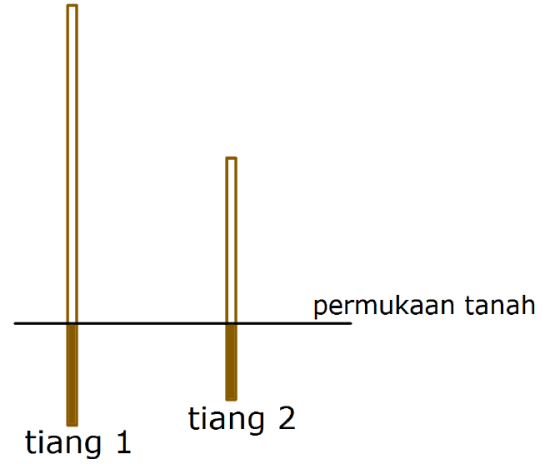 For pole (tiang) 1, the part visible above the ground is $5$ times the length of the part buried underground. Meanwhile, for pole 2, the part visible above the ground is $3$ times the buried part. It is known that the total length of the two poles is $13$ meters and the total length of the buried parts is $2,\!5$ meters.
Put a check mark $(\checkmark)$ on the statements that are true. More than one answer may be correct.
- The length of the first pole is $9$ meters.
- The length of the second pole is $4$ meters.
- The length of the buried part of the first pole is $2$ meters.
- The length of the buried part of the second pole is $0,\!5$ meter.
Suppose the length of the buried part of pole 1 is $x.$ This means the length of the visible part above the ground is $5x.$ Also suppose the length of the buried part of pole 2 is $y$ so that the part above the ground is $3y.$
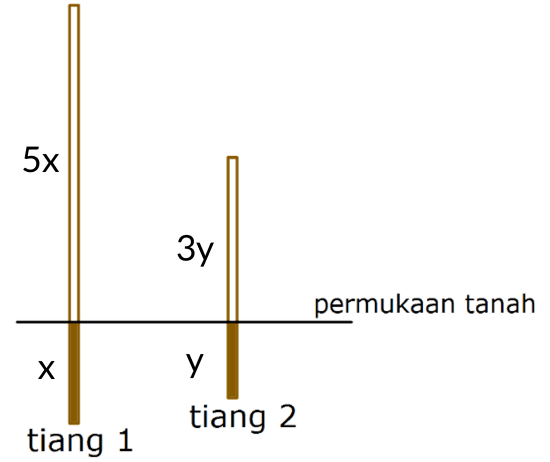 It is known that the total length of the two poles is $13$ meters and the total length of the buried parts is $2,\!5$ meters, so we obtain the following system of linear equations in two variables (SPLDV).
$$\begin{cases} 6x + 4y = 13 \\ x + y = 2,\!5 \end{cases}$$Using the elimination method, we obtain
$$\begin{aligned} \! \begin{aligned} 6x+4y & = 13 \\ x+y & = 2,\!5 \end{aligned} \left| \! \begin{aligned} \times 1 \\ \times 4 \end{aligned} \right| & \! \begin{aligned}~6x+4y & = 13 \\ 4x+4y & = 10 \end{aligned} \\ & \rule{3 cm}{0.6pt} – \\ & \! \begin{aligned} 2x & = 3 \\ x & = 1,\!5. \end{aligned} \end{aligned}$$Substituting $x = 1,\!5$ into Equation $2$ will give $y = 2,\!5-1,\!5 = 1.$
Check Statement 1:
The length of the first pole is $6x,$ namely $6(1,\!5) = 9$ meters. Therefore, Statement 1 is true.
Check Statement 2:
The length of the second pole is $4y,$ namely $4(1) = 4$ meters. Therefore, Statement 2 is true.
Check Statement 3:
The length of the buried part of the first pole is $x,$ namely $1,\!5$ meters, not $2$ meters. Therefore, Statement 3 is false.
Check Statement 4:
The length of the buried part of the second pole is $y,$ namely $1$ meter, not $0,\!5$ meter. Therefore, Statement 4 is false.
Therefore, put a check mark on the following two statements because they are true.
- The length of the first pole is $9$ meters.
- The length of the second pole is $4$ meters.
[collapse]
Essay Section
Problem Number 1
Determine the solution of the following system of equations.
a. $\begin{cases} \dfrac13(x-5)+\dfrac34(y+2) &=-2\dfrac12 \\ \dfrac12(2x+3)-\dfrac23(2y+1) & = 8\dfrac16 \end{cases}$
b. $\begin{cases} \dfrac{2}{x}+\dfrac{1}{y} & = 1\dfrac15 \\ \dfrac{1}{x}-\dfrac{3}{y} & = -\dfrac{1}{10} \end{cases}$
Answer a)
Known
$$\begin{cases} \dfrac13(x-5)+\dfrac34(y+2) &=-2\dfrac12&& (\cdots 1) \\ \dfrac12(2x+3)-\dfrac23(2y+1) & = 8\dfrac16 && (\cdots 2) \end{cases}$$First, simplify Equation $(1)$ by multiplying both sides by $12$.
$$\begin{aligned} \dfrac13(x-5)+\dfrac34(y+2) &=-2\dfrac12 && (\times 12) \\ 4(x-5)+9(y+2) & = -30 \\ 4x-20+9y+18 & = -30 \\ 4x+9y-2 & = -30 \\ 4x+9y & = -28 && (\cdots 3) \end{aligned}$$Also simplify Equation $(2)$ by multiplying both sides by $6$.
$$\begin{aligned} \dfrac12(2x+3)-\dfrac23(2y+1) & = 8\dfrac16 && (\times 6) \\ 3(2x+3)-4(2y+1) & = 49 \\ 6x+9-8y-4 & = 49 \\ 6x-8y+5 & = 49 \\ 6x-8y & = 44 \\ 3x-4y & = 22 && (\cdots 4) \end{aligned}$$Now, using the elimination method, we obtain
$$\begin{aligned} \! \begin{aligned} 4x+9y & = -28 \\ 3x-4y & = 22 \end{aligned} \left| \! \begin{aligned} \times 3 \\ \times 4 \end{aligned} \right| & \! \begin{aligned}~12x+27y & = -84 \\ 12x-16y & = 88 \end{aligned} \\ & \rule{3.4cm}{0.6pt} – \\ & \! \begin{aligned} 43y & = -172 \\ y & = -4 \end{aligned} \end{aligned}$$Substitute $y = -4$ into one of the equations, for example Equation $(4)$.
$\begin{aligned} 3x-4\color{red}{y}& = 22 \\ 3x-4(-4) & = 22 \\ 3x+16 & = 22 \\ 3x & = 6 \\ x & = 2 \end{aligned}$
Therefore, the solution of the system of linear equations is $\boxed{(2, -4)}.$
Answer b)
Known
$\begin{cases} \dfrac{2}{x}+\dfrac{1}{y} & = 1\dfrac15 \\ \dfrac{1}{x}-\dfrac{3}{y} & = -\dfrac{1}{10} \end{cases}$
Suppose $a = \dfrac{1}{x}$ and $b = \dfrac{1}{y}$ so that we obtain the following system of linear equations.
$\begin{aligned} 2a + b & = \dfrac65 && (\cdots 1) \\ a-3b & = -\dfrac{1}{10} && (\cdots 2) \end{aligned}$
Now, using the elimination method, we obtain
$\begin{aligned} \! \begin{aligned} 2a+b & = \frac65 \\ a-3b & = -\frac{1}{10} \end{aligned} \left| \! \begin{aligned} \times 1 \\ \times 2 \end{aligned} \right| & \! \begin{aligned}~2a+b & = \frac65 \\ 2a-6b & = -\frac15 \end{aligned} \\ & \rule{3.2cm}{0.6pt} – \\ & \! \begin{aligned} 7b & = \frac75 \\ b & = \frac15 \end{aligned} \end{aligned}$
Since $b = \dfrac{1}{y}$, it means that $y = 5$.
Substitute $y = 5$ into one of the equations $\dfrac{2}{x}+\dfrac{1}{y} = \dfrac65$.
$\begin{aligned} \dfrac{2}{x} + \dfrac{1}{5} & = \dfrac65 \\ \dfrac{2}{x} & = 1 \\ x & = 2 \end{aligned}$
Therefore, the solution of the system of equations is $\boxed{(2, 5)}.$
Problem Number 2
The weight of a bottle filled completely with water is $1.500$ grams. If the bottle is only half-filled with water, its weight becomes $900$ grams. Determine the weight of the bottle itself (without water).
Suppose $x$ and $y$ represent the weight of the bottle and the weight of the water that completely fills the bottle, respectively. Thus, the following system of linear equations can be formed.
$$\begin{cases} x + y & = 1.500 && (1) \\ x + \dfrac12y & = 900 && (2) \end{cases}$$Eliminating $x$ by subtracting Equation $(2)$ from Equation $(1)$ gives
$$\begin{aligned} x-\dfrac12y & = 1.500-900 \\ \dfrac12y & = 600 \\ y & = 1.200. \end{aligned}$$This means that the weight of the water that completely fills the bottle is $1.200$ grams. Consequently, the weight of the bottle itself is $1.500-1.200 = 300$ grams.
Therefore, the weight of the bottle itself (without water) is $\boxed{300~\text{grams}}.$