
The theorem contained in this combinatorics material takes its name from the event of placing $10$ pigeons into $9$ bird cages. The bird owner asked, “Is it possible for each cage to contain only one bird?” Of course, this is impossible. Then, he asked again, “What is the smallest number of birds that can occupy those cages?“

This question truly stimulates logical thinking. If we place all the birds into one cage, then the number of birds in the cage will be maximum, namely $10$ birds. Now, how can we make the number of birds in a cage minimum? This problem became the background for the creation of the theorem known as the pigeonhole principle, abbreviated as PHP (pigeonhole principle), sometimes also called the birdcage principle.

The problem is actually quite simple. Just like playing congklak, we place one bird into each cage so that one bird will remain outside.
Now, whether we like it or not, we must place this bird into one of the nine existing cages. Therefore, the minimum number of birds in a cage is 2 birds. By observing this case, we must put ourselves in the worst-case condition to solve problems related to PHP.
Theorem: Pigeonhole Principle
Hypothesis:
A total of $(n+1)$ or more objects are placed into $n$ containers with $n \in \mathbb{N}.$
Conclusion:
At least one container contains $2$ or more objects.
We will prove the theorem using the proof by contradiction method. Assume that no box contains more than $1$ object. Since there are $k$ boxes, the maximum number of objects is $k$ (this occurs when each box contains $1$ object). However, this contradicts the statement that we have at least $(k+1)$ objects. Therefore, the assumption is denied, and the theorem is proven true.
Read: Probability Problems and Step-by-Step Solutions for Middle School
Historical records show that the pigeonhole principle first appeared in the year $1624$ in a book associated with Jean Leurechon (1591–1670), a French priest and mathematician. However, the theorem is now more commonly known as the Dirichlet drawer principle (Dirichlet’s drawer principle or Dirichlet’s box principle) after the theorem experiment was carried out by Peter Gustav Lejeune Dirichlet (1805–1859), a German mathematician. Nevertheless, mathematicians still agree that the discoverer of the pigeonhole principle was Jean Leurechon.
Furthermore, this theorem has many applications in other fields that certainly are not limited to placing birds as in the first case. This theorem is also useful in computer science because it can produce more efficient and effective coding or programs. Some examples of the applications of PHP are as follows.
- If a soccer team (consisting of $11$ players) scores $12$ goals in a single match, then at least one player scored two goals. In this case, players are analogous to boxes, while goals are analogous to pigeons.
- If you take $6$ courses that take place from Monday to Friday, then there is at least one day that contains two classes to attend. In this case, days are analogous to boxes, while courses are analogous to pigeons.
- In a group consisting of $367$ people, at least two people have the same birth date and month. In this case, days in a year are analogous to boxes, while people are analogous to pigeons.
Today Quote
Multiple Choice Section
Problem Number 1
The minimum number of students in a class so that there are $2$ students with the same zodiac sign is $\cdots \cdot$
A. $2$ C. $12$ E. $24$
B. $3$ D. $13$
There are $12$ zodiac signs that we know. If we choose $12$ students, it is possible that all their zodiac signs are different, but if we choose $\boxed{12+1=13}$ students, it is guaranteed that at least $2$ students will have the same zodiac sign.
(Answer D)
Read: Solved Probability and Combinatorics Problems for Senior High School
Problem Number 2
The minimum number of people required to guarantee that there are $4$ people with the same birth date is $\cdots \cdot$
A. $31$ D. $120$
B. $63$ E. $125$
C. $94$
Birth dates begin from $1$ and can go up to the $31$st. If we choose $3 \times 31 = 93$ people, it is possible that each set of $3$ people has the same birth date, but if we add $1$ more person, it is guaranteed that there will be $4$ people who have the same birth date.
Therefore, the required number of people is $\boxed{94}$ people.
(Answer C)
Problem Number 3
The minimum number of students that must be selected so that at least $4$ students with the same birth month are guaranteed is $\cdots \cdot$
A. $13$ C. $25$ E. $49$
B. $18$ D. $37$
There are $12$ possible months. If each month contains $3$ students with the same birth month, then there will be $36$ students. Based on the pigeonhole principle, add one more student so that it is guaranteed there will be $4$ students who have the same birth month.
Therefore, the minimum number of students is $\boxed{37}$ people.
(Answer D)
Problem Number 4
There are $38$ students in a class. What is the minimum number of students who have the same birth date in the class?
A. $1$ C. $3$ E. $12$
B. $2$ D. $4$
Birth dates begin from $1$ and can go up to the $31$st. It is possible that $31$ students have different birth dates. Since there are $38$ students, the remaining $7$ students are assumed to have different birth dates as well, so at least $\boxed{2}$ students have the same birth month.
(Answer B)
Problem Number 5
A junior high school (SMP) consists of $111$ students. What is the minimum number of students who are in the same grade level?
A. $30$ D. $38$
B. $35$ E. $111$
C. $37$
There are $3$ grade levels in junior high school, namely grade $7$, grade $8$, and grade $9$. Since $\dfrac{111}{3} = 37$ (without remainder), it can be assumed that there are $37$ students in grade 7, $37$ students in grade 8, and $37$ students in grade $9$. This means that at least $37$ students are in the same grade level.
(Answer C)
Read: Conditional Probability: Definitions, Formulas, and Solved Problems
Problem Number 6
What is the minimum number of children out of $119$ children who were born in the same month?
A. $9$ C. $11$ E. $15$
B. $10$ D. $12$
There are $12$ birth months in the calendar. Since $\dfrac{119}{12} = 9$ with a remainder of $11,$ there will be at least $\boxed{9+1 = 10}$ children who were born in the same month.
(Answer B)
Problem Number 7
A total of $1,000$ people participated in a survey and they were asked to fill in their birth day (Monday, Tuesday, Wednesday, Thursday, Friday, Saturday, or Sunday). What is the minimum number of people who have the same birth day?
A. $124$ D. $144$
B. $142$ E. $184$
C. $143$
There are $7$ days in a calendar week. Since $\dfrac{1,000}{7} = 142$ with a remainder of $6$, we only need to assume that these $6$ people have different birth days. As a result, we find at least $\boxed{142+1=143}$ people with the same birth day.
(Answer C)
Problem Number 8
Out of $100$ people, at least how many people have names with the same initial letter?
A. $3$ C. $5$ E. $8$
B. $4$ D. $6$
There are $26$ letters in the alphabet that we use (English alphabet). Since $\dfrac{100}{26} = 3$ with a remainder of $22,$ we only need to assume that these $22$ people have names with different initial letters. As a result, we find at least $\boxed{3+1=4}$ people who have names with the same initial letter.
(Answer B)
Problem Number 9
From the numbers $1$ to $20$, what is the minimum number of integers that must be selected so that there is guaranteed to be a pair of numbers whose sum is $28$?
A. $7$ C. $13$ E. $18$
B. $10$ D. $15$
Examples of pairs of numbers whose sum is $28$ are $(8, 20),$ $(9, 19),$ $(10, 18),$ and so on, up to $(13, 15).$ Suppose we are in the worst possible condition. Take the numbers $1$ to $14.$ From these $14$ numbers, there is not yet a pair of numbers whose sum is $28.$ Furthermore, if one more number is taken from the choices $15$ to $20,$ there will certainly be a pair of numbers whose sum is $28.$ As an illustration, if the number $16$ is chosen, we obtain $(12, 16)$ as a pair of numbers whose sum is $28.$ Using the pigeonhole principle, the number of integers that must be selected so that there is guaranteed to be a pair of numbers whose sum is $28$ is $\boxed{14+1=15}$
(Answer D)
Problem Number 10
From the integers $10, 11, 12, \cdots, 70$, what is the minimum number of integers that must be randomly selected to ensure that there are two numbers whose sum is $30$?
A. $49$ C. $53$ E. $57$
B. $51$ D. $55$
The pairs of numbers whose sum is $30$ are $(10, 20)$, $(11, 19)$, $(12, 18)$, $(13, 17)$, and $(14, 16)$. The numbers $21$ and so on up to $70$ do not have partners to form a sum of $30$, so we take them first (a total of $70-21+1 = \color{blue}{50}$ numbers). Next, we take the numbers $10$ to $15$ (there are $\color{red}{6}$ numbers, and still no pair summing to $30$ is found.)$ If we take one more number, whatever the number is, we obtain two numbers whose sum is $30$.
Therefore, the number of integers that must be selected is $\boxed{\color{blue}{50}+\color{red}{6}+1=57}.$
(Answer E)
Read: Expected Frequency in Probability: Definitions, Formulas, and Solved Problems
Problem Number 11
Suppose $X$ is the sequence of integers from $1$ to $123$. What is the minimum number of integers that must be randomly selected from $X$ so that there are guaranteed to be two numbers whose difference is $70$?
A. $122$ D. $70$
B. $80$ E. $63$
C. $71$
By considering the worst-case condition, we select $n$ numbers from $2n$ numbers so that we do not obtain two numbers whose difference is $70.$
For this case, the value of $n = 70.$
From the numbers $1$ to $123$, choose the numbers $1, 2, \cdots, 70$ (a total of $70$ numbers). If we take any one more number, it is guaranteed that there will be a pair of numbers differing by $70$. Therefore, the minimum number of integers that must be selected is $\boxed{70+1=71}.$
(Answer C)
Problem Number 12
A box contains a number of numbered cards. There is one card numbered $1$, two cards numbered $2$, three cards numbered $3$, and so on up to twenty cards numbered $20$. To ensure that among the cards we take from the box there are $10$ cards with the same number, at least $\cdots$ cards must be taken.
A. $143$ D. $146$
B. $144$ E. $210$
C. $145$
Assuming that we are in the worst possible condition, we obtain exactly $9$ cards for each number from $1$ to $20.$ Specifically for cards numbered $1$ to $8$, we take all the available cards according to the quantity in the box, while for cards numbered $9, 10, 11, \cdots, 20$ (there are 12 numbers), we take $9$ cards each. Therefore, we obtain
$\begin{aligned} & 1+2+3+\cdots+8+\underbrace{9+9+\cdots+9}_{\text{there are}~12} \\ & = (1+8) \times 4 + 12 \times 9 \\ & = 36 + 108 = 144. \end{aligned}$
Up to this point, we still have not obtained $10$ cards with the same number, but by taking one more card from the box, we are guaranteed to obtain them.
Therefore, at least $\boxed{144+1=145}$ cards must be taken.
(Answer C)
Problem Number 13
There are $52$ white chopsticks, $66$ yellow chopsticks, and $15$ brown chopsticks mixed together. If by closing your eyes, you want to obtain $1$ pair of chopsticks that are not brown and $3$ pairs of chopsticks that are not white, then what is the minimum number of chopsticks that need to be taken?
A. $8$ C. $59$ E. $63$
B. $58$ D. $62$
According to the pigeonhole principle, we must place ourselves in the worst-case condition when taking chopsticks. When we randomly take $52$ chopsticks, we obtain $52$ white chopsticks. This means we have already obtained $1$ pair of chopsticks that are not brown. Then, we take another $1$ chopstick and assume that we obtain $1$ brown chopstick. Finally, take $6$ more chopsticks and assume that we obtain $6$ yellow chopsticks.
Note: The case may be reversed. Assume we obtain $1$ yellow chopstick, then obtain $6$ brown chopsticks.
Thus, we have obtained 3 pairs of chopsticks that are not white.
Therefore, at least $\boxed{52+1+6 = 59}$ chopsticks need to be taken.
(Answer C)
Problem Number 14
A number of students take an exam with the following composition of questions.
- The first section consists of $3$ questions with two choices (True/False).
- The second section consists of $5$ questions with five choices (A, B, C, D, E).
The minimum number of students so that there will always be two students with exactly the same answers in both the first and second sections is $\cdots$ students.
A. $3.126$
B. $12.501$
C. $24.999$
D. $25.000$
E. $25.001$
First, let us determine the number of different possible answer patterns that students can produce.
- There are $3$ questions with $2$ answer choices, so the number of different possible answers for the first section is $2^3 = 8.$
- There are $5$ questions with $5$ answer choices, so the number of different possible answers for the second section is $5^5 = 3.125.$
Therefore, there are $8 \cdot 3.125 = 25.000$ possible different answer patterns. If there are $25.000$ students, it is still possible that no two students have exactly the same answers. According to the pigeonhole principle, one more student must be added to guarantee that there are two students with exactly the same answers. Therefore, the minimum number of students is $\boxed{25.001~\text{students}}.$
(Answer E)
Problem Number 15
A round table will be occupied circularly by a number of children. The children consist of boys and girls with a total of $48$ people who will sit randomly in a circle. The minimum number of girls so that there are certainly six girls sitting consecutively without being separated by boys is $\cdots$ people.
A. $7$ C. $41$ E. $43$
B. $21$ D. $42$
Arrange two groups consisting of 5 girls and 1 boy to be placed in their seating positions around the circular table. Create the groups so that all children are completely covered, resulting in 8 groups consisting of 5 girls and 8 groups consisting of 1 boy (making exactly 48 children in total). Their seating positions will look like the picture.
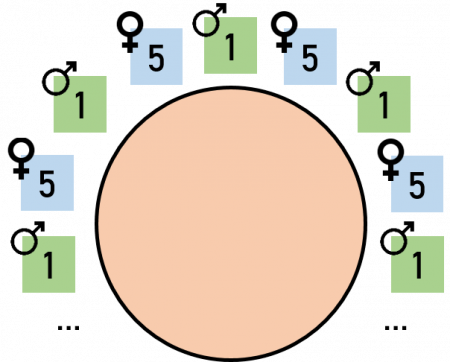 Their seating positions are intentionally arranged alternately by groups so that there are no 6 girls sitting consecutively. Using the pigeonhole principle, add $1$ more girl so that there will definitely be $6$ girls sitting consecutively. Therefore, the minimum number of girls is $8 \cdot 5 + 1 = 41$ girls, while the rest are boys.
(Answer C)
Read: Compound Events in Probability: Definitions, Formulas, and Solved Problems
Problem Number 16
From the numbers $1$ to $100$, what is the minimum number of integers that must be selected so that there is guaranteed to be a pair of numbers whose product is $100$?
A. $85$ C. $92$ E. $97$
B. $88$ D. $96$
Suppose we are in the worst possible condition. First, take the numbers that are not positive factors of $100.$ Since the factors of $100$ are $1, 2, 4, 5,$ $10, 20,$ $25, 50,$ and $100$ (there are $9$ of them), take all other numbers, namely $100-9 = 91$ numbers. Next, take the number $10$ because $10$ does not have a partner so that the product is $100.$ Up to this point, $92$ numbers have been selected. Finally, take the numbers $1, 2, 4,$ and $5$ so that the total number of selected integers becomes $92+4=96.$ If any one more number is selected, it can be guaranteed that we will find a pair of numbers whose product is $100.$ Therefore, the minimum number of integers that must be selected so that there is guaranteed to be a pair of numbers whose product is $100$ is $\boxed{96+1=97}.$
(Answer E)
Essay Section
Problem Number 1
Inside a box there are $8$ red balls, $6$ white balls, and $5$ black balls. Determine the minimum number of balls that must be taken to guarantee obtaining:
- $1$ red ball;
- $1$ white ball;
- $2$ black balls;
- $3$ red balls and $2$ black balls;
- balls with three different colors.
Answer a)
In the worst-case situation, we take $6$ white balls and $5$ black balls, followed by taking one red ball. Therefore, the minimum number of balls that must be taken is $\boxed{6+5+1=12}.$
Answer b)
In the worst-case situation, we take $8$ red balls and $5$ black balls, followed by taking one white ball. Therefore, the minimum number of balls that must be taken is $\boxed{8+5+1=14}.$
Answer c)
In the worst-case situation, we take $8$ red balls and $6$ white balls, followed by taking $2$ black balls. Therefore, the minimum number of balls that must be taken is $\boxed{8+6+2=16}.$
Answer d)
In the worst-case situation, we take $6$ white balls, followed by taking $8$ red balls, and finally $2$ black balls. Therefore, the minimum number of balls that must be taken is $\boxed{6+8+2=16}.$
Answer e)
In the worst-case situation, we are assumed to take as many balls as possible first, namely $8$ red balls, then $6$ white balls, and finally only $1$ black ball. Therefore, the minimum number of balls that must be taken is $\boxed{8+6+1=15}.$
Problem Number 2
Inside a drawer there are several pairs of socks with different colors, namely $5$ pairs of purple socks, $6$ pairs of yellow socks, $4$ pairs of red socks, and $3$ pairs of black socks. In the dark and assuming that left and right socks are considered the same, determine the minimum number of socks that must be taken so that a person is guaranteed to obtain:
- $1$ pair of purple socks;
- $1$ pair of black socks;
- $3$ pairs of red socks;
- socks with $4$ different colors.
Answer a)
In the worst-case situation, we take $6$ pairs of yellow socks, $4$ pairs of red socks, and $3$ pairs of black socks. Then, only afterward do we take $1$ pair of purple socks.
Therefore, the minimum number of socks that must be taken to obtain a pair of purple socks is $\boxed{2(6)+2(4)+2(3)+2(1) = 28}.$
Answer b)
In the worst-case situation, we take $6$ pairs of yellow socks, $4$ pairs of red socks, and $5$ pairs of purple socks. Then, only afterward do we take $1$ pair of black socks.
Therefore, the minimum number of socks that must be taken to obtain a pair of black socks is $\boxed{2(6)+2(4)+2(5)+2(1) = 32}.$
Answer c)
In the worst-case situation, we take $6$ pairs of yellow socks, $5$ pairs of purple socks, and $3$ pairs of black socks. Then, only afterward do we take $3$ pairs of red socks.
Therefore, the minimum number of socks that must be taken to obtain $3$ pairs of red socks is $\boxed{2(6)+2(5)+2(3)+2(3) = 34}.$
Answer d)
In the worst-case situation, we are assumed to take the largest number of sock pairs first, namely $6$ pairs of yellow socks, then $5$ pairs of purple socks, followed by $4$ pairs of red socks, and finally only $1$ black sock (not a pair).
Therefore, the minimum number of socks that must be taken to obtain $4$ socks with different colors is $\boxed{2(6)+2(5)+2(4)+1 = 31}.$
Problem Number 3
Given the sequence of numbers $1, 2, 3, \cdots, 100$. If $51$ numbers are randomly selected from the sequence, prove that there are at least $2$ numbers whose difference is $50$.
The pairs of numbers that have a difference of $50$ are $(1, 51)$, $(2, 52)$, $(3, 53)$, $\cdots$, $(49, 99)$, and $(50, 100).$ We find that there are $50$ pairs. If we take exactly $50$ numbers, it is possible that we obtain the numbers $1, 2, 3, \cdots, 49, 50$ so that there is no pair of numbers with a difference of $50$. Based on the pigeonhole principle, take $50+1 =51$ numbers and it is guaranteed that there are $2$ numbers whose difference is $50.$ $\blacksquare$
Problem Number 4
Given the sequence of numbers $1, 2, 3, \cdots, 100.$ If $55$ numbers are randomly selected from the sequence, prove that there may not necessarily be $2$ numbers whose difference is $11.$
By considering the worst-case condition, we select $n$ numbers from $2n$ numbers so that we do not obtain two numbers whose difference is $11.$
For this case, the value of $n = 9.$
- From the numbers $1$ to $22$, the numbers $1, 2, \cdots, 11$ are selected.
- From the numbers $23$ to $44$, the numbers $23, 24, \cdots, 33$ are selected.
- From the numbers $45$ to $66$, the numbers $45, 46, \cdots, 55$ are selected.
- From the numbers $67$ to $88$, the numbers $67, 68, \cdots, 77$ are selected.
- From the numbers $89$ to $100$, the numbers $89, 90, \cdots, 99$ are selected.
The total number of selected numbers is $11+11+11+11+11=55,$ and no two numbers with a difference of $11$ are found.
Problem Number 5
Given the sequence of numbers $1, 2, 3, \cdots, 100.$ If $55$ numbers are randomly selected from the sequence, prove that there are at least $2$ numbers whose difference is $9.$
By considering the worst-case condition, we select $n$ numbers from $2n$ numbers so that we do not obtain two numbers whose difference is $9.$
For this case, the value of $n = 9.$
- From the numbers $1$ to $18$, the numbers $1, 2, \cdots, 9$ are selected.
- From the numbers $19$ to $36$, the numbers $19, 20, \cdots, 27$ are selected.
- From the numbers $37$ to $54$, the numbers $37, 39, \cdots, 45$ are selected.
- From the numbers $55$ to $72$, the numbers $55, 56, \cdots, 63$ are selected.
- From the numbers $73$ to $90$, the numbers $73, 74, \cdots, 81$ are selected.
From the numbers $91$ to $100$, all existing numbers are selected except $100.$ The total number of selected numbers is $9+9+9+9+9+9 =54.$ If one remaining number is randomly selected (whatever its value), it is guaranteed that there will be two numbers whose difference is $9$. Therefore, it is proven that there are at least $2$ numbers whose difference is $9$ when we randomly select $55$ numbers. $\blacksquare$
Problem Number 6
Suppose there is a drawer containing a dozen brown socks and a dozen black socks distributed randomly. During a power outage (you are assumed unable to see around you), how many socks must you take to ensure that among them there is a pair of socks with the same color?
Note: right and left socks are considered the same.
To obtain a pair of socks with the same color, we must take at least $2$ socks, but it still cannot be guaranteed that we obtain them.
Based on the pigeonhole principle, to guarantee obtaining a pair of socks with the same color, we only need to take at least $2 + 1 = 3$ socks.
Problem Number 7
Given $8$ integers. Show that there exist $2$ integers among them whose sum or difference is divisible by $12$.
If the eight integers are divided by $12$, then the possible remainders are $\{0,1,2,\cdots, 12\}$. Now prepare $7$ “boxes” and label them as follows.
$$\{0\}, \{1,11\}, \{2,10\}, \{3,9\}, \{4,8\}, \{5,7\}, \{6\}$$Then place the eight integers into the “boxes” according to their remainders when divided by $12$. Since there are $7$ boxes and $8$ integers, according to the pigeonhole principle, there is at least one box containing two integers. If that box is labeled $\{0\}$ or $\{6\}$, then the difference between the two integers is a multiple of $12$, for example the integers $6$ and $18$ in the box labeled $\{6\}$ (because their remainders when divided by $12$ are $6$) have a difference of $12$. On the other hand, if the box containing two integers is one of the other boxes, then the sum of those two integers is divisible by $12$, for example the integers $2$ and $22$ in the box labeled $\{2,10\}$ have a sum of $24$, which is a multiple of $12.$ $\blacksquare$
Problem Number 8
Given the set of numbers $\{1, 2, 3, \cdots, 100\}.$
- Determine the minimum number of integers that must be selected to guarantee the existence of three integers $a, b,$ and $c$ such that $a+b=c.$
- Determine the minimum number of integers that must be selected to guarantee the existence of four integers $a, b, c,$ and $d$ such that $a+b+c=d.$
Given the set of numbers $\{1, 2, 3, \cdots, 100\}.$
Answer a)
Suppose we are in the worst possible condition. Take the numbers $50$ through $100.$ Among these $\color{red}{51}$ numbers, there are still no three numbers satisfying $a+b = c.$ This happens because the sum of any two numbers among them definitely exceeds $100.$ Next, if one more number is selected from the numbers $1$ through $49,$ then there will certainly exist three numbers $a, b,$ and $c$ such that $a+b=c.$ For example, if the number $1$ is selected, we obtain the triple $(1, 50, 51).$ If the number $15$ is selected, we obtain the triple $(15, 50, 65).$ Therefore, at least $\boxed{51 + 1 = 52}$ numbers must be selected so that the desired condition is guaranteed to occur.
Answer b)
Suppose we are in the worst possible condition. Take the numbers $33$ through $100.$ Among these $\color{red}{68}$ numbers, there are still no four numbers satisfying $a+b+c=d.$ This happens because the sum of any three numbers among them definitely exceeds $100$ (the smallest possible sum is $33+34+35 = 102 > 100$). Next, if one more number is selected from the numbers $1$ through $32,$ then there will certainly exist four numbers $a, b, c,$ and $d$ such that $a+b+c=d.$ For example, if the number $1$ is selected, we obtain the quadruple $(1, 33, 34, 68).$ If the number $23$ is selected, we obtain the quadruple $(23, 33, 34, 90).$ Therefore, at least $\boxed{68+1=69}$ numbers must be selected so that the desired condition is guaranteed to occur.
Problem Number 9
Show that for every positive integer $n$, there exists a multiple of $n$ whose digits consist only of $0$ and $1.$
Take any positive integer $n.$ We will show that there exists a multiple of $n$ whose digits consist only of $0$ and $1.$
Suppose we have $(n+1)$ positive integers, namely $1, 11, 111, \cdots, \underbrace{111…111}_{\text{there are}~n+1}.$ Observe that when an integer is divided by $n,$ there are $n$ possible remainders, namely $0, 1, 2, 3, \cdots, n-1.$ Since we have $(n+1)$ numbers, according to the pigeonhole principle, there are at least $2$ numbers having the same remainder when divided by $n,$ say $A$ and $B$ with $A > B.$ The number $A-B$ is a multiple of $n$ whose digits consist only of $0$ and $1.$ $\blacksquare$
Illustration: Suppose we want to check whether there exists a multiple of $6$ whose digits consist only of $0$ and $1.$ Construct $7$ numbers, namely $1, 11, 111,$ $1.111, 11.111,$ $111.111,$ and $1.111.111.$ The remainders of these seven numbers when divided by $6$ are respectively $1, 5, 3, 1, 5, 3,$ and $5.$ We simply choose two numbers having the same remainder, for example $1$ and $1.111.$ Observe that their difference, $1.111-1 = 1.110,$ is a multiple of $6$ whose digits consist only of $0$ and $1.$
Problem Number 10
Prove that among $(n+1)$ distinct numbers in the set $\{1, 2, 3, \cdots, 2n\}$, there is always one number that divides another number.
Every integer $n \ge 1$ can be expressed in the form $n = 2^a \cdot b$ where $b$ is the greatest odd factor. Among the $2n$ numbers in the set, there are $n$ distinct odd numbers. Using the pigeonhole principle, if we choose $(n+1)$ distinct numbers from the set, at least two of them must have the same greatest odd factor. Suppose those two numbers are $n_1 = 2^x \cdot b$ and $n_2 = 2^y \cdot b$ so that clearly $n_1 \mid n_2$ if $n_2 \ge n_1$ or $n_2 \mid n_1$ if $n_1 \ge n_2.$ $\blacksquare$
Problem Number 11
Show that among $n+1$ positive integers whose values do not exceed $2n$, there is always an integer that divides another integer.
Illustration: Suppose we take $n = 7.$ The $8$ positive integers we have must not exceed $14.$ Suppose the chosen numbers are $$6, 7, 8, 9, 10, 11, 12, 13.$$The chosen numbers do not have to be distinct. Observe that we find an integer dividing another integer, namely $6 \mid 12.$
The idea we use is the fact that every positive integer can be written as the product of a power of $2$ and an odd number (taken as large as possible). Example: $30 = 2 \times 15$ and $40 = 2^3 \times 5.$
Suppose we have $n+1$ positive integers, namely $a_1, a_2, \cdots, a_n, a_{n+1}.$ Express all these numbers in the form $a_j = 2^{k_j} \cdot q_j$ for $j = 1, 2, \cdots, n+1$ where $k_j$ is a nonnegative integer and $q_j$ is an odd integer. The integers $q_1, q_2, \cdots, q_{n+1}$ are positive odd integers whose values are less than $2n.$ However, there are only $n$ distinct positive odd integers less than $2n.$ According to the pigeonhole principle, there are at least two equal odd integers among $q_1, q_2, \cdots, q_{n+1}.$ In other words, there exist distinct integers $i$ and $j$ such that $q_i = q_j.$ Let $q = q_i = q_j$ so that $a_i = 2^{k_i} \cdot q$ and $a_j = 2^{k_j} \cdot q.$ Consequently, if $k_i < k_j,$ then $a_i$ divides $a_j.$ Conversely, if $k_j < k_i,$ then $a_j$ divides $a_i.$
Therefore, it is proven that among $n+1$ positive integers whose values do not exceed $2n$, there is always an integer that divides another integer. $\blacksquare$
Problem Number 12
A boxer has $75$ weeks to defend his title. Therefore, the coach schedules a sparring program. The coach plans at least one sparring session each week, but no more than $125$ sparring sessions during the $75$-week period. Show that there exists a period consisting of several consecutive weeks in which there are exactly $24$ sparring sessions.
Let $a_i$ be the number of sparring sessions completed by the boxer up to week-$i$ for $i = 1,2,3,\cdots, 75$, so that we obtain
$1 \leq a_1 < a_2 < a_3 < \cdots < a_{75} \leq 125$
and by adding $24$ to each side, we obtain
$$25 \leq a_1 + 24 < a_2+24< \cdots < a_{75} + 24 \leq 149.$$Since there are $149$ integers counted from $1$ to $149,$ while $a_1,a_2,\cdots, a_{75}, a_1+24,$ $a_2+24, \cdots, a_{75}+24$ consist of $75+75=150$ numbers, according to the pigeonhole principle, there are at least $2$ equal numbers in the sequence, namely there exist $i$ and $j$ such that $a_i = a_j +24.$
In other words, during weeks $j+1,j+2,\cdots, i$, the boxer has exactly $24$ sparring sessions. $\blacksquare$