
Today Quote
Multiple Choice Section
Problem Number 1
The correct relation to describe the relationship from set $Q$ to set $P$ is $\cdots \cdot$

A. cube root of
B. cube of
C. square of
D. square root of
The correct relation is “cube of”, as shown by the following relationships:
$1$ is the cube of $1$;
$8$ is the cube of $2$;
$27$ is the cube of $3$.
(Answer B)
Problem Number 2
Observe the following arrow diagram.

The correct relation from set K to set L is $\cdots \cdot$
A. twice of
B. half of
C. one less than
D. less than
The correct relation is “half of”, as shown by the following relationships:
$-3$ is half of $-6$;
$-1$ is half of $-2$;
$1$ is half of $2$;
$2$ is half of $4$;
(Answer B)
Problem Number 3
The correct relation for the following diagram is $\cdots \cdot$

A. greater than C. half of
B. less than D. square of
The correct relation is “half of”, as shown by the following relationships:
$1$ is half of $2$;
$2$ is half of $4$;
$3$ is half of $6$;
$4$ is half of $8$, but since $8$ is not a member of the codomain, $4$ does not have a pair.
(Answer C)
Problem Number 4
Observe the following diagram.

The relation from set $A$ to set $B$ is $\cdots \cdot$
A. factor of
B. greater than
C. less than
D. half of
The arrow diagram above can be expressed in the form of ordered pairs $\{1, 2), (1, 3), (1, 4), (2, 2), (2, 4), (4, 4)\}$.
Notice that $1$ is a factor of $2, 3$, and $4$; $2$ is a factor of $2$ and $4$; $4$ is a factor of $4$.
Therefore, the appropriate relation is FACTOR OF.
Note: a factor is a natural number that divides another number exactly.
(Answer A)
Problem Number 5
Observe the following relations.
(1). $\{(1, a), (2, a), (3, a), (4, a)\}$
(2). $\{(2, b), (3, c), (4, d), (2, e)\}$
(3). $\{(3, 6), (4, 6), (5, 10), (3, 12)\}$
(4). $\{(1, 5), (3, 7), (5, 9), (3, 11)\}$
The relation above that is considered a mapping (function) is $\cdots \cdot$
A. (1) C. (3)
B. (2) D. (4)
In the ordered pair form $(a, b)$, $a$ is called a domain member, while $b$ is called a range member.
A relation is called a mapping (function) if every domain member has exactly one (must be one) pair in the codomain.
In set (1), all domain members have exactly one pair in the codomain, so it is called a function.
In set (2), the domain member $2$ has two pairs, so it is not a function.
In set (3), the domain member $3$ has two pairs, so it is not a function.
In set (4), the domain member $3$ has two pairs, so it is not a function.
(Answer A)
Read: Simple Algebraic Expressions: Word Problems and Step-by-Step Solutions
Problem Number 6
From the following four sets:
$\begin{aligned} P & = \{(1, 1), (2, 0), (2, 1)\} \\ Q & = \{(1, 1), (3, 2), (5, 2)\} \\ R & = \{(5, a), (5, b), (4, c)\} \\ S & = \{(1, 6), (1, 5), (1, 4)\} \end{aligned}$
The set of ordered pairs that represents a mapping (function) is $\cdots \cdot$
A. $P$ C. $R$
B. $Q$ D. $S$
A set of ordered pairs is considered a function if every domain member has exactly one pair in the codomain.
Set $P$ is not a function because the domain member $2$ has more than one pair, namely in the ordered pairs $(2, 0)$ and $(2, 1)$.
Set $Q$ is a function because every domain member has exactly one pair in the codomain.
Set $R$ is not a function because the domain member $5$ has more than one pair, namely in the ordered pairs $(5, a)$ and $(5, b)$.
Set $S$ is not a function because the domain member $1$ has more than one pair, namely in the ordered pairs $(1, 6), (1, 5)$ and $(1, 4)$.
(Answer B)
Problem Number 7
Given $A=\{a,b,c\}$ and $B=\{1,2,3,4,5\}$. The number of possible mappings from $A$ to $B$ is $\cdots \cdot$
A. $15$ C. $125$
B. $32$ D. $243$
Given:
$\begin{aligned} A & = \{a, b, c\} \\ B & = \{1,2,3,4,5\} \end{aligned}$
We obtain $\text{n}(A) = 3$ and $\text{n}(B) = 5$, therefore the number of possible mappings from $A$ to $B$ is $\boxed{\text{n}(B)^{\text{n}(A)} = 5^3 = 125}$
(Answer C)
Problem Number 8
Given $A=\{\text{factors of 6}\}$ and $B=\{\text{multiples of 2 less than 8}\}$. The number of possible mappings from $B$ to $A$ is $\cdots \cdot$
A. $36$ C. $81$
B. $64$ D. $100$
First, write down all members of sets $A$ and $B$.
$\begin{aligned} A & = \{1, 2, 3, 6\} \\ B & = \{2, 4, 6\} \end{aligned}$
We obtain $\text{n}(A) = 4$ and $\text{n}(B) = 3$, therefore the number of possible mappings from $B$ to $A$ is $\boxed{\text{n}(A)^{\text{n}(B)} = 4^3 = 64}$
(Answer B)
Problem Number 9
A function is defined by the formula $f(x)=3-5x$. The value of $f(-4)$ is $\cdots \cdot$
A. $-23$ C. $17$
B. $-17$ D. $23$
Given: $f(x) = 3-5x$.
Substitute $x =-4$ to obtain
$f(-4) = 3-5(-4) = 3 + 20 = 23$
Therefore, the result is $\boxed{f(-4) = 23}$
(Answer D)
Problem Number 10
Given the function formula $f(x)=6-3x$. The value of $f(5)+f(-4)$ is $\cdots \cdot$
A. $18$ C. $-15$
B. $9$ D. $-27$
Given: $f(x) = 6-3x$.
Substitute $x = 5$ to obtain
$f(5) = 6-3(5) = 6-15 =-9$
Substitute $x =-4$ to obtain
$f(-4) = 6-3(-4) = 6 + 12 = 18$
Therefore, the result is $\boxed{f(5) + f(-4) =-9 + 18 = 9}$
(Answer B)
Problem Number 11
Given the function $f(x) = 3x^2-2x-5$. The value of $f\left(-\dfrac{1}{2}\right) = \cdots \cdot$
A. $-4\dfrac{1}{4}$ C. $3\dfrac{1}{4}$
B. $-3\dfrac{1}{4}$ D. $4\dfrac{1}{4}$
Substitute the value $x =-\dfrac{1}{2}$ into the function $f$.
$\begin{aligned} f(x) & = 3x^2-2x-5 \\ f\left(-\dfrac{1}{2}\right) & = 3\left(-\dfrac{1}{2}\right)^2-2\left(-\dfrac{1}{2}\right)-5 \\ & = 3 \times \dfrac{1}{4} + 1-5 \\ & = \dfrac{3}{4}-4 \\ & =-3\dfrac{1}{4} \end{aligned}$
Therefore, the value of $\boxed{f\left(-\dfrac{1}{2}\right) =-3\dfrac{1}{4}}$
(Answer B)
Problem Number 12
Given $f(x)=6x-5$. The value of $f(3a+1)$ is $\cdots \cdot$
A. $9a+1$ C. $18a+1$
B. $9a-4$ D. $18a-4$
Given: $f(x) = 6x- 5$.
Substitute $x = 3a + 1$ to obtain
$\begin{aligned} f(3a+1) & = 6(3a+1)-5 \\ & = 18a+6-5 \\ & = 18a+1 \end{aligned}$
Therefore, the result is $\boxed{f(3a+1) = 18a+1}$
(Answer C)
Problem Number 13
The function $f$ is expressed by $f(x)=3x+5$. The result of $f(2b-3)$ is $\cdots \cdot$
A. $5b+8$ C. $6b-4$
B. $5b+2$ D. $6b-15$
Given: $f(x) = 3x + 5$.
Substitute $x = 2b-3$ to obtain
$\begin{aligned} f(2b-3) & = 3(2b-3) + 5 \\ & = 6b-9 + 5 \\ & = 6b-4 \end{aligned}$
Therefore, the result is $\boxed{f(2b-3) = 6b- 4}$
(Answer C)
Read: Linear Inequations in One Variable: Concepts, Formulas, and Solved Problems
Problem Number 14
Given that the function $f(x)$ is linear. If the function $f(3x+2)=6x+10$, the value of $f(-5) = \cdots \cdot$
A. $-20$ C. $16$
B. $-4$ D. $19$
Given: $f(3x+2)=6x+10$
We will determine the value of $x$ that makes $3x + 2 =-5$ as follows.
$\begin{aligned} 3x + 2 & =-5 \\ 3x & =-7 \\ x & =-\dfrac{7}{3} \end{aligned}$
Substitute $x =-\dfrac73$ into $f(x)$ to obtain
$\begin{aligned} f\left(\cancel{3}\left(-\dfrac{7}{\cancel{3}}\right) + 2\right) & = \cancelto{2}{6}\left(-\dfrac{7}{\cancel{3}}\right) + 10 \\ f(-7+2) & = 2(-7) + 10 \\ f(-5) & =-4 \end{aligned}$
Therefore, the value of $\boxed{f(-5) =-4}$
(Answer B)
Problem Number 15
A function is formulated by $f(3x+3)=(x-4)(x+10)$. The value of $f(21)$ is $\cdots \cdot$
A. $18$ C. $32$
B. $22$ D. $72$
Given: $f(3x+3)=(x-4)(x+10)$
We will determine the value of $x$ that makes $3x + 3 = 21$ as follows.
$\begin{aligned} 3x + 3 & = 21 \\ 3x & = 18 \\ x & = \dfrac{18}{3} = 6 \end{aligned}$
Substitute $x = 6$ into $f(x)$ to obtain
$\begin{aligned} f(3(6)+3) & = (6-4)(6+10) \\ f(18+3) & = 2 \times 16 \\ f(21) & = 32 \end{aligned}$
Therefore, the value of $\boxed{f(21) = 32}$
(Answer C)
Problem Number 16
Given the function formula $f(x)=2x+5$. If $f(a)=11$, the value of $a$ is $\cdots \cdot$
A. $2$ C. $5$
B. $3$ D. $6$
Given: $f(x) = 2x + 5$ and $f(a) = 11$
Substitute $x = a$ to obtain
$\begin{aligned} f(a) & = 2a + 5 \\ 11 & = 2a + 5 \\ 6 & = 2a \\ a & = 3 \end{aligned}$
Therefore, the value of $a$ is $\boxed{3}$
(Answer B)
Problem Number 17
A function $f(x)=4x-1, f(a)=-9$, and $f(2)=b$. The value of $a-b$ is $\cdots \cdot$
A. $-9$ C. $5$
B. $-5$ D. $9$
Given: $f(x) = 4x- 1$.
Substitute $x = a$ to obtain
$\begin{aligned} f(a) & = 4a-1 \\-9 & = 4a-1 \\-8 & = 4a \\ a & =-2 \end{aligned}$
Substitute $x = 2$ to obtain
$f(2) = 4(2)-1 = 8-1 = 7$
This means that the value of $b$ is $7$.
Therefore, the result is $\boxed{a-b =-2-7 =-9}.$
(Answer A)
Problem Number 18
The function $f$ is expressed by the formula $f(x)=4x+3$. If $f(a)=7$ and $f(-2)=b$, then the value of $a+b$ is $\cdots \cdot$
A. $6$ C. $-4$
B. $4$ D. $-6$
Given: $f(x) = 4x + 3$.
Substitute $x = a$ to obtain
$\begin{aligned} f(a) & = 4a + 3 \\ 7 & = 4a + 3 \\ 4 & = 4a \\ a & = 1 \end{aligned}$
Substitute $x =-2$ to obtain
$f(2) = 4(-2) + 3 =-8+3 =-5$
This means that the value of $b$ is $-5$.
Therefore, the result is $\boxed{a+b = 1 +(-5) =-4}$
(Answer C)
Problem Number 19
Given the function formula $f(x)=2x-3$. If $f(m)=5$ and $f(-2)=n$, then the value of $m+n$ is $\cdots \cdot$
A. $5$ C. $-3$
B. $2$ D. $-6$
Given: $f(x)= 2x-3$.
For $x = m$, we obtain
$\begin{aligned} f(m) & = 2m-3 \\ 5 & = 2m-3 \\ 8 & = 2m \\ m & = 4 \end{aligned}$
For $x =-2$, we obtain
$f(-2) = 2(-2)-3 =-7$
thus the value of $n$ is $-7$.
Therefore, the value of $\boxed{m+n=4+(-7)=-3}$
(Answer C)
Problem Number 20
A function $f$ is formulated by $f(x)=px+q$. If $f(2)=5$ and $f(-2)=-11$, the value of $f(-6) = \cdots \cdot$
A. $-27$ C. $-9$
B. $-18$ D. $-3$
For $x = 2$, we obtain
$f(2) = 2p + q = 5.$
For $x =-2$, we obtain
$f(-2) =-2p + q =-11.$
We obtain the system of linear equations: $\begin{cases} 2p+q = 5 \\-2p+q=-11 \end{cases}$
Using the elimination-substitution method, we obtain
$\begin{aligned} \! \begin{aligned} 2p + q & = 5 \\-2p+q & =-11 \end{aligned} \\ \rule{2.5 cm}{0.8pt}- \\ \! \begin{aligned} 4p & = 16 \\ p & = 4 \end{aligned} \end{aligned}$
Next, substitute $p=4$ into one of the equations, for example $2p+q=5.$
$2(4)+q = 5 \Leftrightarrow q =-3.$
Therefore, the values are $\boxed{p=4}$ and $\boxed{q=-3}$.
Thus, $f(x) = 4x-3.$
For $x=-6$, we obtain
$\boxed{f(-6) = 4(-6)-3 =-27}$
(Answer A)
Read: System of Linear Equations in Two Variables: Complete Problems and Step-by-Step Solutions
Problem Number 21
Observe the following arrow diagram.

The function formula from $A$ to $B$ is $\cdots \cdot$
A. $f(x)=2x+7$
B. $f(x)=5x-12$
C. $f(x)=3x-2$
D. $f(x)=2x+3$
Test each provided option.
Option A: $f(x) = 2x + 7$
For $x = 6$, we obtain $f(6) = 2(6) + 7 = 19$ (incorrect), it should be $15$.
Option B: $f(x) = 5x- 12$
For $x = 6$, we obtain $f(6) = 5(6)-12 = 18$ (incorrect), it should be $15$.
Option C: $f(x) = 3x- 2$
For $x = 6$, we obtain $f(6) = 3(6)-2= 16$ (incorrect), it should be $15$.
Option D: $f(x) = 2x + 3$
For $x = 5$, we obtain $f(5) = 2(5) + 3 = 13$ (correct).
For $x = 6$, we obtain $f(5) = 2(6) + 3 = 15$ (correct).
For $x = 8$, we obtain $f(5) = 2(8) + 3 = 19$ (correct).
(Answer D)
Problem Number 22
Observe the following arrow diagram.
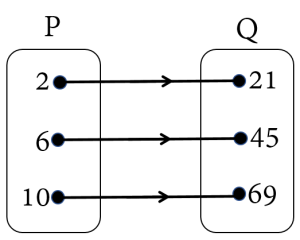
The function formula from $P$ to $Q$ is $\cdots \cdot$
A. $f(x)=4(2x+5)$
B. $f(x)=3(2x+3)$
C. $f(x)=2(3x+9)$
D. $f(x)=\dfrac12(6x+18)$
Test each provided option.
Option A: $f(x) = 4(2x + 5)$
For $x = 2$, we obtain $f(2) = 4(2(2) + 5) = 4(9) = 36$ (incorrect), it should be $21$.
Option B: $f(x) = 3(2x+3)$
For $x = 2$, we obtain $f(2) = 3(2(2) + 3) = 3(7) = 21$ (correct).
For $x = 6$, we obtain $f(6) = 3(2(6) + 3) = 3(15) = 45$ (correct).
For $x = 10$, we obtain $f(10) = 3(2(10) + 3) = 3(23) = 69$ (correct).
Option C: $f(x) = 2(3x + 9)$
For $x = 2$, we obtain $f(2) = 2(3(2) + 9) = 2(15) = 30$ (incorrect), it should be $21$.
Option D: $f(x) =\dfrac12(6x + 18) = 3x + 9$
For $x = 2$, we obtain $f(2) = 3(2) + 9 = 15$ (incorrect), it should be $21$.
(Answer B)
Problem Number 23
The graphs of the two linear functions $f(x) = \dfrac{1}{a}x+b$ and $h(x)=bx-a$ are parallel lines. The possible values of $b-a$ if $\dfrac{h(-1)}{f(1)} = -\dfrac52$ are $\cdots \cdot$
A. $\pm \dfrac12$ C. $\pm \dfrac52$
B. $\pm \dfrac32$ D. $\pm \dfrac72$
Given $f(x) = \dfrac{1}{a}x+b$ and $h(x)=bx-a$. Since the graphs of $f(x)$ and $h(x)$ are parallel, their gradients must be equal, namely $m_f = m_g \Rightarrow \dfrac{1}{a} = b$, equivalent to $ab = 1$.
Next, we obtain
$\begin{aligned} \dfrac{h(-1)}{f(1)} & = -\dfrac52 \\ \dfrac{b(-1)-a}{\dfrac{1}{a}(1)+b} & = -\dfrac52 \\ \dfrac{-a-b}{\dfrac{1}{a}+b} & = -\dfrac52 \\ \text{Multiply both}~&\text{sides by}~-1 \\ \dfrac{a+b}{\dfrac{1}{a}+b} \color{blue}{\times \dfrac{a}{a}} & = \dfrac52 \\ \dfrac{a^2+ab}{1+ab} & = \dfrac52 \\ \text{Substitute}~& ab = 1 \\ \dfrac{a^2+1}{1+1} & = \dfrac52 \\ \dfrac{a^2+1}{2} & = \dfrac52 \\ a^2+1 & = 5 \\ a^2 & = 4 \\ a & = \pm 2 \end{aligned}$
We obtain two possible values for $a$, namely $a = 2$ or $a = -2$. From $ab = 1$, we can determine the value of $b$.
- If $a = 2$, then we obtain $b = \dfrac12$ so that $b-a = \dfrac12-2 = -\dfrac32$.
- If $a = -2$, then we obtain $b = -\dfrac12$ so that $b-a=-\dfrac12-(-2) = \dfrac32$.
Thus, there will be two values for $b-a$, namely $\boxed{\pm \dfrac32}$
(Answer B)
Problem Number 24
Given $H(\sqrt{x+5}) = x$ and $H(x^2) = x^a-b$. The value of $a+b=\cdots \cdot$
A. $16$ C. $4$
B. $9$ D. $3$
Given $H(\sqrt{x+5}) = x$.
Change $x \to x-5$ so that we obtain
$\begin{aligned} H\left(\sqrt{(x-5)+5}\right) & = x-5 \\ H(\sqrt{x}) = x-5 \end{aligned}$
Change $x \to x^4$ so that we obtain
$\begin{aligned} H(\sqrt{x^4}) & = x^4-5 \\ H(x^2) & = x^4-5 \end{aligned}$
Thus, we obtain that $a=4$ and $b=5$ so that the value of $\boxed{a+b=4+5=9}$
(Answer B)
Essay Section
Problem Number 1
From the following curve sketches, which curves represent a function? Assume the domain is the set of real numbers.
a. 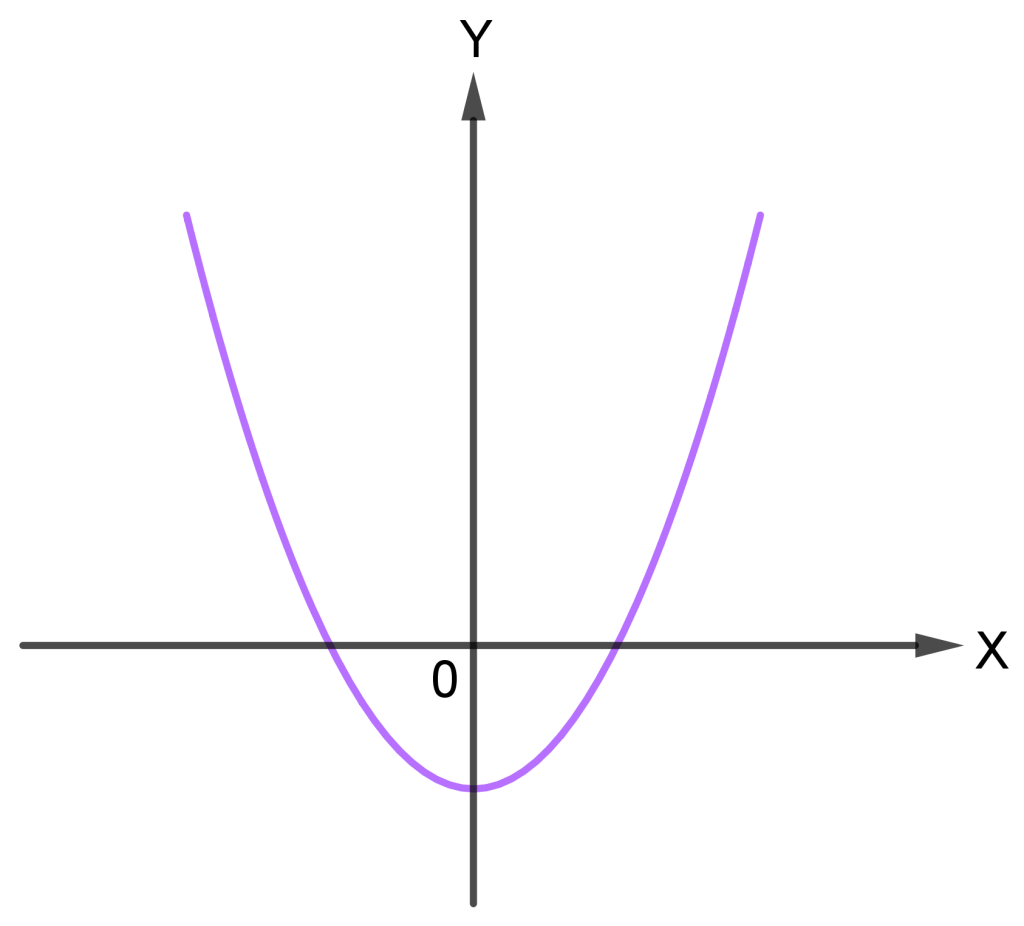
b. 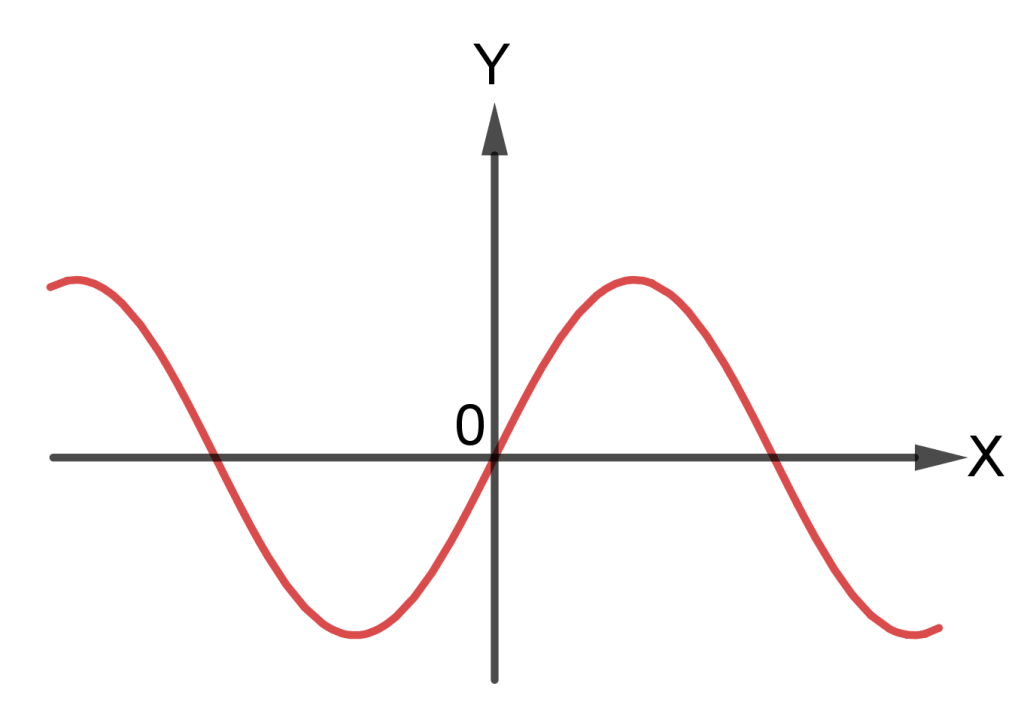
c. 
d. 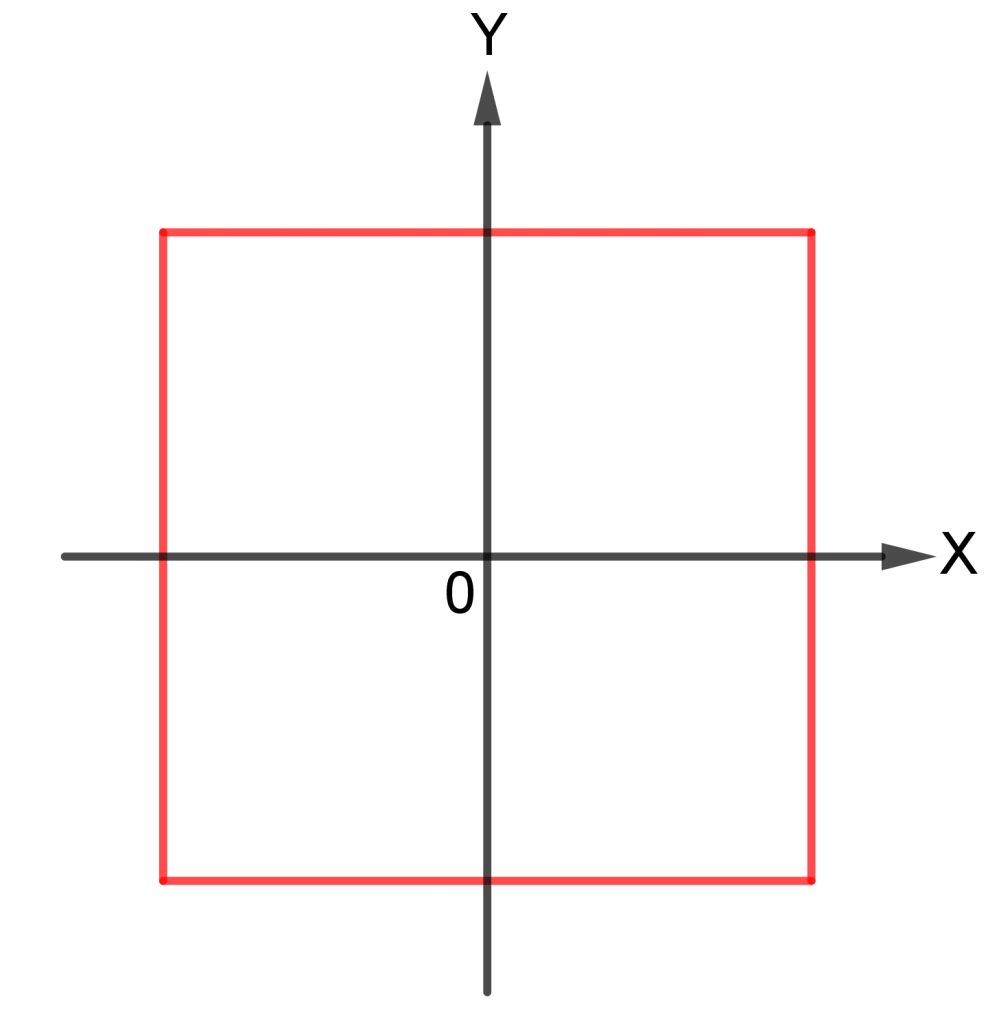
e. 
f. 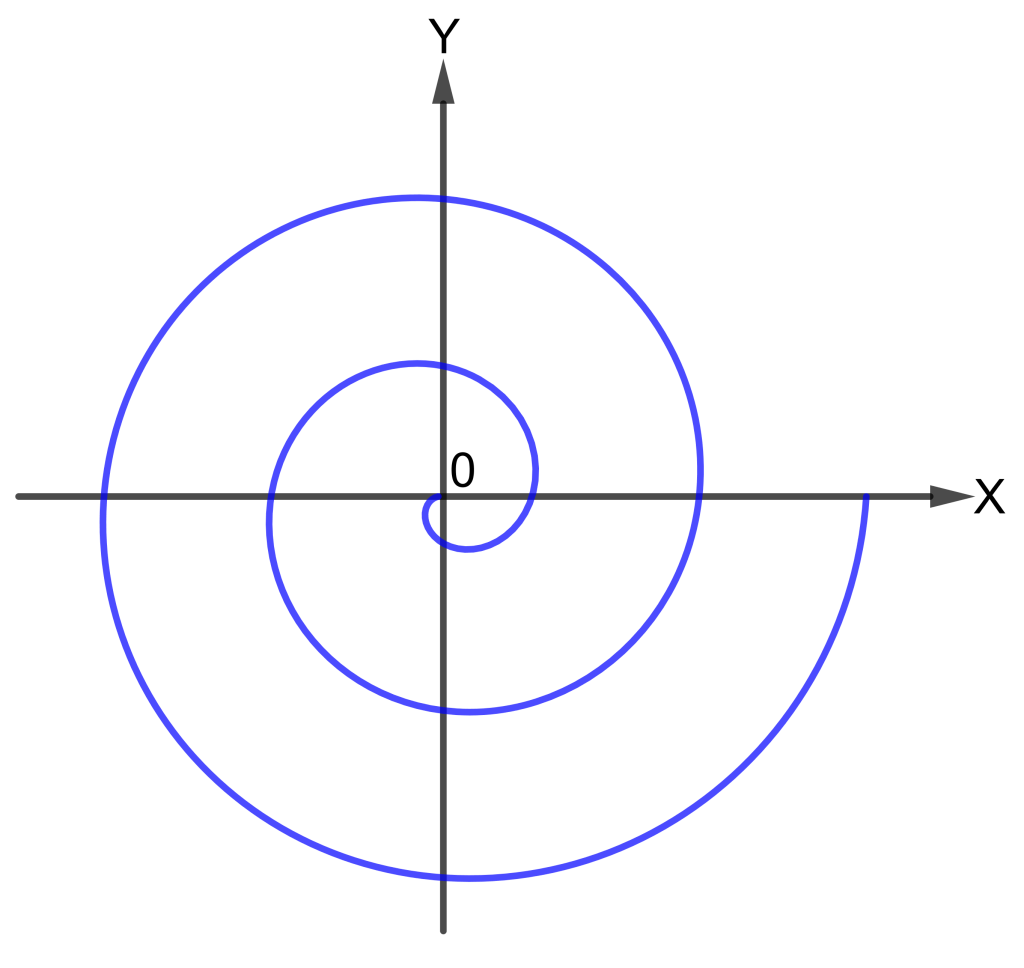
g.
A curve drawn on the Cartesian plane is said to be a function if each value of $x$ corresponds to exactly one value of $y$. Note that the horizontal axis is called the $X$-axis, while the vertical axis is called the $Y$-axis.
Simply put, we draw a vertical dashed line intersecting the curve. If we find more than one intersection point or no intersection point at all, then the curve is not the graph of a function.
Answer a)
 We only find one intersection point when drawing a dashed line from any position. Therefore, the curve represents a function.
Answer b)
 We only find one intersection point when drawing a dashed line from any position. Therefore, the curve represents a function.
Answer c)
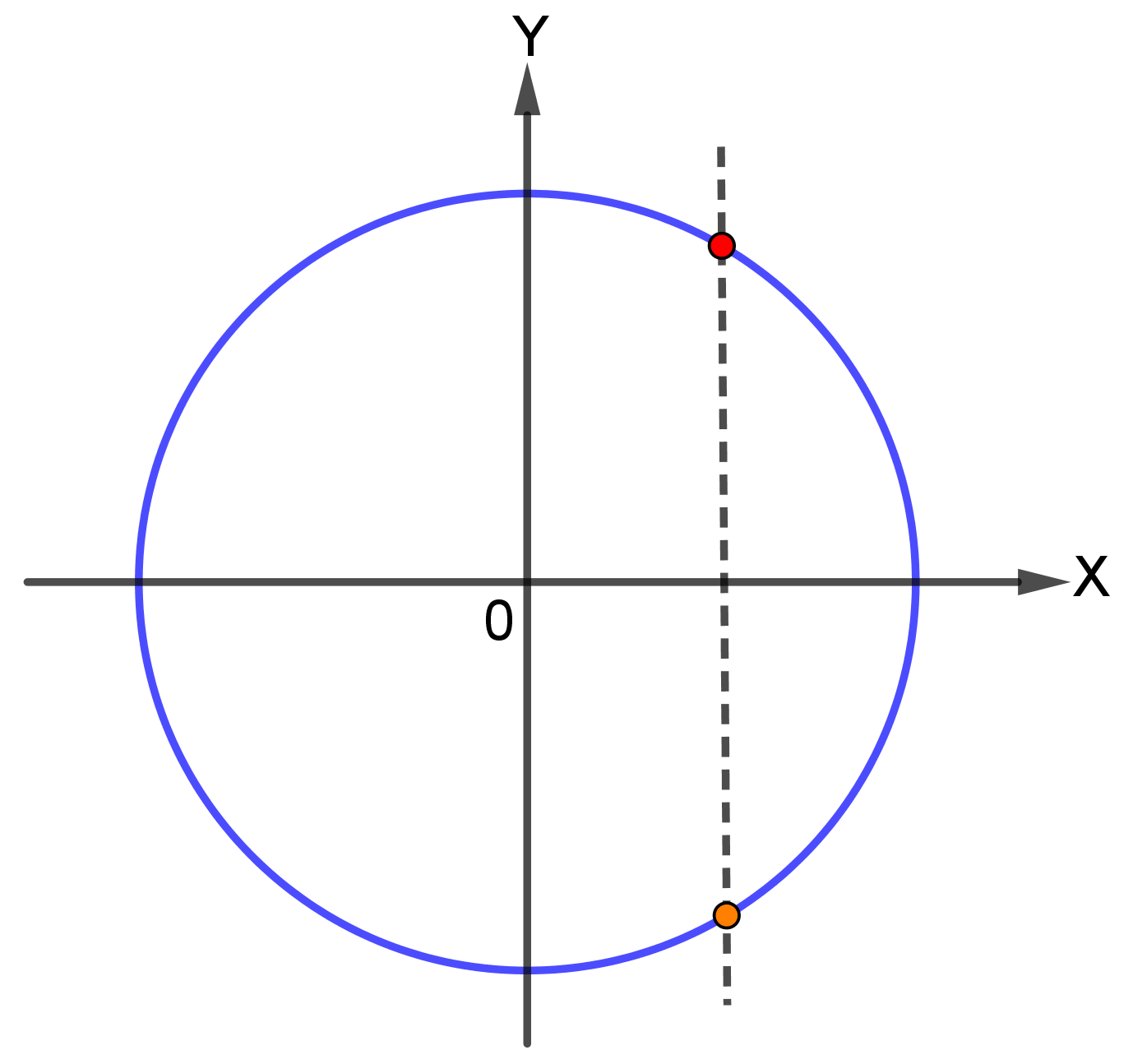 We find two intersection points when drawing a dashed line from the position shown in the figure. Therefore, the curve does not represent a function.
Answer d)
 We find two intersection points when drawing a dashed line from the position shown in the figure. Therefore, the curve does not represent a function.
Answer e)
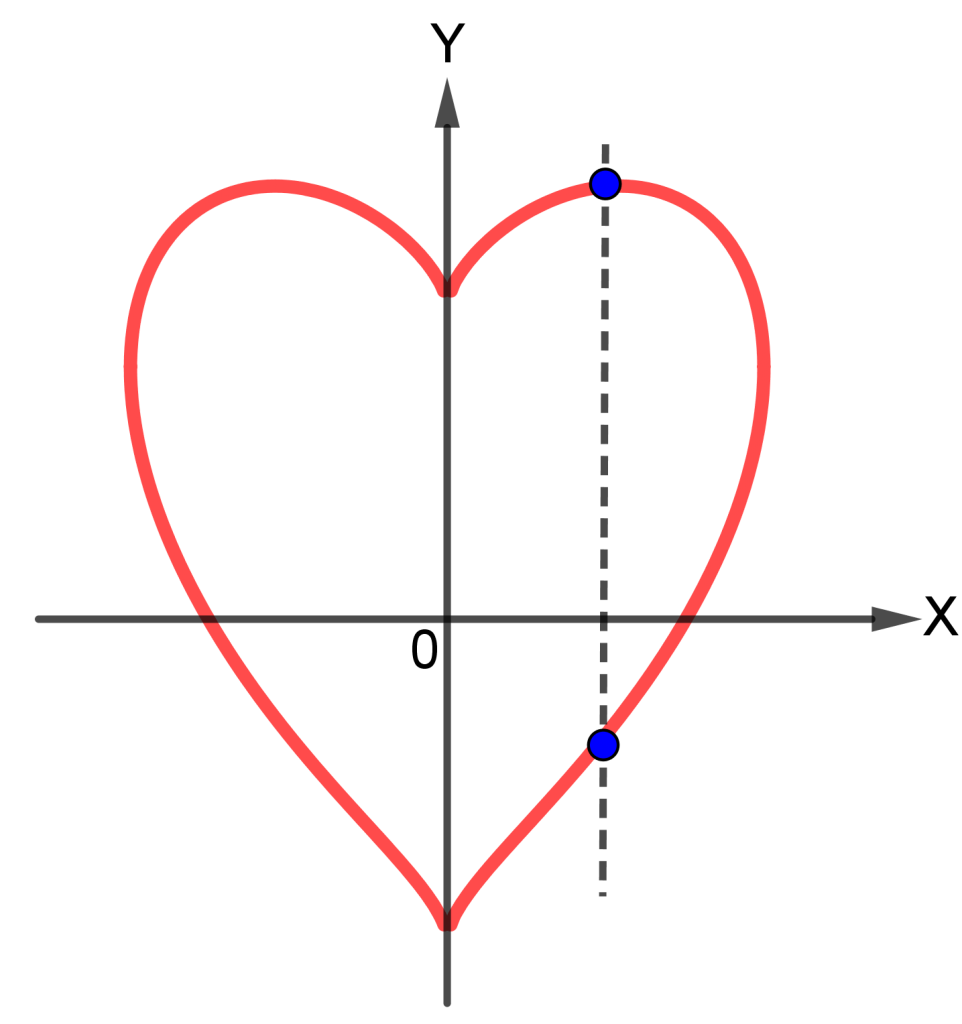 We find two intersection points when drawing a dashed line from the position shown in the figure. Therefore, the curve does not represent a function.
Answer f)
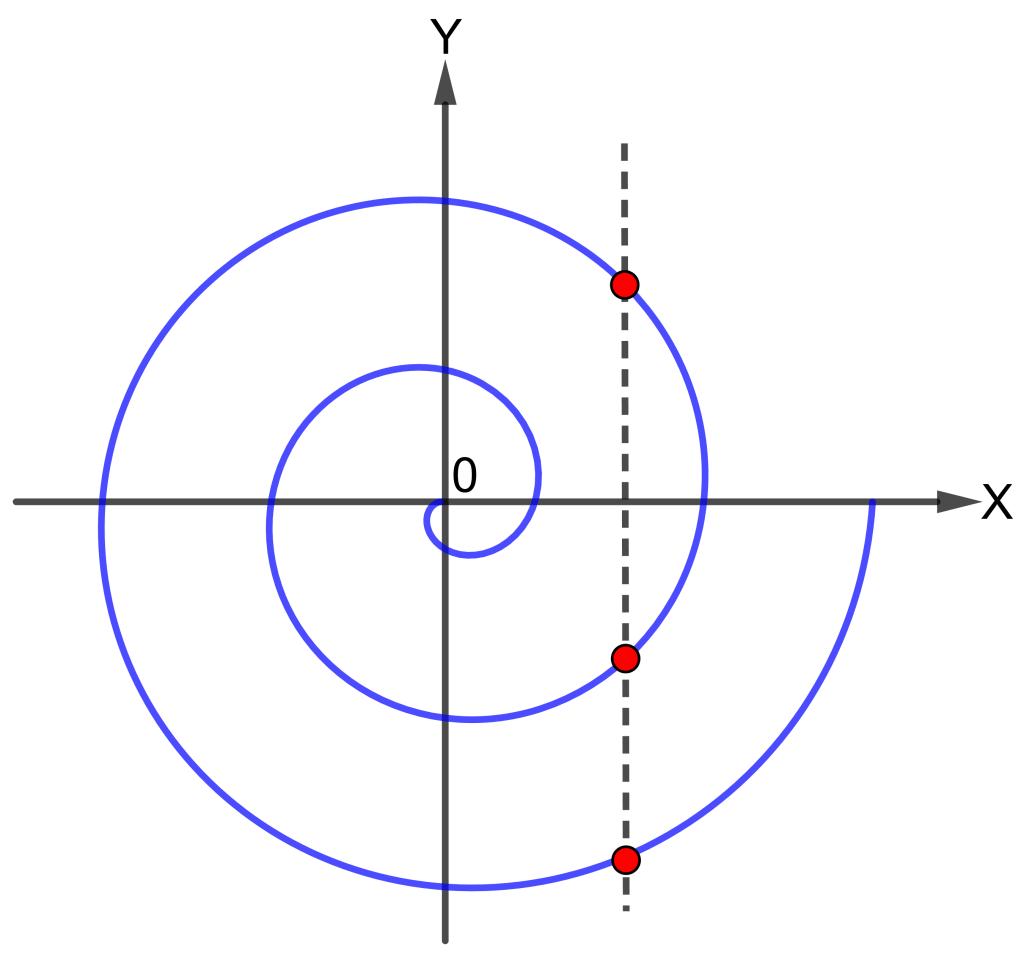 We find three intersection points when drawing a dashed line from the position shown in the figure. Therefore, the curve does not represent a function.
Answer g)
 We find two intersection points when drawing a dashed line from the position shown in the figure. In addition, if we draw a dashed line coinciding with the $Y$-axis, we will not find any intersection point. Therefore, the curve does not represent a function.