
Arithmetic sequences and series are among the most important topics in mathematics because they help us recognize and analyze patterns that increase or decrease by a constant amount. Beyond classroom exercises, these concepts are widely used in everyday situations such as calculating savings plans, predicting future expenses, determining production targets, and analyzing data trends. Understanding how arithmetic patterns work enables students to solve practical problems more efficiently and develop stronger mathematical reasoning skills.
In this article, you will find a collection of arithmetic sequence and series word problems that demonstrate real-life applications of these concepts. Each problem is accompanied by a clear, step-by-step solution to help you understand the underlying principles and problem-solving strategies. By working through these examples, you will gain confidence in translating real-world situations into mathematical models and applying arithmetic sequences and series to obtain accurate solutions.
Quote by Paul Dirac
Multiple Choice Section
Problem Number 1
The production of white-and-gray school uniforms made by students of the Fashion Design Vocational High School Department in the first month was 80 sets. Each following month, production increased by 10 sets, forming an arithmetic series. The total production during the first 6 months is … sets.
A. 530 D. 630
B. 620 E. 840
C. 625
This is an arithmetic sequence case because the production increases by a fixed (constant) amount each month.
Given that \(a = 80\) and \(b = 10.\)
The total number of white-and-gray school uniforms produced during the first 6 months is
\(\begin{aligned} \text{S}_n & = \dfrac{n} {2}(2a+(n-1)b) \\ \text{S}_{6} & = \dfrac{6}{2}(2 \cdot 80 + (6-1) \cdot 10) \\ & = 3(160 + 50) \\ & = 3(210) = 630. \end{aligned}\)
Therefore, the total number of uniforms produced during 6 months is \(\boxed{630~\text{sets}}\)
(Answer D)
Problem Number 2
A company produced 8,000 units of goods in the first month and increased its production by 300 units each month. The total number of goods produced during one semester is …
A. 57,000 units
B. 53,400 units
C. 52,500 units
D. 29,400 units
E. 28,500 units
This is an arithmetic sequence case because production increases by a fixed (constant) amount each month.
Given that \(a = 8,000\) and \(b = 300.\)
The total number of goods produced during one semester (6 months) is
\(\begin{aligned} \text{S}_n & = \dfrac{n} {2}(2a+(n-1)b) \\ \text{S}_{6} & = \dfrac{6}{2}(2 \cdot 8,000 + (6-1) \cdot 300) \\ & =3(16,000 + 1,500) \\ & = 3(17,500) =52,500. \end{aligned}\)
Therefore, the total number of goods produced during one semester is \(\boxed{52,500~\text{units}}\)
(Answer C)
Problem Number 3
A child saves money in a bank with a constant increase in the amount saved each month. In the first month, the child saves Rp50,000.00, in the second month Rp55,000.00, in the third month Rp60,000.00, and so on. The total amount saved by the child over two years is …
A. Rp2,640,000.00
B. Rp2,580,000.00
C. Rp2,040,000.00
D. Rp1,320,000.00
E. Rp1,315,000.00
Since the difference between consecutive terms is constant, the case above is a contextual problem involving an arithmetic sequence.
Given \(\text{U}_1 = a = 50,000\) and \(b = 5,000.\)
We will find the value of \(\text{S}_{24}\) (2 years = 24 months).
$$\begin{aligned} \text{S}_n & = \dfrac{n}{2}(2a + (n-1)b) \\ \text{S}_{24} & = \dfrac{24}{2}(2 \times 50,000 + (24 -1) \times 5,000) \\ & = 12(100,000 + 115,000) \\ & = 12 \times 215,000 = 2,580,000 \end{aligned}$$Therefore, the total amount saved by the child over two years is Rp2,580,000.00.
(Answer B)
Problem Number 4
The monthly production of a factory forms an arithmetic series. If the production in the fourth month is 17 tons and the total production during the first four months is 44 tons, then the production in the fifth month is … tons.
A. 24 C. 22 E. 20
B. 23 D. 21
Given \(\text{U}_4 = 17\) and \(\text{S}_4 = 44\). Using the arithmetic series sum formula,
\(\boxed{\text{S}_n = \dfrac{n}{2}(a + \text{U}_n)}\)
we obtain
\(\begin{aligned} \text{S}_4 & = \dfrac{4}{2}(a + \text{U}_4) \\ 44 & = 2(a + 17) \\ \dfrac{44}{2} & = a + 17 \\ 22 & = a + 17 \\ a & = 5. \end{aligned}\)
Next, we determine the common difference \(b\).
\(\begin{aligned} \text{U}_4 = a + 3b & = 17 \\ 5 + 3b & = 17 \\ 3b & = 12 \\ b & = 4 \end{aligned}\)
Therefore, the production in the fifth month is
\(\boxed{\text{U}_5 = a + 4b = 5 + 4(4) = 21~\text{tons}}\)
(Answer D)
Problem Number 5
In January, Asep started setting aside some of his allowance to save in a savings account. Initially, he saved Rp2,000.00, then Rp2,500.00 in February, Rp3,000.00 in March, and so on. The total amount of money saved by Asep during the first year is …
A. Rp29,500.00
B. Rp30,000.00
C. Rp48,500.00
D. Rp57,000.00
E. Rp57,500.00
The amount of money saved by Asep each month forms an arithmetic sequence with first term \(a = 2,000\) and common difference \(b = 500\). In this case, we will find the value of \(\text{S}_{12}\) (1 year = 12 months).
$$\begin{aligned} \text{S}_n & = \dfrac{n} {2}(2a+(n-1)b) \\ \text{S}_{12} & = \dfrac{12}{2}(2(2,000) + (12-1) \times 500) \\ & = 6(4,000 + 5,500) \\ & = 6(9,500) = 57,000 \end{aligned}$$Therefore, the total amount of money saved by Asep during the first year is Rp57,000.00.
(Answer D)
Problem Number 6
The seats in a movie theater are arranged from the front row to the back row such that each row behind has 4 more seats than the row in front of it. If the theater has 15 rows of seats and the front row contains 20 seats, then the seating capacity of the theater is …
A. 1,200 seats
B. 800 seats
C. 720 seats
D. 600 seats
E. 300 seats
From the problem above, the number of seats in each row forms an arithmetic sequence with first term \(a = 20\), common difference \(b = 4\), and \(n=15.\)
Thus, we obtain
\(\begin{aligned} \text{S}_n & = \dfrac{n} {2}(2a+(n-1)b) \\ \text{S}_{15} & = \dfrac{15}{2}(2 \cdot 20 + (15-1) \cdot 4)\\ & = \dfrac{15}{2}(40 + 56) \\ & = \dfrac{15}{\cancel{2}} \cdot \cancelto{48}{96} \\ & = 15 \cdot 48 = 720. \end{aligned}\)
Therefore, the seating capacity of the theater is \(\boxed{720~\text{seats}}\)
(Answer C)
Problem Number 7
A factory produced 1,960 units of Product A in the first year. Each year, production decreased by 120 units until the 16th year. The total production achieved up to the 16th year is … units.
A. 45,760 D. 16,000
B. 45,000 E. 9,760
C. 16,960
From the problem above, the annual production of Product A forms an arithmetic sequence with first term \(a = 1,960\), common difference \(b = -120\) (negative because production decreases), and \(n=16.\)
Thus, we obtain
$$\begin{aligned} \text{S}_n & = \dfrac{n} {2}(2a+(n-1)b) \\ \text{S}_{16} & = \dfrac{\cancelto{8}{16}}{\cancel{2}}(2 \cdot 1,960 + (16 -1) \cdot (-120)) \\ & = 8(3,920 – 1,800) \\ & = 8 \cdot 2,120 = 16,960. \end{aligned}$$Therefore, the total production achieved up to the 16th year is \(\boxed{16,960~\text{units}}\)
(Answer C)
Problem Number 8
A trader’s profit increases every month by the same amount. If the profit in the first month is Rp46,000.00 and the increase in profit each month is Rp18,000.00, then the total profit up to the 12th month is …
A. Rp1,740,000.00
B. Rp1,750,000.00
C. Rp1,840,000.00
D. Rp1,950,000.00
E. Rp2,000,000.00
From the problem above, the monthly profit forms an arithmetic sequence with first term \(a = 46,000\), common difference \(b = 18,000\), and \(n=12.\)
Thus, we obtain
$$\begin{aligned} \text{S}_n & = \dfrac{n} {2}(2a+(n-1)b) \\ \text{S}_{12} & = \dfrac{\cancelto{6}{12}}{\cancel{2}} (2 \cdot 46,000 + (12-1) \cdot 18,000) \\ & = 6(92,000 + 198,000) \\ & = 6(290,000) = 1,740,000. \end{aligned}$$Therefore, the trader’s total profit up to the 12th month is \(\boxed{\text{Rp}1,740,000.00}\)
(Answer A)
Problem Number 9
A pizza is circular in shape with a diameter of 20 cm and is cut into 10 sector-shaped pieces. The central angles of the 10 pizza slices form an arithmetic sequence. If the central angle of the smallest pizza slice is equal to \(\dfrac{1}{5}\) of the central angle of the largest pizza slice, what is the area of the largest pizza slice?
A. \(51\dfrac13~\text{cm}^2.\)
B. \(51\dfrac23~\text{cm}^2.\)
C. \(52\dfrac13~\text{cm}^2.\)
D. \(52\dfrac23~\text{cm}^2.\)
E. \(53\dfrac13~\text{cm}^2.\)
From the problem above, it is known that
\(\text{U}_1 = \dfrac{1}{5}\text{U}_{10} \Leftrightarrow 5\text{U}_1 = \text{U}_{10}\)
or it can be written as
\(5a = a + 9b \Leftrightarrow 20a = 45b.~~~~(1)\)
The sum of the ten central angles equals the total degrees in one complete circle, namely \(360^{\circ}\), so we write
$$\begin{aligned} \text{U}_1 + \text{U}_2 + \text{U}_3 + \cdots + \text{U}_{10} & = 360^{\circ} \\ a + (a + b) + (a + 2b) + \cdots + (a+9b) & = 360^{\circ} \\ 10a + (1+2+3+\cdots 9)b & = 360^{\circ} \\ 10a + 45b & = 360^{\circ}. && (\cdots 2) \end{aligned}$$Substitute equation \((1)\) into equation \((2)\).
\(\begin{aligned} 10a + 45b & = 360^{\circ} \\ 10a + 20a & = 360^{\circ} \\ 30a & = 360^{\circ} \\ \text{U}_1 & = a = 12^{\circ} \end{aligned}\)
The central angle of the largest pizza slice is
\(\text{U}_{10} = 5\text{U}_1 = 5(12^{\circ}) = 60^{\circ}.\)
The area of a sector with a central angle of \(60^{\circ}\) and radius \(\dfrac{20}{2} = 10~\text{cm}\) is
\(\begin{aligned} L & = \dfrac{60^{\circ}} {360^{\circ}} \pi r^2 \\ & = \dfrac{1}{6} \cdot 3.14 \cdot 100 \\ & = \dfrac{1}{6} \cdot 314 = 52\dfrac13. \end{aligned}\)
Therefore, the area of the largest pizza slice is \(\boxed{52\dfrac13~\text{cm}^2}\)
(Answer C)
Problem Number 10
In 2019, the cattle population in City A was 1,600 head and in City B was 500 head. Every month, the population increased by 25 head in City A and 10 head in City B. When the cattle population in City A becomes three times the cattle population in City B, the cattle population in City A is …
A. 2,550 head D. 2,100 head
B. 2,400 head E. 1,900 head
C. 2,250 head
The cattle populations form arithmetic sequences.
City A: Given \(a = 1,600\) and \(b = 25\), the cattle population in City A in month \(n\), counted from January 2019, is
\(\begin{aligned} A_n & = a + (n-1)b \\ & = 1,600 + (n -1) \cdot 25 \\ & = 1,575+ 25n. \end{aligned}\)
City B: Given \(a = 500\) and \(b = 10\), the cattle population in City B in month \(n\), counted from January 2019, is
\(\begin{aligned} B_n & = a + (n-1)b \\ & = 500 + (n-1) \cdot 10 \\ & = 490 + 10n. \end{aligned}\)
Since the cattle population in City A is three times that of City B, we obtain
\(\begin{aligned} A_n & = 3B_n \\ 1,575 + 25n & = 3(490 + 10n) \\ 1,575 + 25n & = 1,470 + 30n \\ 5n & = 105 \\ n & = 21. \end{aligned}\)
This means that 21 months after January 2019, the cattle population in City A will become three times the cattle population in City B. The cattle population in City A is \(A_{21} = 1,600 + (21-1) \cdot 25 = 2,100\) head.
(Answer D)
Problem Number 11
For 30 days, Sukardi managed to collect a total of 22,350 chicken eggs. If the number of eggs he collected each day formed an arithmetic sequence, and on the first day he collected only 20 eggs, then on the last day he collected … eggs.
A. 1,430 D. 1,470
B. 1,440 E. 1,490
C. 1,450
Given:
\(a = 20, n = 30\), and \(\text{S}_n = 22,350.\)
Asked: \(\text{U}_n\)
Using the arithmetic series sum formula, we obtain
\(\begin{aligned} \text{S}_n & = \dfrac{n} {2}(a + \text{U}_n) \\ 22,350 & = \dfrac{30}{2}(20 + \text{U}_n) \\ 22,350 & = 15(20 + \text{U}_n) \\ 20 + \text{U}_n & = \dfrac{22,350}{15} = 1,490 \\ \text{U}_n & = 1,490 -20 = 1,470. \end{aligned}\)
Therefore, the number of eggs he collected on the last day was \(\boxed{1,470~\text{eggs}}\)
(Answer D)
Problem Number 12
A mother distributes Rp200,000.00 among her 5 children. If the difference in the amount of money received by two children whose ages are consecutive is Rp10,000.00 and the youngest child receives the least amount, then the 3rd child receives …
A. Rp30,000.00
B. Rp35,000.00
C. Rp40,000.00
D. Rp45,000.00
E. Rp50,000.00
Based on the given information, the amounts of money received by the children form an arithmetic sequence with common difference \(b = 10,000\) and \(\text{S}_5 = 200,000.\)
Using the arithmetic series sum formula, we obtain
$$\begin{aligned} \text{S}_n & = \dfrac{n} {2}(2a+(n-1)b) \\ \text{S}_5 & = \dfrac{5}{2}(2a + (5-1)\cdot 10,000) \\ 200,000 & = \dfrac{5}{2}(2a + 40,000) \\ 200,000 \cdot \dfrac25 & = 2a + 40,000 \\ 80,000 & = 2a + 40,000 \\ 2a & = 40,000 \\ a & = 20,000. \end{aligned}$$The value of \(\text{U}_3\) is given by
\(\begin{aligned} \text{U}_3 & = a + 2b \\ & = 20,000+2(10,000) = 40,000. \end{aligned}\)
Therefore, the 3rd child receives Rp40,000.00.
(Answer C)
Problem Number 13
Observe the following sketch.
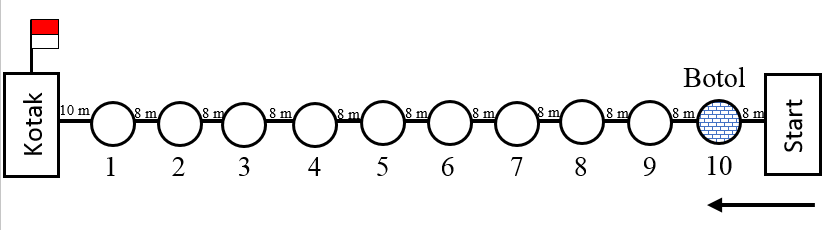
Game rules: There are 10 flags available in the box and they must be transferred into the bottles one by one (not all at once). All participants start from bottle number 10 to take the flags from the box.
The total distance traveled by a participant is …
A. 164 meters D. 1,000 meters
B. 880 meters E. 1,840 meters
C. 920 meters
This is an arithmetic sequence case.
From the position of bottle number 10, the participant moves toward the box for a distance of \(9 \times 8 + 10 = 82~\text{m}.\)
Starting from the box position:
\(\text{U}_1\) is the distance from the box to bottle number 1.
\(\text{U}_2\) is the distance from the box to bottle number 2, and so on, so that
\(\text{U}_1 = 10,\) \(\text{U}_2 = 18,\) \(\text{U}_3 = 26,\) up to \(\text{U}_{10} = 10 + 8 \times 9 = 82.\)
Therefore, the total round-trip distance traveled by the participant (hence multiplied by two) is
\(\begin{aligned} 2 \text{S}_n & = 2 \times \dfrac{n}{2}(\text{U}_1 + \text{U}_n) \\ 2 \text{S}_{10} & = 10(10 + 82) \\ & = 10 \times 92 = 920. \end{aligned}\)
However, note that when the participant carries the last flag and rushes to bottle number 10, there is no need to return to the box because the game has already been completed. Therefore, the total distance traveled is $$\boxed{s = 82 + 920 – (8 \times 9 + 10) = 920~\text{m}}$$(Answer C)
Problem Number 14
A store sells 7 different types of goods. The prices of these 7 goods form an arithmetic sequence. The total price of the 4 cheapest goods is 50, while the total price of the 4 most expensive goods is 86. A customer has 100 units of money. If the customer buys several different goods from the store, then the minimum change received is …
A. 0 C. 5 E. 8
B. 2 D. 6
Suppose the cheapest item has price \(\text{U}_1\).
Next, we obtain
\(\begin{aligned} \text{U}_1 + \text{U}_2 + \text{U}_3 + \text{U}_4 & = 50 \\ \text{U}_4 + \text{U}_5 + \text{U}_6 + \text{U}_7 & = 86. \end{aligned}\)
If expressed in the form \(\text{U}_n = a + (n-1)b\), we obtain
$$\begin{aligned} a + (a + b) + (a+2b) + (a+3b) & = 50 && (\cdots 1) \\ (a+3b) + (a+4b) + (a+5b) + (a+6b) & = 86 && (\cdots 2) \end{aligned}$$Simplify.
\(\begin{aligned} 4a + 6b & = 50 && (\cdots 1) \\ 4a + 18b & = 86 && (\cdots 2) \end{aligned}\)
Subtract the two equations above to obtain \(b = 3\), which implies \(a = 8.\)
Therefore, the prices of the seven goods are \(8, 11, 14, 17, 20, 23,\) and \(26.\)
If the customer buys items priced at \(14, 17, 20, 23,\) and \(26\) (total: \(100\)), then the payment is exact with no change.
Therefore, the minimum change received is \(\boxed{0}\)
(Answer A)
Problem Number 15
A number of children are standing in a straight line. Wesley is one of them. From left to right, they say the numbers \(2, 5, 8, 11, 14, \cdots\), and Wesley says the number \(41.\) From right to left, they say the numbers \(1, 5, 9, 13, 17, \cdots\), and Wesley again says the number \(41.\) How many children are there altogether?
A. 20 C. 23 E. 26
B. 22 D. 24
Consider the sequence \(2, 5, 8, 11, 14, \cdots\), which is an arithmetic sequence with first term \(a = 2\) and common difference \(b = 3.\) The formula for the \(n\)-th term is
$$\begin{aligned} \text{U}_n & = a + (n-1)b \\ & = 2+(n-1) \cdot 3 \\ & = 3n-1. \end{aligned}$$Since Wesley says the number \(41,\) we obtain
$$\begin{aligned} 41 & = 3n-1 \\ 42 & = 3n \\ n & = 14. \end{aligned}$$Therefore, Wesley is in the 14th position from the left. This means there are 13 children to Wesley’s left.
Now consider the sequence \(1, 5, 9, 13, 17, \cdots\), which is an arithmetic sequence with first term \(a = 1\) and common difference \(b = 4.\) The formula for the \(n\)-th term is
$$\begin{aligned} \text{U}_n & = a + (n-1)b \\ & = 1+(n-1) \cdot 4 \\ & = 4n-3. \end{aligned}$$Since Wesley says the number \(41,\) we obtain
$$\begin{aligned} 41 & = 4n-3 \\ 44 & = 4n \\ n & = 11. \end{aligned}$$Therefore, Wesley is in the 11th position from the right. This means there are 10 children to Wesley’s right.
Thus, the total number of children is \(\boxed{13 + 1 + 10 = 24}\)
(Answer D)
Essay Section
Problem Number 1
A taxi driver charges Rp6,000.00 for the first 1 km and Rp2,500.00 for each additional 1 km. How much should a passenger pay for a trip of 15 km?
Since the fare increases by a constant amount, this is a contextual problem involving an arithmetic sequence.
Given \(\text{U}_1 = a = 6,000\) and \(b = 2,500.\) In this case, we are asked to find the value of \(\text{U}_{15},\) which represents the taxi fare for a 15 km trip.
$$\begin{aligned} \text{U}_{n} & = a+(n-1)b \\ \text{U}_{15} & = 6,000 + (15-1) \cdot 2,500 \\ & = 6,000 + 35,000 \\ & = 41,000. \end{aligned}$$Therefore, the taxi fare that the passenger must pay for a 15 km trip is Rp41,000.00.
Problem Number 2
The population of a certain plant species increases according to an arithmetic sequence from 75,230 to 125,280 over 8 years. Assuming that the average growth rate is constant, determine the average population growth.
Since the average growth rate is assumed to be constant, this is a contextual problem involving an arithmetic sequence.
The plant population in the first year is \(\text{U}_1 = a = 75,230.\) In the eighth year, the population becomes \(\text{U}_8 = a + 7b = 125,280,\) where \(b\) is the average growth rate. Substituting \(a = 75,230\) into \(\text{U}_8\) gives
$$\begin{aligned} 75,230 + 7b & = 125,280 \\ 7b & = 50,050 \\ b & = 7,150. \end{aligned}$$Therefore, the average population growth is \(\boxed{7,150}.\)
Problem Number 3
An orchard owner picks oranges every day and records the number of oranges harvested. On the first day, he harvested 75 oranges. On the second day, he harvested 125 oranges. Determine the total number of oranges harvested during the first 20 days if the harvest follows an arithmetic sequence pattern.
Given \(\text{U}_1 = a = 75\) and \(b = 125-75 = 50.\) In this case, we are asked to find \(\text{S}_{20},\) the sum of the first 20 terms of an arithmetic sequence with first term 75 and common difference 50.
$$\begin{aligned} \text{S}_{n} & = \dfrac{n}{2}(2a+(n-1)b) \\ \text{S}_{20} & = \dfrac{20}{2}(2(75) + (20-1) \cdot 50) \\ & = 10(150 + 950) \\ & = 11,000. \end{aligned}$$Therefore, the total number of oranges harvested during the first 20 days is \(\boxed{11,000}\) oranges.
Problem Number 4
An auditorium has 20 rows of seats. The front row contains 15 seats, the second row contains 20 seats, the third row contains 25 seats, and so on. Calculate the total number of seats available in the auditorium.
Since the number of seats increases by a constant amount, this is a contextual problem involving an arithmetic series.
Given \(\text{U}_1 = a = 15\) and \(b = 20-15 = 5.\) In this case, we are asked to find \(\text{S}_{20},\) the sum of the first 20 terms of an arithmetic sequence with first term 15 and common difference 5.
$$\begin{aligned} \text{S}_{n} & = \dfrac{n}{2}(2a+(n-1)b) \\ \text{S}_{20} & = \dfrac{20}{2}(2(15) + (20-1) \cdot 5) \\ & = 10(30 + 95) \\ & = 1,250. \end{aligned}$$Therefore, the total number of seats available in the auditorium is \(\boxed{1,250}\) seats.
Problem Number 5
A salesperson travels around offering products using a motorcycle. In the first week, he travels 1,150 km, and in each subsequent week the distance decreases by 75 km. How much money must he spend on gasoline up to the 3rd month if gasoline costs Rp10,000.00 per liter and each liter allows his motorcycle to travel 30 km? Assume that 1 month equals 4 weeks.
Since the decrease in distance is constant, this is a contextual problem involving an arithmetic series.
Given \(\text{U}_1 = a = 1,150\) and \(b = -75\) (negative because the distance decreases). Since 3 months equal 12 weeks, we are asked to find \(\text{S}_{12},\) the sum of the first 12 terms of an arithmetic sequence with first term 1,150 and common difference \(-75.\)
$$\begin{aligned} \text{S}_{n} & = \dfrac{n}{2}(2a+(n-1)b) \\ \text{S}_{12} & = \dfrac{12}{2}(2(1,150) + (12-1) \cdot (-75)) \\ & = 6(2,300-825) \\ & = 6 \cdot 1,475 \\ & = 8,850. \end{aligned}$$This means that the salesperson has traveled a total distance of 8,850 km during the 3-month period. Since each liter of gasoline allows the motorcycle to travel 30 km, he needs \(\dfrac{8,850}{30} = 295\) liters. Since one liter of gasoline costs Rp10,000.00, the amount of money he must spend on gasoline is \(295 \times\) Rp10,000.00, which is Rp2,950,000.00.
Problem Number 6
At a roof tile factory, a worker is able to produce 5 dozen roof tiles in one day. If he is required to increase his production by 1 dozen every day, in how many days can he produce 2,160 roof tiles?
Since the increase in roof tile production each day is constant, this is a contextual problem involving an arithmetic series. Note that 1 dozen is equal to 12 pieces.
Given \(\text{U}_1 = a = 5 \cdot 12 = 60\) and \(b = 1 \cdot 12,\) and \(\text{S}_n = 2,160.\) In this case, we are asked to determine \(n.\)
$$\begin{aligned} \text{S}_{n} & = \dfrac{n}{2}(2a+(n-1)b) \\ 2,160 & = \dfrac{n}{2}(2(60) + (n-1) \cdot 12) \\ 2,160 & = n(54 + 6n) \\ n^2+9n-360 & = 0 \\ (n+24)(n-15) & = 0 \\ n=-24~\text{or} & ~n=15. \end{aligned}$$Since \(n\) cannot be negative, \(n = 15.\) Therefore, the factory worker can produce 2,160 roof tiles in 15 days.
Problem Number 7
If a debt of Rp8,800,000.00 is repaid in monthly installments of Rp250,000.00, Rp270,000.00, Rp290,000.00, and so on, how long will it take for the debt to be fully paid off?
Since the monthly installment increases continuously by Rp20,000.00, this is a contextual problem involving an arithmetic series.
Given \(\text{U}_1 = a = 250,000\) and \(b = 20,000,\) and \(\text{S}_n = 8,800,000.\) In this case, we are asked to determine \(n.\)
$$\begin{aligned} \text{S}_{n} & = \dfrac{n}{2}(2a+(n-1)b) \\ 8,800,000 & = \dfrac{n}{2}(2(250,000) + (n-1) \cdot 20,000) \\ 8,800,000 & = n(10,000n+240,000) \\ n^2+24n-880 & = 0 \\ (n+44)(n-20) & = 0 \\ n=-44~\text{or} & ~n=20. \end{aligned}$$Since \(n\) cannot be negative, \(n = 20.\) Therefore, the debt will be fully paid off in 20 months.
Problem Number 8
Sukardi and Lili started saving money at a bank at the same time. At the beginning, Sukardi deposited Rp80,000.00 and each month deposited Rp1,500.00 more than in the previous month. Lili initially deposited Rp100,000.00 and in each following month deposited Rp1,000.00 more than in the previous month. In which month will the total amount of their savings be exactly the same?
Since the increase in the amount saved each month is constant, this is a contextual problem involving an arithmetic series.
Sukardi’s savings in the first month are \(\text{U}_1 = 80,000\) with common difference \(b = 1,500.\) Meanwhile, Lili’s savings in the first month are \(\text{V}_1 = 100,000\) with common difference \(c = 1,000.\) Suppose their cumulative savings become exactly equal in the \(n\)-th month, namely \(\text{S}_n.\) In this case, we are asked to determine \(n.\)
$$\begin{aligned} \text{S}_n & = \text{S}_n \\ \cancel{\dfrac{n}{2}}(2\text{U}_1 + (n-1) \cdot b) & = \cancel{\dfrac{n}{2}}(2\text{V}_1 + (n-1) \cdot c) \\ 2(80,000) + (n-1) \cdot 1,500 & = 2(100,000) + (n-1) \cdot 1,000 \\ 500(n-1) & = 40,000 \\ n-1 & = 80 \\ n & = 81. \end{aligned}$$Therefore, the total amount of their savings will be exactly the same in the \(\boxed{81^\text{st}}\) month.